Most retail analysts would tell you Buckle shouldn’t still be winning. It’s a mall-based, denim-heavy, Midwestern fashion retailer in a world where DTC brands are eating legacy retail alive. And yet Buckle posts gross margins that make Zara blush, carries almost no debt, and has a loyal customer base that actually wants to walk into the store.
The Buckle business model works because it never tried to be everything. It picked a lane premium casual, relationship selling, denim authority and it stayed there while competitors chased trends, overexpanded, and burned cash. That’s the thesis. Now let’s break down how it actually works.
What Buckle Actually Is ?
Founded in 1948 in Kearney, Nebraska, The Buckle, Inc. started as a men’s clothing store called Mills Clothing. It quietly evolved into one of the more durable specialty retailers in America operating over 440 stores across 42 states, mostly in malls and lifestyle centers.
The product focus is tight: casual apparel, premium denim, footwear, and accessories. The target customer is young adults and fashion-conscious shoppers who want something better than H&M but aren’t shopping at department stores either. That middle market quality-conscious but not luxury is where Buckle has planted its flag.
Here’s the positioning insight that most people miss: Buckle is not competing on price. It competes on brand curation plus personalized service. A customer walking into Buckle isn’t looking for the cheapest jeans they’re looking for the right jeans, and they’re often willing to pay $80–$150+ for them. That changes everything about how the business model is structured.
The Core Value Proposition (What Buckle Actually Sells)
Denim Authority
Denim isn’t just a product category for Buckle it’s the entire identity. The company has spent decades building credibility around premium denim brands like Rock Revival, Lucky Brand, Wrangler’s higher-end lines, and its own private labels. When a customer thinks “where do I go for great jeans,” Buckle wants to be the instinctive answer.
This focus matters because denim has a naturally high ticket size. A good pair of jeans isn’t a $25 purchase it’s a considered buy. Customers research, try on, and compare. That consideration phase is where Buckle’s in-store model creates enormous value.
A Curated Brand Portfolio
Buckle doesn’t carry 500 brands. It carries the right brands for its customer a mix of recognizable third-party labels that drive traffic and its own private labels that drive margin. This curation signals taste, which builds trust. And trust in a fashion retailer is worth more than any loyalty points program.
The private labels deserve special attention. When you own the brand, you control the margin. Buckle’s house brands don’t have to compete on wholesale price or fight for shelf space they’re built specifically for the Buckle customer, at the exact price point the store wants to hit.
The In-Store Experience as a Moat
This is where Buckle does something most retailers talk about but few execute: genuine relationship-driven selling. Associates are largely commission-based, which creates a natural incentive to actually know the product, remember returning customers, and provide real styling advice rather than just pointing someone toward the fitting room.
In a world where most retail feels transactional, this matters. A customer who gets genuinely helped who leaves with a pair of jeans that actually fits, a belt that ties the outfit together, and a sales associate who texted them when new inventory came in doesn’t need to be retargeted with ads. They come back.
The Loyal Repeat Customer
Buckle’s real competitive moat isn’t any single brand or product it’s the repeat customer. In tier-2 markets especially, where mall options are limited and community relationships run deep, Buckle becomes the default destination for a significant chunk of a person’s fashion spending. That behavioral loyalty is hard to disrupt even when a DTC brand with Instagram ads enters the picture.
How Buckle Actually Makes Money
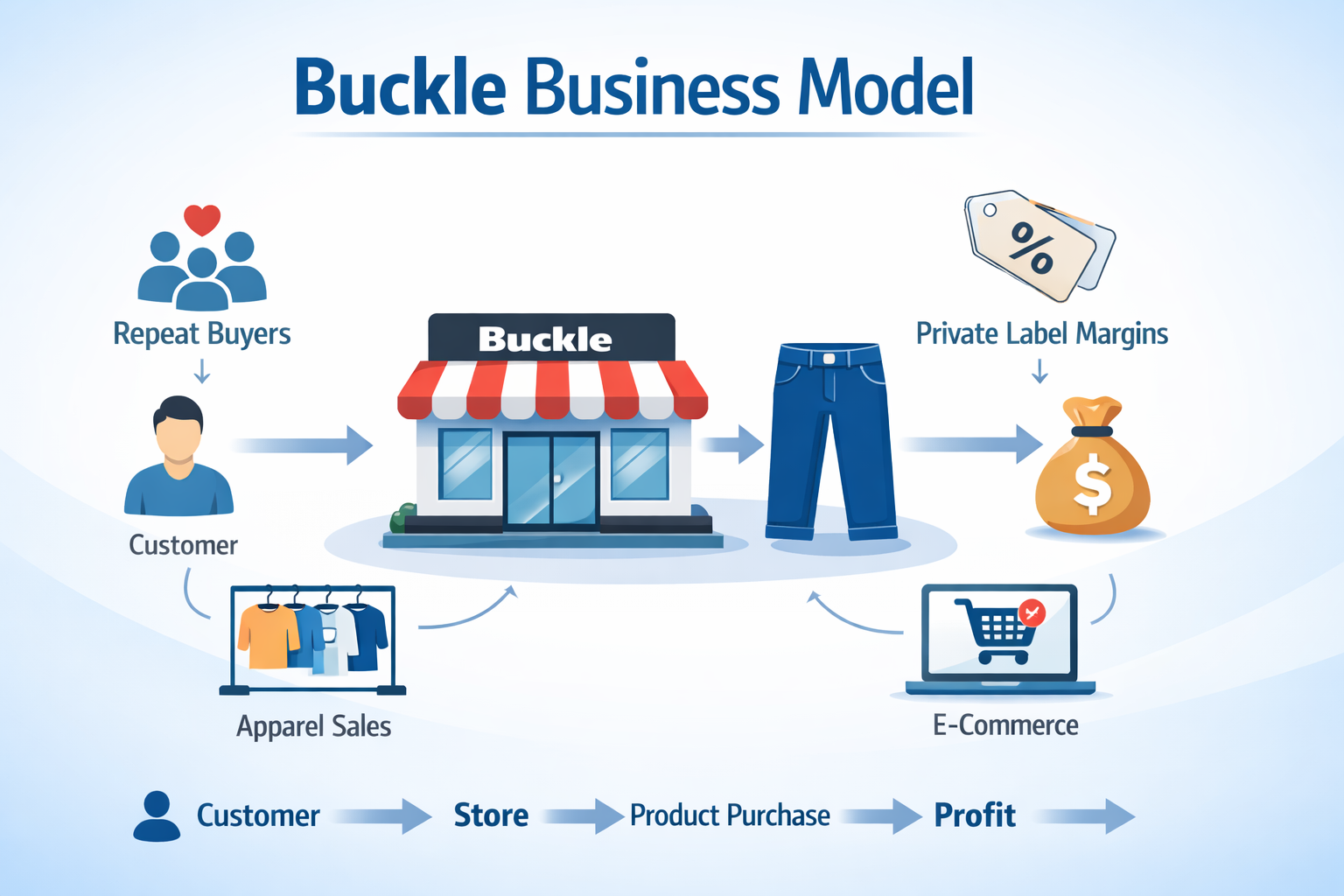
Retail store sales are the engine. The overwhelming majority of revenue comes from physical stores, and Buckle has leaned into this rather than treating stores as a liability. High store productivity revenue per square foot is a metric Buckle consistently performs well on relative to peers.
E-commerce plays a supporting role. Buckle’s online presence exists and grows, but it functions more as a complement to the store experience than a replacement. A customer might browse online, then come in-store to try. Or buy in-store and return online. The digital channel reinforces the physical one rather than cannibalizing it.
Private label margins are where the financial model gets interesting. Third-party brands like Rock Revival come with wholesale costs that compress margins. Private labels don’t. When Buckle sells a pair of its own branded jeans, the gross margin is structurally higher. As private label mix grows, so does overall profitability without needing to grow top-line revenue at the same rate.
Accessories and add-ons are the unsung revenue driver. A customer comes in for jeans and leaves with a belt, maybe a hat, sometimes footwear. This upselling isn’t pushy — it’s styled. The associate who helps you find the right fit also knows what belt works with the wash. Average order value climbs without the customer feeling sold to. That’s the difference between a transactional retail model and a relationship retail model.
The Business Model Canvas
Customer Segments: Young adults (primarily 18–34), fashion-conscious shoppers in mid-size markets, repeat buyers with high brand loyalty, and customers in areas underserved by premium fashion retail.
Value Proposition: Curated premium casual fashion, denim expertise, personalized styling service, and a shopping experience that feels personal rather than algorithmic.
Channels: Mall-based physical stores as the primary channel, e-commerce as a support channel, and a growing omnichannel integration.
Customer Relationships: High-touch, commission-driven associate relationships. Personal outreach, styling consultations, loyalty through service rather than points programs.
Revenue Streams: Apparel sales (denim-heavy), footwear, accessories, and a growing private label mix at higher margins.
Key Resources: Trained sales associates, curated brand relationships, private label intellectual property, and a conservative balance sheet with strong cash reserves.
Key Activities: Merchandise curation, associate training, inventory management, private label development, and in-store experience design.
Key Partners: Premium denim brands, wholesale apparel suppliers, private label manufacturers, and mall operators.
Cost Structure: Associate compensation (including commissions), rent, inventory, logistics, and corporate overhead. Notable for its lack of aggressive marketing spend Buckle largely lets the in-store experience do the marketing.
Distribution Strategy: Why Buckle Still Believes in Malls
The Mall Bet
While the industry narrative has been “malls are dying,” Buckle’s position is more nuanced. The malls that are dying are often the underperforming B and C-tier properties in oversaturated markets. Buckle’s footprint skews toward markets where the mall is still the dominant retail hub smaller cities where online-native shoppers still value having somewhere to go.
In Kearney, Nebraska or Bismarck, North Dakota, the mall isn’t dying. It’s the center of retail gravity. And Buckle has spent 75 years building relationships in exactly these kinds of communities.
Conservative Expansion as a Feature, Not a Bug
Buckle has never chased aggressive store count growth. While competitors opened hundreds of locations in years of peak mall traffic, Buckle grew methodically. This conservatism meant they didn’t lock themselves into bad leases or overextend their operating model. When retail headwinds came, they weren’t scrambling to close 200 stores they had already made the right bets.
Digital as Amplifier
E-commerce at Buckle isn’t the main event, but it’s not an afterthought either. The digital channel extends reach, serves existing customers between store visits, and captures purchases from shoppers in markets without a physical location. The key insight: Buckle uses digital to support the store relationship, not replace it.
Competitive Advantage: How Buckle Holds Its Ground
Against Abercrombie & Fitch, Buckle wins on brand humility it doesn’t rely on a single lifestyle identity that can go out of fashion overnight. Against American Eagle, Buckle’s private label margins and relationship selling create a stickiness AEO’s more transactional model can’t easily replicate. Against Zara, Buckle doesn’t even try to compete on trend speed and that’s the point.
The four real advantages are: relationship selling that creates genuine switching costs, private label margins that competitors can’t easily copy, a balance sheet that carries minimal debt and significant cash, and conservative inventory management that avoids the markdowns that kill retail profitability.
Buckle rarely runs aggressive promotional calendars. It doesn’t need to liquidate inventory with 50% off sales because it didn’t overbuy in the first place. That discipline compounds over time into a structurally more profitable business.
The Financial Model at a Strategic Level
Buckle’s gross margins historically hover in the 48–50% range exceptional for specialty retail, comparable to much higher-end retailers. This is the private label effect in action.
Inventory turnover is conservative but healthy. The company doesn’t chase newness for its own sake, which means fewer markdowns and better sell-through. Store productivity — revenue per square foot — has historically outperformed peers even during periods of broader mall weakness.
The balance sheet tells the most important story: Buckle carries no significant long-term debt and has consistently returned cash to shareholders through dividends, including special dividends when cash accumulates. That financial conservatism is itself a competitive advantage — it creates room to weather industry disruption without existential pressure.
Why Buckle Still Works in 2026
Three things are moving in Buckle’s direction right now.
The shift from fast fashion to quality is real and accelerating. Post-pandemic consumer behavior has trended toward buying less but better — fewer pieces, more intentional purchases. Buckle’s value proposition is built for exactly this mindset.
Denim is having a genuine cultural revival. Wide-leg silhouettes, vintage washes, premium denim as a fashion statement rather than a utility item — this isn’t a manufactured trend. It’s a category Buckle has owned for decades suddenly getting cultural momentum again.
And the in-store experience is making a comeback among younger consumers who grew up shopping online and now find the physical store novel. The tactile, social, personalized nature of a Buckle store visit is actually a differentiator in a world saturated with scrolling and one-click checkout.
The conservative cash strategy is the underpinning of all of this. While overleveraged retailers are fighting for survival, Buckle has optionality to invest, to weather downturns, to move slowly and deliberately. In retail, surviving long enough is itself a form of winning.
Risks Worth Being Honest About
Mall traffic is declining in aggregate, and even if Buckle’s specific locations outperform, the secular trend is a genuine headwind. A format shift toward off-mall retail would require capital and operational changes that haven’t fully materialized yet.
Fashion trend risk is real. Denim dominance is a strength until denim falls out of favor. The company’s category concentration means a shift in consumer preference could hit revenue disproportionately.
DTC brands with Instagram audiences and direct customer relationships are a real competitive threat, particularly for the younger edge of Buckle’s target demographic. A 22-year-old today has more options than ever and less reason to walk into a mall.
These risks don’t invalidate the model but they’re not hypothetical either.
What Founders Can Actually Take From This
The Buckle model is a masterclass in a few things that apply far beyond fashion retail.
Margin over volume. Buckle doesn’t chase the biggest revenue number — it chases the most profitable revenue. Private labels, disciplined inventory, minimal discounting. The lesson: growth that erodes margin isn’t really growth.
Build repeat buyers, not just first-time customers. The relationship selling model is expensive upfront commission-based associates, high-touch service. But the repeat purchase rate it generates is worth far more than acquisition through advertising.
Overexpansion kills. Buckle watched competitors open aggressively and then spend a decade closing stores. The conservative growth path felt slow in good times and looked genius in bad ones.
Own your product where you can. Private labels are a strategic asset. When you own the brand, you own the margin and the customer relationship simultaneously.
Train the people who touch customers. Buckle’s associate training is a genuine investment. In a world where most retail associates are undertrained and undercompensated, a knowledgeable, motivated sales team is a real differentiator.
Final Verdict: Is the Buckle Business Model Sustainable?
The strengths are durable: private label margins, relationship selling, financial conservatism, and a customer base that has demonstrated real loyalty. These aren’t marketing claims they show up in the financials over decades.
The limitations are real but manageable: mall dependency, denim concentration, DTC competition. None of these are existential in the near term, and Buckle has the balance sheet to adapt without urgency-driven mistakes.
The long-term outlook depends on two things: whether the in-store, relationship-driven retail model continues to hold value (evidence suggests yes, especially in their core markets), and whether Buckle’s management continues to resist the temptation to overextend in pursuit of growth metrics that look good in headlines but damage the underlying model.
The companies that survive long cycles in retail are rarely the ones that moved fastest. They’re the ones that understood what they were actually selling and didn’t stop selling it.
Discover more from Business Model Hub
Subscribe to get the latest posts sent to your email.