Atlassian is one of the most studied SaaS companies in the world. Not because it spent billions on advertising. Not because it had a legendary sales team. But because it built products people actually wanted to use, and then let those products do the selling.
This blog breaks down exactly how Atlassian makes money, why its business model works, and what makes it nearly impossible to compete with.
What Is Atlassian?
Atlassian is an Australian-American software company founded in 2002 by Mike Cannon-Brookes and Scott Farquhar. It builds collaboration and productivity tools used by millions of teams across the globe.
Its core products include:
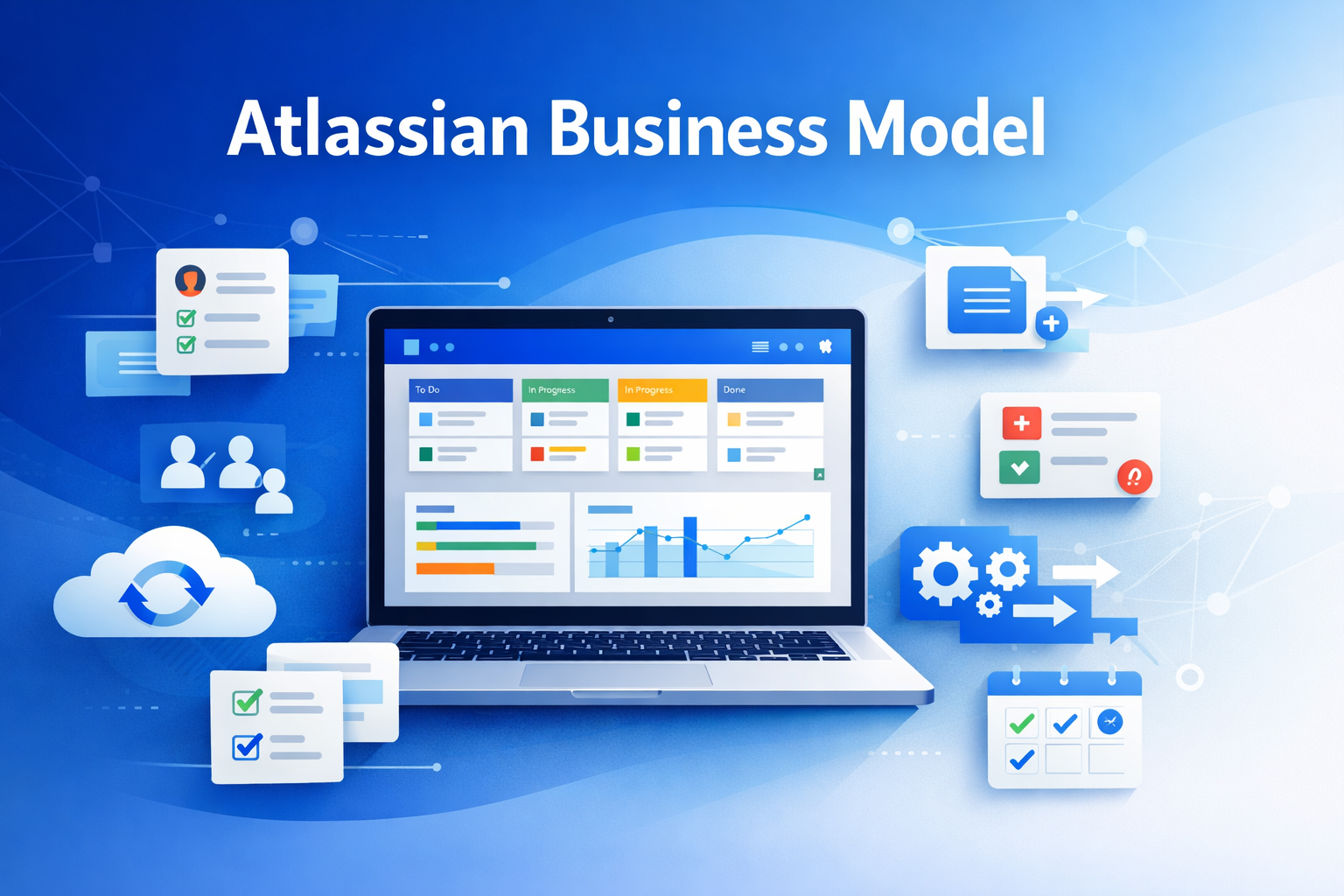
Jira for project tracking and issue management. Confluence for team documentation and knowledge sharing. Trello for visual task management using boards and cards. Bitbucket for code collaboration and version control. Jira Service Management for IT and service desk teams.
The company is publicly traded on the Nasdaq under the ticker TEAM. As of recent filings, Atlassian generates over $4 billion in annual revenue and serves more than 300,000 customers globally.
In simple terms, Atlassian helps teams plan work, track progress, and communicate without the chaos of scattered emails and spreadsheets.
The Core of the Atlassian Business Model
Atlassian operates on a product-led growth (PLG) model. This is the foundation of everything it does.
In a traditional SaaS company, growth depends on sales reps, cold outreach, and aggressive marketing spend. Atlassian flipped that entirely. Instead of chasing customers, it builds products that attract users organically. Those users bring their teams. Those teams bring their companies. And eventually, companies pay.
The core components of this model are:
Subscription-based SaaS revenue that scales with users. Freemium entry points that lower the barrier to adoption. Self-serve onboarding that removes the need for a sales rep at every step. Enterprise upsells that capture larger contract values over time. A marketplace ecosystem that adds value without Atlassian building everything itself.
This model works because Atlassian solves real problems for real teams. The product earns trust before any money changes hands.
How Atlassian Actually Makes Money
Subscription Revenue
Subscription revenue is Atlassian’s primary income source. It accounts for the vast majority of the company’s total annual revenue.
Atlassian charges based on a per-user, per-month model across tiered pricing plans. Every product follows a similar structure.
Free plan is available for small teams, typically up to ten users. It includes core features with some limitations. Standard plan is priced for growing teams and includes more features, storage, and support options. Premium plan adds advanced functionality like automation, analytics, and higher storage limits. Enterprise plan is designed for large organizations and includes unlimited scale, advanced security, and dedicated support.
More users on a team means higher monthly or annual fees. As companies grow and hire more people, their Atlassian bill grows automatically. This creates a naturally expanding revenue stream without Atlassian having to do anything extra.
Atlassian also pushes customers toward annual billing, which improves cash flow predictability and reduces churn risk.
Enterprise Solutions
Enterprise contracts are where the big money lives. Large organizations pay significantly higher fees compared to small and mid-sized teams.
What do enterprise customers get? They get advanced security and compliance features, including data residency options. They get dedicated support with faster response times. They get centralized administration tools to manage thousands of users across departments. They get audit logs, access controls, and SSO integrations.
Enterprise clients across industries like finance, healthcare, and government have compliance requirements that standard plans do not cover. Atlassian packages those requirements into premium contracts that can run into hundreds of thousands of dollars annually.
This segment is growing fast. As Atlassian matures as a company, it is actively investing in enterprise sales capabilities to capture more of these high-value contracts.
Marketplace Revenue
The Atlassian Marketplace is a major part of its monetization strategy and is often overlooked.
The Marketplace is a platform where third-party developers and software vendors can sell apps, plugins, and integrations that extend Atlassian products. Think of it like the App Store, but specifically for Jira, Confluence, and other Atlassian tools.
Currently, the Marketplace hosts thousands of apps across categories like project management, reporting, security, automation, and communication.
Atlassian takes a commission on every sale made through the Marketplace. Partners keep the majority of revenue, but Atlassian earns a percentage without building or maintaining those apps itself.
This creates a powerful flywheel. More apps mean more value for users. More value means more user adoption. More users mean more potential customers for Marketplace apps. More app sales mean more commission revenue for Atlassian.
The Marketplace benefits every stakeholder and costs Atlassian almost nothing to scale.
Cloud Migration Services
Atlassian spent years serving customers through on-premise deployments called Atlassian Server. In 2021, the company announced it would end Server product sales and migrate everyone to the cloud.
This transition created a significant revenue opportunity. Companies needed help migrating years of data, configurations, and workflows from on-premise installations to Atlassian Cloud.
Atlassian generated revenue through migration support services, consulting partnerships, and Atlassian-certified solution partners who handled the technical heavy lifting. Even the migration itself became a business line.
Today, the company is fully committed to its cloud platform. Cloud revenue now represents the overwhelming share of total revenue and continues to grow quarter over quarter.
Data Residency and Compliance Add-Ons
For enterprise customers in regulated industries, Atlassian offers data residency options. This allows companies to specify where their data is stored geographically, which is critical for compliance with regulations like GDPR in Europe or data sovereignty laws in specific countries.
These features are not included in standard plans. They are sold as premium add-ons or are exclusive to enterprise tiers, adding more revenue per account.
Product-Led Growth: Why Atlassian Barely Needs a Sales Team
Atlassian is famous in the SaaS industry for having one of the lowest sales and marketing expenses relative to revenue among major software companies.
Traditional enterprise software companies spend 50 to 80 cents of every dollar of revenue on sales and marketing. Atlassian has historically spent far less, sometimes under 20 cents on the dollar.
How is that possible?
The Self-Serve Funnel
Atlassian products are designed to be tried and adopted without human intervention.
A developer signs up for Jira Free. They invite teammates. Their manager sees the dashboards. The manager expands usage to another team. That team needs more users, so they upgrade to Standard. Two years later, the company is running on Jira, Confluence, and Jira Service Management, and switching feels impossible.
This entire journey happens without a single sales call. The product earns trust and expands on its own.
Word of Mouth and Community
Developers talk to developers. Project managers share tools with their peers. Atlassian built its early reputation within the software development community, which is one of the most interconnected professional communities on the internet.
A developer who loves Jira at one company will recommend it at their next job. That word-of-mouth effect compounds over time and drives new user acquisition at essentially zero marginal cost.
The Freemium Hook
Free plans are not charity. They are customer acquisition tools.
When Atlassian offers Trello or Jira for free to small teams, it is making a calculated investment. It knows that a percentage of those free users will grow their teams, hit plan limits, and upgrade. It knows that some free users will join companies that already pay for Atlassian products. It knows that widespread adoption creates social proof.
Free plans seed the market. Paid plans harvest it.
Atlassian’s Product Ecosystem Strategy
One of Atlassian’s most powerful competitive advantages is not any single product. It is the ecosystem of products working together.
How the Ecosystem Creates Lock-In
Consider a typical software company using Atlassian tools.
Developers use Jira to manage sprints, bugs, and features. Product managers document requirements in Confluence, which links directly to Jira tickets. Customer support teams manage incoming issues in Jira Service Management. Code lives in Bitbucket, where commits are automatically linked to Jira issues. Marketing and operations teams manage campaigns and tasks in Trello.
Every product feeds data into the others. Tickets in Jira link to documents in Confluence. Bitbucket commits reference Jira issues automatically. Service Management tickets trace back to product bugs in Jira.
When a company has built this connected workflow over years, switching costs become enormous. Moving to a competitor does not mean replacing one tool. It means replacing an entire operating system for how the company works.
That is the real moat. Not patents. Not proprietary algorithms. A deeply embedded workflow.
Cross-Selling Within the Ecosystem
Because customers trust one Atlassian product, selling them a second is relatively easy. A company running Jira is a warm prospect for Confluence. A team using Confluence is already familiar with the interface and billing relationship.
Atlassian’s net revenue retention, which measures how much existing customers spend year over year, is consistently strong precisely because of cross-sell and upsell within the ecosystem.
Pricing Strategy Breakdown
Atlassian’s pricing is simple on the surface but strategically sophisticated underneath.
Per-User Pricing
Charging per user aligns Atlassian’s success with customer success. When a company grows, Atlassian grows with it. There is no negotiation needed. Revenue expands naturally.
Per-user pricing also makes budgeting easy for customers. They know exactly what they will pay based on headcount. Predictable billing reduces purchase friction.
Tiered Plans
The four-tier structure, Free, Standard, Premium, Enterprise, is designed to capture customers at every stage of growth.
Startups start free and have no reason to go elsewhere. Growing SMBs upgrade to Standard when they need more seats or features. Scaling companies move to Premium for automation and analytics. Large enterprises sign Enterprise contracts for security and compliance.
Every customer has a natural upgrade path inside Atlassian’s own pricing structure. The company never has to acquire a new customer to grow revenue from them.
Annual vs. Monthly Billing
Atlassian incentivizes annual billing through discounts. Customers who pay annually typically save compared to monthly rates.
For Atlassian, annual billing means cash upfront, better revenue predictability, and lower churn risk. For customers, it means lower costs. Both sides win.
Who Atlassian Sells To
Atlassian’s addressable market is enormous because nearly every organization that employs teams can benefit from its tools.
Developers and Engineering Teams
This is Atlassian’s original core audience. Jira was built specifically for software development teams. Its features around sprints, backlogs, bug tracking, and release management map directly to how engineering teams work.
Developers are influential buyers. When a developer advocates for Jira at a new company, the decision often follows.
IT and Service Teams
Jira Service Management targets IT departments that need help desk and incident management capabilities. This segment has been growing significantly as more companies invest in internal IT infrastructure.
Project Managers and Operations
Confluence and Trello serve a broader audience that includes project managers, operations teams, HR, finance, and marketing. These teams need documentation, task management, and collaboration tools, and Atlassian’s products fit naturally.
Startups
Startups love free plans. Atlassian deliberately makes entry-level access free or very affordable because it knows that today’s five-person startup could be a 500-person company in three years. Planting the flag early pays off later.
Enterprises
Large enterprises represent Atlassian’s highest-value customer segment. They sign larger contracts, need more seats, and require enterprise-grade features. Atlassian has been actively investing in capabilities and sales resources to capture more enterprise deals.
Competitive Landscape
Atlassian does not operate in a vacuum. It faces serious competition across multiple product categories.
Microsoft
Microsoft is the most formidable competitor. Azure DevOps competes directly with Jira for engineering teams. Microsoft Teams competes with Confluence for documentation and collaboration. And Microsoft already has relationships with enterprise IT departments that Atlassian is trying to reach.
The key difference is that Microsoft bundles many of these tools into existing enterprise agreements. Atlassian sells them as best-of-breed standalone products.
Asana and Monday.com
Asana and Monday.com compete with Jira and Trello in the project management space. Both companies have invested heavily in marketing and sales, which is the opposite of Atlassian’s approach.
Atlassian’s advantage here is depth. Jira is far more configurable and developer-friendly than either Asana or Monday.com. But for non-technical teams, Asana and Monday.com can feel more approachable.
Notion
Notion has emerged as a significant competitor to Confluence in the documentation and knowledge management space. It combines notes, wikis, and databases in a highly flexible interface that many teams prefer.
Notion’s growth has been rapid, particularly among startups and creative teams. Atlassian has responded by improving Confluence’s user experience and adding features, but this remains a contested market.
Linear
Linear is a newer entrant that has gained traction with software development teams who find Jira overly complex. It positions itself as a cleaner, faster alternative built for modern engineering teams.
Linear does not have Atlassian’s enterprise scale or ecosystem depth, but it is winning deals among high-growth startups that prioritize speed and simplicity.
Atlassian’s Strengths
Recurring revenue model provides financial stability and predictability that investors value highly. Unlike project-based revenue, SaaS subscriptions compound over time.
Ecosystem lock-in makes churn structurally difficult. Companies that integrate multiple Atlassian products are unlikely to leave because the cost and disruption of switching is too high.
Developer community trust gives Atlassian a brand advantage in one of the most influential buyer communities in enterprise software.
Low customer acquisition cost driven by PLG means Atlassian can grow profitably without spending aggressively on sales and marketing.
Global scalability of cloud software means Atlassian serves customers in over 190 countries from its cloud infrastructure with minimal incremental cost per new customer.
Marketplace network effects create a self-reinforcing ecosystem where more users attract more app developers, which attracts more users.
Atlassian’s Weaknesses and Risks
Jira’s complexity is a real barrier. Many non-technical users find Jira overwhelming. This has opened the door for simpler competitors in the project management space.
Enterprise sales maturity is still developing. Atlassian built its company on self-serve and PLG, which means its enterprise sales motion is less mature than competitors like Salesforce or ServiceNow who have decades of enterprise sales experience.
Competition is intensifying across every product category. Microsoft’s bundling strategy is particularly threatening because it can offer “good enough” tools at lower marginal cost within existing enterprise agreements.
Dependency on cloud adoption means Atlassian’s growth requires customers to continue moving workloads to the cloud. While cloud adoption has been a tailwind, any slowdown could impact Atlassian’s revenue growth.
Marketplace risk exists if major third-party apps decide to build competing standalone products. The Marketplace strengthens Atlassian, but it also creates dependence on partners who have their own incentives.
Future Growth Opportunities
AI Integration Across Products
Atlassian has been integrating AI capabilities through its Atlassian Intelligence initiative. This includes AI-powered writing assistance in Confluence, automated ticket summarization in Jira, and smart recommendations across the platform.
AI represents a major opportunity to increase product value and justify premium pricing. If Atlassian executes well on AI features, it can charge more per user while also improving retention.
Expanding Enterprise Segment
Atlassian is actively building out its enterprise go-to-market capabilities. This includes dedicated enterprise sales reps, partner programs with system integrators, and enterprise-specific product features.
Moving upmarket is a natural evolution for a company that started with SMBs and developers. Enterprise contracts are larger, stickier, and more valuable on a per-account basis.
Marketplace Expansion
The Marketplace still has significant growth potential. As more companies adopt Atlassian tools, the addressable audience for Marketplace apps grows. Atlassian can invest in developer relations and platform capabilities to accelerate app creation and sales.
International Expansion
While Atlassian already has global reach, there are significant untapped markets in regions like Southeast Asia, Latin America, and the Middle East. Cloud adoption in these markets is accelerating, and Atlassian is well-positioned to capture growth as more companies in these regions adopt modern collaboration tools.
Service Management Growth
Jira Service Management is one of Atlassian’s fastest-growing products. The IT service management market is large, and many mid-sized companies still rely on legacy tools. Atlassian’s modern, cloud-native approach is a strong alternative.
What Makes the Atlassian Model Replicable and Rare at the Same Time
Many SaaS companies have tried to copy the PLG playbook. Few have matched Atlassian’s scale.
What separates Atlassian is the combination of factors that are hard to replicate individually and nearly impossible to replicate together.
The products genuinely solve complex problems. The ecosystem creates compounding value. The community creates organic distribution. The pricing makes adoption frictionless. The brand resonates with the people who make buying decisions at technology companies.
Building any one of those factors takes years. Building all of them simultaneously requires exactly the right product decisions, cultural decisions, and business model decisions made consistently over decades.
Atlassian started in 2002 with a credit card and no outside funding. It bootstrapped to profitability before raising venture capital. That origin story shaped a company culture focused on sustainable growth over aggressive spending, and that culture is embedded in the business model itself.
Key Takeaways on the Atlassian Business Model
Atlassian’s success is not accidental. It is the result of a clear, consistent strategy executed over more than two decades.
The model works because it aligns the company’s growth with the customer’s success. When customers grow, Atlassian grows. When customers add more tools, switching becomes harder and Atlassian becomes more valuable. When the ecosystem expands, everyone wins.
The PLG approach keeps acquisition costs low. The tiered pricing keeps the revenue expanding naturally. The ecosystem keeps churn low. The Marketplace generates passive commission revenue. The enterprise segment provides high-value contracts that diversify the customer base.
Put it all together, and you get a SaaS business model that is remarkably efficient, durable, and scalable.
Atlassian did not build a billion-dollar company by hiring the biggest sales team or spending the most on ads. It built products teams actually wanted to use, made them easy to adopt, and then made it very hard to leave.
That is the entire playbook, and it is hiding in plain sight.
FAQs
Subscription-based SaaS pricing is Atlassian’s primary revenue source. It charges per user across tiered plans for products like Jira, Confluence, and Trello.
Yes. Atlassian operates primarily as a cloud-based SaaS company. It discontinued its on-premise Server product line and has fully transitioned to cloud delivery.
The combination of PLG, an interconnected product ecosystem, a third-party Marketplace, and per-user pricing creates a self-reinforcing growth engine that keeps acquisition costs low and retention high.
Microsoft (Azure DevOps, Teams), Asana, Monday.com, Notion, and Linear all compete with different parts of Atlassian’s product portfolio.
Trello follows the same freemium and tiered subscription model. Free plans attract individual users and small teams, while Standard, Premium, and Enterprise plans generate subscription revenue as teams scale.
Discover more from Business Model Hub
Subscribe to get the latest posts sent to your email.