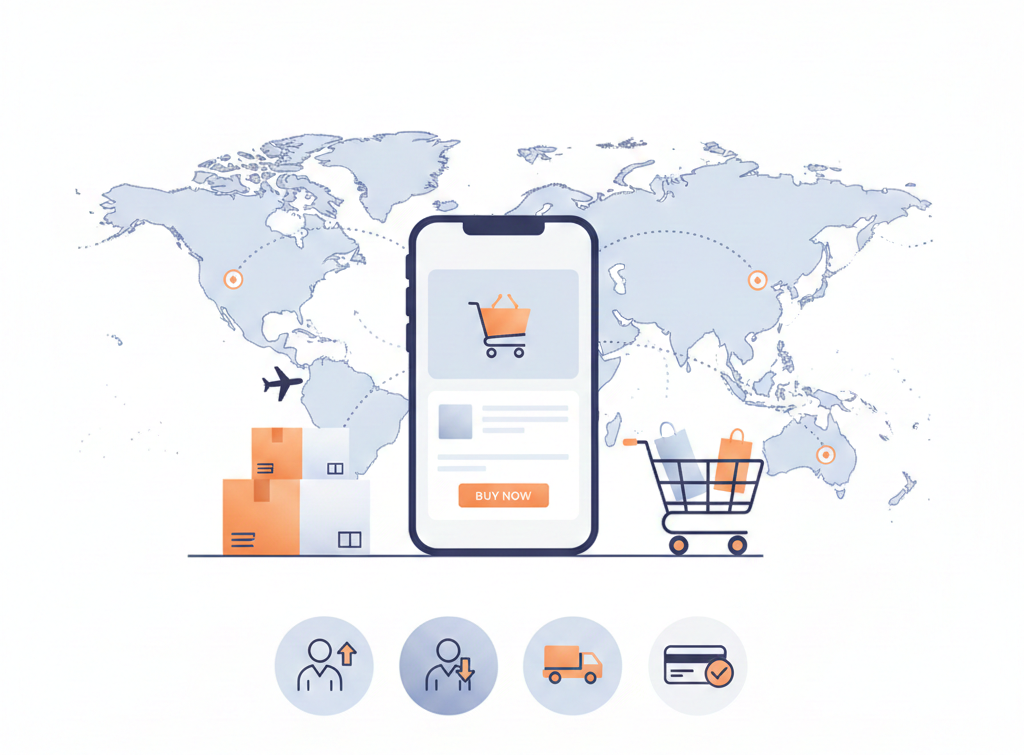
AliExpress is a global online marketplace owned by Alibaba Group that connects Chinese manufacturers and sellers directly with international retail buyers. The platform operates as an asset-light marketplace model, earning revenue primarily through seller commissions (typically 5-8% per transaction), advertising fees, premium seller services, and value-added logistics solutions. Built for price-conscious consumers, small-to-medium sellers, and dropshippers worldwide, AliExpress has become one of the largest cross-border e-commerce platforms by facilitating millions of transactions between Chinese suppliers and global buyers without holding any inventory itself.
What Is AliExpress?
AliExpress launched in 2010 as Alibaba Group’s strategic entry into the global retail market. While Alibaba.com focuses on B2B wholesale transactions with minimum order quantities, AliExpress was designed specifically for retail consumers who want to buy single items directly from Chinese manufacturers and sellers.
The key difference is simple: Alibaba.com connects businesses buying in bulk, while AliExpress serves individual shoppers looking for everything from phone cases to wedding dresses at factory-direct prices.
AliExpress gained its strongest foothold in emerging markets like Russia, Brazil, Spain, and France, where price sensitivity is high and consumers were willing to wait 2-4 weeks for delivery in exchange for significant savings. The platform became globally popular because it offered an unprecedented level of access—regular consumers could suddenly buy products at near-wholesale prices directly from the source, bypassing traditional retail markups entirely.
How AliExpress Works
For buyers, the journey is straightforward: browse millions of products, compare prices across sellers, place an order, and pay through the platform. The payment is held in escrow while the item ships (usually from China). Once the buyer confirms receipt or a set period expires, the funds are released to the seller. If there’s a dispute, AliExpress mediates and can issue refunds.
For sellers, onboarding involves registering a store (often requiring business verification), listing products with photos and descriptions, setting prices, and choosing shipping methods. Chinese sellers dominate the platform, though some local sellers operate in specific markets.
The complete order flow works like this: Customer places order → Payment held by AliExpress → Seller ships product → Tracking updates provided → Delivery confirmed → Payment released to seller (minus commission). Throughout this process, the escrow system protects buyers by ensuring they can dispute orders if items don’t arrive or don’t match descriptions.
This buyer protection mechanism became AliExpress’s trust foundation, addressing the natural skepticism of purchasing from unknown sellers halfway around the world.
AliExpress Business Model at a Glance
AliExpress operates as a hybrid B2C and C2C marketplace while most sellers are small businesses or manufacturers (making it B2C), individual entrepreneurs can also sell (adding C2C elements).
The model is asset-light: AliExpress owns no warehouses, manufactures no products, and holds no inventory. It simply provides the digital infrastructure connecting buyers and sellers, taking a cut of each transaction. This approach allows for massive scalability without the capital requirements of traditional retail.
The platform’s global cross-border commerce focus is its defining characteristic. Unlike domestic marketplaces like Amazon.com or Flipkart that optimize for fast local delivery, AliExpress built its entire operation around moving goods internationally from Chinese suppliers to consumers worldwide. This specialization in cross-border logistics and payments became both its greatest strength and its biggest operational challenge.
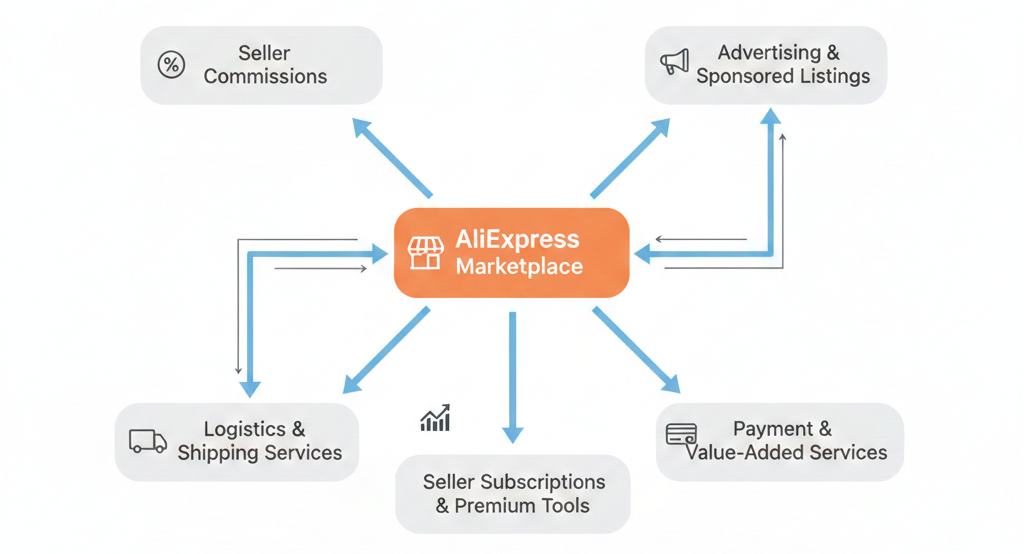
How AliExpress Makes Money (Revenue Model)
Commission From Sellers
The primary revenue driver is transaction commissions, which vary by product category. Electronics might carry a 5% commission, while fashion could be 8%, and digital goods might reach 10%. These rates are significantly lower than Amazon’s referral fees (often 15%+), making AliExpress attractive to price-sensitive sellers.
Sellers accept these fees because the value exchange is compelling: access to hundreds of millions of international customers they could never reach independently, payment processing in multiple currencies, dispute resolution, and a trusted platform that drives organic traffic to their products.
Seller Subscriptions & Services
Beyond transaction fees, AliExpress offers premium seller accounts with enhanced features—better search visibility, advanced analytics, priority customer service, and the ability to showcase more products. These subscription tiers create recurring revenue while helping serious sellers grow their businesses.
Premium seller tools include inventory management systems, automated repricing software, multi-channel integration, and professional storefront design templates. Larger sellers gladly pay for these services because they directly impact conversion rates and operational efficiency.
Advertising & Sponsored Listings
The advertising revenue stream has grown substantially. Sellers can promote individual products or entire stores through sponsored search results, display ads on category pages, and featured placements. Just like Amazon’s advertising business, this has become increasingly profitable as more sellers compete for visibility.
These ads are profitable for AliExpress because the platform controls both supply (seller ad budgets) and demand (buyer traffic), allowing it to optimize pricing algorithmically while sellers see direct ROI through increased sales.
Value-Added Services
Logistics solutions like AliExpress Standard Shipping generate fees while solving sellers’ biggest pain point—reliable international delivery. By negotiating bulk shipping rates and offering integrated logistics, AliExpress earns money while improving the customer experience.
Payment facilitation fees come from currency conversion and transaction processing. When a Brazilian buyer pays in reais for a product priced in dollars from a Chinese seller who receives yuan, AliExpress captures a margin on these conversions.
Data insights and analytics represent an emerging revenue opportunity. Sellers pay for market intelligence about trending products, pricing recommendations, and customer behavior patterns that help them optimize their catalogs.
Key Customer Segments
Global retail buyers form the largest segment—individuals shopping for personal use who want to save money and don’t mind longer shipping times. These shoppers range from students buying phone accessories to parents finding toys at a fraction of local retail prices.
Small sellers and manufacturers in China use AliExpress to reach international markets without establishing their own e-commerce infrastructure. A factory making LED strips in Shenzhen can suddenly sell directly to customers in Poland or Mexico.
Dropshippers and resellers built entire businesses around AliExpress, using it as their inventory source. They market products on Shopify stores, social media, or eBay, then fulfill orders by purchasing from AliExpress sellers who ship directly to end customers. While some sellers discourage this, it drove significant early growth.
Local sellers in select countries now include non-Chinese merchants in markets where AliExpress established local operations, though Chinese sellers still dominate the platform globally.
Value Proposition of AliExpress
For Buyers
Low prices are the headline attraction—products often cost 50-80% less than equivalent items on Amazon or in local stores because they come directly from manufacturers without middlemen markups.
Wide product variety is staggering, with hundreds of millions of listings spanning virtually every consumer product category. If it can be manufactured in China, you can probably find it on AliExpress.
Buyer protection through escrow payments and dispute resolution reduces purchase risk. The system isn’t perfect, but it provides meaningful recourse when orders go wrong.
For Sellers
Access to global customers transforms a local Chinese manufacturer into an international retailer overnight. A small electronics factory can suddenly serve customers in 150+ countries without any physical presence abroad.
Low entry barriers mean minimal upfront investment—no need to manufacture inventory, rent warehouses, or navigate international shipping independently. List products, make sales, and ship orders.
Logistics and payment support handles the complex challenges of cross-border commerce: international shipping arrangements, customs documentation, multi-currency payments, and buyer communication in different languages (through translation features).
AliExpress Logistics & Supply Chain Model
AliExpress Standard Shipping became the platform’s answer to delivery reliability concerns. By partnering with postal services and logistics providers globally, AliExpress offers tracking and relatively predictable (though still slow) delivery times of 15-30 days for most destinations.
Cainiao Network, Alibaba’s logistics arm, plays a crucial coordinating role—aggregating packages, optimizing routes, managing customs clearance, and providing tracking visibility across multiple carriers. This behind-the-scenes infrastructure makes the disjointed process of moving millions of small packages from China to doorsteps worldwide actually function.
Cross-border delivery challenges remain significant: customs delays, lost packages, damaged goods, and the sheer complexity of last-mile delivery in diverse markets. Each country has different regulations, postal infrastructure quality varies wildly, and return logistics are often impractical or expensive.
How shipping impacts trust and retention cannot be overstated. Fast, reliable delivery builds loyalty; lost packages and month-long wait times drive customers to competitors. AliExpress’s ongoing investment in logistics partnerships and local warehousing directly addresses its biggest weakness.
Technology & Platform Strategy
Search and recommendation systems use sophisticated algorithms to match buyer queries with relevant products among hundreds of millions of listings. The platform must balance relevance, seller quality, shipping speed, and price to optimize conversions.
Mobile-first approach proved essential—most AliExpress traffic comes from mobile apps, particularly in emerging markets where smartphones are the primary internet access point. The app experience emphasizes visual browsing, flash sales, and gamified shopping.
Data-driven seller optimization provides merchants with insights about pricing competitiveness, optimal shipping methods, product photography quality, and description effectiveness. Sellers who follow these recommendations generally see better sales performance.
AI for pricing and ranking helps sellers dynamically adjust prices based on competition, demand patterns, and conversion data, while AliExpress uses machine learning to rank products in search results based on predicted buyer satisfaction.
Marketing & Growth Strategy
App-based growth leveraged mobile distribution channels aggressively, with app-exclusive deals, gamified features like daily check-in rewards, and push notifications about sales and price drops. In many markets, the AliExpress app became a discovery and entertainment platform, not just a shopping tool.
Flash sales and discounts create urgency and entertainment value—limited-time offers, countdown timers, and dramatic price reductions (often from artificially inflated “regular” prices) drive impulse purchases and daily engagement.
Influencer and affiliate marketing expanded through programs that pay commissions to content creators who drive traffic and sales. YouTubers reviewing gadgets, Instagram influencers showcasing fashion finds, and bloggers writing “best of AliExpress” guides all became acquisition channels.
Country-specific localization means tailored interfaces, local payment methods (like Boleto in Brazil or iDEAL in Netherlands), region-specific marketing campaigns, and even local customer service teams in key markets. This localization investment separates AliExpress from competitors who treat all international customers identically.
Competitive Advantage of AliExpress
Price leadership remains fundamental—no major platform consistently undercuts AliExpress because few can match its direct connection to Chinese manufacturing at scale. This pricing power attracts initial customers and retains price-sensitive shoppers.
Manufacturer-to-consumer access eliminates distribution layers that add cost in traditional retail. When factories sell directly to consumers worldwide, the economics are simply different from models involving importers, distributors, wholesalers, and retailers.
Alibaba ecosystem backing provides enormous advantages: technology infrastructure, logistics networks (Cainiao), payment systems (Alipay integration), financial resources for expansion, and data insights from Alibaba’s other platforms about consumer trends and seller behavior.
Strong logistics partnerships built over a decade create operational moats—negotiated shipping rates, customs facilitation relationships, tracking integration, and delivery network coverage that new entrants can’t quickly replicate.
AliExpress vs Amazon vs Temu (Quick Comparison)
Business model differences: Amazon operates as both marketplace and retailer (holding its own inventory for many products), while AliExpress is purely a marketplace connecting third-party sellers with buyers. Temu (like AliExpress) is a marketplace but with more centralized merchandising control.
Control vs marketplace approach: Amazon exerts significant control over logistics (FBA) and product quality standards; AliExpress gives sellers more autonomy; Temu sits between them with stricter seller requirements than AliExpress but more flexibility than Amazon.
Pricing vs speed trade-off: Amazon charges premium prices but delivers in 1-2 days; AliExpress offers the lowest prices with 2-4 week delivery; Temu targets the middle ground with slightly higher prices than AliExpress but faster shipping and more buyer protections.
Seller freedom comparison: AliExpress gives sellers significant control over pricing, shipping, and customer communication. Amazon’s FBA model requires following strict fulfillment standards. Temu exercises more control over seller operations than AliExpress, sometimes setting prices or shipping requirements.
Challenges in AliExpress Business Model
Long delivery times remain the platform’s most significant weakness. In an era where Amazon conditioned consumers to expect 2-day delivery, waiting 3-4 weeks feels increasingly unacceptable, particularly in developed markets. This fundamentally limits AliExpress’s appeal for time-sensitive purchases.
Quality control issues plague the platform—inconsistent product quality, items not matching descriptions, counterfeit goods, and sellers who disappear after problems arise. While buyer protection exists, the dispute process is cumbersome, and many customers simply accept subpar products rather than fighting for refunds.
Increasing competition from Temu, Shein (in fashion), and even Amazon’s direct-from-China programs puts pressure on AliExpress’s market position. Temu in particular launched aggressively with massive marketing spending and faster shipping, directly targeting AliExpress’s core customer base.
Trust and returns management present ongoing challenges. Returning items internationally is often impractical—shipping costs exceed product value, and sellers may refuse to provide return addresses. This means buyers essentially gamble on many purchases, accepting that some won’t work out and won’t be returnable.
Is AliExpress Profitable?
The long-term platform economics favor profitability as AliExpress scales. The asset-light model means marginal costs per transaction are low, while revenue per transaction increases as advertising and value-added services mature. Transaction volume growth drives profitability without proportional cost increases.
However, AliExpress’s role inside Alibaba Group isn’t purely about standalone profits. It serves strategic purposes: extending Alibaba’s ecosystem globally, creating data on international consumer behavior, providing Chinese manufacturers with global market access, and building logistics infrastructure that benefits other Alibaba businesses.
The platform’s focus on scale over margins means aggressive investment in growth markets, subsidized shipping promotions, and customer acquisition spending that may suppress short-term profits to build long-term market position. Alibaba can afford to be patient because AliExpress advances broader corporate objectives beyond its own P&L.
What Startups & Founders Can Learn From AliExpress
Asset-light marketplaces demonstrate how massive businesses can be built without owning physical assets. By focusing on platform infrastructure, payment systems, and trust mechanisms rather than inventory or fulfillment centers, AliExpress achieved global scale with dramatically less capital than traditional retailers required.
Cross-border expansion lessons include the importance of localization (payment methods, language, customer service), patience with unit economics while building network effects, and the reality that international expansion requires sustained investment before profitability emerges.
Importance of logistics partnerships shows that even purely digital platforms must eventually engage with physical logistics to deliver quality customer experiences. AliExpress couldn’t succeed on technology alone—the Cainiao investment and shipping partnerships were essential to moving beyond a reputation for unreliable delivery.
Trust systems in global platforms need multiple layers: payment escrow, dispute resolution, seller ratings, buyer reviews, and clear policies. Building trust across cultural boundaries and languages requires more than just technology—it demands fair processes, responsive support, and willingness to rule against sellers when appropriate.
Future of AliExpress Business Model
Local warehousing trends indicate AliExpress’s strategic direction—establishing fulfillment centers in major markets to enable faster delivery. This moves away from the pure asset-light model toward hybrid infrastructure that owns or controls some inventory and logistics, trading capital efficiency for customer experience improvements.
Faster delivery focus addresses the platform’s biggest weakness. Investments in overseas warehouses, partnerships with local logistics providers, and potentially encouraging Chinese sellers to stock inventory abroad all aim to reduce delivery times from weeks to days.
Competition with Temu & Shein intensifies pressure on both pricing and delivery speed. Temu’s aggressive expansion and marketing spending, combined with Shein’s fast-fashion dominance, forces AliExpress to defend its market position rather than grow unopposed.
Shift toward regional sellers may see AliExpress recruiting more non-Chinese merchants in local markets, essentially becoming a more traditional marketplace in some countries rather than purely a cross-border platform. This would improve delivery times and potentially product quality but would dilute the core value proposition of factory-direct Chinese manufacturing.
From Business Perspective
AliExpress built a remarkable business by solving a specific problem: giving global consumers direct access to Chinese manufacturing at near-wholesale prices, while providing Chinese sellers with international market reach they couldn’t achieve independently. The asset-light marketplace model, supported by sophisticated logistics partnerships and trust systems, created a platform processing billions in transactions annually without owning inventory or warehouses.
Founders building global marketplaces should study AliExpress because it demonstrates both the opportunities and challenges of cross-border commerce: the difficulty of building trust across cultural boundaries, the strategic importance of logistics infrastructure even for digital platforms, and how patient capital investment in network effects can create defensible market positions.
This model works best when serving price-sensitive customers willing to trade delivery speed for savings, connecting fragmented suppliers with distributed buyers, and operating in categories where product quality inspection before purchase isn’t critical. It struggles in time-sensitive categories, with products requiring try-before-buy experiences, and in markets where consumers increasingly value fast delivery over price savings. The future of AliExpress depends on whether it can maintain its pricing advantage while closing the delivery speed gap—or whether faster competitors will eventually capture customers no longer willing to wait weeks for their purchases.
Discover more from Business Model Hub
Subscribe to get the latest posts sent to your email.