
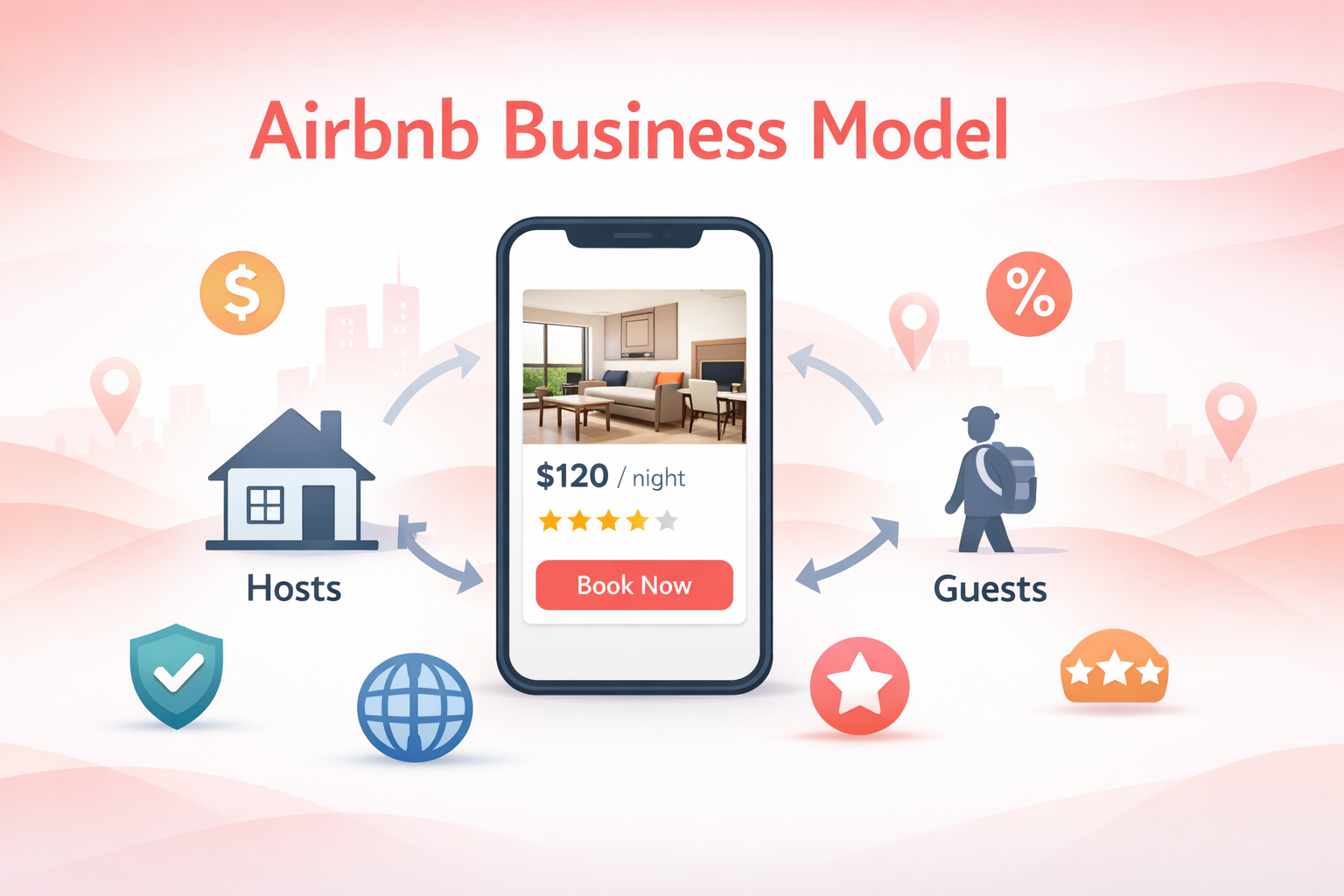
Most people think of Airbnb as a place to book a room. But that framing misses the whole point.
Airbnb is not a hospitality company. It is not a hotel chain. It does not own property, employ housekeepers, or manage real estate portfolios. What Airbnb owns is something far more valuable: a platform that connects people who have space with people who need it.
Founded in 2008 by Brian Chesky, Joe Gebbia, and Nathan Blecharczyk in San Francisco, Airbnb started as a simple idea: rent out air mattresses in your apartment to conference attendees who could not find a hotel room. That scrappy experiment turned into a company valued at over $70 billion, operating in nearly every country on earth.
The secret was never the rooms. The secret was the model.
The Core Business Model: Two-Sided Marketplace
What a Two-Sided Marketplace Actually Means
Airbnb operates what is called a two-sided marketplace. On one side you have hosts, people and property managers who list their homes, apartments, cabins, villas, and everything in between. On the other side you have guests, travelers looking for a place to stay. Airbnb sits in the middle and earns a fee every time a transaction happens between the two sides.
This is the same fundamental structure that powers Uber, eBay, and Etsy. The platform does not produce the product. It facilitates the exchange.
Why This Model Is So Powerful
The beauty of this structure is what it does not require. Airbnb does not need to buy property to grow its inventory. It does not need to hire staff to clean rooms. It does not carry the capital costs that hotel chains like Marriott or Hilton carry every single quarter.
Instead, Airbnb scales by growing its network. More hosts bring more listings. More listings attract more guests. More guests make hosting more lucrative. That cycle feeds itself, which is exactly what makes the model so hard to compete with once it reaches critical mass.
This is called a network effect, and it is arguably the most important concept in platform business strategy.
How Airbnb Actually Makes Money
Guest Service Fees
The most straightforward revenue stream is the guest service fee. When you book a stay on Airbnb, a service fee is added on top of the host’s listed price. This typically ranges from 5% to 20% of the booking subtotal, and it varies based on factors like booking size, location, and length of stay. The guest pays it, often without thinking too hard about it.
Host Service Fees
On the other side of the transaction, hosts also pay a fee. Airbnb uses two different fee structures depending on the host’s setup.
In the split-fee model, hosts pay around 3% of the booking subtotal. This is the most common structure and is designed to feel relatively painless for the host since the guest absorbs the larger portion.
In the host-only fee model, which is required for hosts using certain software or managing multiple properties, the host pays between 14% and 16% of the booking subtotal. In exchange, guests see no added service fee on their end, which can improve conversion rates for hosts with high booking volumes.
Airbnb Experiences
Beyond accommodation, Airbnb launched Experiences, a product that lets locals offer activities, tours, classes, and events to travelers. A chef in Tokyo teaches you to make ramen. A photographer in Paris takes you to hidden spots at golden hour. A surfer in Bali gives you a two-hour lesson.
Airbnb takes a commission on each Experience booking, and this segment gives the platform a reason for travelers to engage with Airbnb even when they are not booking a place to sleep.
Long-Term Stays
The pandemic reshaped travel permanently, and one of the most significant shifts was the rise of remote work. When people could work from anywhere, they started staying for weeks or months rather than weekends. Airbnb leaned into this hard, improving its monthly stay filters, pricing tools, and discoverability features for longer bookings. Long-term stays now represent a substantial and growing share of total nights booked on the platform.
Premium Tiers: Airbnb Plus and Luxe
Airbnb also operates higher-end product tiers. Airbnb Plus features verified homes that meet a higher standard of quality and comfort, appealing to guests who want reliability without the hotel experience. Airbnb Luxe targets the high-end travel market with curated luxury properties, dedicated trip designers, and white-glove service. These segments allow Airbnb to compete across multiple price points and capture spending from travelers who would otherwise go to boutique hotels or luxury villa rental services.
Airbnb’s Pricing Strategy
Dynamic Pricing at Scale
Airbnb does not use fixed pricing. The platform runs a dynamic pricing algorithm that adjusts recommendations based on demand signals, local events, seasonality, competitor pricing, and historical booking data. This is conceptually similar to how airlines price seats or how Uber adjusts fares during peak hours.
Smart Pricing for Hosts
Hosts can opt into Airbnb’s Smart Pricing tool, which automatically adjusts their nightly rate within a range they set. The algorithm tries to maximize occupancy and earnings simultaneously, raising prices during high-demand periods and lowering them when demand softens.
The Full Cost Stack for Guests
One thing that frustrates many Airbnb users is how the final price compares to the listed price. By the time you add the service fee, the cleaning fee, and local taxes, a $100-per-night listing can cost significantly more. This pricing transparency issue has been a recurring criticism of the platform, and Airbnb has made some moves to show total prices upfront in search results to address this.
The Value Proposition on Both Sides
What Guests Get
Guests choose Airbnb because it offers things hotels cannot or do not. The inventory is enormous, spanning everything from a one-bedroom city apartment to a treehouse in the mountains to a castle in Scotland. The pricing, particularly for group travel or extended stays, often beats comparable hotel options. The experience feels more local and personal. And the flexibility, especially for long stays, is something the traditional hospitality industry still struggles to match.
What Hosts Get
Hosts choose Airbnb because it gives them access to a global audience of travelers without any marketing effort on their part. They can monetize a spare room, a vacation property, or an investment unit through a platform that handles payments securely, provides liability coverage through AirCover, and offers tools to manage pricing, availability, and guest communication. The barrier to entry is low, and the upside can be significant in high-demand markets.
What Makes Airbnb’s Model Actually Work
Trust as Infrastructure
The biggest risk in a marketplace where strangers share homes is trust. Airbnb solved this by making trust a core product feature rather than an afterthought.
The review system is central to this. Both guests and hosts leave reviews after each stay, and those reviews are visible to everyone. A host with 300 five-star reviews signals safety and quality to a prospective guest. A guest with a strong review history signals reliability to a host. The system creates accountability on both sides and makes the marketplace safer for everyone participating in it.
Verification features, Airbnb’s rebooking and refund policy, and AirCover insurance protection all layer on top of the review system to reinforce that trust infrastructure.
Network Effects as a Moat
The more hosts that list on Airbnb, the more choices guests have, which attracts more guests, which makes the platform more valuable to hosts, which attracts more hosts. This self-reinforcing loop is a genuine competitive moat. It is extremely difficult for a new competitor to replicate this dynamic without years of investment and an equally compelling reason for both sides to join.
Platform Technology
Airbnb’s search algorithm, pricing tools, trust scoring systems, and fraud detection capabilities are all underpinned by significant technology infrastructure. The platform processes enormous amounts of data continuously, using it to improve match quality between hosts and guests, detect bad actors, and optimize pricing recommendations.
Growth Strategy: How Airbnb Got Big
The Craigslist Hack
In its early days, Airbnb used a now-legendary growth hack. The team built a tool that let Airbnb hosts cross-post their listings to Craigslist, a platform with massive reach and no comparable short-term rental product at the time. This gave Airbnb access to a large existing audience of people looking for places to stay and gave hosts a reason to list on Airbnb since it expanded their distribution instantly. It was scrappy, technically clever, and highly effective.
Referral Programs
Airbnb invested heavily in referral programs, offering travel credits to users who referred new guests and hosts. Referrals are one of the most cost-efficient acquisition channels available to a marketplace because the new user arrives with a built-in trust signal from someone they already know.
SEO and Organic Growth
One of Airbnb’s most underappreciated growth channels is search engine optimization. The platform created thousands of location-specific landing pages targeting searches like “homes in London” or “apartments in Barcelona.” These pages rank in Google for high-intent travel searches and drive a significant volume of organic traffic that costs Airbnb nothing beyond the initial investment in building and maintaining those pages.
The Pandemic Pivot
When COVID-19 collapsed international travel in 2020, Airbnb pivoted fast. The company shifted its messaging toward domestic travel, highlighting nearby getaways for people who were tired of being stuck at home but not ready to fly internationally. It also leaned into the remote work trend, positioning long-term Airbnb stays as a viable alternative to a static home office. This pivot helped Airbnb recover faster than most of the travel industry.
Competitive Landscape
How Airbnb Compares to Key Rivals
Booking.com operates a similar marketplace model but focuses more heavily on hotels and traditional accommodations, though it has expanded into vacation rentals. It takes a commission from properties for each booking and has a massive global footprint, particularly in Europe.
Vrbo, owned by Expedia Group, focuses exclusively on whole-home rentals, specifically targeting families and groups who want private spaces rather than shared homes. It does not compete in the urban apartment or single-room segment the way Airbnb does.
OYO operates a very different model. Rather than a pure marketplace, OYO leases or partners with budget hotels and standardizes their quality, then sells rooms through its platform. It is more operationally intensive and asset-adjacent compared to Airbnb’s fully asset-light approach.
Airbnb’s advantage over all of them is the combination of brand recognition, depth of unique supply, trust infrastructure, and network effects built over 15-plus years.
Risks and Challenges
Regulatory Pressure
This is the most significant long-term risk Airbnb faces. Cities around the world have moved aggressively to restrict short-term rentals. New York City, Barcelona, Amsterdam, and others have implemented strict rules that limit who can list, how often, and under what conditions. These regulations are typically driven by concerns about housing affordability and neighborhood disruption, and they show no signs of easing. Every new restriction reduces the addressable supply on Airbnb’s platform.
Host Quality Control
Airbnb has limited control over the physical condition or hospitality standards of its listings. A guest who books a property based on beautiful photos and glowing reviews can arrive to find something very different. While the review system catches persistent bad actors over time, it cannot prevent a bad experience before it happens. This inconsistency remains a structural weakness of the marketplace model.
Platform Disintermediation
Some hosts, particularly those with strong repeat guest relationships, are incentivized to take bookings directly and avoid paying Airbnb’s fees. This disintermediation risk exists in any marketplace and is difficult to eliminate entirely. Airbnb addresses it partly through contract terms and partly by making the platform valuable enough in terms of payment security, insurance, and discoverability that most hosts prefer to stay on-platform even when they could go around it.
Strategic Evolution Over Time
Phase 1: Budget Alternative to Hotels
Airbnb started by targeting price-sensitive travelers who wanted something cheaper than a hotel and were willing to trade predictability for savings and local character.
Phase 2: Global Expansion
After proving the model in the United States, Airbnb expanded aggressively into international markets, building supply in cities across Europe, Asia, Latin America, and beyond.
Phase 3: Experiences
Adding Experiences expanded Airbnb’s addressable market and gave travelers a reason to engage with the platform beyond finding a place to sleep, deepening the company’s relationship with its user base.
Phase 4: Remote Work and Long-Term Stays
The pandemic accelerated what was already a trend. Airbnb made long-term stays a first-class product and positioned itself as a platform for people who wanted to live somewhere different for a month rather than just visit for a weekend.
Phase 5: Categories and Flexible Search
More recently, Airbnb introduced a categories-based search interface, letting users browse by property type rather than destination. Searching for treehouses, lakefront homes, or iconic properties rather than typing in a city name opened up discovery for travelers who did not have a fixed destination in mind. This was a meaningful shift in how people navigate the platform.
SWOT Analysis of Airbnb
Strengths
Airbnb has one of the most recognized travel brands in the world. Its network effects are deep and self-reinforcing. The asset-light model generates strong operating leverage at scale. And the trust infrastructure built around reviews and verification is genuinely difficult to replicate.
Weaknesses
The platform has limited control over listing quality, which creates inconsistent guest experiences. Pricing transparency has been a persistent complaint. Regulatory vulnerability is baked into the business model in a way that does not affect traditional hotel chains in the same way.
Opportunities
AI-powered search and personalization could significantly improve how guests find the right property. Experiences remains an underpenetrated product with room to grow. The long-term stay segment continues to expand as remote work becomes permanent for a meaningful portion of the workforce. Emerging markets represent substantial untapped supply and demand.
Threats
Municipal and national regulation is the clearest external threat. Platform disintermediation is a structural risk. Competition from Booking.com, Vrbo, and hotel chains investing in their own direct booking capabilities is intensifying. And macroeconomic downturns hit discretionary travel spending hard.
Lessons for Founders
Start With Supply Before Demand
Airbnb’s early effort focused on getting hosts to list before worrying about filling every listing with guests. In a marketplace, you need inventory first. An empty storefront drives customers away. A full one draws them in.
Trust Is a Product Feature
The review system was not a nice-to-have. It was the mechanism that made strangers comfortable enough to sleep in each other’s homes. When you are building a marketplace or any product that requires trust between users, build trust infrastructure as seriously as you build the core product.
Build Network Effects Early
Network effects are hard to engineer late. They have to be embedded in the product from the beginning. Design your product so that each new user makes it more valuable for every existing user. If you can do that, your moat builds itself over time.
Stay Asset-Light If You Can
Owning assets slows scale. Controlling transactions scales faster. Airbnb grew to millions of listings without buying a single property. If you can build a platform instead of building inventory, the economics of scale work massively in your favor.
Platform Beats Inventory
The most durable businesses in the internet era are platforms, not producers. A platform that enables others to create value can grow far larger and faster than any business that has to produce its own value. Airbnb does not make rooms. It makes it easy for others to offer them and for guests to find them. That difference is the entire company.
The Future of Airbnb
AI and Personalization
Airbnb has significant opportunity to use AI to improve search personalization, match guests to listings they are more likely to love, and reduce the friction of the discovery process. As AI-powered search becomes more natural and conversational, the ability to say “find me somewhere quiet in nature within three hours of London for four adults who want hiking” and get genuinely useful results will be a major differentiator.
Experiences Expansion
The Experiences product is still relatively small compared to accommodations. There is a real opportunity to grow it into a meaningful standalone business that competes directly with tour operators and activity platforms.
Long-Term and Flexible Stays
The normalization of remote work means that flexible, extended travel is not a trend. It is a structural shift. Airbnb is well positioned to capture an increasing share of how people live while traveling, not just how they vacation.
Regulatory Adaptation
The companies that survive the regulatory pressure on short-term rentals will be the ones that find ways to work with local governments rather than fight them. Airbnb has been investing in this area, including tools that help cities enforce existing rules and programs that encourage responsible hosting.
Finally: Is Airbnb’s Business Model Sustainable?
Yes, with one important caveat.
The core model is sound. The network effects are real. The brand is strong. The asset-light structure generates exceptional returns on capital once the platform reaches scale. Airbnb has proven it can survive a global pandemic that nearly wiped out travel entirely and come back growing faster than before.
The long-term variable that matters most is regulation. Cities are not going to stop pushing back on short-term rentals. The housing affordability pressure that drives those restrictions is not going away. How well Airbnb navigates that regulatory landscape, market by market, city by city, over the next decade will determine whether the platform retains its supply depth in the places that matter most.
If it does, the model is not just sustainable. It is one of the most defensible businesses built in the last twenty years.
FAQs
Yes, Airbnb is profitable.
After struggling during the COVID travel shutdown, Airbnb returned to profitability in 2022 and has since reported strong net income driven by high booking volume and its asset-light marketplace model.
Because Airbnb does not own properties, its margins can be strong once platform costs are covered
Airbnb typically takes:
3% from hosts (under the split-fee model)
5%–20% from guests (service fee)
In some cases (especially hotels or professional hosts), Airbnb may use a host-only fee model, where hosts pay 14%–16%, and guests pay little or no service fee.
So yes, total platform fees combined can approach 15–20% depending on structure — but it’s not always a flat 20%.
No.
Airbnb does not own the homes listed on its platform. It operates as a technology marketplace that connects property owners (hosts) with travelers (guests).
This is what makes it asset-light and scalable.
Airbnb operates a:
Two-sided marketplace business model
It connects:
Supply side → Hosts
Demand side → Guests
And earns revenue by charging service fees on transactions.
It’s also considered:
A platform business
A sharing economy model
An asset-light tech-enabled hospitality model
Here’s how it works:
A guest books and pays through Airbnb.
Airbnb holds the payment.
24 hours after check-in, Airbnb releases payment to the host.
The host receives payout via bank transfer, PayPal, or other supported payout methods.
Airbnb deducts its host service fee before sending the money.
Key differences:
Airbnb
Hotels
Does not own properties
Own or lease property
Individual hosts
Corporate ownership
Unique homes & apartments
Standardized rooms
Peer-to-peer marketplace
Traditional hospitality model
Commission-based
Room revenue model
Airbnb competes with hotel chains like Marriott International but operates very differently structurally.
Not usually as a flat rate.
Airbnb’s total fees (host + guest combined) can sometimes approach 15–20%, but:
Hosts usually pay ~3%
Guests typically pay 5–20%
Some professional hosts pay 14–16% under host-only model
So the “20%” idea depends on fee structure and booking type.
The “90-day rule” refers to short-term rental regulations in certain cities.
For example:
In places like London, entire homes cannot be rented out for more than 90 nights per year without special permission.
The rule is designed to prevent full-time short-term rental conversions of residential housing.
Regulations vary by city.
Startup cost depends on whether you already own property.
If you own the property:
Basic furnishing: $2,000–$10,000+
Cleaning setup
Photography
Minor renovations
If you rent property (rental arbitrage model):
Security deposit
First month’s rent
Furnishing costs
Local licensing
In India or emerging markets, starting costs may be lower. In major cities globally, it can be significantly higher.
There is no fixed amount it depends on property type, city, and positioning (budget vs premium).
Discover more from Business Model Hub
Subscribe to get the latest posts sent to your email.






[…] Airbnb aggregates privately owned rooms, apartments, and houses without owning a single property. Its trust system (reviews, verified IDs, host guarantees) solves the biggest barrier to adoption: trusting a stranger’s home. […]