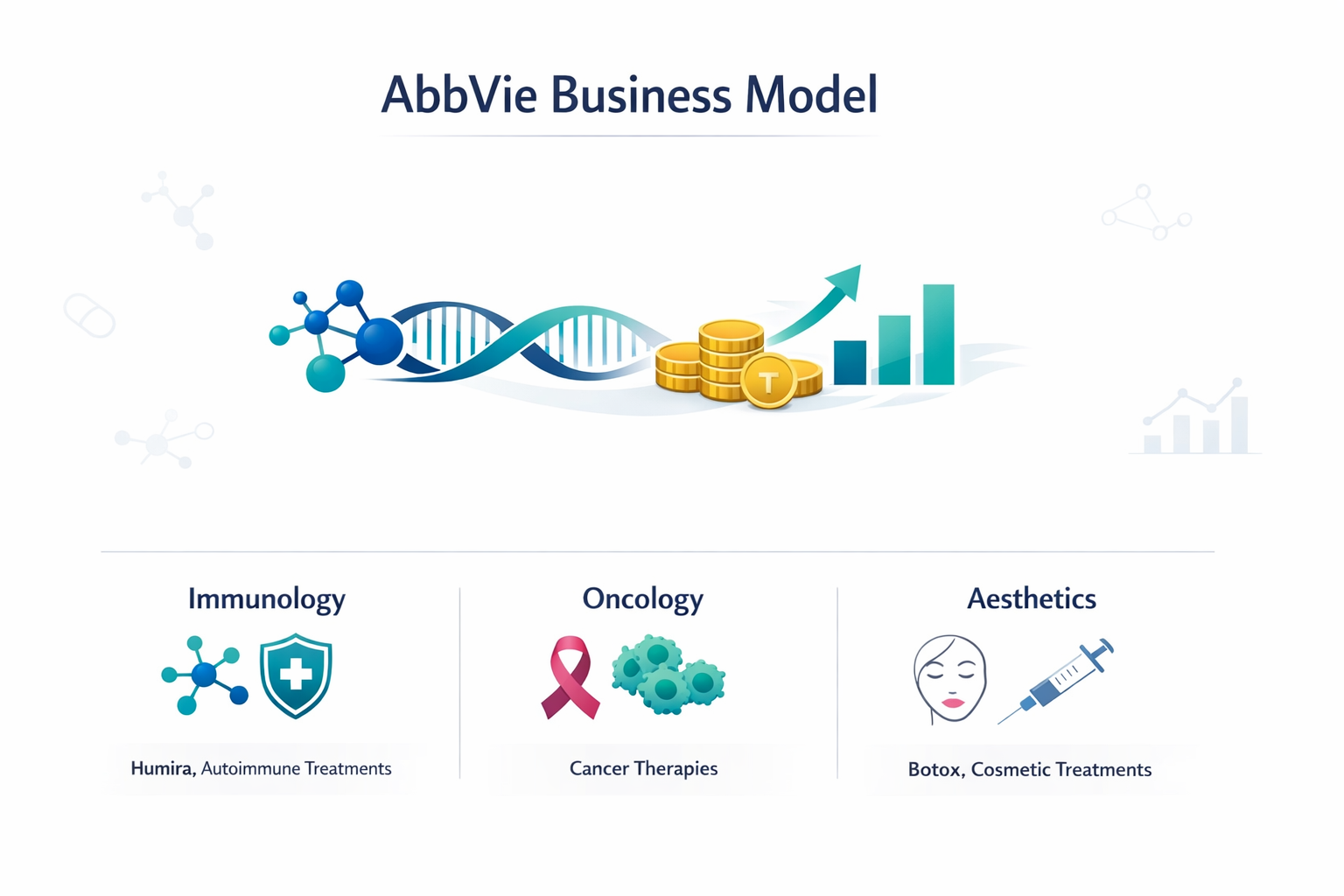
AbbVie’s business model is built on developing, manufacturing, and selling pharmaceutical drugs. Its revenue flows primarily from patented medicines, immunology treatments, oncology drugs, and strategic acquisitions like Allergan. This article breaks down each layer of that model in detail.
What is AbbVie?
AbbVie is a research-driven biopharmaceutical company headquartered in North Chicago, Illinois. It was spun off from Abbott Laboratories in 2013 and has since grown into one of the largest pharmaceutical companies in the world by market capitalisation.
Its core focus areas include:
- Immunology — treating autoimmune and inflammatory diseases
- Oncology — developing targeted cancer therapies
- Neuroscience — addressing mental health and neurological conditions
- Aesthetics — non-surgical cosmetic treatments, primarily through the Allergan portfolio
Since its spin-off, AbbVie has aggressively expanded through R&D investment and billion-dollar acquisitions, establishing itself as a dominant force in specialty medicine.
AbbVie Business Model Overview
AbbVie does not operate like a generalist pharmaceutical company. Its model is built around a few key strategic pillars that work together to generate high margins and long-term revenue.
Research-driven innovation. AbbVie invests heavily in discovering and developing new drugs. The company bets on complex biological treatments that are difficult for competitors to replicate.
Patent-based revenue strategy. When AbbVie develops a new drug, it secures patents that give the company exclusive rights to sell that drug for a defined period. This temporary monopoly allows AbbVie to charge premium prices and capture most of the market before generic or biosimilar competition enters.
High-margin specialty drugs. AbbVie focuses on specialty medicines, which treat complex, chronic, or serious conditions. These drugs command far higher prices than general medications and often require ongoing prescriptions.
Acquisition-led expansion. Rather than building every capability from scratch, AbbVie has pursued large-scale acquisitions to enter new markets, add revenue streams, and diversify away from dependence on any single drug.
B2B and B2G distribution. AbbVie does not sell directly to patients. Its customers are hospitals, healthcare providers, pharmacy benefit managers, insurance companies, and governments. This B2B and B2G model means AbbVie must navigate complex procurement, pricing, and reimbursement systems in every country it operates.
How AbbVie Makes Money
Let’s look at AbbVie’s revenue streams in detail.
Immunology Drugs
Immunology has historically been AbbVie’s most important revenue driver, and the story here begins and ends with one name: Humira.
Humira (adalimumab) is a biologic drug that treats a range of autoimmune diseases including rheumatoid arthritis, Crohn’s disease, psoriasis, and ulcerative colitis. At its peak, Humira was the best-selling drug in the world, generating over $20 billion in annual sales for AbbVie.
This is the essence of the blockbuster drug model: instead of generating modest revenue from many drugs, a pharma company bets on a small number of treatments that become dominant in their category. When a drug treats a chronic condition requiring indefinite medication, the revenue is not just large, it is recurring. Patients with rheumatoid arthritis, for example, may take Humira for years or decades.
The trade-off is concentration risk. When Humira’s patent protection weakened in the United States after 2023, biosimilar competitors entered the market. AbbVie anticipated this transition and spent years building the next generation of immunology drugs, primarily Skyrizi (risankizumab) and Rinvoq (upadacitinib). Both have posted strong growth figures and are on track to collectively exceed Humira’s peak revenue.
Key products in immunology:
- Humira (adalimumab)
- Skyrizi (risankizumab)
- Rinvoq (upadacitinib)
Oncology
AbbVie’s oncology segment has grown into a significant contributor to overall revenue and is central to its long-term diversification strategy.
Imbruvica (ibrutinib) is a targeted therapy for blood cancers including chronic lymphocytic leukaemia and mantle cell lymphoma. It is developed and co-commercialised with Johnson & Johnson, which means AbbVie shares both revenue and costs in certain markets.
Venclexta (venetoclax), co-developed with Roche/Genentech, targets a protein that some cancer cells rely on to survive. It is used in treatment of blood cancers and has been expanding its approvals across additional cancer types.
The oncology portfolio is strategically important because it opens AbbVie to a patient population with high unmet medical needs and a strong willingness from payers to fund effective treatments. Cancer medicines are also highly resistant to substitution since treatment choices are made at the oncologist level with significant clinical specificity.
Neuroscience Portfolio
AbbVie’s neuroscience segment addresses mental health and neurological conditions, an area that has seen growing investment across the pharmaceutical industry due to significant unmet patient need and limited treatment innovation over prior decades.
Vraylar (cariprazine) is used to treat schizophrenia, bipolar disorder, and major depressive disorder. It has posted consistent growth as awareness and prescribing patterns expand.
AbbVie has also invested in treatments related to migraine, Parkinson’s disease, and other neurological conditions. The Allergan acquisition brought additional assets in this space, including Botox Therapeutic, which is used medically to treat chronic migraine, spasticity, and overactive bladder, distinct from its cosmetic use.
Neuroscience is a longer-horizon bet. Drug development timelines are extended, clinical trials complex, and reimbursement negotiations demanding. But for companies that break through, the rewards are durable and difficult for competitors to replicate quickly.
Aesthetics and Cosmetic Business
The Allergan acquisition in 2020 brought AbbVie into a category most pharmaceutical companies do not touch: aesthetics.
Botox Cosmetic is the flagship product here. It is used in cosmetic clinics, dermatology practices, and medical spas for facial rejuvenation procedures. Botox has extraordinary brand recognition, and the term itself has become synonymous with the treatment category it created.
Beyond Botox, the aesthetics portfolio includes:
- Juvederm — a range of dermal fillers
- CoolSculpting — a fat-reduction procedure using cryolipolysis
- SkinMedica — a medical-grade skincare product line
What makes the aesthetics business structurally attractive is that demand is largely driven by consumer discretionary spending rather than insurance reimbursement. This gives AbbVie exposure to a different kind of revenue, one more correlated with consumer confidence than healthcare policy decisions. It also provides genuine geographic diversification since the aesthetics market is growing rapidly across Asia-Pacific and Latin America.
Other Specialty Medicines
Beyond its four primary segments, AbbVie has revenue from a range of specialty medicines covering:
- Hepatitis C — although this category has declined as curative treatments reduced the patient pool
- Eye care — including products for dry eye and glaucoma inherited from Allergan
- Women’s health — endometriosis and uterine fibroid treatments including Orilissa and Oriahnn
These segments represent AbbVie’s broader diversification strategy. No single additional product rivals Humira in scale, but together they reduce dependence on any one therapeutic area.
AbbVie’s Acquisition Strategy
Acquisitions have been central to AbbVie’s growth trajectory, and the logic is straightforward: building breakthrough drugs from scratch takes over a decade and carries enormous failure risk. Acquiring companies with validated products or advanced pipelines compresses that timeline significantly.
The most significant transaction in AbbVie’s history was its $63 billion acquisition of Allergan in 2020. This was not just a financial transaction. It was a strategic pivot.
Before Allergan, AbbVie was almost entirely reliant on Humira. Any investor looking at AbbVie’s revenue breakdown would immediately identify the concentration risk. Humira’s patent cliff was well-known and well-discussed.
The Allergan deal accomplished several things simultaneously:
- It added Botox and the aesthetics portfolio, creating a new high-margin revenue stream largely insulated from biosimilar competition
- It added Botox Therapeutic, contributing to neuroscience
- It diversified AbbVie’s customer base across consumer-facing aesthetics providers and traditional healthcare institutions
- It added eye care, women’s health, and other specialty medicines
The cost was significant. AbbVie took on considerable debt to complete the transaction, and integrating a company of Allergan’s scale was operationally demanding. However, the strategic rationale has largely played out as intended. AbbVie’s revenue base is now materially broader than it was before the acquisition, and Botox’s brand durability makes it one of the more defensible assets in the pharmaceutical industry.
Research and Development Strategy
AbbVie consistently ranks among the top pharmaceutical companies globally by R&D spending. Its investment in research serves multiple functions.
Building the future pipeline. AbbVie’s revenues today depend on drugs developed years or decades ago. Its revenues in 2030 depend on what its scientists are working on now. Continuous investment in early-stage research is therefore not discretionary; it is the foundation of the entire business model.
Clinical trials. Developing a new drug requires moving through Phase 1, Phase 2, and Phase 3 clinical trials before regulatory approval. This process typically costs hundreds of millions of dollars per drug and takes many years. Most drugs fail at some point in this process, which is why diversified pipelines with many candidates are preferable to concentrated bets on one or two treatments.
Patent protection. When AbbVie identifies a new compound, it files patents early in the development process to protect its intellectual property. Patent terms are typically 20 years from the filing date, but since much of that time is consumed by clinical development, the effective market exclusivity period after approval is often 10 to 12 years. During this window, AbbVie can charge premium prices without generic competition.
Innovation versus risk. AbbVie’s model requires accepting the reality that most research investments will not produce approved drugs. The R&D model is therefore a portfolio strategy: many candidates enter the pipeline, a fraction reach approval, and a smaller fraction become commercially significant. The few that do must generate enough revenue to justify the entire investment.
AbbVie Business Model Canvas
Here is a simplified view of how AbbVie’s model fits together:
Key Partners
- Research universities and academic institutions
- Contract research organisations
- Hospitals and health systems
- Government health agencies and procurement bodies
- Distributors and wholesalers
- Co-commercialisation partners like Johnson & Johnson (Imbruvica)
Key Activities
- Drug discovery and early research
- Clinical trial design and execution
- Regulatory submissions and compliance
- Manufacturing and quality control
- Medical marketing and sales to healthcare providers
Value Proposition
- Life-saving and chronic disease treatments with strong clinical evidence
- Research-backed medicines that address conditions with limited alternatives
- Aesthetic treatments with trusted brand recognition
Customer Segments
- Hospitals and health systems (buying specialty medicines)
- Healthcare providers and prescribers (recommending drugs to patients)
- Government payers and insurers (reimbursing treatments)
- Aesthetic clinics and cosmetic medicine providers (purchasing Botox and fillers)
- Patients (the end beneficiaries, largely indirect customers)
Revenue Streams
- Branded drug sales across immunology, oncology, neuroscience, and aesthetics
- Licensing fees from IP agreements
- Partnership revenues from co-commercialised products
AbbVie’s Competitive Advantages
Strong Patent Portfolio
Patents are the foundation of AbbVie’s pricing power. A newly approved drug protected by patents faces no generic competition. AbbVie can price based on clinical value rather than cost of production. This translates directly into the high gross margins that characterise AbbVie’s financial performance.
The company is also skilled at patent lifecycle management, including filing additional patents on formulations, delivery mechanisms, and manufacturing processes to extend effective exclusivity beyond the original compound patent.
Blockbuster Drug Strategy
AbbVie concentrates resources behind drugs with multi-billion dollar revenue potential. This is capital-intensive but creates enormous leverage when a drug succeeds. Humira’s success funded decades of subsequent R&D, acquisitions, and shareholder returns.
The risk is that blockbusters eventually lose exclusivity. AbbVie’s answer has been to develop successor drugs before the cliff arrives, as it did with Skyrizi and Rinvoq before Humira’s biosimilar exposure increased.
Diversified Portfolio
Following the Allergan acquisition, AbbVie now has meaningful revenue across four distinct therapeutic areas. This matters because regulatory risk, patent timelines, and market dynamics vary across categories. A setback in oncology does not necessarily affect immunology or aesthetics.
Brand Trust in Healthcare
In pharmaceutical and medical aesthetics markets, trust is a foundational asset. Botox’s brand equity is essentially unmatched in its category. Humira built strong clinical relationships with rheumatologists over two decades. These relationships take years to build and are difficult for new entrants to replicate quickly.
Challenges in AbbVie’s Business Model
Patent Expirations
The patent cliff is the defining structural challenge for any pharmaceutical company. When Humira’s US patents faced biosimilar challenges from 2023 onwards, AbbVie’s immunology revenue came under direct pricing and volume pressure for the first time. While the company had prepared by growing Skyrizi and Rinvoq, the transition demonstrated how quickly patent expiration can reshape a revenue profile.
Future patent expirations across AbbVie’s portfolio will require continuous pipeline replenishment to avoid revenue gaps.
Regulatory Risks
Every drug AbbVie sells must be approved by regulatory bodies including the FDA in the United States and equivalent agencies globally. The approval process is long, expensive, and uncertain. Drugs that fail in late-stage trials represent large sunk costs. Even approved drugs face post-marketing safety monitoring and can be withdrawn if unexpected side effects emerge at scale.
High R&D Costs
AbbVie spends billions annually on research and development. In years where the pipeline produces approvals, this investment looks justified. In periods where trials fail or development timelines extend, the cost base creates margin pressure. The inherent unpredictability of drug development makes budgeting and revenue forecasting challenging.
Competition from Generics and Biosimilars
Biosimilars are biological medicines that are highly similar to an originator product but are produced by different manufacturers after patent expiration. Unlike generic small-molecule drugs, biosimilars are more complex to manufacture, which limits the number of competitors and the degree of price erosion. However, even partial market share losses can represent billions of dollars in annual revenue for a blockbuster like Humira.
AbbVie has had to adjust its US pricing and contracting strategies significantly to retain Humira market share in the biosimilar era.
Future Growth Strategy
AbbVie’s forward strategy is built around several themes.
Next-generation immunology. Skyrizi and Rinvoq are both growing faster than analysts originally projected. AbbVie has guided that these two drugs, combined, should surpass Humira’s historical revenue peak. Continued label expansions into new indications drive further volume growth.
Oncology expansion. AbbVie is investing in new oncology assets beyond Imbruvica and Venclexta. This includes earlier-stage pipeline candidates targeting solid tumors and haematological cancers through newer biological mechanisms. The oncology market continues to expand as precision medicine advances enable more targeted treatments.
Growth in aesthetics. Global demand for aesthetic procedures is growing, particularly in markets like China, South Korea, Brazil, and the Middle East. AbbVie’s Allergan aesthetics portfolio is positioned to benefit from this trend through both existing products and pipeline extensions.
AI in drug discovery. AbbVie has been investing in computational approaches to drug discovery, including the use of machine learning to analyse biological data, predict molecular behaviour, and identify promising drug candidates earlier in the process. This is an industry-wide shift that could meaningfully reduce R&D timelines and improve success rates in clinical development.
Emerging markets expansion. As healthcare infrastructure improves in developing economies and populations age, demand for specialty medicines grows. AbbVie has been building commercial presence in emerging markets to capture long-term volume growth beyond its traditional strongholds in North America and Europe.
Key Takeaways
AbbVie is one of the most financially successful pharmaceutical companies in the world, and its model reflects several enduring truths about the industry:
- Patents create pricing power. Without patent protection, the economics of drug development fall apart. AbbVie’s margins depend on maintaining exclusivity across its portfolio.
- Blockbuster drugs carry concentration risk. Humira’s dominance was an asset for a decade and a liability once biosimilar competition arrived. The lesson was not to avoid blockbusters, but to develop successors before the cliff.
- Acquisitions accelerate diversification. The Allergan deal transformed AbbVie from a single-drug-dependent company into a multi-segment specialty healthcare business in a single transaction.
- R&D is not optional, it is the business. AbbVie’s revenue today is the result of research decisions made years or decades ago. The pipeline it builds now determines its financial profile in the 2030s.
- Diversification across therapeutic areas provides resilience. Operating across immunology, oncology, neuroscience, and aesthetics gives AbbVie buffers against setbacks in any single segment.
For investors, analysts, and healthcare professionals trying to understand how AbbVie creates value, the model is clear: patent-protected innovation, blockbuster drug economics, strategic acquisitions, and a disciplined focus on high-margin specialty medicine. The transition away from Humira dependency is well underway, and the next chapter of AbbVie’s growth story is being written through Skyrizi, Rinvoq, and the continued expansion of its Allergan aesthetics portfolio.
FAQs
AbbVie primarily generates its revenue from its immunology portfolio, especially blockbuster drugs like Humira.
For years, Humira has been one of the highest-selling drugs globally, used to treat chronic autoimmune conditions like rheumatoid arthritis, psoriasis, and Crohn’s disease. Because of its wide usage and premium pricing, it contributed a significant portion of AbbVie’s total revenue.
However, as patents expire, AbbVie is actively shifting towards newer immunology drugs like Skyrizi and Rinvoq to maintain growth. This shows that while immunology remains the core revenue engine, the company is evolving its portfolio to stay competitive.
AbbVie is highly profitable mainly because of its patent-driven business model. When a pharmaceutical company develops a new drug, it gets patent protection, which gives it exclusive rights to sell that drug for a certain period.
This allows AbbVie to:
Charge premium prices without direct competition
Maintain high profit margins
Recover massive R&D investments
For example, Humira enjoyed years of market exclusivity, generating billions in revenue annually.
Additionally, AbbVie focuses on specialty drugs (not mass-market medicines), which are typically high-value treatments for chronic or complex diseases—further boosting profitability. Its efficient commercialization strategy and strong relationships with healthcare providers also contribute to sustained margins.
AbbVie acquired Allergan in a major deal to diversify its revenue streams and reduce over-dependence on a single drug (Humira).
Through this acquisition, AbbVie gained access to a completely new business segment—medical aesthetics and cosmetic treatments. The biggest asset from this deal was Botox, one of the most recognized brands in both medical and cosmetic markets.
This move helped AbbVie:
Enter the high-margin aesthetics industry
Build a non-immunology revenue stream
Reduce risk from patent expirations
Strengthen its global brand portfolio
In simple terms, Allergan transformed AbbVie from a pure pharma company into a more diversified healthcare business.
The biggest challenge for AbbVie is patent expiration, especially for blockbuster drugs like Humira.
Once a patent expires, other companies can launch biosimilars (similar versions of the drug), which leads to:
Sharp decline in revenue
Increased price competition
Loss of market share
This is already happening with Humira in multiple markets.
Apart from this, AbbVie also faces:
High R&D risks (not all drugs succeed in trials)
Strict regulatory approvals (FDA and global agencies)
Pricing pressure from governments and insurers
Competition from other pharma giants
To overcome these challenges, AbbVie is investing heavily in next-generation drugs, acquisitions, and diversification strategies.
Discover more from Business Model Hub
Subscribe to get the latest posts sent to your email.