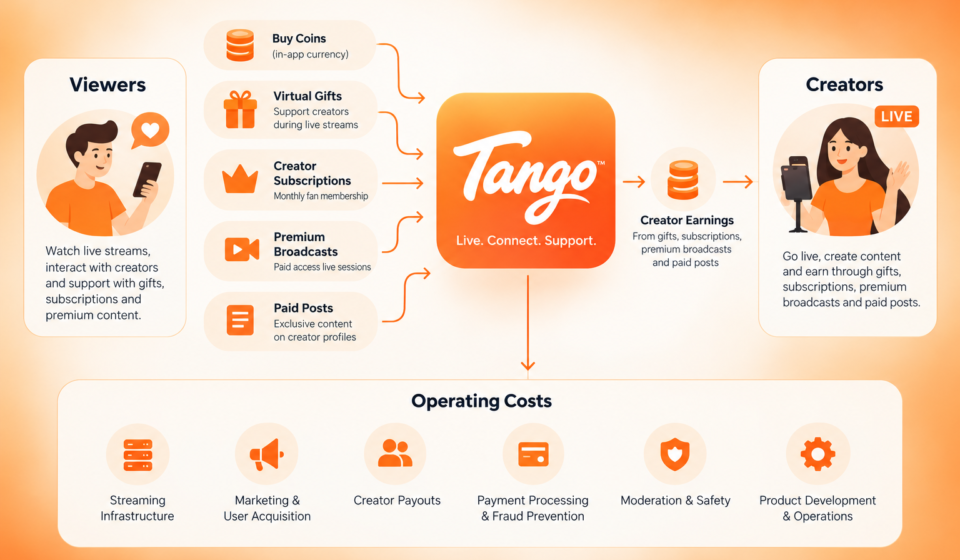

Tango makes money primarily by monetizing interactions between viewers and live-streaming creators. Its business model includes virtual gifts purchased with in-app currency, creator subscriptions, premium broadcasts, paid posts, and partner referral programs. These revenue opportunities allow Tango to earn from digital purchases and creator-audience relationships rather than relying exclusively on advertising.
Tango Live operates as a two-sided digital platform. Viewers come to watch broadcasts, interact with creators, and access exclusive experiences. Creators attract audiences, produce content, and can earn through eligible monetization features. Tango provides the technology, payment systems, discovery tools, and platform environment that connect both groups.
The business model extends beyond sending gifts during a live stream. Tango’s official materials describe monthly creator subscriptions, premium broadcasts, and paid posts, while its partner program provides another route for acquiring users. Tango’s official blog and Help Center document these features.
Understanding the Tango business model requires looking at how money enters the platform, how creators earn, what operating expenses affect profitability, and why users continue spending. This article examines those components and the business lessons other entrepreneurs can learn from Tango.
What Is Tango and How Does It Work?
Tango Live is a social livestreaming platform where users can watch broadcasts, communicate with creators, send virtual gifts, and access selected premium experiences. It connects people who want live entertainment and social interaction with broadcasters who create content for an audience.
Unlike a traditional video platform that primarily earns through advertising, Tango supports direct monetization between viewers and creators. Users can spend money on digital currency and eligible paid features, while creators can earn through supported monetization programs.
Who Uses Tango?
Tango’s business model serves several groups:
- Viewers: People who watch live broadcasts, discover creators, and participate in conversations.
- Paying fans: Users who purchase in-app currency, send gifts, or pay for selected creator experiences.
- Subscribers: Fans who pay recurring monthly fees for eligible creator benefits.
- Broadcasters and creators: People who produce live content and build relationships with viewers.
- Partners and referral publishers: Eligible agencies, publishers, and influencers who help attract users through partner arrangements.
Each group contributes differently. Viewers provide audience activity, paying fans generate direct spending, creators supply content, and partners can help expand the user base.
How Does the Platform Work?
The typical user journey starts when someone discovers Tango and creates an account. The user can browse broadcasts, follow creators, watch live content, and interact through available features.
When a viewer wants to support a broadcaster or access a paid experience, the viewer may purchase in-app currency or subscribe to an eligible creator. The resulting transactions can generate earnings for creators and revenue for the platform, subject to Tango’s applicable terms.
Creators, in turn, use their content and audience relationships to encourage repeat viewing and participation. The platform benefits when viewers find content worth returning to and creators can build sustainable audiences.
The Role of Creators and Viewers
Creators are essential to Tango’s value proposition because the platform needs engaging broadcasts and exclusive content to attract viewers. Viewers create the demand that makes those broadcasts commercially valuable.
This creates a network effect: more appealing creators can attract more viewers, while a larger and more engaged audience can make the platform more attractive to creators.
However, audience size alone does not guarantee revenue. The business also depends on viewer retention, spending behavior, creator activity, and the platform’s ability to convert engagement into paid transactions.
How Does Tango Make Money?
Tango’s monetization model combines virtual gifting, subscriptions, premium broadcasts, paid content, and partner-led user acquisition. These features create multiple ways to generate economic value from the same audience instead of depending on a single paid product.
The exact contribution of each revenue stream is not publicly established through audited financial statements in the sources reviewed. The following sections explain how the documented features work and how they can support the platform’s economics.
1. Virtual Gifts and In-App Purchases
Virtual gifting is a central part of Tango’s business model. Viewers purchase in-app currency and use it to send digital gifts to creators during live broadcasts.
A gift is a digital item rather than a physical product. It can function as a public expression of appreciation, a way to participate in a live session, or a way for a viewer to stand out in a creator’s community.
The business mechanism works as follows:
- A viewer purchases in-app currency.
- The viewer spends that currency on eligible virtual gifts.
- The creator receives earnings according to the platform’s applicable rules.
- Tango operates the transaction, streaming experience, and creator monetization system.
The commercial advantage is that one live broadcast can generate transactions from multiple viewers. A creator does not need to sell a separate physical product to every fan. Instead, the platform monetizes digital interactions around content that is already being produced.
Virtual gifts can also encourage repeat spending. A viewer may return to support a favorite creator, participate in a special event, or contribute during a live session.
However, the amount a viewer spends is not necessarily the amount a creator receives. Currency conversion, platform rules, transaction costs, and payout conditions can affect the final economics.
2. Creator Subscriptions
Tango also supports monthly subscriptions to eligible broadcasters. Subscribers receive additional benefits in exchange for recurring payments made through the platform’s subscription system.
According to Tango’s Help Center, subscription benefits can include highlighted names and comments during live streams, access to a subscribers-only feed, and the ability to chat with the broadcaster under the feature’s stated conditions. Tango documents three fan levels: Fan, Super Fan, and Exclusive Fan. The benefits differ by level, and Exclusive Fan includes access to premium broadcasts without an additional entry fee.
Creators can set subscription prices within the options available to them. Subscribers can cancel, so recurring revenue depends on the ability to deliver ongoing value.
Subscriptions support the Tango business model in two important ways.
First, they create a recurring payment opportunity rather than requiring every transaction to begin with a new gift purchase. Second, they give creators an incentive to develop a stronger community by offering benefits that encourage fans to maintain their memberships.
For Tango, subscriptions can diversify monetization beyond individual live-stream interactions. For creators, they can make a portion of income more predictable, although subscription revenue is never guaranteed.
3. Premium and Private Broadcasts
Tango offers premium or private broadcasts in addition to public live streams. These broadcasts restrict access to selected viewers and can use an entry-fee gift or another designated access mechanism.
Tango’s Help Center describes premium broadcasts as sessions in which broadcasters choose who can join. The documented setup process includes selecting an entry-fee gift and inviting viewers. Eligibility requirements and feature availability may apply.
The difference between public and premium broadcasts is the access model.
A public stream is generally available to its intended audience without a specific entry fee. A premium broadcast offers more restricted access, making the experience itself part of the monetization opportunity.
This model can appeal to creators whose audiences value more focused interaction or exclusive access. It also gives the platform another way to monetize demand without requiring creators to depend entirely on gifts sent during public streams.
Premium broadcasts and subscriptions should not be treated as identical. A subscription can provide recurring access to a package of benefits, while a premium broadcast is a specific restricted-access experience. Tango’s subscription benefits may overlap with premium access for certain membership levels.
4. Paid Posts and Exclusive Content
Tango’s monetization model has expanded beyond live broadcasting to include paid posts.
In an August 2026 feature update, Tango described its Feed as a place where creators can publish paid posts and monetize content directly through their profiles. The update presents paid posts as an additional income opportunity alongside live-stream gifting.
This matters because live-streaming income is closely tied to creator activity. A broadcaster generally needs to be live to generate the interactions associated with that session. Paid posts can create another monetization opportunity around content published outside a live broadcast.
For example, a creator might offer exclusive footage, tutorials, behind-the-scenes material, or other content that a particular audience values. The actual content and availability depend on the creator and the features supported by Tango.
Paid posts can help creators monetize their profiles as well as their live sessions. They may also give viewers more ways to support creators at times when they cannot watch a broadcast.
For Tango, this expands the range of paid experiences available within the platform. The key business question is whether creators can produce content that viewers are willing to purchase and whether those purchases generate enough value to justify the platform’s operating costs.
5. Partner and Affiliate Commissions
Tango also has a partner program designed to reward eligible partners for referring users to the platform.
The official partner page describes arrangements for agencies and influencers, including cost-per-acquisition and revenue-share models. Its published terms have included payments linked to referred users’ qualifying activity and spending.
Under a cost-per-acquisition model, a partner earns when a referred user meets specified qualifying conditions. Under a revenue-share model, compensation depends on eligible purchases or revenue generated by referred users.
These structures can help Tango acquire users through third parties rather than relying exclusively on its own marketing campaigns.
For partners, the opportunity is to monetize an audience they already reach. For Tango, the potential benefit is access to new viewers or creators through tracked referrals.
The exact commission, eligibility requirements, qualifying activity, payment terms, and duration can vary by program or agreement. Older public partner pages may not reflect the terms currently offered to every participant, so prospective partners should confirm the applicable terms before calculating expected earnings.
Partner commissions are also an economic cost. A referral channel is valuable only when the lifetime value of the users it brings in justifies the associated acquisition and reward expenses.
6. Loyalty Programs and Premium Memberships
Tango uses loyalty features to recognize eligible spending and encourage continued participation. Its Help Center describes loyalty levels linked to coin purchases and gifts, with requirements that users must meet to enter or maintain a level.
Documented benefits include exclusive gifts, coupons on selected coin offers, additional support options, and other membership-related perks. Benefits depend on the user’s level and the current program terms.
Loyalty programs differ from creator subscriptions. A creator subscription primarily gives a fan benefits associated with a particular broadcaster. A platform loyalty program rewards qualifying activity across the platform under its own rules.
From a business perspective, loyalty features can encourage repeat purchases by giving frequent users additional reasons to remain active. They can also make spending milestones more visible and help the platform recognize its most engaged customers.
There is a trade-off, however. Rewards and discounts have costs, and spending-based incentives must be designed carefully. A successful loyalty program should improve retention and customer value without giving away so much value that it weakens the platform’s margins.
How Tango’s Coins, Gifts, and Creator Earnings Work
Tango’s in-app currency connects viewer spending with digital experiences and creator monetization. Viewers purchase coins or other eligible currency packages, use them for supported features, and may send gifts that generate earnings for broadcasters.
The money flow can be summarized as follows:
Viewer purchases currency → viewer sends gifts or buys an eligible experience → creator accrues eligible earnings → payout occurs under applicable terms.
Each stage has different economics.
How Viewers Spend Money
Viewers can purchase in-app currency through supported payment channels. They may then use it for gifts, subscriptions, or other eligible paid features, depending on the feature and account conditions.
The amount a viewer pays for a currency package is not necessarily the amount that reaches a creator. The platform may use a separate accounting system for creator earnings, and payout conditions can differ from the original purchase price.
How Creators Earn
Creators can generate earnings through eligible gifts and other monetization features. Their actual income depends on factors such as audience activity, content demand, the features they can access, and the applicable payout rules.
Creators should check the current in-app earnings information and official Help Center documentation for details about balances, withdrawals, eligibility, and payout timing.
Why Viewer Spending and Creator Earnings Differ
It is important to distinguish three figures:
- Gross consumer spending: What viewers pay for purchases.
- Creator earnings: The amounts credited to creators under Tango’s applicable rules.
- Platform revenue and profit: The amounts Tango recognizes as revenue and retains after relevant costs and expenses.
These figures are not interchangeable. App distribution fees, payment processing, creator payouts, refunds, incentives, and accounting treatment can affect the relationship between them.
Exact coin conversion rates, platform shares, withdrawal thresholds, and payout terms should be verified using current official documentation. They should not be assumed from an illustrative example or an outdated third-party article.
How Much Money Does Tango Make?
Tango’s exact company revenue and net profit cannot be established from the official product and Help Center pages alone. Third-party app intelligence providers publish estimates, but those estimates should not be presented as audited financial results.
For example, Sensor Tower’s Tango app listing has displayed an estimated worldwide monthly revenue figure of approximately $3 million in its recent app overview data. This is a third-party estimate, not a company-reported revenue figure, and it should be interpreted according to the reporting period and measurement scope shown by the provider.
Such estimates can help indicate the commercial scale of an app, but they do not establish Tango’s full company revenue or profitability.
There are several reasons for this distinction:
- App intelligence estimates may cover particular app stores, platforms, or transaction categories.
- Gross user spending may differ from the revenue recognized by the company.
- Creator payouts and other variable costs reduce the amount retained by the platform.
- Infrastructure, marketing, staff, moderation, and compliance create additional expenses.
- A large user base or high download count does not prove that the business is profitable.
A reliable assessment of Tango’s financial performance would require more information about recognized revenue, creator payouts, distribution and payment fees, operating expenses, and the relevant accounting period.
For business research, the safest conclusion is that Tango has several documented monetization mechanisms and third-party services estimate substantial app-level spending. Its exact revenue mix, net profit, and profitability should not be stated as fact without stronger financial evidence.
Tango’s Revenue Model and Operating Costs
Tango’s financial performance depends on the relationship between monetized user activity and the cost of running a live-streaming platform. In simple terms, the business needs to generate enough revenue from paid experiences to cover creator-related payments and its operating expenses.
Major Operating Costs
1. Video streaming and cloud infrastructure
Live video requires infrastructure for media delivery, storage, reliability, and real-time interaction. Costs can increase with viewing hours, video quality, traffic, and geographic coverage.
2. Creator payouts
Creator monetization is part of the platform’s value proposition. Tango needs workable payout processes and clear earning rules to maintain creator participation. The actual payout economics depend on the platform’s terms and transaction mix.
3. User acquisition and referral incentives
Tango needs to attract viewers and creators. Marketing campaigns, partner commissions, and referral incentives can help expand the user base, but they must be evaluated against the value generated by acquired users.
4. Payment processing and fraud prevention
Digital purchases require payment infrastructure and controls for fraud, chargebacks, refunds, and disputed transactions. These costs can affect the amount retained from customer spending.
5. Moderation and user protection
Live content creates operational demands around reporting, content moderation, age-related safeguards, privacy, and enforcement of platform rules. These are essential functions for user trust and risk management.
6. Product development and business operations
Engineering, design, customer support, analytics, compliance, and administration all contribute to the cost of maintaining the platform and launching new features.
Hypothetical Revenue Example
Consider a simplified example in which a livestreaming platform processes $100,000 in customer spending during a month. The following figures are assumptions for explaining the economics, not actual Tango financial data.
| Illustrative item | Amount |
|---|---|
| Customer spending | $100,000 |
| Assumed creator payouts | $50,000 |
| Assumed payment and distribution costs | $10,000 |
| Assumed infrastructure and moderation costs | $8,000 |
| Assumed marketing and referral costs | $12,000 |
| Amount remaining after these selected costs | $20,000 |
In this example, $20,000 remains after the listed costs. That amount is not necessarily net profit. The calculation may exclude salaries, product development, taxes, legal expenses, refunds, other operating costs, and accounting adjustments. It also assumes that all customer spending can be treated as the starting revenue base, which may not match the platform’s actual accounting treatment.
The example illustrates the core principle: a high volume of transactions does not automatically create high profit. The amount retained depends on payouts, transaction costs, acquisition efficiency, infrastructure, and the full cost of operations.
Tango Business Model Canvas
The Business Model Canvas helps explain how Tango connects customers, creators, monetization features, and operating resources.
| Business Model Canvas block | Tango analysis |
|---|---|
| Customer segments | Viewers, paying fans, subscribers, broadcasters, agencies, and eligible referral partners |
| Value proposition | Live entertainment, social interaction, access to creators, virtual gifting, and selected exclusive experiences |
| Channels | Mobile applications, creator profiles, live broadcasts, supported web channels, and partner referral links |
| Customer relationships | Live chat, creator communities, subscriptions, loyalty benefits, and ongoing content discovery |
| Revenue streams | In-app purchases and monetized experiences; the precise revenue mix requires verified financial data |
| Key resources | Streaming technology, creator network, audience, payment infrastructure, platform brand, and user data systems |
| Key activities | Live video delivery, creator monetization, discovery, product development, payment operations, moderation, and user acquisition |
| Key partnerships | Payment providers, app distribution platforms, creators, agencies, and eligible referral partners |
| Cost structure | Infrastructure, creator payouts, marketing, payment processing, fraud prevention, moderation, engineering, and support |
The main strategic relationship is between creator supply, audience engagement, paid experiences, and operating costs.
Creators make the platform useful by producing content. Viewers make that content commercially valuable through attention, participation, and purchases. Monetization features convert some of that activity into transactions, while the platform must manage the costs and risks associated with those transactions.
The model works best when each side receives sufficient value. Viewers need worthwhile experiences, creators need credible earning opportunities, and Tango needs enough retained revenue to operate and improve the service.
What Makes Tango’s Business Model Work?
Tango’s business model combines direct creator monetization with multiple paid experiences and tools designed to support ongoing participation. Several principles help explain the model’s commercial logic.
Direct Monetization Between Fans and Creators
Virtual gifts allow viewers to support creators without requiring a traditional product sale. The transaction is tied to a social interaction, which can make it relevant to the viewer’s immediate experience.
This gives Tango a way to monetize audience relationships rather than relying exclusively on advertising revenue. The challenge is maintaining a balance between paid features and a useful free experience.
Recurring Revenue From Subscriptions
Monthly creator subscriptions can produce recurring transactions while giving fans continuing benefits. They also encourage creators to develop communities that remain active between individual broadcasts.
However, recurring billing alone does not guarantee predictable revenue. Subscription cancellations, changes in audience interest, and creator inactivity can affect retention.
Monetization Beyond Live Streaming
Paid posts allow creators to monetize eligible content outside live sessions. This gives the platform more opportunities to support creator income and provides viewers with additional ways to access content.
The broader lesson is to identify whether users want value in formats beyond the platform’s original product.
Loyalty and Gamification
Loyalty levels, exclusive benefits, and rewards can encourage users to return and continue participating. These mechanisms can strengthen retention when the benefits are valuable to users.
They should still be evaluated against their cost. Incentives that increase spending but reduce the margin on those transactions may not improve overall business performance.
Partner-Led User Acquisition
Referral and partner programs can help a platform reach audiences through agencies, influencers, and publishers. A performance-linked arrangement can connect partner compensation to qualifying user activity.
The business benefit depends on the quality of the users acquired, not just the number of registrations. Users who remain active and make repeat purchases may create more value than users who register once and leave.
Challenges and Risks in Tango’s Business Model
Tango’s model has several risks that apply broadly to live-streaming and creator monetization platforms.
Dependence on high-spending users: A platform can become vulnerable if a small portion of its audience generates a large share of spending. Changes in the behavior of these users can affect revenue.
Creator income variability: Earnings may differ significantly between creators and from month to month. If creators cannot build audiences or understand payout rules, they may stop producing content.
Payment disputes and fraud: Refunds, chargebacks, fraudulent transactions, and account misuse can create direct costs and operational work.
Content moderation and user protection: Live content is difficult to review entirely in advance. Platforms need effective reporting, moderation, enforcement, and age-related safeguards to protect users and maintain trust.
Privacy and regulatory compliance: A global platform must manage applicable rules involving personal data, payments, content, and user eligibility. Requirements may vary by market.
App distribution and platform policies: Changes in app store policies, payment rules, or distribution fees can affect the economics of in-app purchases.
Competition: Tango competes for creators and viewers with other livestreaming, social video, and creator monetization services. Users can move to alternatives if they offer better discovery, content, community, or earning opportunities.
These risks affect more than reputation. They can increase operating costs, reduce user retention, disrupt transactions, and weaken the long-term economics of the business. Safety, payment reliability, and transparent creator policies are therefore core operational requirements, not optional extras.
What Entrepreneurs Can Learn From Tango
Entrepreneurs studying the Tango business model can apply several lessons when building a digital platform or creator-focused business.
1. Monetize Existing User Behavior
Tango connects paid features to activities users already value, including watching creators, interacting during live streams, and accessing exclusive content.
A startup should first identify what its users naturally want to do. Monetization is more likely to work when it improves an existing experience rather than adding payments without a clear benefit.
2. Offer Multiple Earning Options
Gifts, subscriptions, premium broadcasts, and paid posts serve different audience needs. A creator may have viewers who prefer occasional gifts, while others value ongoing access or exclusive content.
A new platform does not need to launch every feature at once. It can start with one or two clear monetization options and expand when user behavior supports the investment.
3. Make Payout Rules Transparent
Creators need to understand how their activity translates into earnings. Unclear currency conversions, withdrawal conditions, or payout timing can weaken trust.
A startup should document its fees, payout schedules, eligibility rules, and transaction records before attempting to scale its creator network.
4. Introduce Subscriptions When Repeat Demand Exists
Recurring payments work best when users have a reason to keep paying. Before introducing subscriptions, a startup should test whether people return regularly and value benefits that continue over time.
If users only visit occasionally, a one-time purchase may fit their behavior better than a monthly plan.
5. Measure Retention and Unit Economics
Useful metrics include:
- Viewer-to-paying-user conversion rate.
- Average revenue per paying user.
- Repeat purchase rate.
- Creator retention and earnings distribution.
- Customer acquisition cost.
- Contribution margin after creator payouts and transaction costs.
- Subscription renewal and cancellation rates.
These metrics help distinguish growth in activity from growth in sustainable revenue.
6. Treat Trust as Part of the Product
Moderation, privacy, payment reliability, and user protection affect whether people continue using a platform. These functions should be included in the initial operating plan rather than added only after problems appear.
A Practical Example for a Startup
Imagine a startup launching a small livestreaming community for language tutors. Instead of building a full-scale platform immediately, it could begin with scheduled public sessions and a simple paid membership.
The founders could measure how many viewers return, how many purchase access, what creators earn, and how much each session costs to deliver. If users demonstrate demand for exclusive sessions, the startup could test premium broadcasts. If viewers want additional learning materials, it could test paid posts or downloadable resources.
This staged approach reduces the risk of building features before proving demand. It also makes it easier to understand whether the platform’s revenue can support creator payments, technology, and customer acquisition.
The lesson from Tango is not to copy every feature. It is to build monetization around real user behavior and expand only when the economics support it.
Conclusion
The Tango business model shows how a social livestreaming platform can monetize the relationship between creators and their audiences. Virtual gifts remain an important mechanism, while subscriptions, premium broadcasts, paid posts, loyalty features, and partner referrals provide additional ways to support monetization and growth.
However, the number of users or the volume of purchases does not determine profitability on its own. Creator payouts, payment costs, infrastructure, marketing, moderation, and retention all affect the economics.
For entrepreneurs, the central lesson is to connect monetization to real user demand. Start with valuable content or interactions, make earning and payment rules clear, measure repeat behavior, and expand paid features when the data supports them. A platform becomes more sustainable when viewers receive value, creators have credible earning opportunities, and the business can operate at a manageable cost.
Discover more from Business Model Hub
Subscribe to get the latest posts sent to your email.