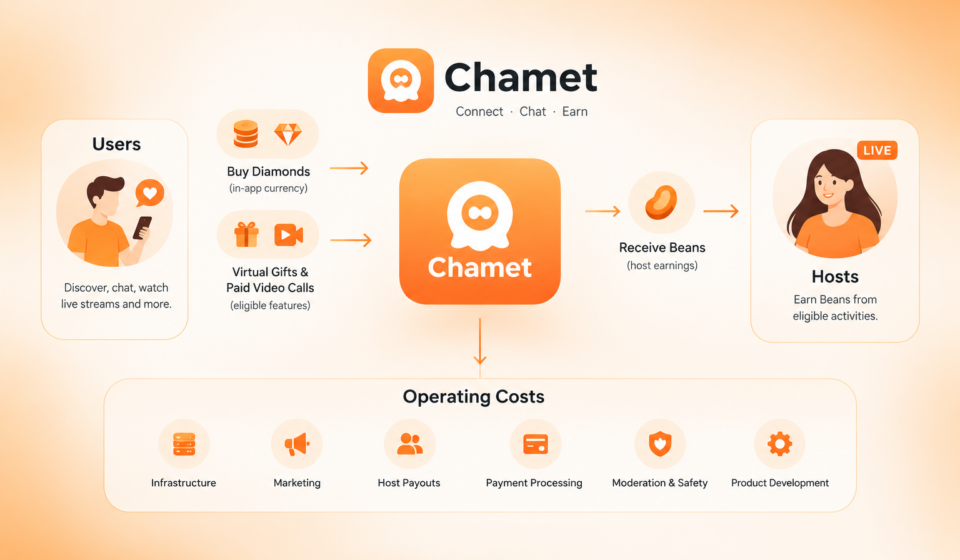

The Chamet business model combines in-app purchases, paid video interactions, virtual gifts, and a host earning system to monetize online social connections. Users can purchase Diamonds to access eligible paid features, while hosts can earn Beans from qualifying activities such as live-stream gifts and video chats. The platform brings these participants together through a digital entertainment ecosystem.
Chamet operates across several social formats, including one-to-one video chats, live streaming, group chat rooms, and interactive experiences. Each format gives users a different way to engage, while creating opportunities for paid participation.
Understanding this business model requires looking beyond in-app purchases. The platform must also support its host network, maintain video infrastructure, acquire users, manage payments, and protect the community. These activities influence how much revenue the business can retain after paying its operating costs.
This guide explains how Chamet makes money, how its Diamond and Bean system works, what its Business Model Canvas looks like, and what entrepreneurs can learn from its approach to digital platform monetization.
What Is Chamet and How Does It Work?
Chamet is a social entertainment platform that connects people through real-time video conversations, live streaming, virtual gifts, and group interactions. Its features allow users to discover people, communicate across languages, watch creators, and participate in shared online experiences.
The platform serves several groups:
- Regular users: People who want to meet others, join conversations, and explore live content.
- Paying users: People who purchase Diamonds to access eligible paid features or send virtual gifts.
- Hosts and creators: People who earn Beans through qualifying platform activities.
- Agency partners: Businesses or individuals who help recruit, support, or manage hosts under applicable partner arrangements.
The basic user journey starts with account registration and profile setup. Users can explore available features, discover other participants, join conversations, or watch live streams. Depending on the feature, they may be able to participate for free or spend Diamonds on additional interactions.
Hosts provide the activity that makes the platform useful. They can engage audiences through live streaming, participate in eligible one-to-one video chats, and use group-oriented features when available to their accounts.
This creates a two-sided platform: users seek social interaction, while hosts provide conversations and content. Chamet connects these groups and uses in-app transactions to monetize some of their interactions.
How Does Chamet Make Money?
Chamet’s monetization model centers on in-app spending associated with video interactions, virtual gifts, and other eligible paid activities. Diamonds act as the user-facing currency for supported transactions, while hosts can receive Beans from qualifying activity.
The following revenue mechanisms help explain the platform’s business model.
1. Diamond Purchases
Diamond purchases are a central part of Chamet’s monetization system.
Users purchase Diamonds through supported recharge channels and spend them on eligible features within the platform. Depending on the feature and account, this may include virtual gifts, video chats, and Party Room interactions.
The business benefit is that users can purchase in-app currency before deciding how to use it. This creates a payment balance that can support different paid activities without requiring a separate payment for every interaction.
For example, a user may purchase Diamonds and use part of the balance to send gifts during a live stream. The remaining balance may be available for other supported activities.
However, the total value of Diamond purchases should not automatically be treated as profit. Payment processing, platform distribution fees where applicable, host earnings, refunds, taxes, and operating expenses can affect the amount retained by the business.
2. Paid Private Video Calls
One-to-one video chats provide another opportunity for monetization.
Chamet offers video interactions in which users can connect directly with another person. Some calls or extended interactions may require Diamonds, depending on the applicable feature and pricing shown in the app.
This creates a usage-based monetization model. The amount spent can depend on the duration of an interaction and the applicable rate.
Consider a hypothetical example: if a paid interaction costs 100 Diamonds per minute, a ten-minute session would consume 1,000 Diamonds. This example illustrates the calculation only; it is not a verified Chamet rate.
For the platform, usage-based pricing connects revenue opportunities to actual engagement. Users who want longer conversations may spend more than users who only explore basic features.
Hosts may receive Beans from eligible video chats according to the platform’s applicable rules. The difference between customer spending and the associated host earnings is important when evaluating the economics of this model.
3. Virtual Gifts and Live Streaming
Virtual gifts allow users to send digital items during supported interactions, including live streams.
Chamet’s live-streaming experience includes audience participation, real-time comments, virtual gifts, and creator activities. Users can spend Diamonds on eligible gifts, and hosts receive Beans from qualifying gifts.
This mechanism links monetization to audience engagement.
For example, a creator who regularly attracts viewers may receive gifts during a live session. The creator’s earnings depend on eligible activity and the platform’s rules, rather than simply on the number of people watching.
Virtual gifts also give users a way to participate beyond watching or commenting. They create an optional paid action within the social experience.
From a business perspective, gifting can encourage repeat spending without requiring every user to purchase a subscription. However, gift revenue can vary considerably with audience size, engagement, and user spending behavior.
4. Premium Features and Other Paid Activities
Social platforms can monetize additional features through subscriptions, premium access, or other paid benefits.
For Chamet, the specific paid activities available to a user can depend on the current product, account, and region. Its official materials document Diamond-based interactions and eligible paid activities, but a complete, independently verified breakdown of subscription revenue is not publicly established here.
For that reason, subscriptions should not be treated as a confirmed major Chamet revenue stream without supporting evidence about the current offering.
The broader business lesson is that platforms can test additional monetization options when they solve a clear user need. For example, a social app might test premium profile features or additional discovery controls if users demonstrate willingness to pay for them.
New paid features should be evaluated by their impact on conversion, retention, and total spending rather than by the number of features launched.
5. Agency Partnerships and Host Economics
Agencies may help recruit hosts, provide training, support account growth, and coordinate creator activity under applicable agreements.
These partnerships can help a platform expand its host network without handling every recruitment and support activity directly. Depending on the agreement, agency compensation may be linked to host activity, performance, or other eligibility criteria.
It is important to distinguish agency earnings from Chamet’s own revenue. An agency commission is a payment or allocation under a partner arrangement, not automatically a separate source of customer revenue.
Chamet’s official host earnings guidance also states that hosts do not need an agency to begin earning through the eligible formats available to them. Agency participation should therefore not be presented as mandatory for every host.
How Chamet’s Diamond and Bean System Works
Chamet uses Diamonds and Beans for different sides of its in-app economy. Diamonds are purchased and spent by users, while Beans represent earnings hosts receive from qualifying activities. Eligible balances can be withdrawn through the supported withdrawal process.
The basic money flow works as follows.
Step 1: Users purchase Diamonds.
Users add in-app currency through supported recharge channels. The payment creates a balance they can spend on eligible activities.
Step 2: Users spend Diamonds.
Diamonds may be used for supported video chats, virtual gifts, and Party Room interactions. The applicable features and costs depend on the account and product rules.
Step 3: Hosts receive Beans.
Qualifying activities can generate Beans for the receiving host. The amount credited depends on the activity and the applicable earning rules.
Step 4: Hosts withdraw eligible earnings.
Hosts can request withdrawals through Chamet’s supported wallet process when they meet the applicable requirements. Available payout methods, fees, and processing times may vary by country.
The currency system separates the user’s spending balance from the host’s earnings balance. It also provides a consistent mechanism for handling transactions across several types of social interaction.
Why Virtual Currencies Matter
Virtual currencies can make transactions easier to manage because a platform can use one in-app balance across multiple features.
They also create opportunities to offer different spending options, such as small gifts or longer paid interactions. However, the platform must clearly communicate currency pricing, applicable rules, withdrawal requirements, and any restrictions.
Entrepreneurs considering a similar model should pay particular attention to the relationship between customer spending and creator payouts. A currency system is only commercially useful when the business can manage its transaction costs, maintain user trust, and make the economics sustainable.
How Much Money Does Chamet Make?
Chamet’s exact company revenue and net profit cannot be established from the official product and host earnings pages alone. Reliable financial disclosures or clearly attributed third-party estimates are needed to report a defensible figure.
Three financial measures should be kept separate.
Gross customer spending is the amount users spend on eligible purchases and transactions during a defined period.
Platform revenue is the amount recognized by the business under its accounting arrangements. Depending on the platform’s role in each transaction, gross customer spending may not equal reported revenue.
Net profit is what remains after recognized expenses, including relevant payouts, infrastructure, marketing, personnel, and other operating costs.
These measures answer different questions. A platform could process substantial customer spending but retain a much smaller amount after payments to creators and other costs.
Downloads also do not establish profitability. A large installation base does not necessarily translate into active users, paying customers, repeat purchases, or positive margins.
To assess Chamet’s financial performance, researchers would need reliable information about its revenue, user spending, active users, payment fees, host payouts, acquisition costs, and operating expenses.
If a third-party app intelligence provider publishes revenue estimates, those figures should be accompanied by the provider’s name, reporting period, geographic coverage, and methodology. They should not be described as audited company financials unless the source supports that claim.
How Chamet’s Revenue and Costs Work
Chamet’s financial performance depends on the amount of paid activity it generates and the cost of supporting users, hosts, and transactions.
Major Operating Costs
Video infrastructure: Real-time video calls and live streams require network capacity, video processing, and reliable infrastructure. Costs may rise as usage increases.
Host earnings and partner payments: Qualifying activities generate host earnings, and applicable partner agreements may add other payout obligations.
User acquisition: Marketing campaigns, promotional offers, and referral programs can help attract new users. Their effectiveness depends on how many acquired users become active and paying customers.
Payment processing and refunds: Transaction processing, disputed payments, refunds, and fraud prevention can affect the amount retained from customer spending.
Trust, safety, and moderation: Social video platforms need tools and processes to address abusive behavior, impersonation, inappropriate content, privacy concerns, and user reports.
Product development and compliance: App maintenance, new features, customer support, and compliance activities contribute to ongoing operating expenses.
A Hypothetical Chamet Revenue Example
The following example shows how a digital platform might evaluate customer spending. These figures are illustrative and do not represent Chamet’s actual financial results.
Assume a platform processes $100,000 in customer spending during one month.
| Financial item | Illustrative amount |
|---|---|
| Gross customer spending | $100,000 |
| Host payouts and eligible partner payments | $45,000 |
| Payment and distribution costs | $10,000 |
| Infrastructure and moderation | $12,000 |
| Marketing and other operating costs | $18,000 |
| Illustrative amount remaining | $15,000 |
Under these assumptions, $15,000 remains after the listed costs, equivalent to 15% of gross customer spending.
This is not necessarily the company’s accounting profit or net margin. Actual accounting treatment, taxes, unlisted expenses, and whether customer spending is recognized as gross or net revenue can change the calculation.
The example demonstrates a key principle: high transaction volume does not guarantee high profitability. A platform needs to understand both how much users spend and how much it costs to support that spending.
Chamet Business Model Canvas
The Chamet Business Model Canvas shows how the platform connects customer segments, social interactions, host participation, and monetization.
| Business model block | Chamet analysis |
|---|---|
| Customer segments | Regular users, paying users, hosts, creators, and eligible agency partners |
| Value proposition | Real-time video conversations, live content, social discovery, and group interactions |
| Channels | Mobile apps and other officially supported access channels |
| Customer relationships | User profiles, live engagement, community interactions, and repeat visits |
| Revenue streams | Diamond purchases and monetized activities; additional streams require verification |
| Key resources | Platform software, user network, host network, video infrastructure, and payment systems |
| Key activities | Product development, user acquisition, moderation, transaction management, and host support |
| Key partnerships | Payment providers, app distribution partners, and applicable agency partners |
| Cost structure | Infrastructure, marketing, host payouts, payment costs, support, moderation, and compliance |
The blocks work together rather than operating independently.
The value proposition attracts users and hosts. Hosts provide conversations and live content, which can encourage user engagement. Some users spend Diamonds on eligible interactions, generating transactions that support the platform’s monetization model.
The platform must then manage payouts, infrastructure, safety, and customer acquisition. These costs determine how much of the economic value created by customer activity can be retained.
This canvas is a qualitative analysis of Chamet’s model, not a disclosure of its internal financial structure. Exact revenue shares, partner agreements, and cost allocations require additional evidence.
What Makes Chamet’s Business Model Work?
Chamet’s model depends on attracting users, maintaining an active host network, encouraging repeat engagement, and converting some of that activity into paid transactions.
1. Free Entry Can Reduce Adoption Barriers
A free-to-start experience gives people an opportunity to explore a platform before committing money. This can help attract users who would not otherwise pay for an unfamiliar service.
The business challenge is converting some of those users into repeat participants without making the free experience so limited that they leave.
2. Network Effects Connect Users and Hosts
A social platform becomes more useful when users can discover people they want to interact with and hosts can find an audience.
A larger active network can improve discovery and create more opportunities for meaningful engagement. However, total registrations alone do not create a strong network. The platform needs active participants, relevant interactions, and effective discovery mechanisms.
3. Multiple Activities Create Different Spending Opportunities
Chamet combines one-to-one conversations, live streaming, virtual gifts, and group-oriented experiences.
These formats give users different ways to participate. Someone may prefer watching live content, while another person may prefer a private conversation or a group room.
Different activities can support different spending patterns, reducing reliance on a single interaction type.
4. Host Incentives Support Content Supply
Hosts contribute time, attention, and content to the platform. A clear earning mechanism can encourage participation and help maintain a supply of live interactions.
However, host earnings should be assessed alongside audience demand and payout rules. If hosts cannot build a consistent audience or understand how earnings work, they may stop participating.
The platform therefore needs to balance user satisfaction, host incentives, and its own operating costs.
Challenges and Risks in Chamet’s Business Model
Live video chat platforms face several business risks that can affect revenue, operating expenses, and long-term retention.
User and host retention: Users may leave if they struggle to find relevant interactions. Hosts may stop participating if engagement or earnings do not meet their expectations. Both outcomes can weaken the platform’s network.
Fraud and payment disputes: Unauthorized purchases, fraudulent activity, and chargebacks can increase operating costs and create payment risks.
Content moderation and user safety: Live interactions create challenges involving harassment, inappropriate content, impersonation, and abuse. Effective reporting, blocking, moderation, and enforcement are important to maintaining trust.
Privacy and age-related safeguards: Platforms must protect user information and apply appropriate safeguards for their intended audience. Weak controls can expose users to harm and create legal or reputational risks.
Dependence on in-app spending: If a large portion of monetization depends on a small group of heavy spenders, revenue may fluctuate when their spending changes.
Platform and regulatory risks: Changes to app distribution policies, payment rules, privacy requirements, or local regulations can affect product availability and costs.
Managing these risks is part of the business model, not a separate technical concern. A platform that monetizes engagement but fails to protect its users may struggle to retain both customers and hosts.
What Entrepreneurs Can Learn From Chamet
Entrepreneurs can learn from Chamet’s approach to combining a user network, digital interactions, and in-app monetization. The most useful lessons apply to social apps, creator platforms, live-streaming products, and other two-sided marketplaces.
1. Match Monetization to the Core Product
The best monetization method should fit the activity users already value.
For a live interaction platform, virtual gifts or usage-based payments may be natural starting points. A productivity app, by contrast, may be better suited to subscriptions or per-seat pricing.
Founders should test whether users are willing to pay for a feature before building an elaborate monetization system around it.
2. Build Both Sides of the Platform
A two-sided platform needs enough useful activity on both sides.
Recruiting users without enough hosts can produce a poor experience. Recruiting hosts without an active audience can leave creators with little reason to remain.
A new platform should focus on a specific audience, location, interest, or use case before expanding broadly.
3. Measure Paying-User Conversion and Retention
Downloads and registrations are useful acquisition metrics, but they do not explain whether the business is sustainable.
Track metrics such as:
- Monthly active users and repeat usage.
- Percentage of users who make a first purchase.
- Repeat purchase rate and average spending.
- Customer acquisition cost.
- Host activity and retention.
- Revenue after applicable payouts and transaction costs.
These measures help founders identify whether growth is creating economic value.
4. Make Creator Payouts Transparent
If a platform depends on creators or service providers, participants should understand how earnings are calculated, when balances become withdrawable, and which rules apply.
Clear payout policies can reduce disputes and help establish trust.
5. Test New Revenue Streams Gradually
Consider a startup building a live community app. Instead of immediately introducing gifts, subscriptions, premium profiles, and paid calls, the team could begin by testing virtual gifts with a small user group.
If users engage with the feature and the economics are promising, the startup can refine the pricing and payout structure before expanding.
The goal is not to copy Chamet feature for feature. It is to identify a monetization mechanism that fits the target audience and produces sustainable economics.
6. Evaluate Profitability, Not Just Revenue
A platform may grow quickly while spending heavily on acquisition, infrastructure, and creator payments.
Founders should calculate contribution margin, track acquisition payback periods, and understand how costs change as activity increases. These measures help determine whether growth improves the business or simply increases transaction volume.
Conclusion
The Chamet business model connects social interaction with digital monetization. Diamond purchases, eligible paid video chats, virtual gifts, and host earning mechanisms create opportunities for the platform to generate revenue from user engagement.
Its broader business model also depends on maintaining an active host network, attracting paying users, managing transaction costs, and protecting the community. These factors influence whether transaction growth can translate into sustainable financial performance.
For entrepreneurs, the key lesson is that a successful digital platform needs more than a popular product. It needs a clear value proposition, repeat user engagement, workable creator incentives, and a cost structure that supports profitable growth.
Chamet offers a useful case study in platform economics, particularly for founders exploring live-streaming apps, creator monetization, and virtual currency systems. Its exact financial performance, however, should be evaluated using reliable financial disclosures or clearly attributed estimates rather than assumptions about downloads or spending.
Frequently Asked Questions About Chamet’s Business Model
Chamet uses a digital social entertainment model built around video chats, live streaming, group interactions, and virtual gifts. Users can spend Diamonds on eligible paid activities, while hosts receive Beans from qualifying interactions. The model connects social engagement with in-app monetization.
Chamet monetizes eligible in-app spending, including Diamond-based activities such as paid video chats and virtual gifts. Other paid features may vary by product and account. Its exact revenue breakdown is not established by the public product information discussed in this article.
Diamonds are the in-app currency users purchase and spend on eligible features. Beans represent earnings hosts receive from qualifying activities. These balances serve different purposes within the platform’s transaction and withdrawal system.
Hosts can earn Beans from qualifying live-stream gifts, eligible one-to-one video chats, and certain Party Room activities. Earnings depend on the supported activity and applicable rules. Eligible balances can be withdrawn through Chamet’s supported wallet process.
Agency partners may receive compensation under applicable partner agreements for recruiting, managing, or supporting hosts. Exact commission structures depend on the agreement and should not be assumed to be universal. Hosts can also participate without joining an agency, according to Chamet’s official host earnings guidance.
Chamet’s exact net profit cannot be established from the public product and host earnings information used here. Profitability depends on recognized revenue, host payouts, marketing, infrastructure, payment costs, moderation, and other expenses. Downloads or gross customer spending alone do not prove profitability.
Major cost categories for a platform like Chamet include video infrastructure, host earnings, partner payments, user acquisition, payment processing, refunds, customer support, moderation, and compliance. The actual amounts and cost percentages require company-specific financial information.
Startups can learn to align monetization with user behavior, build an active network of users and creators, offer transparent payout rules, and measure repeat purchases and contribution margins. The strongest lesson is to test demand and validate unit economics before scaling the platform.
Discover more from Business Model Hub
Subscribe to get the latest posts sent to your email.