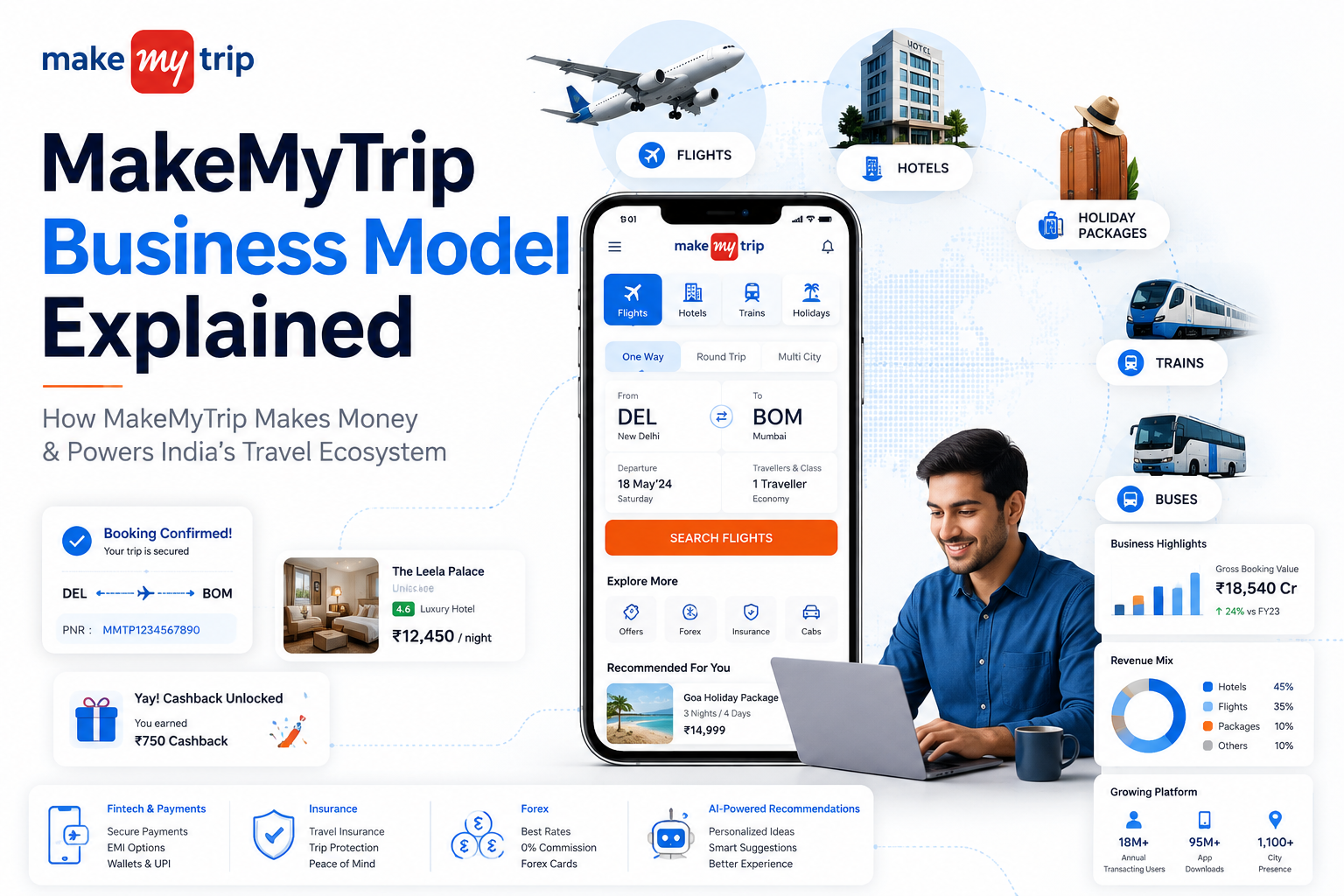

MakeMyTrip operates as an online travel marketplace that earns revenue through hotel and flight commissions, convenience fees, advertising, holiday packages, fintech services, and corporate travel solutions. The platform connects travelers with airlines, hotels, and travel service providers digitally.
What Is MakeMyTrip?
MakeMyTrip is India’s leading online travel company that revolutionized how Indians book their travel. Founded by Deep Kalra in 2000, the company started as a travel portal for non-resident Indians looking to book flights to India.
The company is headquartered in Gurugram, India, and has grown into a comprehensive travel ecosystem. Over two decades, MakeMyTrip transformed from a simple flight booking website into a full-service travel platform.
Today, MakeMyTrip holds a dominant position in the Indian online travel market. The platform competes with both domestic and international players but maintains strong brand recognition across India.
Core Services Offered
Flight Booking
MakeMyTrip allows users to search and book domestic and international flights. The platform aggregates options from multiple airlines, showing real-time pricing and availability.
Hotel Booking
Users can browse thousands of hotels across different price ranges. The platform offers detailed photos, reviews, and amenities information to help travelers make informed decisions.
Train Tickets
Through its IRCTC partnership, MakeMyTrip enables train ticket booking. This service is particularly important in India where trains are a primary mode of travel.
Bus Booking
The platform connects users with bus operators across India. Travelers can compare routes, timings, and seat types before booking.
Holiday Packages
MakeMyTrip curates complete vacation packages that bundle flights, hotels, and activities. These packages often come at discounted rates compared to booking separately.
Forex Services
International travelers can order foreign currency through the platform. This service adds convenience for outbound tourists planning trips abroad.
Corporate Travel
MakeMyTrip Business serves companies with their travel management needs. Corporate clients get dedicated account management and customized booking solutions.
Insurance
Travel insurance products are offered during the booking process. These cover trip cancellations, medical emergencies, and baggage loss.
How MakeMyTrip Works
User Journey
The user experience starts when someone searches for a travel service on MakeMyTrip. The search could be for flights, hotels, trains, or complete packages.
The platform immediately aggregates options from its network of suppliers. Users see multiple choices with pricing, timings, and other relevant details displayed clearly.
Pricing comparison happens automatically on the platform. Users can filter results by price, ratings, amenities, or other preferences to find their best match.
Once a user selects an option, the booking gets confirmed through the platform. Payment processing happens securely, and confirmation details are sent via email and SMS.
The supplier then fulfills the actual service. Airlines provide the flight, hotels offer the accommodation, and other partners deliver their respective services.
MakeMyTrip earns its fees and commissions from this transaction. The revenue comes from the supplier side, customer convenience fees, or both depending on the service type.
Supplier Workflow
Hotels upload their inventory to MakeMyTrip’s platform regularly. Room availability, pricing, and policies are updated in real-time through integrated systems.
Airlines integrate their booking systems through APIs. This technical connection allows instant seat availability checks and booking confirmations.
Dynamic pricing systems adjust rates based on demand. Hotels and airlines can modify their pricing strategies, and these changes reflect immediately on the platform.
Partner management happens through dedicated portals. Suppliers can track bookings, manage inventory, and analyze their performance through MakeMyTrip’s partner ecosystem.
MakeMyTrip Business Model Explained
Marketplace Aggregation Model
MakeMyTrip operates fundamentally as a digital intermediary. The company does not own hotels, airlines, or buses. Instead, it connects customers with these service providers through technology.
This aggregation model creates value for both sides. Travelers get convenience and choice in one place. Suppliers get access to millions of potential customers without building their own distribution channels.
The platform reduces friction in the travel booking process. Instead of visiting multiple websites or calling different vendors, users complete everything through one interface.
Network effects strengthen as more suppliers join. More options attract more customers, which in turn attracts more suppliers creating a virtuous cycle.
Commission-Based Revenue Model
Hotel Commissions
Hotels pay MakeMyTrip a percentage of each booking value. This commission typically ranges from 15% to 25% depending on the property type and partnership terms.
Premium hotels often pay higher commission rates for better visibility on the platform. Budget properties might negotiate lower rates but still value the customer access.
Commission structures can vary by season and demand. During peak travel periods, MakeMyTrip might earn higher percentages as hotels compete for visibility.
Airline Commissions
Airline commissions work differently than hotels. Traditional airline commissions have declined globally, with many carriers reducing or eliminating them entirely.
MakeMyTrip earns through a combination of reduced commissions and transaction fees. Some airline partnerships include incentive-based payments for volume targets.
Low-cost carriers often pay minimal or zero commissions. This explains why MakeMyTrip focuses more on convenience fees for flight bookings.
Bus and Train Commissions
Bus operators pay commissions similar to hotels. The percentage varies by operator but provides steady revenue as bus travel remains popular in India.
Train bookings through IRCTC partnerships generate smaller margins. However, the volume of train travelers in India makes this a valuable service line.
Convenience Fee Model
Platform fees are charged directly to customers during checkout. These fees appear as convenience charges, service fees, or booking fees depending on the service.
Convenience fees have become increasingly important as supplier commissions declined. Airlines especially generate significant revenue from these customer-paid fees.
The fee structure varies by booking value and service type. A flight booking might have a different fee structure compared to a hotel reservation.
Payment gateway charges are sometimes passed to customers. Credit card, debit card, or wallet transactions may include additional processing fees.
Advertising and Sponsored Listings
Hotels can pay for enhanced visibility on the platform. Sponsored listings appear at the top of search results, increasing the likelihood of bookings.
This advertising revenue works like a pay-per-click or pay-per-impression model. Hotels bid for prominent placement in relevant search categories.
Banner advertisements on the platform generate additional income. Travel-related brands advertise to MakeMyTrip’s large user base.
Featured property programs allow hotels to showcase amenities. These premium placements command higher advertising rates than standard listings.
Holiday Package Revenue
Bundled travel packages generate margins beyond simple commissions. MakeMyTrip negotiates bulk rates with hotels and airlines, then packages them at retail prices.
The margin between the bulk purchase price and retail sale price becomes profit. These margins are often higher than commission-only transactions.
Customized packages allow for premium pricing. When users request tailored itineraries, MakeMyTrip can build in higher margins for the personalization service.
International packages typically carry better margins. Outbound tourism from India has grown significantly, making this a lucrative segment.
Fintech and Add-On Revenue
Insurance Products
Travel insurance is offered during the booking flow. MakeMyTrip partners with insurance companies and earns commissions on policies sold.
Multiple insurance tiers give customers options. Basic coverage to comprehensive plans create different price points and commission opportunities.
Forex Services
Foreign currency exchange generates commission revenue. MakeMyTrip partners with forex providers and facilitates currency orders for international travelers.
The convenience of ordering forex through the travel booking platform increases conversion rates. Users appreciate handling everything in one place.
EMI and BNPL Options
Easy monthly installment plans are offered for expensive bookings. Banking partners provide the credit, and MakeMyTrip earns facilitation fees.
Buy Now Pay Later services have grown popular. Younger travelers especially appreciate flexible payment options for their trips.
Travel Protection Plans
Extended protection plans cover scenarios beyond basic insurance. These might include quarantine coverage, adventure sports protection, or visa assistance.
Higher-value protection plans mean higher commission earnings. The incremental revenue from add-ons improves overall transaction profitability.
MakeMyTrip Business Model Canvas
| Business Model Canvas Element | MakeMyTrip Example |
|---|---|
| Key Partners | Airlines, hotels, banks, bus operators, IRCTC, payment gateways, insurance providers |
| Key Activities | Booking management, platform development, marketing campaigns, customer support, supplier relations |
| Key Resources | Mobile app, website, brand trust, travel inventory APIs, technology infrastructure, customer data |
| Value Proposition | Easy travel booking with price comparison, multiple options in one place, trusted brand, loyalty rewards |
| Customer Relationships | 24/7 customer support, loyalty programs, app notifications, personalized recommendations, email marketing |
| Channels | Mobile app, website, digital advertising, social media, partnerships, affiliate networks |
| Customer Segments | Leisure travelers, business travelers, families, budget tourists, luxury travelers, corporate clients |
| Cost Structure | Marketing and advertising, technology development, customer support, payment processing, partnerships |
| Revenue Streams | Hotel commissions, flight commissions, convenience fees, advertising, holiday packages, insurance, forex |
Why the Business Model Canvas Matters
The business model canvas shows how MakeMyTrip creates, delivers, and captures value. Each element works together to form a cohesive business strategy.
Scalability becomes clear when viewing the canvas. The platform model allows MakeMyTrip to grow revenue without proportionally increasing costs.
Platform economics are demonstrated through the canvas structure. High fixed costs in technology and marketing are offset by variable commission revenue.
Network effect advantages appear in the key partners and value proposition sections. More partners create more value for customers, which attracts more partners.
Startup founders studying marketplace models can learn from this framework. The canvas shows how intermediary platforms balance supplier and customer needs.
MakeMyTrip Revenue Streams
| Revenue Stream | How It Earns |
|---|---|
| Hotel Bookings | Commission percentage ranging from 15% to 25% per booking |
| Flight Bookings | Reduced airline commissions plus customer convenience fees |
| Advertising | Sponsored hotel listings, banner ads, featured placements |
| Holiday Packages | Margin on bundled services sold at retail above wholesale cost |
| Insurance | Commission from insurance partners on policies sold |
| Corporate Travel | Subscription fees and service contracts from business clients |
| Bus Bookings | Commission from bus operators per ticket sold |
| Train Bookings | Service fees and partnership revenue from IRCTC bookings |
| Forex Services | Commission from forex partners on currency orders |
| Fintech Products | Facilitation fees from EMI and BNPL partnerships |
Revenue Mix and Priorities
Hotel bookings traditionally generate the highest revenue. The combination of decent commission rates and high booking values makes hotels profitable.
Flight bookings drive volume but lower margins. Airlines pay minimal commissions, so convenience fees become crucial for flight profitability.
Holiday packages offer the best margin potential. Bulk purchasing power combined with retail pricing creates healthy profit spreads.
Advertising and sponsored listings provide high-margin revenue. These digital advertising products have minimal incremental costs once the platform exists.
Why MakeMyTrip Became Successful
First-Mover Advantage
MakeMyTrip launched in 2000 when online travel booking was new in India. Being early allowed them to establish brand recognition before competition intensified.
Building trust took years in the Indian market. Early movers had time to prove reliability and safety of online transactions.
Market education happened gradually through first movers. MakeMyTrip invested in teaching Indians about online travel booking benefits.
Mobile-First Strategy
MakeMyTrip recognized smartphone adoption trends early. The company invested heavily in mobile app development when others focused only on desktop.
App-based bookings grew faster than website bookings. Push notifications, location services, and camera features enhanced the mobile booking experience.
Mobile-first users became more loyal. The convenience of booking from anywhere increased engagement and repeat usage.
Brand Trust and Recognition
Consistent advertising built strong brand recall. Television commercials, digital ads, and outdoor campaigns made MakeMyTrip a household name.
Customer service quality reinforced trust. Reliable support during booking issues or cancellations built long-term customer relationships.
Word-of-mouth marketing amplified reach. Satisfied customers recommended MakeMyTrip to friends and family, reducing acquisition costs over time.
Strategic Partnerships
The IRCTC partnership brought train booking capabilities. This was crucial since trains are India’s most used intercity transportation mode.
Airline partnerships ensured comprehensive flight inventory. Direct connections with carriers provided competitive pricing and availability.
Banking partnerships enabled payment flexibility. Multiple payment options including EMI made expensive travel more accessible.
Wide Inventory Network
Thousands of hotel partnerships created choice. From budget hostels to luxury resorts, the variety attracted different customer segments.
Pan-India coverage ensured relevance everywhere. Tier 2 and Tier 3 city inventory made MakeMyTrip useful beyond metro markets.
International inventory supported outbound travel. As Indians traveled abroad more, having global hotel options became important.
Offers and Cashback Strategy
Aggressive promotional campaigns attracted price-sensitive customers. Discounts, cashback, and coupon codes drove trial and conversion.
Loyalty programs encouraged repeat bookings. MyWallet credits and member-exclusive deals increased customer lifetime value.
Festival season campaigns capitalized on high travel periods. Diwali, Christmas, and summer vacation promotions matched natural demand peaks.
MakeMyTrip Marketing Strategy
Google Ads and Search Marketing
Paid search campaigns target high-intent travelers. Bidding on keywords like “book flight to Goa” captures users ready to purchase.
Display advertising retargets website visitors. Users who searched but didn’t book see MakeMyTrip ads across the web.
YouTube video ads build brand awareness. Travel inspiration content mixed with promotional messages reaches broader audiences.
SEO Strategy
Organic search optimization drives free traffic. Content about destinations, travel tips, and booking guides ranks in Google results.
Hotel and flight landing pages target long-tail keywords. Specific searches like “hotels in Udaipur with pool” lead to optimized pages.
User-generated reviews improve search rankings. Fresh, authentic content from travelers signals quality to search engines.
App Install Campaigns
Mobile app promotion happens across channels. App store optimization, social media ads, and influencer promotions drive downloads.
First-booking discounts incentivize app installation. New users get exclusive deals when they download and book through the app.
Push notifications re-engage app users. Price drops, limited-time offers, and travel inspiration bring users back to the app.
Influencer Marketing
Travel influencers create authentic content. Partnerships with bloggers and Instagram creators showcase real travel experiences.
Micro-influencers provide targeted reach. Smaller creators with engaged audiences deliver better ROI than celebrity partnerships.
User-generated content campaigns encourage sharing. Hashtag campaigns and photo contests turn customers into brand advocates.
Festival and Seasonal Campaigns
Diwali and holiday campaigns target peak travel. Extended family gatherings and vacations drive high booking volumes.
Summer vacation promotions capture family travel. School break periods see concentrated marketing around family destinations.
Long weekend campaigns encourage spontaneous trips. Three-day weekends get targeted promotions for quick getaways.
Retargeting and Remarketing
Cart abandonment campaigns recover lost bookings. Users who started but didn’t complete bookings see reminder ads.
Email remarketing sends personalized offers. Browse history and search behavior inform customized email promotions.
Cross-device retargeting follows users everywhere. Someone who searched on mobile sees ads on desktop and tablet.
Loyalty and Retention Campaigns
MyPartner loyalty program rewards frequent bookers. Points, exclusive deals, and priority support increase retention.
Email newsletters keep the brand top-of-mind. Travel inspiration, destination guides, and special offers arrive regularly.
Referral programs turn customers into advocates. Successful referrals earn both parties discounts or cashback.
MakeMyTrip vs Competitors
| Platform | Core Strength | Key Differentiator |
|---|---|---|
| MakeMyTrip | Strong Indian ecosystem integration | Complete travel services with train, bus, and flight options |
| Booking.com | Global hotel inventory | International property selection and worldwide presence |
| Airbnb | Unique stays and experiences | Alternative accommodations and local host connections |
| EaseMyTrip | Low convenience fees | Zero convenience fee model on flights |
| Yatra | Competitive pricing | Strong corporate travel services |
| Goibibo | MyBiz loyalty program | Aggressive cashback and rewards |
Competitive Advantages
MakeMyTrip’s comprehensive service range stands out. Few competitors offer flights, hotels, trains, buses, and packages all together.
Brand trust gives MakeMyTrip an edge in India. Years of consistent service built credibility that newer entrants lack.
Scale provides negotiating power with suppliers. Large booking volumes allow MakeMyTrip to secure better rates and terms.
Competitive Challenges
International players have stronger global inventory. Booking.com and Expedia offer more international hotel options.
New entrants undercut on pricing. Zero convenience fee models from competitors pressure MakeMyTrip’s revenue.
Niche players serve specific segments better. Airbnb dominates alternative accommodations while others focus on specific services.
Challenges in MakeMyTrip’s Business Model
Low Airline Margins
Airline commissions have declined globally. Most carriers reduced or eliminated traditional travel agency commissions.
Convenience fees face customer resistance. Travelers often complain about additional charges on top of ticket prices.
Competition forces fee reductions. When competitors charge lower fees, MakeMyTrip must match or lose bookings.
Customer Acquisition Costs
Digital advertising costs continue rising. Google, Facebook, and other platforms charge more for customer attention.
Price-sensitive customers lack loyalty. Many users compare across platforms and book wherever prices are lowest.
Promotional discounts reduce margins. Heavy discounting to acquire customers cuts into profitability.
Heavy Competition
Multiple players fight for market share. Domestic and international competitors create a crowded marketplace.
Differentiation becomes harder over time. Travel booking platforms offer similar services and features.
Price wars hurt everyone’s margins. Competitive pressure leads to unsustainable pricing practices.
Refund Management
Cancellations and refunds create operational challenges. Processing refunds quickly while managing supplier policies requires resources.
COVID-19 highlighted refund issues. Massive cancellation volumes during the pandemic strained systems and customer relations.
Refund disputes damage brand reputation. Delayed refunds or policy disagreements lead to negative reviews and complaints.
Dependency on Tourism Economy
Economic downturns hurt travel immediately. When people cut spending, travel is often the first to go.
External shocks like pandemics devastate business. COVID-19 demonstrated how vulnerable travel platforms are to global events.
Fuel price fluctuations impact demand. Higher airline and bus ticket prices reduce overall travel volumes.
Seasonal Demand Volatility
Peak seasons require scaling resources. Summer vacations and festivals need more customer support and infrastructure.
Off-peak periods see reduced revenue. Non-holiday months generate significantly lower booking volumes.
Inventory management becomes complex. Balancing supplier relationships during slow periods while maximizing peak season revenue is challenging.
Future of MakeMyTrip
AI-Based Travel Recommendations
Machine learning will personalize suggestions. Understanding individual preferences will allow highly targeted destination and hotel recommendations.
Predictive analytics can forecast demand. Anticipating price changes helps users book at optimal times.
Chatbots will handle more customer service. AI assistants can answer questions, suggest options, and guide bookings conversationally.
Voice Search Booking
Smart speakers will enable hands-free booking. Asking Alexa or Google Assistant to book travel will become commonplace.
Voice commands will simplify searches. Speaking naturally instead of typing will make trip planning more accessible.
Voice authentication could streamline payments. Secure voice-based transactions may replace manual payment entry.
Dynamic Pricing AI
Real-time price optimization will maximize revenue. AI will adjust prices based on demand, competition, and user behavior.
Personalized pricing may emerge. Different users might see different prices based on their willingness to pay.
Surge pricing during peak demand could increase margins. Similar to ride-sharing apps, travel platforms might adopt dynamic pricing models.
Travel Super App Model
Comprehensive travel services beyond bookings will expand. Visas, travel insurance, airport transfers, and activity bookings in one app.
Financial services integration will deepen. Complete trip financing, forex, and travel credit cards create an ecosystem.
Loyalty across services will increase stickiness. Points earned on flights used for hotels or packages keeps users within the platform.
International Expansion
Growing outbound travel from India creates opportunities. More Indians traveling internationally means demand for global inventory.
Inbound tourism to India remains underserved. International travelers coming to India could become a target segment.
Southeast Asian markets offer growth potential. Similar emerging markets with growing middle classes mirror India’s opportunity.
Hyper-Personalization
Individual travel profiles will guide experiences. Past bookings, preferences, and behaviors will shape everything users see.
Contextual recommendations based on life events. Honeymoons, family vacations, and business trips will get different treatment.
Micro-moments will trigger personalized offers. Location-based promotions when near airports or during trip planning moments.
Lessons Startups Can Learn From MakeMyTrip
Aggregation Models Scale Rapidly
Marketplace platforms can grow without owning inventory. Connecting suppliers with customers scales faster than building owned assets.
Technology investment enables rapid expansion. Once the platform works in one city, expanding to others is relatively easier.
Network effects create competitive moats. Each new supplier and customer makes the platform more valuable to others.
Trust Creates Long-Term Retention
Building brand trust takes time but pays dividends. Customers who trust a platform become repeat users and advocates.
Consistent service quality reinforces trust. Reliable booking experiences and responsive support build credibility over time.
Transparency reduces friction. Clear pricing, honest policies, and straightforward communication prevent dissatisfaction.
Cross-Selling Improves Margins
Additional services increase transaction value. Insurance, forex, and packages sold alongside core bookings boost revenue.
Bundle offerings create perceived value. Packages feel like deals even when margins are higher than standalone bookings.
Payment flexibility removes barriers. EMI and BNPL options make expensive travel accessible to more customers.
Mobile-First Execution Matters
Smartphone adoption changes user behavior. Platforms optimized for mobile win in markets with high smartphone penetration.
App-based experiences enable unique features. Location services, camera integration, and push notifications work better on mobile.
Mobile users show higher engagement. People check apps more frequently than websites, increasing booking opportunities.
Brand Recall Reduces CAC Over Time
Strong brand awareness lowers acquisition costs. Users directly navigate to known brands instead of clicking expensive ads.
Word-of-mouth marketing amplifies reach. Satisfied customers recommend trusted brands to their networks organically.
Brand equity allows premium positioning. Recognized brands can charge slightly more because customers trust them.
Conclusion
MakeMyTrip built one of India’s strongest travel ecosystems by combining aggregation, convenience, technology, and trust. The marketplace business model allows the company to scale rapidly without owning physical assets like hotels or airlines.
The revenue model leverages multiple streams. Commissions from suppliers, convenience fees from customers, advertising from partners, and margins on packages create diversified income sources.
Platform economics work in MakeMyTrip’s favor over time. High fixed costs in technology and marketing are offset by variable revenue that scales with transaction volume.
Cross-selling capabilities improve unit economics. Insurance, forex, and payment products increase revenue per transaction beyond the core booking commission.
Scalability remains the model’s greatest strength. Adding new suppliers or destinations costs relatively little once the platform infrastructure exists.
Trust and brand recognition reduce customer acquisition costs over time. Direct brand searches and word-of-mouth referrals cost less than paid advertising.
The future points toward deeper personalization and broader services. AI-powered recommendations, voice booking, and super app features will likely define the next evolution.
MakeMyTrip demonstrates how digital marketplaces can dominate traditional industries. The company transformed travel booking in India from offline to online, creating value for travelers and suppliers alike.
For startup founders, the lessons are clear. Marketplace models scale efficiently, trust builds competitive moats, mobile-first execution matters, and diversified revenue streams create resilience. MakeMyTrip’s journey from a simple flight booking site to a comprehensive travel ecosystem shows the power of platform thinking and consistent execution.
FAQs
MakeMyTrip makes money through multiple revenue streams. The primary sources include commissions from hotels and airlines on bookings, convenience fees charged to customers, advertising from hotels wanting better visibility, margins on holiday packages, and partnerships with insurance and forex providers. The company earns a percentage of each transaction while also charging platform fees for the convenience and technology it provides.
MakeMyTrip uses a marketplace aggregation business model. The platform acts as a digital intermediary connecting travelers with airlines, hotels, bus operators, and other travel service providers. It does not own the inventory but instead aggregates options from multiple suppliers, allowing customers to compare and book in one place while earning commissions and fees from transactions.
MakeMyTrip has faced profitability challenges over the years. The company went public in 2010 and has invested heavily in growth, technology, and customer acquisition. Competition in the online travel space creates margin pressure. While specific quarters have shown operating profits, sustained profitability remains a focus area as the company balances growth investments with financial returns.
MakeMyTrip competes with several domestic and international players. Major competitors include Booking.com and Expedia in the global space, Yatra and EaseMyTrip as direct Indian competitors, Goibibo which MakeMyTrip actually acquired in 2017, Airbnb for alternative accommodations, and Cleartrip which Flipkart acquired. Each competitor has different strengths and market positioning.
No, MakeMyTrip does not own any hotels or airlines. The company operates purely as a platform that connects travelers with service providers. This asset-light model allows MakeMyTrip to scale rapidly without the capital investment required to own physical assets. The platform aggregates inventory from thousands of independent hotels and partners with airlines rather than operating these services directly.
Hotel bookings generate higher commissions and better margins. Hotels typically pay 15% to 25% commission on bookings, while airlines have reduced or eliminated traditional commissions. Additionally, hotels have more pricing flexibility and higher ticket prices on average. Flight bookings rely more on convenience fees charged to customers, which face resistance. The combination of better commission rates and less price transparency makes hotels more profitable.
Hotel bookings represent MakeMyTrip’s largest revenue source. The combination of decent commission rates from hotels and high booking volumes makes this segment the most significant contributor. While flight bookings generate high transaction volume, lower margins make them less profitable than hotels. Holiday packages also contribute meaningfully, especially for international travel where margins are better.
MakeMyTrip attracts users through multiple marketing channels. Google search ads target high-intent travelers, SEO drives organic traffic, television and digital advertising build brand awareness, cashback and promotional offers incentivize trial, app install campaigns drive mobile adoption, influencer partnerships create authentic content, and loyalty programs encourage repeat bookings. The company invests heavily in customer acquisition across paid and organic channels.
Discover more from Business Model Hub
Subscribe to get the latest posts sent to your email.