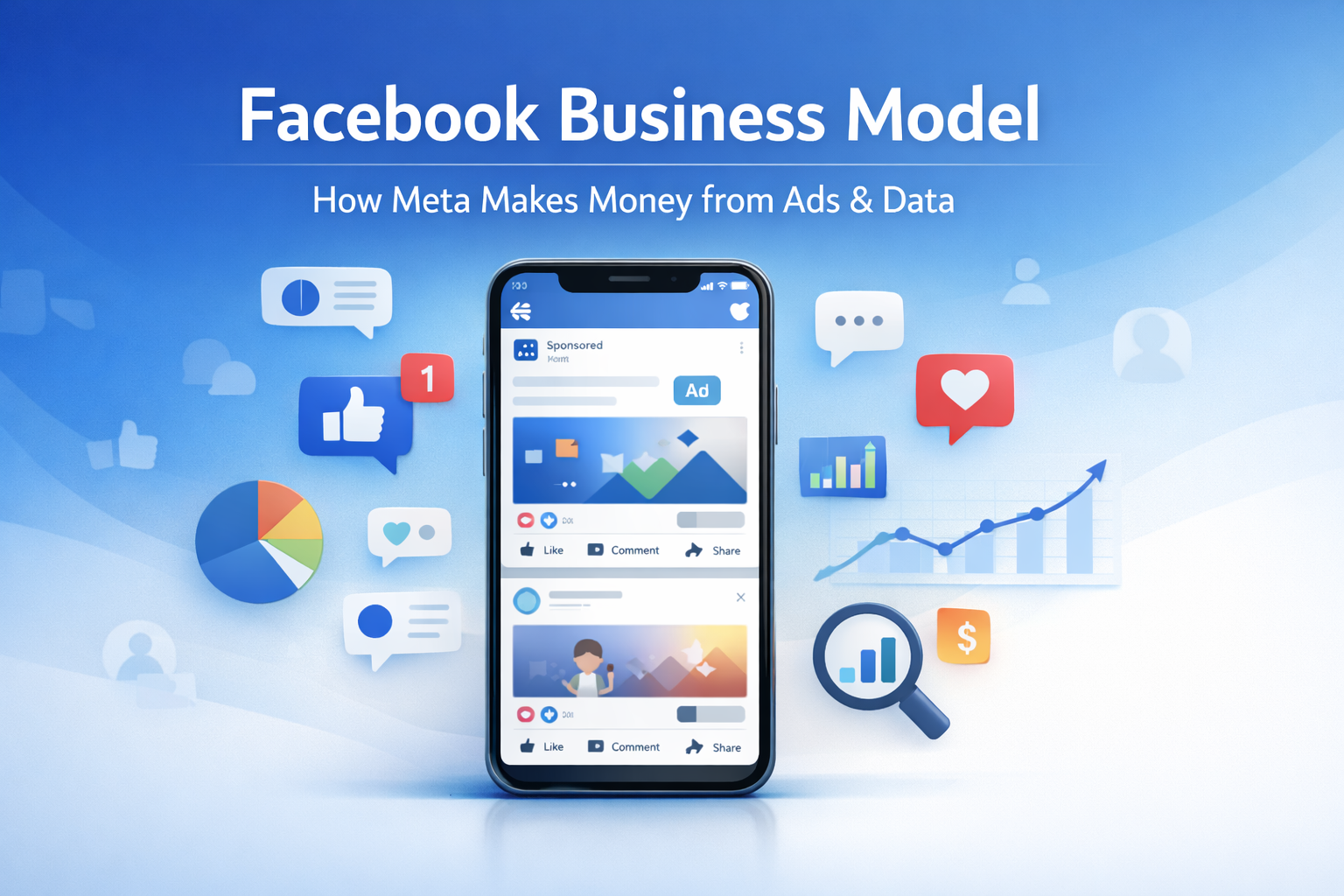
The Facebook Business Model And How Meta Turns Free Likes Into Billions

The Facebook business model is built on advertising. It gives users free access and makes money by selling targeted ads to businesses using massive amounts of user data and engagement.
That’s the short answer. But the full story is way more interesting.
Why I Think This Model Is Pure Genius
Let me be honest with you. When I first really looked at how Facebook makes money, I was kind of blown away.
Think about it. You’ve never paid a single dollar to use Facebook. Neither has your mom, your neighbor, or your cousin across the country. Billions of people use it every day for free.
So where does the money come from?
That’s exactly what I want to break down for you today. By the end of this blog, you’ll understand how Facebook turns your scroll time into serious cash, and honestly, it’ll change how you look at every “free” app you use.
Quick Answer
Facebook makes money primarily through advertising.
It offers a free platform to users, collects data on their behavior and interests, and sells that data access to advertisers who want to reach specific audiences.
In 2023, Meta reported over $116 billion in revenue. Almost all of it came from ads. That’s the business model in one sentence.
What Is Facebook (Meta)?
Facebook rebranded to Meta Platforms in 2021. The company owns several major apps and platforms that most of the world uses daily.
Here’s what Meta controls:
- Facebook (the original social network)
- Instagram (photo and video sharing)
- WhatsApp (messaging, used heavily outside the US)
- Messenger (Facebook’s direct messaging app)
- Threads (Twitter/X competitor, launched in 2023)
Together, these platforms have over 3.2 billion daily active users. That’s almost half the planet using a Meta product every single day.
That scale is what makes the business model so powerful. More users mean more data. More data means better ad targeting. Better ad targeting means more money.
It’s a loop. And it keeps spinning.
The Core Business Model Explained Simply
Let me draw this out in plain language.
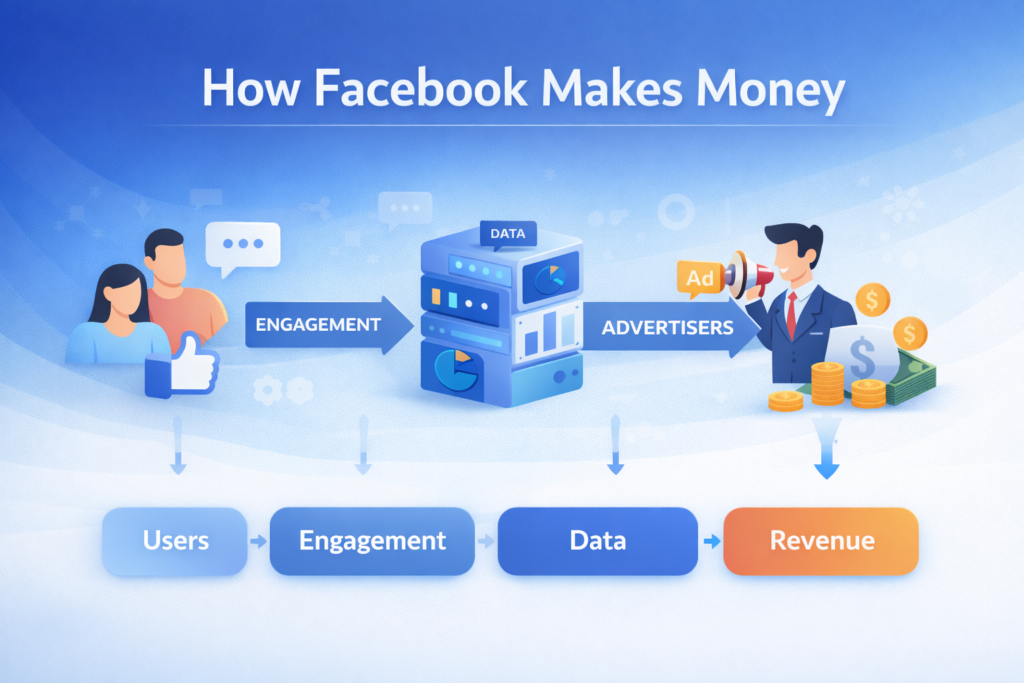
Users join for free → They engage with content → Facebook collects data → Advertisers pay to reach those users → Facebook earns revenue
That’s literally it. That’s the whole model.
But each step in that chain is carefully designed. Facebook isn’t just lucky. Every product decision, every algorithm tweak, every new feature, it all feeds back into this loop.
Here’s how each step works:
Step one: Free access attracts everyone. There’s no cost to sign up. This gets billions of people on the platform.
Step two: Engagement creates data. When you like a post, watch a video, join a group, or click a link, Facebook records it all.
Step three: Data gets packaged and sold (in a way). Facebook doesn’t sell your personal info directly. Instead, it lets advertisers target users based on interests, behaviors, location, age, and more.
Step four: Advertisers pay. Businesses pay Facebook to show their ads to the right people. Every click, view, and impression has a price.
Step five: Facebook profits. The margin is massive because the “product” (ad space) costs almost nothing to produce once the platform exists.
Simple. Brilliant. Slightly unsettling when you really think about it.
How Facebook Actually Makes Money
Advertising Revenue
This is the big one. Advertising makes up over 97% of Meta’s total revenue.
Facebook runs ads across all its platforms. These aren’t random ads either. They’re hyper-targeted based on everything Facebook knows about you.
Here are the main ad types businesses use:
- Feed ads (those sponsored posts you scroll past)
- Stories ads (full-screen ads in Instagram and Facebook Stories)
- Video ads (shown before or during videos in Watch and Reels)
- Reels ads (short-form video ads, growing fast)
- Sidebar ads (on desktop, less common now)
What makes these ads so valuable is the targeting. A small bakery in Austin can run an ad targeting women aged 25 to 45, within 10 miles, who have shown interest in baking and local food. No other ad platform does that as well as Facebook.
That precision is why advertisers keep coming back.
Business Tools and Promotions
Facebook also makes money from tools it gives businesses to promote themselves.
Boosted posts are a great example. A local restaurant posts about their weekend special. They can pay $20 to “boost” that post and reach 5,000 people nearby. That’s a Facebook revenue stream.
Ads Manager is the self-serve platform businesses use to create and manage campaigns. It’s free to use, but every dollar spent on campaigns goes straight to Facebook.
Facebook Shops and lead generation tools also help businesses convert users, which makes advertisers spend more.
Meta Ecosystem Monetization
Here’s something people miss. It’s not just Facebook the app making money. It’s the whole Meta ecosystem.
Instagram is a massive ad platform. Influencer culture, shopping features, branded content, it all generates ad revenue for Meta.
WhatsApp Business API lets companies pay to message their customers at scale. It’s huge in markets like India and Brazil.
Messenger ads let businesses show ads inside conversations. Not everyone loves this, but it works.
The beauty is that Meta owns all these platforms. An advertiser can run one campaign and reach users across Facebook, Instagram, and Messenger at the same time.
That kind of reach is impossible to replicate anywhere else.
The Value Proposition (Why People Keep Coming Back)
For Regular Users
Why does anyone use Facebook? It’s free, obviously. But that’s not the whole answer.
Facebook gives users something deeply human: connection and entertainment.
- You can message family across the world for free
- You can discover content that matches your exact interests
- You can join communities of people who share your hobbies
- You can watch videos, follow news, and stay updated
Facebook’s algorithm is incredibly good at showing you things you want to see. That keeps you on the app longer. And more time on the app means more ads served. It’s all connected.
For Businesses
From a business perspective, Facebook is one of the best advertising investments you can make, especially for small businesses.
Here’s why:
- You can start with a budget as low as $1 a day
- You can target incredibly specific audiences
- You can track exactly how your ads are performing
- You can retarget people who visited your website
I’ve talked to small business owners who built their entire customer base through Facebook ads alone. That’s the real value: access to billions of people with surgical precision.
Key Components That Make This Model Work
The User Base
Everything starts with users. Facebook has over 3 billion monthly active users on the Facebook app alone. Add Instagram, WhatsApp, and Messenger, and that number grows dramatically.
You can’t build an ad empire without an audience. Facebook built the biggest audience on the internet.
The Data Engine
This is the real secret weapon.
Facebook tracks a staggering amount of data. What you like. What you comment on. What you scroll past. What you search for. What websites you visit (through Meta Pixel tracking). What apps you use.
All of this creates a detailed behavioral profile. Advertisers use this profile to show the right ad to the right person at the right time.
It’s why you see an ad for running shoes right after you Googled marathon training. That’s not a coincidence. That’s Facebook’s data engine at work.
The Ad Platform
Facebook’s self-serve ad platform, Meta Ads Manager, is one of the most powerful tools in digital marketing.
Anyone can create an account and start running ads in minutes. No sales team. No minimum budget. No approval process (mostly).
This opens the door to millions of small businesses, solopreneurs, and marketers. And each one of them is paying Facebook for ad space.
The scale of advertisers is just as important as the scale of users.
The Algorithm
Facebook’s algorithm decides what you see in your feed. It’s designed to show you content that keeps you engaged and on the platform longer.
More time on platform = more ads seen = more revenue for Facebook.
The algorithm is constantly being updated and refined. It rewards content that sparks reactions, shares, and comments. This keeps users creating more content, which attracts more users, which keeps the loop going.
Facebook’s Growth Strategy
Facebook didn’t just get lucky. It made very smart moves to keep growing.
Acquisitions
This is probably the most powerful part of Facebook’s strategy.
When Instagram started getting popular in 2012, Facebook bought it for $1 billion. At the time, people thought it was crazy expensive. Today, Instagram alone is estimated to be worth hundreds of billions.
When WhatsApp was growing globally in 2014, Facebook bought it for $19 billion. Again, people laughed. But WhatsApp now has over 2 billion users worldwide.
These acquisitions weren’t just about eliminating competition. They were about owning more of people’s daily digital lives.
Expanding Ad Inventory
Facebook keeps adding new places to show ads. Stories were added. Then Reels. Then in-stream video ads. Each new format creates new ad inventory and new revenue opportunities.
Reels ads in particular are growing fast. As short-form video dominates attention, Facebook is monetizing it aggressively.
AI-Driven Recommendations
Meta has invested heavily in artificial intelligence. Its recommendation systems are among the best in the world.
AI helps Facebook show you more content you’ll engage with, which keeps you on the app longer, which gives Facebook more chances to serve you ads.
AI also helps advertisers. Meta’s AI can optimize campaigns automatically, spending your budget where it’s most likely to get results. This makes ads more effective, which makes advertisers spend more.
Creator Economy Focus
Facebook has been pushing hard to support creators. Tools like Reels bonuses, fan subscriptions, and Stars (virtual tips) help creators earn money on the platform.
Why does this matter for the business model? Because creators create content that keeps users engaged. And engaged users see more ads.
It’s not charity. It’s a smart business decision.
Business Model Canvas
Here’s the full picture in one place:
Customer Segments: Regular users and businesses/advertisers
Value Proposition: Free platform for users, precision targeting for advertisers
Channels: Facebook app, Instagram, WhatsApp, Messenger, web
Key Resources: User data, AI systems, developer infrastructure, brand trust
Key Activities: Platform development, algorithm updates, ad sales, data analysis
Revenue Streams: Advertising (97%+), business messaging, minor hardware sales
Cost Structure: Data centers, engineers, content moderation, R&D
The model is elegant because the two customer segments (users and advertisers) feed each other. Users create value for advertisers. Advertiser revenue funds the free platform for users.
Challenges and Risks
No business model is perfect. Facebook’s has some serious vulnerabilities.
Privacy Concerns
This is the biggest one. Facebook has faced massive backlash and legal action over how it collects and uses data. The Cambridge Analytica scandal in 2018 was a turning point. It showed the world just how much data Facebook had and how it could be misused.
New privacy laws like GDPR in Europe and iOS privacy changes by Apple have made it harder for Facebook to track users across the web. This directly impacts ad targeting quality.
Ad Dependency
Almost all of Meta’s money comes from ads. That’s a fragile position. If advertisers cut budgets during a recession, or if a competitor steals their attention, Meta feels it immediately.
In 2022, Meta’s revenue actually dropped year over year. It was a wake-up call.
Competition
TikTok changed everything. Short-form video exploded in popularity, and for a while, younger users were choosing TikTok over Instagram and Facebook.
YouTube is a strong competitor for video ad dollars. Snapchat and Pinterest compete for visual ad budgets.
Facebook is no longer the only game in town.
Regulation Issues
Governments around the world are looking hard at Meta. Antitrust investigations, data privacy lawsuits, and content moderation debates are constant challenges.
There’s genuine risk that regulations could force Meta to change how it operates or even break up its portfolio of apps.
Real-World Example
Let me make this super concrete with a simple example.
Imagine you run a small yoga studio in Chicago. You want to attract new students.
Here’s what you do:
You open Meta Ads Manager and create a campaign. You set your budget at $10 a day. You target women aged 22 to 45, living within 5 miles of your studio, who have shown interest in yoga, fitness, and wellness.
You create a simple video ad showing your studio and offer a free first class.
Facebook shows that ad to exactly those people. Over two weeks, you spend $140. You get 12 new students who claimed the free class. Half of them sign up for a monthly membership at $80 a month.
You spent $140. You potentially gained $480 a month in recurring revenue.
Facebook made its money from your ad spend. You made your money from new clients. Win-win.
That’s why small businesses love Facebook ads. And that’s why Facebook is worth over a trillion dollars.
The Future of the Facebook Business Model
Meta isn’t standing still. Here’s where things are heading.
The Metaverse Vision
Mark Zuckerberg rebranded the whole company to Meta because of this bet. He believes the next big computing platform is virtual and augmented reality.
Meta has spent tens of billions on its Reality Labs division, building VR headsets like the Quest 3 and developing virtual worlds.
The idea is that people will eventually spend time in virtual spaces, and Meta will monetize that attention, just like it does on Facebook today.
It’s a long-term play. Reality Labs loses money every year. But if the metaverse becomes mainstream, Meta wants to own the platform.
AI Ads Optimization
Meta is betting big on AI to make ads even more effective. Tools like Advantage+ campaigns use machine learning to automatically find the best audiences and creative combinations for advertisers.
If AI makes ads more effective, advertisers get better results, spend more, and Meta earns more. It’s a positive cycle.
Creator Monetization Tools
Meta is doubling down on helping creators make money. More monetization tools mean more creators choose Meta platforms over competitors. More creators mean more content. More content means more user engagement. More engagement means more ad revenue.
It’s all connected.
Messaging Commerce
WhatsApp and Messenger are becoming shopping and customer service platforms. Businesses can take orders, answer questions, and process payments through WhatsApp.
This “conversational commerce” model could become a significant revenue stream, especially in markets like India, Brazil, and Southeast Asia.
Wrapping Up
Let me wrap this up simply.
Facebook’s business model is: Attention leads to Data, Data powers Ads, Ads generate Money.
Everything Facebook has built, every feature, every acquisition, every algorithm update, serves this core loop. Give people a free, engaging platform. Collect data on how they behave. Sell that audience access to advertisers.
It’s one of the most profitable business models ever created.
Here’s what I genuinely find fascinating: Facebook taught the world that free is a business model. Before Facebook, people assumed you had to charge for software. Zuckerberg proved you don’t, as long as you’re monetizing attention instead of transactions.
If you’re building a startup, understanding Facebook’s model teaches you something fundamental: you don’t need to charge users. You need to build something they can’t stop using.
That’s where the real value hides.
FAQs
Facebook makes money by selling advertising space. Users don’t pay, but businesses pay to show ads to users. Facebook uses data it collects about user behavior to make those ads highly targeted and effective.
Over 97% of Meta’s total revenue comes from advertising. The remaining small percentage comes from things like Reality Labs hardware sales and business messaging.
No, Facebook doesn’t directly sell personal data to third parties. Instead, it keeps the data and lets advertisers target users based on interests and behaviors through its own ad platform. You’re not the product being sold. Your attention is.
Because it works. Facebook offers precise targeting, a massive audience, measurable results, and flexible budgets. Small businesses can start with just a few dollars a day and still reach thousands of potential customers.
Instagram is estimated to contribute the largest single share of Meta’s ad revenue, surpassing the Facebook app itself. Reels ads on Instagram are growing especially fast.
AI powers Facebook’s content recommendation algorithm, ad targeting, campaign optimization tools, and content moderation. It helps keep users engaged longer and helps advertisers get better results, both of which benefit Meta’s revenue.
Discover more from Business Model Hub
Subscribe to get the latest posts sent to your email.

[…] Examples: OLX, eBay, Quikr, Facebook Marketplace […]