Wattpad Business Model and How This Free Reading App Became a Global Storytelling Empire

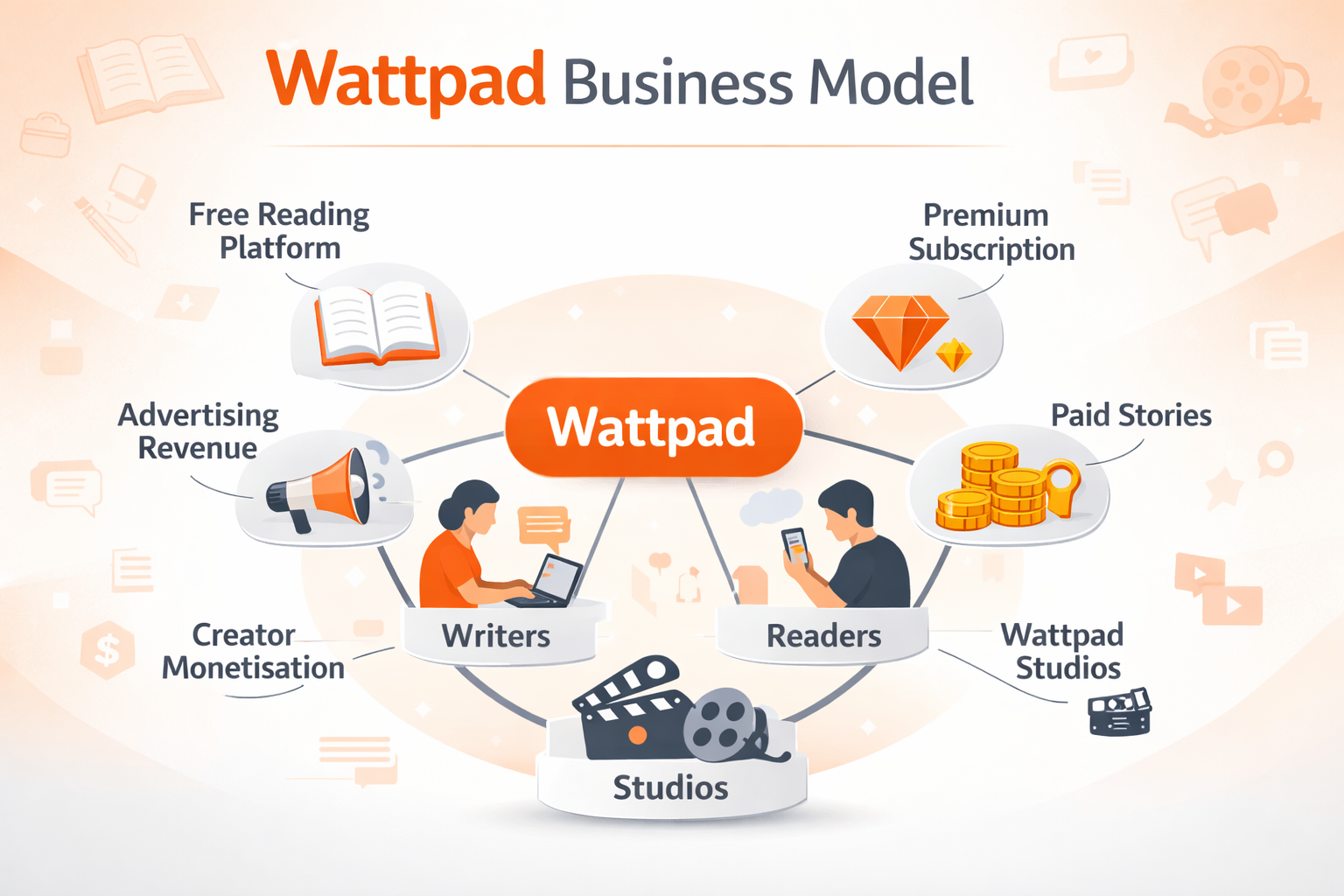
Wattpad’s business model is built on a freemium content platform where anyone can read and publish stories for free. The platform earns revenue through premium subscriptions, advertising, paid stories, and content monetisation partnerships that turn viral fiction into films, series, and books.
It sounds simple. But the execution behind it is anything but.
What is Wattpad?
Wattpad is a user-generated storytelling platform that lets anyone publish and read stories for free. Founded by Allen Lau and Ivan Yuen in Toronto in 2006, it started as a mobile reading app built for a world that hadn’t fully embraced smartphones yet.
The core idea was radical for its time:
- Anyone can be a writer
- Anyone can be a reader
- No gatekeepers, no publishing contracts, no waiting
In 2021, South Korean internet giant Naver acquired Wattpad for approximately $600 million, combining it with Webtoon to form one of the largest digital storytelling empires in the world.
But here’s the insight most people miss: Wattpad isn’t just a reading app. It’s a content discovery engine, a community platform, and an IP factory all rolled into one.
The Core Problem Wattpad Solves
To understand why Wattpad works, you need to understand what was broken before it existed.
Traditional publishing had serious problems:
- The process from manuscript to bookstore shelf takes years
- Literary agents and publishers act as gatekeepers
- New voices, especially from underrepresented communities, rarely break through
- Readers had limited access to diverse, niche, or experimental fiction
Readers had their own frustrations:
- Books are expensive
- Library access is uneven globally
- Mobile-friendly reading content barely existed
- Serialised storytelling, which readers actually love, had almost no digital home
Wattpad solved all of this at once:
- Writers publish immediately, chapter by chapter
- Readers access content for free on their phones
- The algorithm surfaces stories based on engagement, not publisher budgets
- Communities form around stories in real time through comments and votes
The result is a platform where a teenager in the Philippines can publish a romance novel on a Tuesday and have ten thousand readers by Friday.
How Wattpad Works
The platform operates through three interconnected layers that feed each other constantly.
Readers:
- Browse stories by genre, trending charts, or recommendations
- Read chapter by chapter, often following stories as they’re being written
- Vote on chapters they enjoy (Wattpad’s version of a like)
- Leave inline comments on specific sentences or paragraphs
- Follow favourite writers and get notified of new updates
Writers:
- Create a free account and start publishing immediately
- Build an audience organically through tags, community engagement, and algorithmic promotion
- Interact directly with readers through comments and author notes
- Receive real-time feedback that shapes how their stories develop
The Platform:
- Tracks reading behaviour across hundreds of millions of data points
- Identifies which stories are gaining momentum
- Promotes trending content through discovery features
- Uses engagement signals (reads, votes, comments, completion rates) to surface high-potential stories
The best way to think about Wattpad’s platform design is this: it’s YouTube meets Medium meets Netflix, but for fiction.
Like YouTube, anyone can publish. Like Medium, the format is text-driven and community-engaged. Like Netflix, the platform itself identifies the content worth investing in and turning into something bigger.
The Wattpad Business Model, Broken Down
Wattpad’s monetisation strategy has evolved significantly since its early days. What began as a simple ad-supported free platform is now a multi-layered revenue engine.
The Freemium Foundation
The entire model rests on one foundational decision: make reading free.
This is not accidental. Free access drives massive scale. Scale drives data. Data drives better content discovery. Better discovery drives more users. More users attract more advertisers and more writers. The flywheel never stops.
Most content on Wattpad remains completely free to read. Premium features are layered on top for users who want a better experience. This is the classic freemium approach, and Wattpad executes it well.
Wattpad Premium (Subscription Revenue)
Wattpad offers a paid subscription tier that gives subscribers an upgraded experience without changing what free users can access.
What Premium subscribers get:
- Ad-free reading experience across the entire platform
- Offline reading, so you can download stories and read without internet access
- Early access to select stories before they go public
- Exclusive badges and profile features that signal status in the community
The subscription model works because the free experience is genuinely good. Users who love the platform and read consistently are willing to pay to remove friction, specifically ads, and gain small but meaningful perks.
This is smart freemium design. The premium tier enhances the experience without making the free tier feel broken.
Advertising Revenue
Free users see ads. That’s the trade. You get access to millions of stories at no cost, and in return, Wattpad monetises your attention.
Ad formats Wattpad uses:
- Display ads between chapters or story sections
- Video ads that play before or during reading sessions
- Native ads embedded more naturally within the content experience
The advertising model scales with user growth. With over 90 million users globally, even modest CPM rates (cost per thousand impressions) generate substantial revenue.
The insight here is straightforward: free users are not the product in a negative sense, they are the audience that makes the platform valuable to advertisers. The more engaged the readers, the more time they spend on the platform, and the more ad impressions Wattpad can sell.
Wattpad’s engagement metrics are exceptionally strong. Readers don’t skim; they binge. Serialised storytelling creates the same compulsive reading behaviour that serialised television creates in viewers. That kind of sustained attention is exactly what advertisers want.
Paid Stories (Microtransactions)
This is where individual readers can directly support writers and access exclusive content.
How Paid Stories works:
- Writers can designate certain chapters as paid content
- Readers purchase coins (Wattpad’s virtual currency) and spend them to unlock chapters
- Writers receive a share of the revenue generated from their paid chapters
This model mirrors what platforms like Radish Fiction and Tapas have built their entire businesses around. Wattpad adopted it as an additional revenue layer on top of its existing ad and subscription model.
For readers, it’s a low-commitment way to pay for stories they love. Instead of buying an entire book, you unlock chapters as you go. The microtransaction format reduces the psychological barrier to spending.
For writers, it’s a direct monetisation path tied to reader demand. Popular stories generate real income. That income attracts serious writers who treat the platform professionally rather than casually.
The Creator Monetisation Program
Wattpad has built a more structured system for rewarding its most successful writers, because keeping top creators on the platform is critical to maintaining content quality and reader loyalty.
How writers earn on Wattpad:
- Paid Stories revenue share: Writers keep a portion of what readers spend unlocking their chapters
- Brand partnerships: Wattpad connects writers with brands for sponsored story integrations
- Wattpad Stars program: Top writers receive additional support, promotional placement, and opportunities to collaborate with Wattpad Studios
This is important for the business model because Wattpad’s content costs are dramatically lower than a traditional publisher or streaming platform. The writers create all the content. Wattpad’s job is to surface the best of it, help it find an audience, and then monetise that audience.
By investing in creator monetisation, Wattpad keeps its best content creators from leaving for competing platforms. It’s a retention strategy as much as a revenue strategy.
Wattpad Studios (IP Monetisation)
This is the most strategically interesting part of Wattpad’s business model, and the one that sets it apart from every other reading platform.
Wattpad Studios is an entertainment production arm that adapts popular Wattpad stories into films, television series, web content, and traditionally published books.
Here’s why this matters: Wattpad has already done the hard work of identifying which stories audiences love. By the time a story reaches Wattpad Studios’ attention, it has been validated by millions of real readers. The engagement data removes the guesswork that traditional studios and publishers live with.
Examples of Wattpad-to-screen adaptations:
- “The Kissing Booth” started as a Wattpad story and became a Netflix film franchise
- “After” began on Wattpad and was adapted into a major film series
- Numerous Filipino, Korean, and Indonesian Wattpad stories have been adapted into local films and TV dramas, particularly in markets where Wattpad has deep cultural penetration
The Studios model works like this:
- Wattpad identifies stories with massive engagement and proven audience demand
- It approaches writers to develop their intellectual property for film, television, or publishing
- Wattpad earns through licensing deals, co-production agreements, and revenue sharing
- Writers gain exposure, income, and career opportunities far beyond the platform
For Wattpad, every piece of content on the platform is potential IP. The platform itself functions as the world’s largest story development database, with real audience feedback built in.
Brand Partnerships and Sponsored Content
Beyond standard advertising, Wattpad has developed a native advertising model that fits the storytelling format.
What this looks like in practice:
- Brands commission original stories written on Wattpad that feature their products or values
- Established Wattpad writers create sponsored content that reads like organic stories
- Wattpad packages audience data and storytelling expertise to help brands connect with younger readers
This is particularly effective because Wattpad’s core audience skews young, with a significant Gen Z and millennial base. Brands that struggle to connect with younger demographics through traditional advertising find Wattpad’s native story format far more effective.
Sponsored stories get read. Standard banner ads get ignored. Wattpad knows this and has built a product around it.
Revenue Streams at a Glance
Here’s how all of Wattpad’s revenue sources work together:
Subscription revenue comes from Wattpad Premium subscribers who pay monthly or annually for an ad-free, enhanced reading experience.
Advertising revenue comes from display, video, and native ads shown to free users. This scales directly with the size of the free user base and time spent on the platform.
Paid Stories revenue comes from microtransactions where readers purchase coins to unlock premium chapters, with writers receiving a share.
Content licensing revenue comes from Wattpad Studios deals where popular stories are adapted into films, series, or books. Licensing fees, co-production deals, and royalty arrangements all contribute here.
Brand collaboration revenue comes from sponsored storytelling programs where brands pay Wattpad to create native content campaigns within the platform.
Each stream reinforces the others. More free users means more ad revenue and more data. More data means better Studios investments. Better Studios output means more cultural attention on Wattpad. More cultural attention brings more writers and readers. The cycle continues.
How Wattpad Makes Money: The Simple Flow
If you strip everything back to basics, the monetisation logic looks like this:
- Free users generate advertising revenue through their attention
- Engaged readers spend on Paid Stories when they find content they love
- Power users convert to Premium subscriptions for an upgraded experience
- Top content gets identified by Wattpad Studios and monetised as IP
Every user, regardless of how they use the platform, contributes to the revenue model in some way. That’s elegant business design.
Wattpad’s Growth Strategy
Wattpad’s growth hasn’t happened by accident. Several deliberate strategic choices have driven its expansion to over 90 million users across more than 50 languages.
The User-Generated Content Flywheel
This is the engine at the heart of everything:
- More writers join and publish more content
- More content attracts more readers
- More readers give writers bigger audiences and more feedback
- Bigger audiences attract more writers who want that exposure
UGC platforms live or die by this flywheel. Wattpad has one of the strongest versions of it in the content industry. The platform doesn’t need to commission content. It needs to facilitate and reward content creation, and then get out of the way.
Community Engagement as a Retention Tool
Wattpad’s community features are not just nice to have. They are central to why users stay.
What makes the community sticky:
- Inline commenting lets readers react to specific sentences in real time
- Writers respond directly to reader comments, creating genuine relationships
- Dedicated fan communities form around popular stories and writers
- Reader investment in serialised stories keeps them coming back for each new chapter
The emotional connection readers develop with both stories and writers is far stronger than what you’d find on a standard ebook platform. That connection is retention. Retained users are monetisable users.
Mobile-First by Design
Wattpad was built for mobile before mobile-first was a strategy everyone talked about. The founders recognised early that the future of content consumption was on phones, and they designed the reading experience accordingly.
This matters for the business model because:
- Mobile users have lower attention spans, and serialised chapter-by-chapter storytelling fits that perfectly
- Mobile is where Gen Z lives, and Gen Z is Wattpad’s core demographic
- Mobile ad formats (especially video) are among the most valuable in digital advertising
Data-Driven Content Discovery
Wattpad collects enormous amounts of reading behaviour data:
- Which chapters readers finish versus abandon
- Where readers drop off within a story
- What genres, writing styles, and story structures generate the most votes and comments
- How reading patterns vary by region and language
This data does two things. First, it powers the recommendation algorithm that surfaces the right stories to the right readers, which keeps engagement high. Second, it gives Wattpad Studios an almost unfair advantage in identifying which stories will succeed as adaptations. Instead of gut instinct, they have data from millions of readers.
Global Expansion Through Local Content
Wattpad’s reach extends far beyond North America and English-language content. The platform has a particularly strong presence in:
- Southeast Asia, especially the Philippines, where Wattpad stories regularly become mainstream cultural phenomena and film adaptations
- South Korea, which gained new momentum through the Naver acquisition
- Latin America, with large Spanish-language reader and writer communities
- Indonesia and other parts of Asia where mobile-first content consumption is the norm
Supporting local language content isn’t just culturally respectful. It’s commercially smart. It opens entirely new markets where traditional publishing infrastructure is weak and readers are hungry for accessible fiction.
Why Wattpad Works: Key Insights
Several factors combine to make Wattpad’s business model genuinely durable:
Low content creation costs: Writers create all the content for free. Wattpad’s content cost structure is dramatically lower than any traditional media company.
High engagement: Serialised storytelling is psychologically compelling. Readers invest in characters and return repeatedly for new chapters. This is not casual browsing; it’s habitual engagement.
Strong creator ecosystem: Writers who build audiences on Wattpad are incentivised to stay. Their followers are on the platform. Moving means starting over.
The data advantage: Every read, vote, comment, and abandonment gives Wattpad information that makes the platform smarter over time. This compounds into a significant competitive advantage.
Multiple monetisation paths: Rather than depending on a single revenue stream, Wattpad has built several that reinforce each other. If ad revenue softens, subscriptions and Paid Stories provide cushion. If the consumer side slows, Studios deals provide a different income path.
Challenges in Wattpad’s Business Model
No business model is without weaknesses, and Wattpad faces real ones.
Content quality control is an ongoing tension. Open platforms generate enormous volumes of content, and most of it is not good. Finding the signal in the noise requires constant algorithmic refinement and community moderation. Content policy violations, including plagiarism and inappropriate material, are persistent challenges at scale.
Balancing monetisation and the free experience is delicate. The moment free users feel like the platform is nickel-and-diming them, or that the best content is locked behind paywalls, trust erodes. Wattpad has to maintain a genuinely valuable free tier while still finding ways to generate revenue from that free audience.
Competition has intensified significantly:
- Amazon Kindle Unlimited offers a massive library with a subscription model and strong brand trust
- Webtoon (ironically now part of the same Naver family) dominates serialised visual storytelling and competes for the same young audience
- Radish Fiction and Tapas have built aggressive paid chapter models specifically designed to compete with Wattpad
- Royal Road and other niche platforms have carved out loyal communities in specific genres like fantasy and progression fiction
Wattpad vs Traditional Publishing
The contrast between Wattpad and traditional publishing reveals why the platform resonated so strongly:
| Factor | Wattpad | Traditional Publishing |
|---|---|---|
| Entry Barrier | Low, anyone can publish | High, requires agents and publishers |
| Speed to Publication | Immediate | Months to years |
| Monetisation | Flexible, multiple paths | Fixed advances and royalties |
| Content Discovery | Algorithm and community driven | Publisher marketing budgets |
| Reader Feedback | Real-time, direct | Delayed, indirect |
| Global Reach | Built in through digital distribution | Dependent on translation deals |
Traditional publishing selects for certain kinds of books written in certain kinds of ways by certain kinds of writers. Wattpad selects for engagement. The market decides what rises, not a committee of editors.
The Future of Wattpad
Several trends will shape where Wattpad goes from here.
More OTT-style content production: As Wattpad Studios matures and the Naver connection deepens, expect more direct investment in original content production rather than pure licensing deals.
AI-driven storytelling and recommendations: Machine learning will become more central to how Wattpad personalises reading experiences and identifies breakout stories. AI writing tools may also reshape what the platform looks like for creators.
Expansion into regional content markets: Southeast Asia, South Asia, and Latin America represent enormous growth opportunities. Localised content strategies and language-specific community building will be key.
Stronger creator monetisation: As competition for top writers intensifies, Wattpad will need to offer more compelling financial incentives to retain its best creators. Expect more structured revenue sharing, better Paid Stories economics, and expanded brand partnership programs.
Wrapping Up
Wattpad’s real innovation was never technology. Plenty of platforms could have built a mobile reading app. The innovation was recognising that user-generated content, when given the right community infrastructure and discovery tools, could generate intellectual property as valuable as anything produced by traditional media companies.
The business model follows a clear and repeatable logic:
Build a platform that removes barriers for writers and readers alike.
Grow a community through engagement features that make reading and writing social rather than solitary.
Monetise attention through advertising, subscriptions, and microtransactions that serve different user types.
Scale IP globally by turning the platform’s best content into films, series, and books through Wattpad Studios.
Every layer reinforces the next. Community growth fuels data. Data fuels better discovery. Better discovery fuels more engagement. More engagement creates more monetisable content and more attractive ad inventory. Top content becomes Studios material. Studios adaptations create cultural moments that bring new users to the platform.
FAQs
Yes, Wattpad is free to use for both readers and writers. However, it also offers premium features like ad-free reading and offline access through a paid subscription.
Wattpad earns money through multiple streams including subscriptions, ads, paid stories, and content licensing via its studio division.
Yes, writers can earn through paid stories, brand partnerships, and Wattpad’s creator monetisation programs.
Wattpad Premium is a subscription plan that offers benefits like no ads, offline reading, and access to exclusive content.
Paid Stories allow readers to unlock chapters using coins, enabling writers to earn revenue from their content.
Wattpad Studios is the division that turns popular stories into movies, web series, and books, creating additional revenue streams.
Wattpad is owned by Naver, a global technology company that also owns platforms like Webtoon.
Wattpad focuses on long-term monetisation through its creator ecosystem and content licensing, though profitability depends on scaling its premium and studio segments.
Discover more from Business Model Hub
Subscribe to get the latest posts sent to your email.