Short answer: HealthifyMe makes money by combining AI-powered calorie tracking with paid health subscriptions, personal coaching, corporate wellness programs, and premium digital health tools.
Why this works: It turns daily fitness tracking into a long-term subscription habit.
What Is HealthifyMe?
HealthifyMe is one of India’s leading mobile-first health and fitness platforms, founded in 2012 by Tushar Vashisht and Mathew Cherian. What started as a simple calorie-counting app has evolved into a comprehensive digital health ecosystem serving millions of users across India and beyond.
Unlike traditional fitness apps that rely solely on automation, HealthifyMe takes a hybrid approach blending AI-driven insights with human expertise from nutritionists and fitness coaches. This combination makes personalized health coaching accessible and affordable, particularly in markets where one-on-one professional guidance has historically been expensive or unavailable.
The platform’s mobile-first design recognizes that smartphones are the primary internet gateway for most Indian consumers, making health tracking convenient and always accessible.
The Core Problem HealthifyMe Solves
Before diving into how HealthifyMe makes money, it’s important to understand the pain points it addresses:
Nutritional blindness: Most people underestimate their calorie intake by 20-50%. They simply don’t know what or how much they’re eating, making weight management feel impossible.
Generic fitness advice: Traditional fitness apps offer cookie-cutter workout plans that don’t account for individual dietary preferences, cultural food habits, or specific health conditions.
Lack of accountability: Starting a fitness journey is easy; staying consistent is hard. Without regular check-ins and encouragement, most people abandon their goals within weeks.
Affordability gap: Personal nutritionists and trainers can cost thousands of rupees per month, pricing out the majority of people who could benefit from professional guidance.
HealthifyMe bridges these gaps by making professional health coaching scalable, affordable, and culturally relevant especially for Indian users who need guidance on traditional regional cuisines.
HealthifyMe’s Product Ecosystem
HealthifyMe isn’t just one app it’s an interconnected ecosystem of health tools:
Calorie and nutrition tracking: Users can log meals by searching an extensive food database, scanning barcodes, or even uploading photos for AI-powered food recognition.
Ria, the AI nutritionist: This chatbot provides instant answers to nutrition questions, suggests meal alternatives, and offers motivation—available 24/7 without human intervention.
Fitness plans and workout routines: From yoga to strength training, users get customized workout plans based on their goals, fitness level, and available equipment.
Human coaches: Premium subscribers are matched with certified nutritionists and fitness trainers who provide personalized meal plans, track progress, and offer accountability through regular check-ins.
Corporate wellness dashboard: Employers can monitor aggregate health metrics across their workforce, run challenges, and promote healthy habits at scale.
This ecosystem creates multiple touchpoints for engagement, increasing the likelihood that users will form lasting habits around the platform.
HealthifyMe Business Model Explained
Freemium-First Strategy
HealthifyMe’s business model starts with a classic freemium approach. The free tier offers:
- Basic calorie and nutrition tracking
- Access to the food database
- Simple workout routines
- Limited interaction with Ria, the AI nutritionist
This free experience serves a crucial purpose: habit formation. By getting users to log their meals daily, HealthifyMe embeds itself into their routine. Once tracking becomes a habit, users are more likely to see value in upgrading to unlock deeper insights and personalized support.
Subscription-Driven Revenue
The core of HealthifyMe’s monetization lies in converting free users to paid subscribers. Premium plans unlock:
- Personal coaches: One-on-one support from certified nutritionists and fitness trainers
- Custom meal plans: Tailored to dietary preferences, allergies, and regional cuisines
- Advanced analytics: Detailed breakdowns of macros, micronutrients, and progress trends
- Unlimited coach access: Regular check-ins via chat or call
- Priority support: Faster response times and dedicated assistance
Subscriptions typically range from monthly plans (higher per-month cost but lower commitment) to yearly plans (discounted rates encouraging long-term retention). This recurring revenue model creates predictable cash flow and improves unit economics over time.
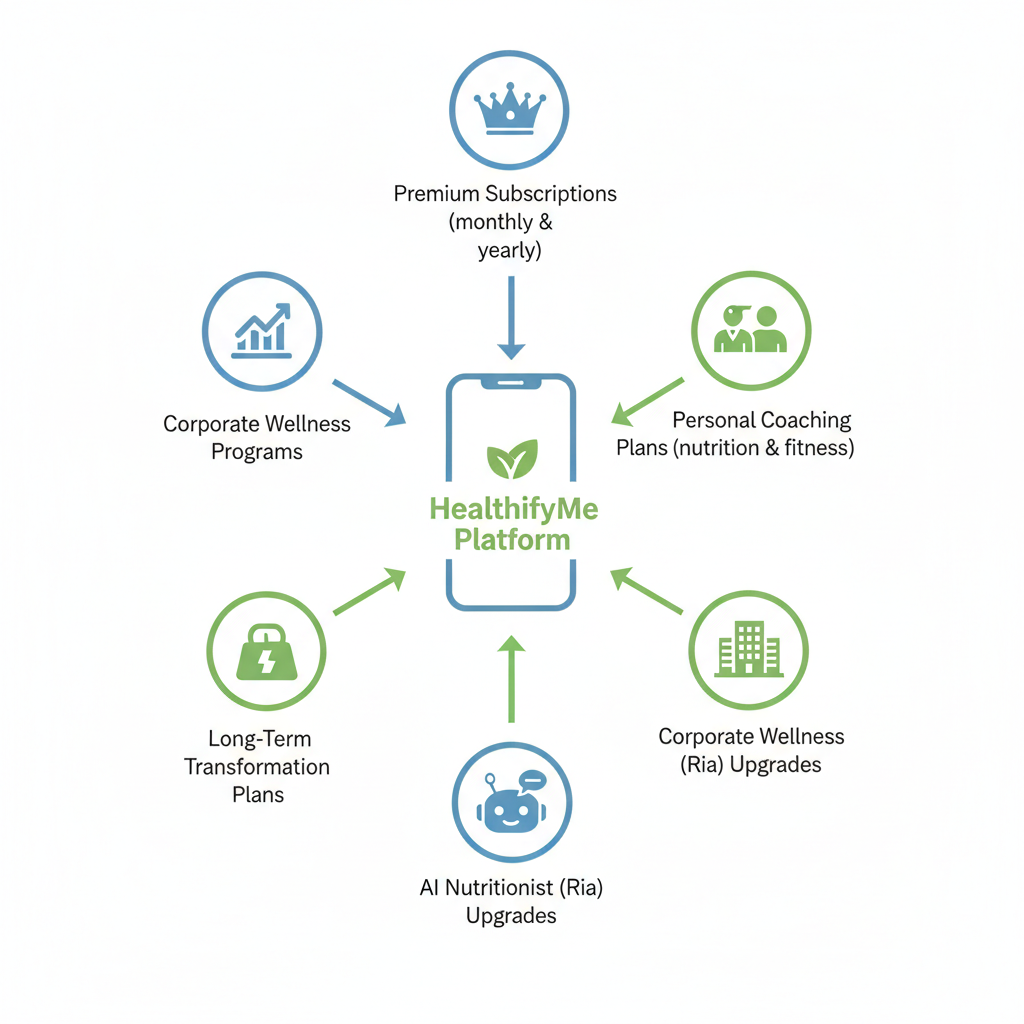
How HealthifyMe Makes Money (Revenue Streams)
HealthifyMe generates revenue through several channels:
1. Monthly and yearly premium subscriptions
The primary revenue driver. Users pay recurring fees to access coaches, personalized plans, and advanced features. The longer the subscription period, the better the discount—incentivizing annual commitments.
2. Personal nutrition and fitness coaching plans
Beyond standard subscriptions, HealthifyMe offers intensive transformation programs—often 3, 6, or 12-month packages with dedicated coach support, weekly reviews, and customized plans. These premium-tier offerings command higher prices.
3. Corporate wellness partnerships
Businesses purchase HealthifyMe subscriptions for their employees as part of wellness benefits. Companies pay per employee, and HealthifyMe provides a corporate dashboard to track engagement, run health challenges, and measure ROI on wellness initiatives.
4. Health programs for enterprises
Beyond basic subscriptions, some corporations engage HealthifyMe for specialized programs targeting diabetes management, weight loss challenges, or preventive health—often with customized reporting and on-site workshops.
5. Upsells on long-term transformation plans
Users who start with a monthly subscription are frequently upsold to longer, more comprehensive programs once they see initial results. This increases customer lifetime value (LTV) significantly.
Role of AI in HealthifyMe’s Business Model
Artificial intelligence isn’t just a feature—it’s fundamental to HealthifyMe’s scalability and profitability.
AI nutritionist for food recognition: Users can snap a photo of their meal, and the AI identifies the food items and estimates calories. This reduces friction in logging and improves accuracy.
Automated meal logging and insights: The AI learns user preferences over time, suggesting meals, predicting calorie intake, and flagging nutritional gaps without human intervention.
Personalized recommendations at scale: While human coaches handle complex cases, the AI delivers routine advice, reminders, and motivational nudges to thousands of users simultaneously.
Reduces cost of human coaching: By automating repetitive tasks and common questions, HealthifyMe needs fewer coaches per user, improving margins while maintaining service quality.
Improves retention and margins: AI-driven personalization keeps users engaged longer, reducing churn. Since AI scales at near-zero marginal cost, profitability improves as the user base grows.
This hybrid model—AI for scale, humans for trust and complex guidance—is HealthifyMe’s secret weapon in building a sustainable business.
Target Customer Segments
HealthifyMe focuses on several key customer groups:
Urban working professionals: Time-poor individuals looking for convenient health solutions that fit into busy schedules.
Weight-loss focused users: People with specific weight goals who need structured guidance and accountability.
Fitness beginners: Those new to health and fitness who need hand-holding and education rather than advanced training protocols.
Corporates and HR teams: Companies investing in employee wellness to reduce healthcare costs and improve productivity.
Health-conscious smartphone users: Digital natives comfortable with app-based solutions and willing to pay for quality health services.
The India-first focus means HealthifyMe deeply understands regional cuisines, cultural eating habits, and price sensitivity—giving it a competitive edge over global fitness apps.
Customer Acquisition Strategy
HealthifyMe employs a multi-channel approach to attract users:
App store optimization: Strategic use of keywords, reviews, and screenshots to rank highly in app store searches for fitness and nutrition.
Content marketing: A robust blog, YouTube channel, and social media presence offering free health tips, recipes, and success stories—building trust and brand awareness.
Influencer and fitness creator partnerships: Collaborations with health influencers and fitness personalities who promote HealthifyMe to their engaged audiences.
Word-of-mouth and referrals: Satisfied users share their transformation stories, and HealthifyMe incentivizes referrals with discounts or free trial extensions.
Corporate sales teams: Dedicated B2B teams reach out to HR departments, offering pilot programs and demonstrating ROI through employee health metrics.
The freemium model itself acts as a acquisition tool—users download for free, experience value, and convert to paid plans organically.
Retention & Engagement Strategy
Acquiring users is one thing; keeping them is where HealthifyMe truly excels:
Daily reminders and streaks: Push notifications encourage consistent meal logging, leveraging behavioral psychology around streak maintenance.
Progress tracking dashboards: Visual representations of weight loss, calorie trends, and fitness milestones provide tangible evidence of progress.
Coach accountability: Regular check-ins with human coaches create a sense of responsibility and personal connection that’s hard to abandon.
Personalized nudges: AI-driven messages based on user behavior—congratulating achievements, suggesting healthier alternatives, or re-engaging inactive users.
Community and success stories: User testimonials, before-and-after photos, and community challenges foster a sense of belonging and inspiration.
These retention tactics reduce churn significantly, which is critical since customer acquisition costs are high in the competitive fitness app market.
HealthifyMe Business Model Canvas (Overview)
Here’s a simplified breakdown of HealthifyMe’s business model:
Value Proposition: Affordable, personalized health coaching combining AI efficiency with human expertise, tailored to Indian dietary habits.
Key Customers: Urban professionals, weight-loss seekers, fitness beginners, and corporate wellness programs.
Key Activities: App development, AI training, coach recruitment and training, content creation, corporate sales, customer support.
Revenue Streams: Premium subscriptions, coaching packages, corporate wellness contracts, transformation programs.
Cost Structure: Technology development, AI infrastructure, coach salaries, marketing and user acquisition, customer support, platform maintenance.
Key Resources: Proprietary AI technology, extensive food database, network of certified coaches, brand reputation, user data.
Key Partnerships: Certified nutritionists and trainers, corporate clients, wearable device manufacturers, payment platforms, health data providers.
Channels: App stores, website, social media, corporate sales teams, influencer partnerships, content marketing.
Customer Relationships: Freemium self-service for basic users, dedicated personal assistance for premium subscribers, automated AI support for all.
This canvas illustrates how HealthifyMe creates, delivers, and captures value across multiple customer segments.
Key Partnerships
HealthifyMe’s ecosystem relies on strategic partnerships:
Fitness trainers and nutritionists: A network of certified professionals who deliver human coaching at scale, maintaining quality while keeping costs manageable.
Corporate clients: Companies that purchase bulk subscriptions for employees, providing stable B2B revenue alongside consumer subscriptions.
Health data providers: Integrations with wearables like Fitbit, Apple Health, and Google Fit enrich user profiles and improve personalization.
Device integrations (wearables): Seamless data sync from fitness trackers and smartwatches makes the platform stickier and more comprehensive.
Payment platforms: Partnerships with payment gateways ensure smooth subscription billing, reducing friction in conversion.
These partnerships extend HealthifyMe’s capabilities without requiring massive internal investment, allowing focus on core competencies.
Cost Structure
Understanding costs is essential to appreciating HealthifyMe’s business model:
Technology and AI development: Ongoing investment in app features, AI models, food recognition algorithms, and platform infrastructure.
Coach salaries and training: While AI reduces the coach-to-user ratio, human coaches remain a significant cost—though they’re the key differentiator.
Marketing and user acquisition: Digital ads, influencer partnerships, content creation, and app store optimization require substantial budget.
Customer support: Handling user queries, technical issues, and billing problems demands dedicated support teams.
Platform maintenance: Server costs, data storage, security, and regular updates to maintain app performance and compliance.
The beauty of HealthifyMe’s model is that many costs (especially AI and technology) have high upfront investment but low marginal costs as users scale, improving unit economics over time.
Competitive Advantage of HealthifyMe
What sets HealthifyMe apart in a crowded market?
Strong local food database: Unlike global apps, HealthifyMe has an extensive database of Indian regional cuisines—from dosas to biryani—with accurate calorie counts.
AI + human hybrid model: The combination of automation for scale and human coaches for trust creates a service that’s both affordable and effective.
High user retention through habits: Daily logging creates sticky behavior patterns that keep users engaged longer than typical fitness apps.
Early mover advantage in India: Being among the first serious players in India’s digital health space built brand recognition and user trust.
Scalable subscription economics: As the user base grows, technology costs spread across more subscribers while AI handles increasing volume without proportional cost increases.
These advantages create moats that make it difficult for new entrants to replicate HealthifyMe’s success quickly.
Challenges in HealthifyMe’s Business Model
No business model is without challenges:
High churn in fitness apps: The fitness industry notoriously struggles with user retention. Motivation wanes, goals are achieved (or abandoned), and users cancel subscriptions.
User fatigue after short-term goals: Once someone loses their target weight, they may no longer see value in continued subscription, especially if maintenance feels less urgent than transformation.
Cost of human coaches: While AI helps, human coaches remain expensive. Balancing coach quality with cost efficiency is an ongoing challenge.
Competition from global fitness apps: Giants like MyFitnessPal, Noom, and new AI-first competitors continuously innovate, forcing HealthifyMe to differentiate constantly.
Price sensitivity in emerging markets: Many potential users find even discounted subscriptions expensive, limiting market penetration in tier-2 and tier-3 cities.
Addressing these challenges requires continuous innovation in product features, pricing strategies, and customer engagement tactics.
Future Growth Opportunities
Where can HealthifyMe expand?
Expansion into global markets: While India-focused today, the hybrid AI-human model could work in other emerging markets with similar dietary diversity and price sensitivity.
Deeper AI personalization: Advanced AI could predict health risks, suggest preventive measures, and provide even more tailored recommendations—increasing perceived value.
Chronic health management programs: Expanding beyond fitness into diabetes management, hypertension control, and other chronic conditions taps into larger healthcare budgets.
Wearable-first experiences: As smartwatch adoption grows, HealthifyMe could build native experiences optimized for wearables, capturing users earlier in their health journey.
Insurance and healthcare partnerships: Collaborating with insurance companies to offer premium discounts for healthy users or partnering with hospitals for post-treatment nutrition plans creates new B2B2C revenue streams.
These opportunities could significantly expand HealthifyMe’s total addressable market and deepen its integration into users’ lives.
Takeaway
HealthifyMe isn’t just a fitness app it’s a subscription-based digital health platform that monetizes habit-building, data, and personalized coaching at scale.
By offering a free entry point that builds daily habits, then converting engaged users to paid subscribers who receive AI-enhanced human coaching, HealthifyMe has created a sustainable business model with strong unit economics.
The key to its success lies in understanding local markets deeply, combining technology with human touch, and creating enough value that users willingly pay recurring fees for ongoing support.
As digital health continues to grow especially in emerging markets where smartphone penetration outpaces traditional healthcare access HealthifyMe’s model offers a blueprint for building profitable, impactful health tech businesses.
Whether you’re an entrepreneur studying successful business models, an investor evaluating health tech opportunities, or simply curious about how your favorite fitness app makes money, HealthifyMe demonstrates that the future of healthcare is hybrid: smart technology scaled through subscriptions, enhanced by human expertise where it matters most.
Discover more from Business Model Hub
Subscribe to get the latest posts sent to your email.