Direct Answer Intro (Snippet-Optimised)
Short answer: Craigslist makes money mainly by charging listing fees in a few specific categories, while keeping most of the platform free. Its low-cost, trust-light marketplace model relies on scale, simplicity, and minimal operations.
Why this matters: Craigslist proves that a platform can be massively profitable without heavy monetisation, ads, or complex technology.
What Is Craigslist?
Craigslist is one of the internet’s most enduring success stories. Founded in 1995 by Craig Newmark as a simple email distribution list for events in San Francisco, it evolved into a sprawling online classifieds platform that now serves hundreds of cities worldwide.
At its core, Craigslist is a digital bulletin board where people post listings for jobs, apartments, items for sale, services, community events, and personal connections. The platform maintains a deliberately minimal design that has barely changed in decades, featuring text-heavy listings organized by city and category.
Despite its bare-bones interface, Craigslist has maintained remarkable global presence with dedicated pages for major cities across North America, Europe, Asia, and beyond. The platform’s strength lies in its hyperlocal focus, with each city operating as its own micro-marketplace where neighbors connect with neighbors.
How Craigslist Works (Simple Flow)
For Users
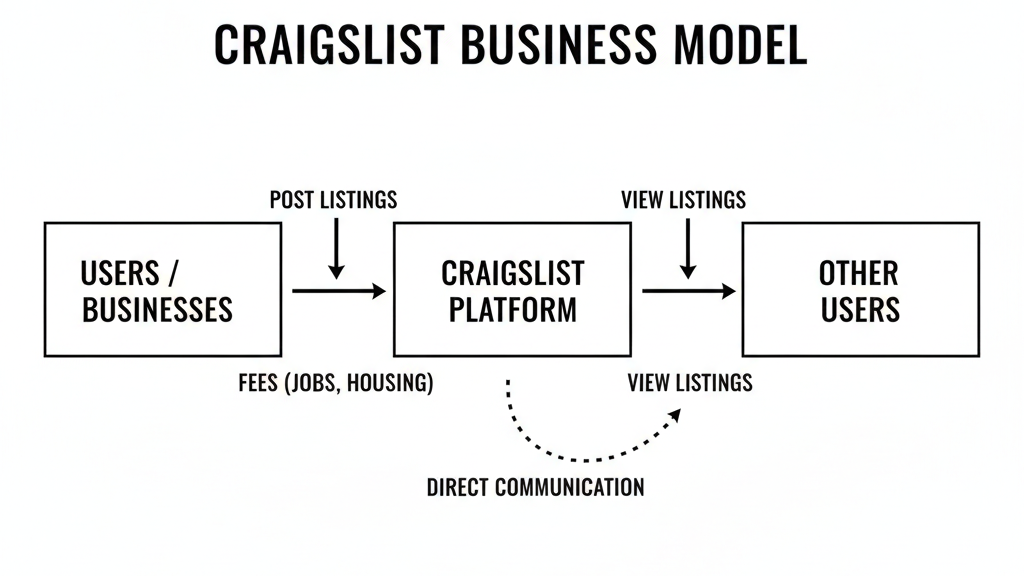
The typical Craigslist experience is refreshingly straightforward. Users select their local city, browse categories ranging from furniture and electronics to gigs and events, and click through text-based listings with minimal photos. Posting is equally simple: you write a description, add a few images if desired, provide contact information, and publish.
Communication happens directly between parties through email or phone, with Craigslist serving merely as the introduction point. Once contact is made, buyers and sellers arrange meetings, inspect items, negotiate prices, and complete transactions entirely offline. Craigslist never touches the money or mediates disputes.
For Businesses & Recruiters
For the minority of users who pay, the process remains equally uncomplicated. Employers post job openings by filling out a form and paying a flat fee, typically ranging from $10 to $75 depending on the city and job category. Real estate brokers and landlords follow a similar process for apartment listings.
There are no bidding systems, no premium placements, and no analytics dashboards. You pay your fee, your listing goes live for a set period, and you can renew it manually when it expires.
Craigslist’s Core Business Model Explained
Craigslist operates on what might be called the “freemium classifieds” model, though even that term feels too sophisticated for its approach. The fundamental strategy is to offer free listings for the vast majority of categories to generate massive traffic and network effects, then charge modest fees only in categories where users demonstrate clear willingness and ability to pay.
This creates a virtuous cycle: free listings attract millions of users, which makes the platform valuable for job seekers and apartment hunters, which in turn makes employers and landlords willing to pay to reach that audience. The platform acts purely as infrastructure, providing the digital bulletin board but remaining uninvolved in what happens next.
Unlike modern marketplaces that insert themselves into every transaction, Craigslist’s involvement ends the moment two parties connect. There are no payment processing fees, no shipping integrations, no seller ratings, and no algorithmic matching. This hands-off approach dramatically reduces operational complexity and cost.
Craigslist Revenue Streams
Paid Job Listings
Job postings represent Craigslist’s primary revenue engine. In major metropolitan areas like San Francisco, New York, and Los Angeles, employers pay between $25 and $75 to post a job listing for 30 days. Smaller cities typically charge less, often around $10-25 per posting.
This revenue stream works because employers face a straightforward calculation: for the price of a couple hours of minimum wage labor, they can reach thousands of local job seekers. For companies hiring multiple positions, these fees add up quickly, but remain far cheaper than traditional recruitment advertising or staffing agencies.
The genius lies in selective pricing. Craigslist charges for job categories where institutional buyers (companies, not individuals) are the primary posters and where the stakes justify a modest fee. Meanwhile, keeping gigs and part-time opportunities free maintains traffic from job seekers.
Paid Housing Listings
The second major revenue source comes from real estate, specifically apartment and housing rental listings in select cities. Brokers and landlords in competitive rental markets like New York City pay $5-10 per listing to reach apartment hunters.
This category works on similar logic to job postings: professional listers who manage multiple properties or represent numerous landlords have clear business incentive to pay small fees for access to serious renters. The fees also serve a mild quality-control function, reducing the incentive for spam in high-volume categories.
Urban markets with tight housing supply and high rental prices provide the strongest revenue concentration, as both listing volume and user willingness to pay remain high.
Miscellaneous Category Fees
Beyond jobs and housing, Craigslist charges fees in a handful of other categories on a city-by-city basis. Some cities charge for therapeutic services listings or certain types of business services. These represent minor revenue streams, included more for spam prevention than meaningful income.
Notably absent from Craigslist’s revenue model: display advertising, sponsored listings, premium subscriptions, transaction fees, data monetization, or virtually any other revenue tactic employed by modern platforms. This restraint is intentional, not accidental.
Pricing Strategy: Why Craigslist Remains Cheap
Craigslist’s pricing philosophy stands in stark contrast to modern platform economics. Fees are flat, transparent, and deliberately modest. There’s no dynamic pricing, no premium placement bidding, and no tiered subscription packages.
This approach reflects founder Craig Newmark’s stated philosophy of running a service rather than maximizing shareholder returns. The company remains privately held, with no pressure to demonstrate hockey-stick growth or escalating monetization to investors.
The under-monetization is strategic. By keeping fees low and limiting which categories charge at all, Craigslist maintains its community ethos and avoids alienating the user base that gives the platform its value. Users tolerate the outdated interface partly because they trust the platform isn’t trying to extract maximum revenue from their attention.
Why Craigslist Scales With Almost No Change
Perhaps the most remarkable aspect of Craigslist’s business model is its operational efficiency. The company reportedly employs fewer than 50 people, yet serves millions of listings and tens of millions of users monthly across hundreds of cities.
This tiny headcount is possible because the technology stack remains deliberately simple. There are no machine learning recommendation engines to maintain, no complex matching algorithms to optimize, no payment processing systems to secure, and no mobile apps to update constantly.
The interface hasn’t meaningfully changed in over two decades not due to neglect, but by design. When your product is essentially a database with a search function, maintenance requirements remain minimal. Servers cost money, but at Craigslist’s scale and with its text-heavy content, hosting costs remain trivial relative to revenue.
Community moderation handles much of the quality control. Users flag problematic posts, which triggers review by the small Craigslist team. This crowdsourced approach prevents spam and abuse without requiring large moderation workforces or expensive AI systems.
Trust, Risk, and User Responsibility
Craigslist’s hands-off approach creates an interesting trust dynamic. The platform explicitly disclaims responsibility for transactions, posting prominent warnings about scams and safety. Users are expected to exercise their own judgment, verify claims independently, and meet in safe public locations.
This creates real risks. Craigslist transactions occasionally involve fraud, theft, or even violence. The platform provides no payment escrow, no identity verification, no seller ratings, and no insurance against problems.
The trade-off is freedom and simplicity. Without Craigslist inserting itself into transactions, users avoid fees, maintain privacy, and transact on their own terms. For many use cases—selling a couch to a neighbor, finding a roommate, hiring someone for a one-time task—this feels appropriate. The stakes don’t justify the overhead of a heavily mediated marketplace.
Craigslist essentially says: “We provide the bulletin board. What you do from there is your business.” This works because most transactions are small-scale and local, where traditional social trust mechanisms can operate.
Craigslist’s Competitive Advantages
Despite its outdated appearance and lack of modern features, Craigslist maintains several powerful moats.
First-mover advantage remains significant. Craigslist dominated online classifieds before Facebook existed, before smartphones, before most current internet users were online. This early position allowed it to become the default destination for certain types of transactions in many cities.
Brand recognition functions as shorthand for “local classifieds.” When someone wants to sell used furniture or find an apartment, “check Craigslist” is a reflexive suggestion, similar to “Google it” for search. This mental availability is invaluable.
Habitual user behavior creates stickiness. People return to Craigslist because they’ve used it successfully before. The interface may be ugly, but it’s familiar ugly. Users know how to navigate it, understand its quirks, and have developed strategies for effective use.
Local network effects prove durable. In cities where Craigslist achieved critical mass, it’s hard to displace. Buyers go where sellers are; sellers go where buyers are. New platforms face a chicken-and-egg problem that Craigslist solved 20 years ago.
Craigslist vs Modern Marketplaces
Comparing Craigslist to contemporary platforms highlights radically different philosophies.
Facebook Marketplace has captured significant market share by leveraging its social graph, offering free listings, and providing integrated messaging. It succeeds by making listing easier and by importing trust signals from social connections. However, it monetizes through ads and data, where Craigslist charges modest direct fees.
Platform-managed marketplaces like Airbnb and Uber represent the opposite extreme from Craigslist. They control pricing, handle payments, verify identities, provide insurance, and maintain quality through ratings. This creates safer, more consistent experiences but requires substantial infrastructure, higher fees, and significant platform control.
Craigslist occupies the “low control, low trust, low cost” quadrant. Modern platforms offer “high control, high trust, high cost.” Neither approach is objectively superior; they serve different use cases and user preferences.
For standardized, repeatable transactions where consistency matters lodging, transportation, buying new products managed marketplaces excel. For one-off, local, varied transactions where flexibility matters more than guarantees, Craigslist’s model remains competitive.
Challenges in Craigslist’s Business Model
The Craigslist model faces genuine challenges that have eroded its dominance in some categories.
User experience expectations have evolved. Younger users accustomed to polished interfaces, instant messaging, and mobile-first design find Craigslist’s 1990s aesthetic off-putting. The platform works but feels dated, creating friction that competitors exploit.
Safety and scam concerns persistently plague the platform. Horror stories about Craigslist crimes, while statistically rare, generate outsized attention. Sophisticated scammers exploit the platform’s minimal verification. These issues particularly impact categories involving strangers meeting in private settings.
Niche platform competition has fragmented the classifieds space. Apartment hunting moved partly to Zillow and Apartments.com. Car sales shifted to dedicated automotive sites. Professional freelancing migrated to Upwork and Fiverr. Each vertical platform offers specialized features Craigslist can’t match.
Limited monetization expansion constrains revenue growth. Having chosen not to introduce ads or expand fees to more categories, Craigslist’s revenue potential is capped. The business is profitable but not scalable in the venture-capital sense.
Key Metrics That Matter for Craigslist
Unlike metrics-obsessed modern platforms, Craigslist operates with remarkable opacity. The company doesn’t publish active users, transaction volumes, or growth rates. However, certain metrics clearly drive the business.
Number of active listings determines platform utility. More listings mean more choice for buyers and more competition for sellers, but also higher likelihood of finding what you need. Maintaining listing volume, particularly in key categories, is essential.
Paid listings per city directly drives revenue. The company needs sufficient job posting volume in major metros and housing listing volume in competitive rental markets. Conversion rate from free users to occasional paid posters matters.
Job posting demand specifically matters as the revenue backbone. Economic downturns that reduce hiring, or employer shifts to alternative platforms like LinkedIn or Indeed, would significantly impact the bottom line.
Platform reliability may be the most critical metric. For a service this simple, uptime is paramount. Listings need to post reliably, search needs to work, and the site needs to stay accessible. Operational excellence with minimal staff requires rock-solid infrastructure.
What Founders Can Learn From Craigslist
Craigslist offers counterintuitive lessons for anyone building platforms or marketplaces.
Simplicity can beat sophistication. Craigslist’s bare-bones interface hasn’t prevented it from facilitating millions of transactions. Sometimes solving the core problem simply is better than adding features. Complexity is expensive to build and maintain.
Profitability doesn’t require maximum monetization. Craigslist deliberately leaves money on the table through free listings and low fees, yet remains highly profitable due to minimal costs. Optimizing for sustainability rather than growth maximization is a valid, arguably superior, strategy.
Local network effects are powerful. City-by-city dominance creates defensibility. Even as national competitors emerge, maintaining strong local presence in key metros sustains the business.
Operating costs matter more than revenue stories. With fewer than 50 employees serving millions of users, Craigslist’s cost structure enables profitability at revenue levels that would make venture-backed competitors panic. Low costs buy strategic freedom.
Community can replace features. User-driven moderation, trust-building through reputation, and social enforcement of norms can substitute for expensive platform-provided solutions.
Is Craigslist Profitable?
While Craigslist doesn’t publish financial statements, industry estimates suggest the company generates several hundred million dollars in annual revenue with profit margins that would make most tech companies envious likely exceeding 75-80%.
With minimal employees, low technology costs, no expensive sales or marketing operations, and revenue from millions of small transactions, the unit economics are extraordinary. A $25 job posting costs essentially nothing to process once infrastructure exists.
The business throws off substantial cash with minimal reinvestment requirements. There’s no pressure to expand into new markets, develop new products, or increase monetization. The company can simply run profitably in perpetuity, providing a service while generating wealth for its owners.
This financial sustainability without growth pressure represents the ultimate privilege in tech: the freedom to operate on your own terms.
Final Takeaway: Why Craigslist’s Model Still Works
Craigslist endures because it solves basic listing needs efficiently. People need to sell furniture, find apartments, hire help, and post job openings. Craigslist provides digital infrastructure for these activities at minimal cost to users.
The platform prioritizes usability over design. The interface is ugly but functional, familiar to millions of users who know exactly how to navigate it. There’s no learning curve, no account requirements for browsing, and no forced app downloads.
Monetization happens only where users demonstrate clear willingness to pay employers posting jobs and brokers listing apartments. Everywhere else remains free, maintaining the traffic and network effects that make paid categories valuable.
Craigslist represents a rare example of “do less, earn more” radical simplicity as competitive advantage. In an era of aggressive platform monetization, data harvesting, and feature bloat, Craigslist’s restrained approach feels almost subversive.
The model won’t work for every business. But for founders seeking inspiration beyond the growth-at-all-costs playbook, Craigslist demonstrates that solving problems simply, keeping costs low, and resisting the temptation to maximize short-term revenue can build enduring, profitable businesses that serve users well while enriching owners.
Discover more from Business Model Hub
Subscribe to get the latest posts sent to your email.