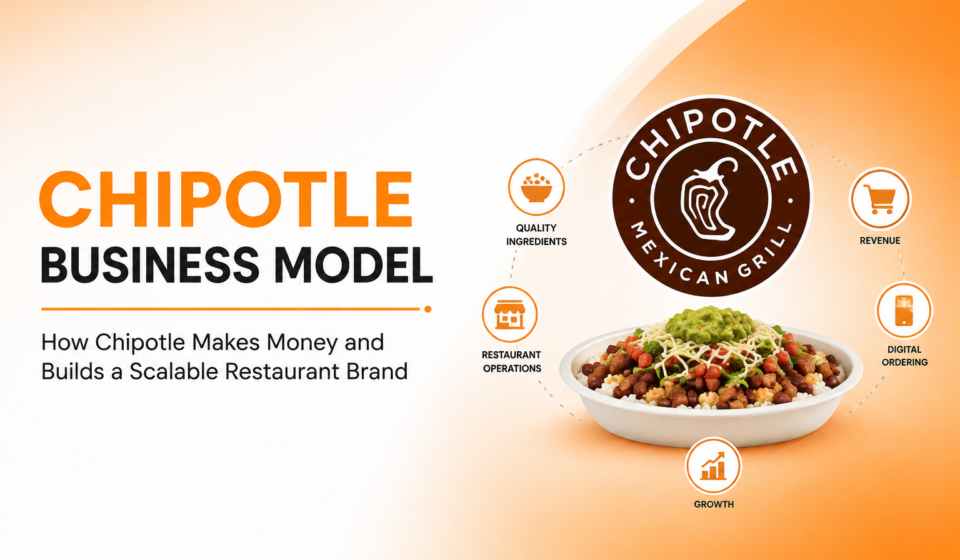
Chipotle Business Model: How a Burrito Chain Built a $11.9 Billion Empire

When Steve Ells opened the first Chipotle Mexican Grill in 1993, he had a simple goal: fund his dream of opening a fine dining restaurant. What started as a small burrito shop in Denver has transformed into a fast-casual powerhouse generating nearly $12 billion in annual revenue . The story of Chipotle isn’t just about burritos, it is a masterclass in building a scalable business model that balances quality, technology, and operational efficiency.
What Makes Chipotle Different
Chipotle occupies a unique space in the restaurant industry. It sits squarely in the fast-casual category, positioned between traditional fast food and casual dining . This positioning allows Chipotle to charge premium prices while maintaining the speed and convenience customers expect from quick-service restaurants.
The core idea behind Chipotle’s business model is deceptively simple: serve fresh, customizable Mexican-inspired food through an assembly line format that can be replicated across thousands of locations. This operational simplicity is the foundation upon which the entire empire is built.
The Chipotle Business Model Canvas
Customer Segments
Chipotle casts a wide net when it comes to its target audience. The brand attracts students and young consumers who appreciate the customization options and social media appeal. Working professionals value the speed and convenience during busy lunch hours. Families appreciate the ability to feed everyone with different preferences through the customizable menu. Health-conscious customers gravitate toward Chipotle’s focus on fresh ingredients and responsible sourcing. And pretty much everyone appreciates being able to build a meal exactly the way they want it.
Value Propositions
Chipotle delivers value through several key channels. Fresh ingredients are the cornerstone of the brand promise. The customizable menu lets customers control exactly what goes into their meal. Fast service keeps lines moving even during peak hours. Digital ordering through the app and website adds convenience. And the brand positioning around Food with Integrity creates an emotional connection that goes beyond just a meal .
Channels
Chipotle reaches customers through multiple channels, all of which are company-owned and operated. The traditional restaurant footprint forms the backbone of the business. The Chipotle website and mobile app handle a growing share of orders. Third-party delivery platforms extend reach to customers who prefer to eat at home. Digital pickup and drive-thru options add convenience for customers on the go.
Customer Relationships
The relationship with customers extends far beyond the transaction. Personalized meal customization creates a sense of ownership. The Chipotle Rewards loyalty program, with over 21 million active members, drives repeat purchases . Mobile ordering makes it easy to maintain the habit. Promotions and rewards keep customers engaged. Social media interaction builds community and brand affinity.
How Chipotle Makes Money
Restaurant Sales Drive Revenue
Restaurant sales remain the primary source of revenue for Chipotle. In fiscal year 2025, food and beverage sales accounted for approximately 99.5% of the company’s $11.9 billion in revenue . Each location generates average annual unit volume of $3.1 million, with restaurant-level cash flow of roughly $787,000 per unit at a 25.4% margin .
The economics work because of the simple assembly line format. Once fixed costs are covered, each incremental dollar of revenue flows through at roughly 40 cents of profit. This operating leverage makes throughput incredibly valuable and explains why Chipotle focuses so heavily on operational efficiency .
Digital Sales Are Growing Fast
Digital ordering has become a major revenue driver. Approximately 37% of sales now come through digital channels including the app and website . This is a dramatic increase from 2018 when digital sales accounted for only 10% of total revenue .
The mobile app and website create convenience that keeps customers coming back. Digital orders can be placed ahead of time for pickup, eliminating wait times. Delivery options bring Chipotle to customers who might not otherwise visit a physical location. The digital ecosystem also provides valuable customer data that fuels personalized marketing and menu innovation.
The Loyalty Program Fuels Repeat Business
Chipotle Rewards has become one of the most lucrative parts of the business. With more than 21 million active members, the program drives roughly 30% of total sales . About 90% of digital orders are tied to rewards, compared with roughly 20% of in-store transactions .
The loyalty program does more than just reward customers, it turns every order into a repeatable habit. Members accumulate points with each purchase that can be redeemed for free food. The program also enables personalized offers and early access to new menu items, creating additional incentives to order more frequently .
Catering and Large Orders
Catering represents another revenue stream, though smaller than in-store and digital sales. Large group orders for corporate events and gatherings typically have higher transaction values. This segment is an area where Chipotle sees growth potential, particularly as it builds out its catering capabilities .
The Pricing Strategy
Premium Fast-Casual Positioning
Chipotle charges more than traditional fast-food restaurants because customers perceive higher value in the ingredients and customization. The brand message around fresh preparation and responsible sourcing justifies the premium . Management has noted that core offerings like the Chicken Bowl are priced 20-30% below comparable fast-casual meals, making the value proposition compelling even at higher price points .
Customization Drives Higher Average Orders
The assembly line format does more than just speed up service. It encourages customers to add extras that increase the average check size. The base item gets upgraded with protein choices, premium toppings, guacamole, and other add-ons. Every additional component adds to the transaction value without significantly increasing service time.
Managing Inflation Pressures
Chipotle faces ongoing cost pressures from food inflation, particularly in beef and chicken prices . The company adjusts menu prices to maintain margins while preserving customer value perception. In 2025, food, beverage, and packaging costs came in at 29.6% of total revenue, down slightly from the previous year despite inflationary pressures .
The Cost Structure
Food and Packaging Costs
Food costs represent the largest expense line for Chipotle. Meat, produce, grains, dairy, and packaging all factor into the cost of goods sold. The company’s focus on quality ingredients means these costs can be higher than traditional fast-food competitors, but the premium pricing offsets this .
Labor Costs
Labor represents another significant expense. Restaurant employees, management, training, and workforce development all contribute to labor costs, which ticked up to 25.5% of Q4 2025 revenue . Chipotle addresses wage inflation through operational efficiencies and technology that reduce labor requirements. The high-efficiency equipment package now being rolled out reduces prep time by two to three hours, allowing teams to focus on hospitality .
Occupancy and Restaurant Costs
Rent, utilities, maintenance, and restaurant construction make up the occupancy cost structure. Chipotle leases almost all of its properties through long-term agreements, keeping the balance sheet free of debt . Each new restaurant requires significant upfront investment in build-out, equipment, and Chipotlane infrastructure where applicable. In 2025, the average capital expenditure per opening was $1.5 million .
Technology Investment
Technology and digital infrastructure represent a growing cost category. The mobile app, online ordering systems, payment systems, and digital kitchen technology all require ongoing investment. These costs are essential for maintaining the digital ecosystem that now drives over a third of sales .
The Supply Chain Strategy
Food with Integrity
Chipotle’s supply chain strategy revolves around the Food with Integrity mission that began in 1999. The story starts with Steve Ells reading an article about pork raised without antibiotics or growth hormones, which led to changing the carnitas recipe and charging $1 more . Customers responded to both the taste and the story, and sales rose sharply.
That decision set a pattern that would define Chipotle’s approach to sourcing. What began with pork extended to chicken, beef, produce, beans, and dairy. The company now scrutinizes its entire ingredient base for quality and responsible sourcing practices.
Supplier Relationships
Chipotle maintains long-term relationships with suppliers who meet its quality standards. This is challenging because the number of farmers operating at the required level is limited, especially as the business expands nationally . The company has built a network of agricultural producers who share its commitment to quality.
Food Safety and Consistency
Food safety is paramount given the company’s history and the importance of consumer trust. Chipotle maintains strict food handling standards and supply chain controls to ensure consistency across thousands of locations . Food safety incidents remain one of the biggest risks to the business model .
Scalability Challenges
Supporting restaurant expansion while maintaining quality is an ongoing challenge. The supply chain must scale alongside the growing restaurant footprint. This requires careful planning and supplier development to ensure that quality remains consistent as the business grows .
The Digital Business Model
Mobile Ordering Revolution
The Chipotle app has transformed how customers interact with the brand. The app allows for ordering ahead, skipping the line, and earning rewards points automatically . The digital experience is designed to be seamless and convenient, making it easy for customers to maintain their Chipotle habit.
The app serves as a digital storefront that extends the brand presence beyond physical locations. Customers can browse the menu, customize orders, save favorites, and pay from their phones. The convenience factor has proven to be a powerful driver of customer retention.
Digital Kitchen Operations
Chipotle has invested heavily in digital kitchen technology to handle the growing volume of digital orders. The high-efficiency equipment package improves prep speed and consistency, delivering a better experience for both teams and guests . The equipment reduces prep time during peak periods and improves throughput.
The technology also helps manage the complexity of digital orders. With multiple channels including app, web, and third-party delivery, the kitchen systems must coordinate order flow to ensure accuracy and speed. This operational technology is a key enabler of the digital growth strategy.
Delivery Ecosystem
Third-party delivery platforms extend Chipotle’s reach to customers who prefer to eat at home. The convenience of delivery comes with costs, including platform commissions that can reduce profitability . Chipotle manages this tradeoff by encouraging direct ordering through its own app, where margins are higher.
Customer Data as an Asset
The loyalty program and digital ordering create valuable customer data. Purchase behavior, preferences, and ordering patterns can be analyzed to personalize marketing and drive engagement . The 21 million active rewards members provide insights that inform menu innovation, promotions, and operational decisions .
The Growth Strategy
Restaurant Expansion
Chipotle’s primary growth driver is opening new restaurants. In 2025, the company opened a record 334 company-owned restaurants and 11 international partner-operated locations . For 2026, management is targeting 350-370 new openings .
The expansion is supported by strong unit economics. New locations typically have payback periods of less than two years, making the capital allocation highly attractive . Cash-on-cash returns for full-volume stores with Chipotlanes are estimated at 50-60% .
Chipotlane Drive-Thru Pickup
The Chipotlane format represents a key innovation in restaurant design. These drive-thru pickup locations improve convenience and sales per restaurant . At least 80% of new openings are expected to include a Chipotlane, creating a compounding tailwind for system-wide margins over time .
Chipotlane units generate higher volumes and margins while investment costs remain virtually identical . This format is particularly valuable for digital orders, allowing customers to pick up without leaving their cars.
International Expansion
Chipotle sees growth opportunities outside the United States. The company currently operates in Canada, the UK, France, Germany, and the Middle East through both company-owned and partner-operated stores . International expansion brings challenges including adapting the concept to different markets and building supply chains in new regions.
Menu Innovation
Limited-time offerings and new menu items drive demand and customer engagement. Recent initiatives like Chipotle Honey Chicken, which appeared in one out of every four orders, and the new Adobo Ranch dip have generated strong customer response . Management is increasing the cadence of menu innovation to keep the brand relevant and drive incremental transactions .
The Marketing Strategy
Brand Positioning
Chipotle’s marketing revolves around freshness, food quality, transparency, and responsible sourcing. The Food with Integrity message resonates with customers who care about what they eat . The brand occupies a unique space in the restaurant industry, allowing it to command premium prices while maintaining broad appeal .
Social Media and Content
User-generated content, product launches, and influencer campaigns drive social media engagement. Chipotle has built a strong presence on platforms like TikTok and Instagram, connecting with younger consumers where they spend their time. The brand’s social media strategy emphasizes authenticity and community engagement.
Loyalty Marketing
The rewards program serves as a powerful marketing tool. Promotions, personalized offers, and gamified experiences encourage more frequent ordering . The Summer of Extras campaign drew participation from millions of customers and helped re-energize traffic . The loyalty program also generates valuable data that informs other marketing initiatives.
Cultural Connection
Chipotle has positioned itself as a brand that connects with younger consumers through shared values around food quality and sustainability. Brand storytelling emphasizes the commitment to responsible sourcing and fresh preparation. This cultural connection builds brand affinity that goes beyond the transaction.
What Makes the Model Successful
Several factors combine to make Chipotle’s business model work. Brand differentiation around food quality creates a premium position in the market . The simple but customizable menu keeps operations efficient while giving customers control. Fast-casual positioning allows for premium pricing without sacrificing speed.
The restaurant format is highly scalable, with the assembly line replicating across thousands of locations . Digital ordering creates convenience and generates valuable customer data. The loyalty program drives repeat purchases and customer retention . Operational standardization ensures consistency across the system. And strong brand recognition provides a competitive moat .
The Challenges Ahead
Rising Food Costs
Inflation in beef and chicken prices, compounded by tariffs, has pressured margins . Chipotle expects food costs in the mid-30% range for Q1 2026, reflecting higher costs for beef, avocados, and oils . Managing these cost pressures while maintaining value perception is an ongoing challenge.
Labor Costs and Retention
Wage inflation and labor shortages create cost pressures. Labor costs rose to 25.5% of revenue in Q4 2025, driven by lower sales volumes and wage inflation . Chipotle addresses this through internal promotions and career development, with 23,000 internal promotions in 2025 .
Food Safety Risks
Given the company’s history, food safety remains a critical risk . Any incident could damage consumer trust and brand reputation. Maintaining rigorous food safety standards across thousands of locations is challenging.
Intense Competition
Chipotle faces competition from multiple directions. Traditional fast-food chains like Taco Bell offer aggressive value meals like $5 combo meals . Fast-casual rivals like Sweetgreen appeal to health-conscious, digitally savvy diners . And other Mexican food concepts like Qdoba compete directly on the same customer base.
Maintaining Quality During Expansion
Rapid expansion creates risks of operational inconsistency. As the restaurant count grows toward the target of 7,000 locations, maintaining quality becomes more challenging . Supply chain constraints and training requirements must keep pace with growth.
Economic Dependence
Consumer spending is vulnerable to economic downturns. If customers reduce discretionary spending, Chipotle’s traffic and sales could suffer. The company addresses this through value positioning and loyalty programs that encourage continued engagement.
The Future Outlook
Chipotle’s business model appears sustainable for the long term. Revenue scalability is demonstrated by 5.4% year-over-year growth even in a challenging consumer environment . Restaurant expansion economics remain attractive with sub-two-year payback periods . Digital growth continues with digital sales now exceeding 37% of revenue .
The supply chain is being built to support continued expansion. Brand strength provides a competitive moat that rivals find difficult to replicate . And the combination of company-owned restaurants, digital ordering, loyalty programs, and catering creates multiple revenue streams and customer touchpoints.
Key Lessons for Entrepreneurs
Chipotle’s success offers valuable lessons for any business. Build around a clear value proposition that customers understand and appreciate. Make customization part of the product to increase engagement and satisfaction. Use technology to improve convenience and create data assets. Build repeat purchases through loyalty programs and personalization. Standardize operations before scaling to maintain quality. And differentiate on more than price, create a brand that stands for something.
Conclusion
Chipotle has built a remarkable business model that combines fast-casual food, customization, technology, and operational scalability into a repeatable restaurant concept. From the first burrito shop in Denver to over 4,000 locations worldwide, the company has proven that quality and efficiency can coexist . The integration of restaurants, digital ordering, loyalty programs, and catering creates multiple revenue streams and customer touchpoints. As Chipotle continues to expand toward 7,000 locations, the fundamentals of the business model remain strong. The burrito empire that started as a means to fund a fine dining restaurant has become one of the most successful restaurant concepts in history.
Frequently Asked Questions
How does Chipotle make money?
Chipotle generates nearly all its revenue from company-owned restaurants selling Mexican-inspired food. In fiscal year 2025, food and beverage sales accounted for approximately 99.5% of the $11.9 billion in revenue . Additional revenue comes from digital orders, catering, and loyalty-driven repeat purchases.
What is Chipotle’s business model?
Chipotle operates a fast-casual restaurant model based on fresh ingredients, customizable menu items, and company-owned locations. The business combines efficient assembly line operations with digital ordering, loyalty programs, and premium pricing to generate strong unit economics and support continued expansion .
What are Chipotle’s main revenue streams?
The primary revenue streams are in-store food sales, digital orders (app and website), delivery orders, and catering. Digital sales now represent approximately 37% of total revenue .
Is Chipotle a fast-food or fast-casual restaurant?
Chipotle is positioned as a fast-casual restaurant. This places it between traditional fast food and casual dining, allowing premium pricing while maintaining speed and convenience .
Who are Chipotle’s target customers?
Chipotle targets students, young consumers, working professionals, families, health-conscious customers, and anyone seeking customizable meals. The broad appeal comes from fresh ingredients and the ability to build meals exactly to preference.
What makes Chipotle different from its competitors?
Key differentiators include fresh ingredients prepared using classic cooking techniques, the customizable assembly line format, the Food with Integrity sourcing philosophy, and a strong digital and loyalty ecosystem .
How does Chipotle use technology?
Chipotle uses technology through its mobile app and website for ordering, digital kitchen equipment for operational efficiency, customer data from the loyalty program for personalization, and AI-driven marketing to drive engagement .
What are the biggest challenges in Chipotle’s business model?
Major challenges include rising food costs and inflation, labor costs and retention, food safety risks, intense competition from both quick-service and fast-casual rivals, maintaining quality during rapid expansion, and dependence on consumer spending .
Discover more from Business Model Hub
Subscribe to get the latest posts sent to your email.