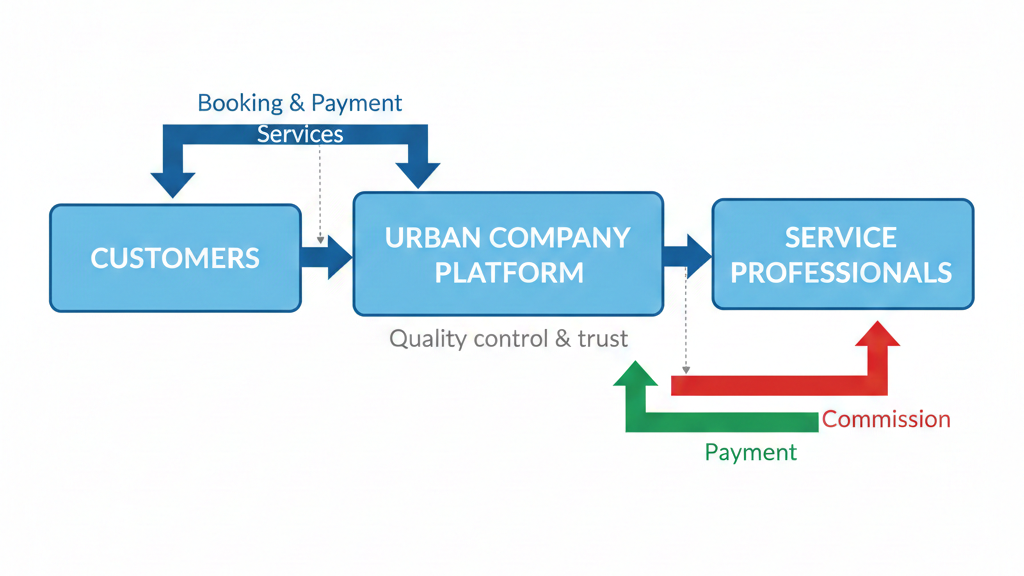

Short answer: UrbanClap (now Urban Company) makes money by taking a commission on every service booked through its platform, along with subscription plans for professionals, lead-based fees, brand partnerships, and value-added services.
Why this matters: Urban Company is one of the strongest examples of a managed services marketplace, not just a listing platform. Unlike aggregators that simply connect customers with service providers, Urban Company controls the entire experience—from pricing to quality standards to training. This control is what makes its business model unique and defensible.
What Is UrbanClap (Urban Company)?
Urban Company started as UrbanClap in 2014, founded by Abhiraj Bhal, Varun Khaitan, and Raghav Chandra. The platform was built to solve a simple but persistent problem: finding reliable, trustworthy professionals for everyday home services.
In 2020, the company rebranded to Urban Company to reflect its evolution from a local service aggregator to a globally ambitious home services brand.
Core services include:
- Home cleaning and pest control
- Salon services at home (haircuts, facials, manicures)
- Repairs and installations (electricians, plumbers, carpenters)
- Appliance servicing (AC repair, washing machine maintenance)
- Painting, home deep cleaning, and more
Today, Urban Company operates across major cities in India, the UAE, Saudi Arabia, Australia, and Singapore. It has served millions of customers and trained tens of thousands of service professionals.
How Urban Company Works (Simple Flow)
For Customers
- Choose a service category – Browse through home cleaning, beauty, repair, or other categories.
- Select time slots and pricing – Fixed, transparent pricing with no hidden charges.
- Book via the app – Confirm the booking with a few taps.
- Professional visits and completes the service – Trained, background-verified professionals arrive on time.
- Rate and provide feedback – Post-service ratings ensure accountability.
For Service Professionals
- Onboarding and training – Urban Company trains professionals in specific service categories.
- Background checks and quality standards – Police verification, skill assessments, and hygiene checks.
- Accept jobs via the app – Professionals receive job requests based on availability and ratings.
- Earn and grow – Performance-based visibility and repeat customers drive income.
Urban Company’s Core Business Model Explained
Urban Company operates as a managed marketplace, which is fundamentally different from platforms like Ola or Zomato.
Here’s the difference:
- Open marketplace (like OLG or Airbnb): The platform connects buyers and sellers but doesn’t control pricing, quality, or service standards.
- Managed marketplace (like Urban Company): The platform sets prices, trains providers, enforces quality, and owns the customer experience.
This control creates trust, but it also requires heavy operational involvement. Urban Company invests in:
- Training centers for professionals
- Quality audits and mystery shopping
- Standardised pricing across cities
- Customer support and service guarantees
The result? A premium, reliable experience that justifies higher prices and builds repeat usage.
Urban Company Revenue Streams
1. Commission From Service Providers
This is the primary revenue driver. Urban Company charges a percentage-based commission on every booking completed through the platform.
The commission varies by service category:
- High-frequency, low-ticket services (like home cleaning) might have lower commissions.
- High-ticket services (like full home painting or appliance installation) command higher commissions.
This commission covers platform costs, customer acquisition, and operational overhead.
2. Subscription Plans for Professionals
Urban Company offers monthly or usage-based subscription plans to service professionals. These plans provide:
- Priority access to high-intent leads
- Better visibility in search results
- Premium support and faster payouts
Professionals who want consistent work often opt for these plans, creating a steady recurring revenue stream for Urban Company.
3. Lead-Based Fees
In some categories, Urban Company charges professionals a fee per lead or per job request, regardless of whether the booking is completed. This works well in categories where professionals have flexibility in pricing or where demand exceeds supply.
4. Product Sales & Brand Partnerships
Urban Company has expanded into selling branded products alongside services:
- Beauty products (facewash, hair serums) during salon services
- Cleaning products and disinfectants during home cleaning
- Spare parts and accessories during appliance repairs
The platform also partners with brands like Philips, IFB, and others to offer exclusive deals and cross-sell products. This creates a new revenue layer beyond pure services.
Pricing Strategy: Why Urban Company Feels Premium
Urban Company’s pricing is higher than what you’d pay to a local electrician or beautician found through word-of-mouth. But customers are willing to pay because:
- Fixed and transparent pricing – No haggling, no surprise charges.
- Quality control justifies the cost – Trained professionals, guaranteed service, and accountability.
- Convenience – Booking takes 30 seconds; no phone calls or negotiations.
- Trust-first logic – Background checks, insurance, and refund policies reduce risk.
Urban Company positions itself as the premium, reliable alternative to informal hiring. The pricing reflects that positioning.
Why Urban Company Scales Well
Urban Company’s business model is designed for scalability:
- Strong operational playbook: Once a city is cracked, the same playbook can be replicated elsewhere.
- City-by-city rollout: Instead of spreading thin, Urban Company focuses on dominating one city before moving to the next.
- Repeat usage across categories: A customer who books a cleaner is likely to book a beautician or a plumber next.
- Brand-led trust loop: Every good experience strengthens the brand, making the next booking easier.
This focus on depth over breadth is why Urban Company became the category leader in home services.
Trust as the Core Differentiator
In a market where trust is scarce, Urban Company built its moat around it:
- Background-verified professionals: Police verification and ID checks are mandatory.
- Training and standardisation: Professionals undergo multi-day training programs.
- Service guarantee and refunds: If something goes wrong, Urban Company steps in.
- Centralised customer support: Unlike calling a random plumber, you have a platform to complain to.
This trust infrastructure is expensive to build, but it’s nearly impossible for competitors to replicate quickly.
Urban Company’s Competitive Advantages
- High-quality supply network – Trained, verified professionals who deliver consistent experiences.
- Brand trust – Urban Company is synonymous with reliable home services in India.
- Operational excellence – Backend systems for scheduling, quality checks, and support.
- Multi-category expansion – Once a customer trusts the brand, cross-selling becomes easier.
These advantages create network effects: more customers attract more professionals, and more professionals improve service availability, which attracts more customers.
Urban Company vs Local Service Providers
| Aspect | Urban Company | Local Providers |
|---|---|---|
| Booking | App-based, instant | Phone calls, negotiations |
| Pricing | Fixed, transparent | Variable, often negotiated |
| Accountability | Platform-backed, refund policies | No recourse if service fails |
| Quality | Trained, standardised | Inconsistent |
| Convenience | Doorstep service, scheduled slots | Availability depends on individual |
For customers who value time and trust, Urban Company is worth the premium.
Challenges in Urban Company’s Business Model
Despite its strengths, Urban Company faces real challenges:
1. High operational costs
Training, quality audits, customer support, and insurance are expensive. Unlike pure marketplaces, Urban Company can’t scale without proportional cost increases.
2. Supply-side dissatisfaction risks
Service professionals sometimes feel the commission structure is unfair, especially in low-margin categories. This has led to protests and partner churn in the past.
3. Maintaining quality at scale
As the platform grows, maintaining consistent service quality across thousands of professionals becomes harder.
4. Thin margins in some categories
High-frequency services like home cleaning operate on thin margins, making profitability difficult without scale.
Key Metrics That Drive Urban Company’s Growth
Urban Company tracks several critical metrics:
- Booking frequency per user: How often does a customer book services?
- Professional retention rate: Are trained professionals staying on the platform?
- Average order value (AOV): How much does a customer spend per booking?
- Customer lifetime value (CLTV): What’s the total revenue from a customer over time?
- Service success rate: What percentage of bookings are completed without issues?
Optimising these metrics is key to long-term profitability.
What Founders Can Learn From Urban Company
- Control improves trust but increases cost – Managed marketplaces are harder to build but create stronger moats.
- Quality beats speed in service marketplaces – Customers value reliability over cheap prices.
- Training supply is a competitive moat – Investing in professionals creates long-term defensibility.
- Repeat usage matters more than GMV – Focus on frequency, not just transaction volume.
Urban Company proves that in services, brand trust and operational excellence matter more than being the cheapest option.
Is Urban Company Profitable?
Profitability at Urban Company varies by category:
- High-margin services (like beauty, salon, and painting) are more profitable.
- Low-margin services (like home cleaning) require high volume to break even.
The company has focused on achieving category-wise profitability before scaling aggressively. In recent years, Urban Company has reported improved unit economics and is moving toward overall profitability through:
- Increasing repeat bookings
- Upselling premium services and products
- Reducing customer acquisition costs through brand strength
The long-term goal is sustainable profitability through scale and operational efficiency.
Final Takeaway: Why Urban Company’s Model Works
Urban Company’s success lies in its refusal to be just another aggregator. By combining marketplace dynamics with deep operational control, the company built something rare: a trusted, scalable, premium service brand.
It monetises not just by connecting customers with professionals, but by owning the entire experience from training to pricing to quality assurance.
For anyone building in the services space, Urban Company offers a masterclass in how to build trust, scale quality, and create long-term value in a fragmented market.
The lesson? In services, control is costly but it’s also the only way to win.
Discover more from Business Model Hub
Subscribe to get the latest posts sent to your email.