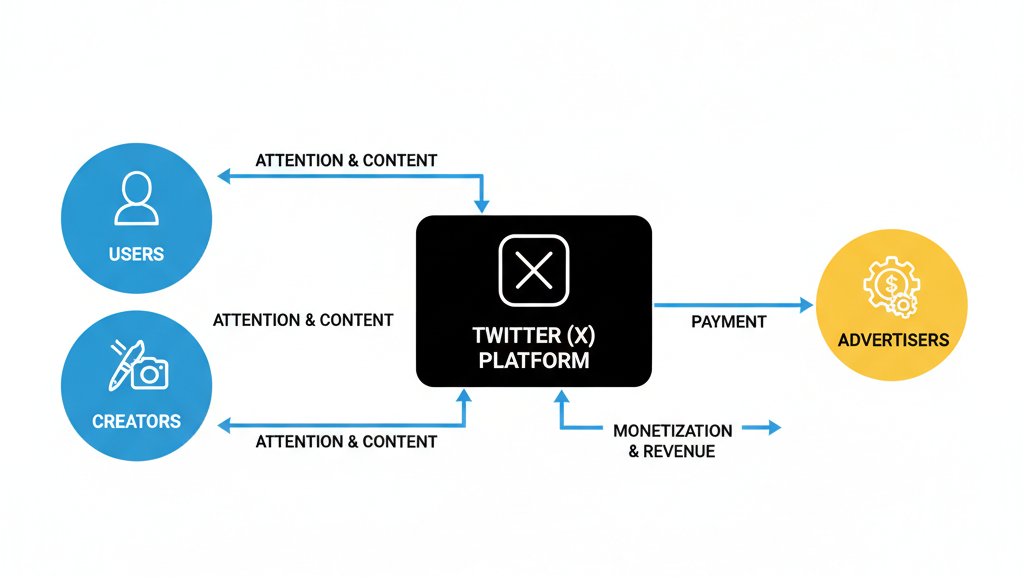

Short answer: Twitter makes money mainly through advertising, data licensing, and paid subscriptions, while expanding into creator monetisation and platform services under the X ecosystem.
Why this matters: Twitter is not just a social media app it’s a real-time information network where attention, influence, and conversations are monetised differently from traditional social platforms.
What Is Twitter (X)?
Twitter began as a simple microblogging platform where users could share thoughts in 140 characters or less. Today, under Elon Musk’s ownership and rebranding as “X,” it has evolved into something more ambitious a real-time information network and a foundation for what Musk envisions as an “everything app.”
At its core, Twitter remains a platform for public conversations. It’s where news breaks, trends emerge, and communities form around shared interests. From journalists and politicians to entrepreneurs and entertainers, Twitter attracts voices that shape public discourse.
The platform serves several core use cases: breaking news consumption, public debate and conversation, creator content distribution, brand communication, and niche community building. With hundreds of millions of users globally, Twitter has become culturally relevant far beyond its user count—a tweet can make headlines, move markets, or spark movements.
How Twitter Works
For Users
The basic Twitter experience is straightforward. Users post tweets (short messages up to 280 characters), reply to others, follow accounts and topics that interest them, and engage through likes and reposts. The platform functions as a real-time feed of information, algorithmically personalized to show users what they’re most likely to engage with.
For Creators & Influencers
Twitter has become a powerful platform for building personal brands and audiences. Creators use it to share expertise, entertain, and connect with followers. The platform now offers multiple monetisation paths: subscription-based communities, advertising revenue sharing, direct tips from supporters, and analytics tools to understand and grow their audience.
For Businesses & Advertisers
Companies use Twitter to promote products, build brand awareness, and engage directly with customers. They can run targeted advertising campaigns, promote individual tweets to reach broader audiences, track engagement metrics, and measure return on advertising spend. The platform’s real-time nature makes it particularly valuable for timely marketing and customer service.
Twitter’s Core Business Model Explained
Twitter operates on an attention-based platform model. The fundamental value proposition is simple: users get free access to a global conversation network, and Twitter monetises the attention they generate.
This creates a delicate balance. Twitter must keep the platform open and engaging enough to attract users and content creators, while finding ways to extract revenue without degrading the user experience. It’s a classic two-sided marketplace where users create the content, other users consume it, and advertisers pay to insert their messages into the flow.
The model works because Twitter sits at the intersection of media, social networking, and public discourse. It’s simultaneously a news source, a social network, and a broadcasting platform each aspect reinforcing the others.
Twitter Revenue Streams
Advertising Revenue
Advertising has historically been Twitter’s primary revenue source, though its dominance has been challenged in recent years. The platform offers several ad formats: promoted tweets that appear in users’ feeds, promoted accounts to boost follower growth, and promoted trends that appear in the trending topics section.
Advertisers can target users based on interests, behaviors, demographics, keywords, and even specific conversations. Twitter’s real-time nature makes it particularly valuable for event-based marketing and timely brand messaging. However, ad revenue can be volatile, fluctuating with broader economic conditions and advertiser confidence in the platform.
Subscriptions (X Premium)
Previously known as Twitter Blue, X Premium represents Twitter’s push toward subscription revenue. For a monthly fee, users get access to enhanced features: the blue verification checkmark (previously reserved for notable accounts), longer posts and videos, edit functionality, reduced ads, and boosted visibility in replies and searches.
This tier creates a revenue stream that’s more stable and predictable than advertising, while also catering to power users who derive significant value from the platform. It’s part of a broader strategy to reduce dependence on advertising revenue.
Data Licensing & API Access
Twitter sits on an enormous trove of public conversation data. Companies, researchers, and developers pay for access to this data through Twitter’s API. Use cases include market research and sentiment analysis, academic research, third-party application development, and competitive intelligence.
This data licensing business generates meaningful revenue with relatively low marginal costs the data is already being created by users, and Twitter simply provides structured access to it.
Creator Monetisation Fees
As Twitter builds out creator monetisation tools, it takes a percentage of various revenue streams. When creators earn money through subscriptions, tips, or advertising revenue sharing, Twitter typically keeps a platform fee. This aligns Twitter’s interests with creator success the more creators earn, the more Twitter earns.
Pricing Strategy: Why Twitter Remains Free for Most Users
Twitter’s core experience remains free because that’s what drives the network effects that make the platform valuable. Every additional user makes Twitter more useful for everyone else more content, more conversations, more reasons to stay engaged.
The ad-supported model works because most users are willing to trade attention (viewing ads) for access. Meanwhile, premium features target power users and businesses who derive enough value to justify paying. This tiered approach maximizes both reach and revenue.
Why Twitter Scales Differently From Other Social Platforms
Twitter’s text-first format creates lower friction for content creation than photo or video platforms. You don’t need production quality or aesthetic curation just something to say. This enables higher posting frequency and real-time interaction.
The platform’s public nature also differentiates it. Unlike Facebook’s social graph or Instagram’s follower model, Twitter conversations are inherently open. Anyone can join, reply, or amplify. This creates powerful network effects—a large following isn’t necessary to have a viral tweet or join a trending conversation.
Twitter’s strength in news and real-time events creates unique value. When something happens, people go to Twitter to learn about it and discuss it. This makes the platform essential for journalists, politicians, and anyone interested in staying informed.
Content & Attention as the Core Asset
Twitter’s real product isn’t the technology it’s the content and attention that users generate and consume. The platform succeeds when it captures and directs attention effectively.
User-generated content costs Twitter nothing to produce but creates all the value. The company’s job is to organize this content, surface the most engaging pieces, and create an environment where users want to return frequently.
Trending topics and virality mechanics amplify certain voices and conversations, creating moments that draw even more attention. This creates an influence economy where attention itself becomes a valuable commodity that can be monetised through various means.
Twitter’s Competitive Advantages
Twitter’s real-time public conversation model is genuinely unique. No other major platform combines these elements in quite the same way. This gives Twitter strong defensive moats in specific categories.
The platform has achieved critical mass in news, politics, technology, finance, and certain professional communities. This creates self-reinforcing network effects these audiences are on Twitter because everyone else in their field is, making it hard for competitors to dislodge them.
The low friction of tweeting just type and post enables spontaneous, authentic communication. This attracts voices and creates moments that feel more genuine than heavily curated Instagram posts or polished YouTube videos.
Twitter vs Other Social Media Platforms
Compared to Facebook, Twitter prioritizes real-time public discourse over personal social graphs. While Facebook connects friends and family, Twitter connects people around interests, ideas, and events.
Against Instagram, Twitter is text-first rather than visual-first. This attracts different content creators and consumption patterns. Instagram is about aesthetics and lifestyle; Twitter is about ideas and conversations.
LinkedIn targets professional networking with a focus on career development and B2B marketing. Twitter’s professional use cases are broader and less formal it’s where professionals think out loud, share insights casually, and build public intellectual brands.
Challenges in Twitter’s Business Model
Advertising revenue volatility presents a constant challenge. Economic downturns, brand safety concerns, and platform controversies can quickly impact ad spending. Twitter’s smaller user base compared to Facebook or YouTube gives it less pricing power.
Content moderation at scale is expensive and controversial. Twitter must balance free expression with preventing harassment, misinformation, and illegal content. These decisions affect both user experience and advertiser confidence.
Platform trust and safety issues can create cycles of negative news coverage, advertiser flight, and user attrition. Managing this while maintaining an open platform is an ongoing struggle.
User growth has often lagged competitors. Twitter’s interface can be confusing for newcomers, and the public nature of conversations can feel intimidating. Retaining casual users while serving power users creates tension in product development.
Key Metrics That Drive Twitter’s Growth
Daily active users (DAU) measures engaged usage rather than just registered accounts. This metric indicates the platform’s ability to create habitual behavior.
Engagement rate shows how actively users interact with content—likes, retweets, replies. Higher engagement indicates a healthier, more valuable platform for both users and advertisers.
Ad impressions and CPM (cost per thousand impressions) directly impact revenue. Twitter must balance ad load against user experience.
Subscription adoption rate indicates success in diversifying revenue beyond advertising. Higher paid conversion suggests users find genuine value in premium features.
Creator activity levels show the platform’s health as a content creation ecosystem. Vibrant creator activity drives content quality and quantity, which in turn drives user engagement.
What Founders & Creators Can Learn From Twitter
Twitter demonstrates that attention is monetisable at scale, but requires reaching massive user numbers before meaningful revenue materializes. The platform spent years building user base before achieving profitability.
Open platforms grow faster than closed ones because they enable viral spread and easy onboarding. However, openness also makes them harder to control and moderate. This trade-off is fundamental.
Creators are leverage, not just users. Platforms that empower creators to build audiences and earn money create self-reinforcing ecosystems. The platform becomes valuable because creators attract audiences, and audiences attract more creators.
Real-time relevance creates powerful stickiness. When people know they must check a platform to stay informed about breaking news or trending topics, it becomes habitual. Building this kind of urgency is powerful but difficult.
Is Twitter Profitable?
Twitter’s profitability has fluctuated over its history. The company achieved profitability in 2018-2019 before Elon Musk’s acquisition in 2022 added significant debt burden.
The platform faces high infrastructure costs for serving real-time content at scale, significant content moderation expenses, and the costs of competing for engineering talent. These costs are relatively fixed, while advertising revenue can be volatile.
Profitability depends heavily on advertising market conditions. Strong economic periods boost ad spending; downturns hit hard. The push toward subscription revenue aims to create more stable income streams.
Long-term potential lies in successfully diversifying monetisation combining advertising, subscriptions, creator tools, and data licensing into a sustainable mix that doesn’t over-rely on any single revenue source.
Final Takeaway: Why Twitter’s Business Model Is Unique
Twitter’s business model is built on public conversations rather than private social networks. This fundamental difference shapes everything from content moderation challenges to monetisation strategies.
The platform monetises three interconnected assets: attention (through advertising), influence (through creator tools), and data (through licensing). Each reinforces the others.
Twitter balances free access for the masses with paid power tools for professionals and businesses. This tiered approach maximizes network effects while capturing value from those who benefit most.
Ultimately, Twitter operates a complex platform economy where users, creators, advertisers, and data customers interact in overlapping markets. Managing these constituencies each with different needs and incentives is what makes Twitter’s business model both fascinating and challenging. The platform’s future success depends on maintaining the delicate balance that keeps all parties engaged and extracting value.
Discover more from Business Model Hub
Subscribe to get the latest posts sent to your email.

[…] user control, open protocols, and interoperability instead of pure advertising-driven revenue like X (Twitter) or […]
[…] platforms accelerated dramatically in recent years, particularly following controversial changes at Twitter/X under new ownership. Millions of users began exploring alternatives, with Mastodon emerging as one […]
[…] Twitter, now X, is built around public personalities and the performance of ideas in public. The platform’s value is tied to influential accounts and the real-time flow of public discourse. Monetization is rooted in the attention that famous and influential people generate. […]