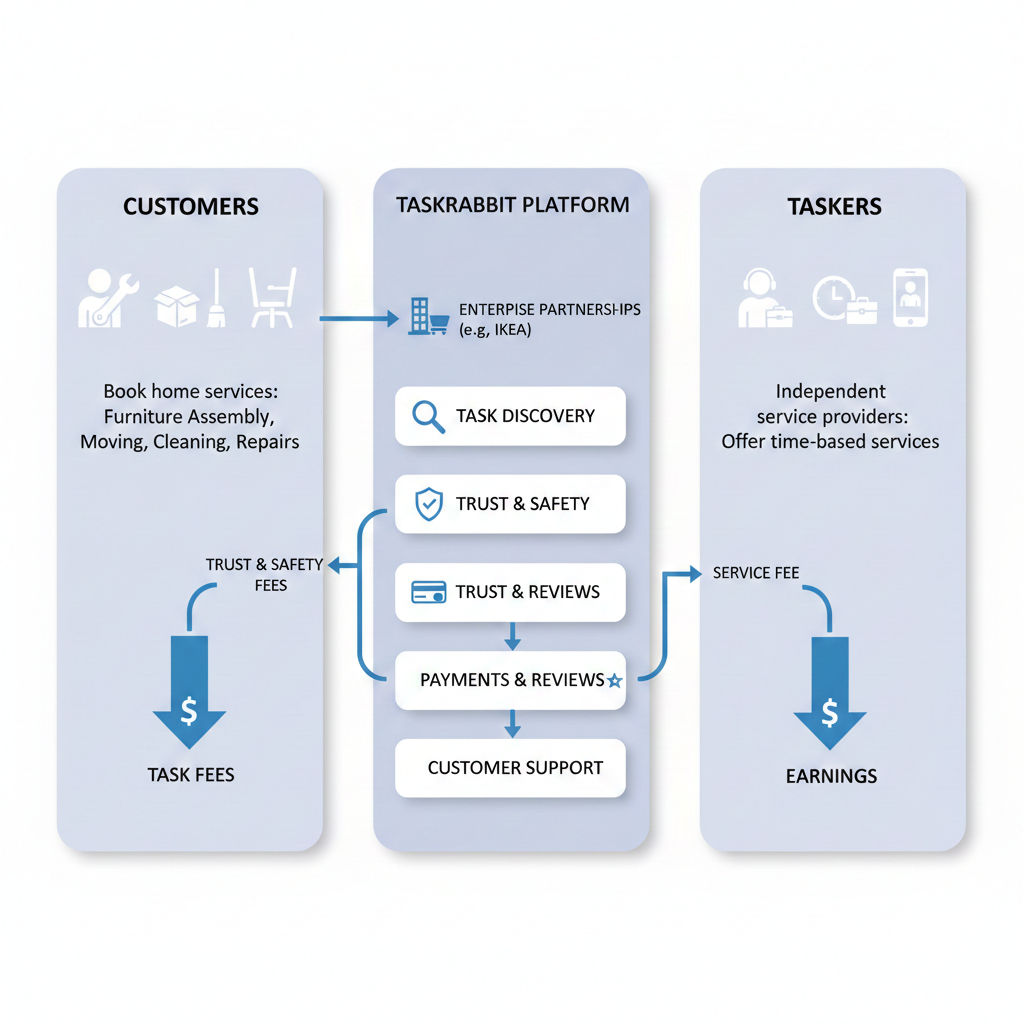

TaskRabbit makes money by charging a service fee on every task booked through its platform. It also earns through trust and safety fees, enterprise partnerships (like IKEA), and value-added services for taskers and businesses.
Why this matters:
TaskRabbit is a textbook example of a two-sided marketplace where trust, convenience, and local availability create repeat usage. If you want to understand how service marketplaces scale without owning labor, TaskRabbit is one of the clearest real-world examples.
What Is TaskRabbit?
TaskRabbit is an on-demand local services platform that connects people who need help with everyday tasks to independent workers called taskers.
Instead of calling local service providers, bargaining over price, or relying on personal references, users can open the app, book a verified tasker, pay digitally, and get the job done.
Types of tasks offered on TaskRabbit
TaskRabbit focuses on time-based, practical tasks, such as:
- Furniture assembly
- Home repairs and handyman services
- Moving help
- Cleaning
- Mounting TVs or shelves
- Errands and delivery
- Minor outdoor work
These are not long-term contracts. They’re short, repeatable, and urgent perfect for an on-demand model.
How TaskRabbit connects customers and taskers
TaskRabbit doesn’t employ taskers. Instead, it:
- Verifies them
- Lists them on the platform
- Handles discovery, payments, and trust
- Takes a cut for enabling the transaction
This keeps the business asset-light and scalable.
Ownership background (IKEA acquisition)
TaskRabbit was acquired by IKEA in 2017. The acquisition made strategic sense because furniture assembly is one of TaskRabbit’s most popular use cases. IKEA didn’t buy TaskRabbit to sell ads it bought it to complete the customer experience.
How TaskRabbit Works
For Customers
The customer journey is intentionally simple:
- Search by task and location
Users choose what they need help with and where they’re located. - Choose taskers
Customers compare taskers based on:- Hourly rates
- Ratings and reviews
- Availability
- Book and communicate in-app
All communication stays inside the platform, which reduces risk. - Task completion and reviews
After the job, customers leave ratings that affect tasker visibility.
The key here is confidence users don’t feel like they’re hiring a stranger blindly.
For Taskers
TaskRabbit is equally structured on the supply side:
- Onboarding and verification
Taskers go through identity and background checks. - Setting rates and availability
Taskers control their pricing and schedules. - Accepting jobs and earning income
Payments are handled by TaskRabbit, reducing friction. - Ratings affect future visibility
Good work leads to more jobs. Poor ratings reduce reach.
This creates a self-regulating marketplace.
TaskRabbit’s Core Business Model Explained
At its core, TaskRabbit is a two-sided marketplace.
- Demand side: People who need quick, trusted help
- Supply side: Freelancers selling time and skills
- Platform role: Matchmaking, trust, payments, and protection
TaskRabbit doesn’t create the service. It creates the infrastructure that makes offline services feel digital, predictable, and safe.
This is why the platform can scale without hiring thousands of workers.
TaskRabbit Revenue Streams
Service Fees From Customers
This is TaskRabbit’s primary revenue stream.
- Customers pay a service fee on top of the tasker’s hourly rate
- The fee varies by task and location
- It covers platform usage, payments, and support
Customers don’t mind this fee because it replaces:
- Time spent searching
- Risk of unreliable workers
- Payment uncertainty
Trust & Safety Fees
Trust is expensive and TaskRabbit monetises it.
These fees cover:
- Background checks
- Identity verification
- Insurance protection
Instead of treating trust as a cost center, TaskRabbit turns it into a value-added feature.
Tasker-Side Monetisation
TaskRabbit also earns from taskers indirectly:
- Processing and onboarding fees
- Platform usage costs baked into earnings
- Optional visibility or priority placement (where applicable)
This ensures both sides contribute to the platform’s sustainability.
Enterprise & Partner Services
One of TaskRabbit’s smartest moves was B2B partnerships.
The best example is IKEA:
- Customers buy furniture
- TaskRabbit handles assembly
- IKEA improves customer satisfaction
This creates predictable, high-volume demand something most marketplaces struggle with.
Pricing Strategy: Why TaskRabbit Feels “Worth It”
TaskRabbit’s pricing works because it feels fair and transparent.
- Hourly rates are visible upfront
- Users choose the tasker not the platform
- No surprise negotiations
Compared to traditional service providers, TaskRabbit saves:
- Time
- Mental effort
- Follow-ups
Convenience often beats cheap pricing and TaskRabbit understands this well.
Why TaskRabbit Scales Well
TaskRabbit scales without owning tools, trucks, or workers.
Key reasons it scales:
- Asset-light model
- City-by-city expansion
- Repeat household demand
- Reviews create organic growth
Once a city reaches a critical mass of taskers and customers, growth becomes easier and cheaper.
Trust as the Real Product
Most people think TaskRabbit sells services. In reality, it sells trust.
Trust is built through:
- Ratings and reviews
- Background checks
- Secure payments
- Dispute resolution
Without trust, the marketplace collapses. With trust, users stop comparing alternatives.
TaskRabbit’s Competitive Advantages
Strong brand recognition
People associate TaskRabbit with reliability, not randomness.
IKEA ecosystem integration
Few competitors have such a strong enterprise anchor.
High switching costs
Once users find good taskers, they don’t want to start over elsewhere.
Local supply density
More taskers → faster bookings → better customer experience.
TaskRabbit vs Traditional Local Service Providers
| TaskRabbit | Traditional Providers |
|---|---|
| App-based booking | Phone calls |
| Transparent pricing | Negotiated pricing |
| Platform accountability | Informal hiring |
| Scalable trust system | Personal references |
TaskRabbit modernises a very old problem: finding reliable help.
Challenges in TaskRabbit’s Business Model
Despite its strengths, the model isn’t perfect.
Supply-demand imbalance
Smaller cities struggle with liquidity.
Price sensitivity
Not all markets accept service fees easily.
Tasker churn
Freelancers may leave for better opportunities.
Regulatory risks
Labor classification laws can impact operations.
Marketplaces are powerful but fragile if not balanced carefully.
Key Metrics That Drive TaskRabbit’s Growth
TaskRabbit focuses on metrics that reflect marketplace health:
- Task completion rate
- Repeat booking frequency
- Tasker retention
- Average order value (AOV)
- City-level supply density
If these metrics work, revenue follows naturally.
What Founders Can Learn From TaskRabbit
There are strong lessons here for marketplace founders:
- Trust unlocks transactions
- Local density beats global ambition
- Simple pricing converts better
- Reviews are growth engines, not just feedback
Most importantly, offline problems need online trust, not just apps.
Is TaskRabbit Profitable?
TaskRabbit has strong unit economics:
- High gross margins
- Low marginal cost per transaction
However, profitability depends on:
- City maturity
- Supply stability
- Customer repeat rate
Well-established cities are far more profitable than new ones.
Final Takeaway: Why TaskRabbit’s Model Works
TaskRabbit succeeds because it:
- Solves a real, everyday problem
- Monetises trust instead of attention
- Scales without owning labor
- Balances convenience with control
It’s not just a gig app. It’s a trust infrastructure for local services and that’s why the business model works.
Discover more from Business Model Hub
Subscribe to get the latest posts sent to your email.

[…] TaskRabbit – Focuses on smaller, task-based jobs like furniture assembly and moving help, owned by IKEA […]
[…] TaskRabbit is probably the closest competitor. It focuses more on handyman-style tasks and allows customers to browse individual professionals and negotiate. […]