
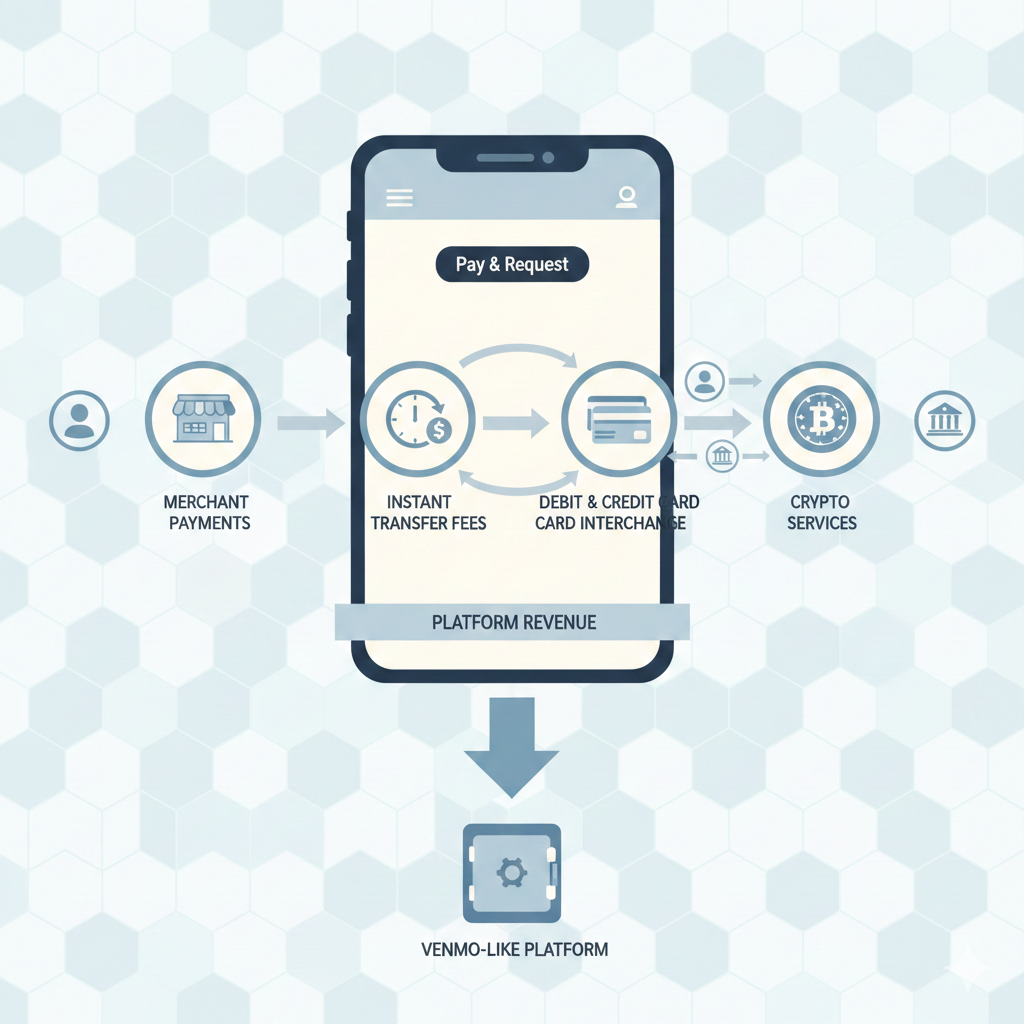
Short answer: Venmo operates on a peer-to-peer digital payments business model, allowing users to send and receive money instantly, while earning revenue through transaction fees, merchant payments, instant transfers, and financial service add-ons.
Here’s the key insight: Venmo turned free money transfers into a profitable fintech platform by layering monetization on top of social engagement making payments feel less like transactions and more like social interactions, then charging for speed, convenience, and business use.
What Is Venmo?
Venmo launched in 2009 as a simple way to split bills between friends. PayPal acquired the company in 2013 for $800 million, recognizing its potential to capture younger users who found traditional payment methods clunky.
The problem Venmo solves: Before Venmo, splitting a dinner check meant awkward cash exchanges or writing checks. Venmo made peer-to-peer payments instant, mobile-first, and surprisingly social.
Core users: College students, millennials, Gen Z consumers, friends settling shared expenses, and increasingly, small merchants and creators accepting payments.
The promise: Send money as easily as sending a text message—with emojis, inside jokes, and a social feed that makes financial transactions feel human.
Venmo’s Core Business Model Explained
Peer-to-Peer Payments Platform
Venmo operates as a two-sided payments network connecting individuals who want to send and receive money instantly. Unlike traditional banks, Venmo doesn’t hold inventory or focus on balance-sheet lending. Instead, it facilitates transactions and earns money on the flow of payments.
The platform benefits from powerful network effects: the more friends who use Venmo, the more valuable it becomes to each user. This creates a natural moat that’s difficult for competitors to breach.
Freemium Monetisation Approach
Venmo’s genius lies in making core transfers completely free. Sending money from your Venmo balance or linked bank account costs nothing. This removes friction from adoption and encourages frequent use.
Monetization happens through premium actions: instant transfers, business payments, crypto trading, and card usage. Users opt into these paid features when they need speed or additional services.
This low-friction adoption strategy allowed Venmo to build a massive user base—over 90 million users—before aggressively monetizing.
How Venmo Makes Money
Merchant Payments
When you pay a business through Venmo, the merchant pays a transaction fee (typically around 1.9% + $0.10 per transaction). This applies to both in-store QR code payments and online checkout.
Venmo has grown acceptance among small merchants (coffee shops, farmers markets, freelancers) and increasingly larger retailers. This merchant fee structure mirrors traditional payment processors but with lower friction for setup.
Instant Transfers
Users can withdraw money from their Venmo balance to their bank account for free—but it takes 1-3 business days. For a 1.75% fee (with a minimum of $0.25 and maximum of $25), users get instant access to their funds.
This convenience-driven revenue stream capitalizes on impatience and urgent cash needs without forcing users into it.
Debit and Credit Card Revenue
The Venmo Debit Card generates interchange fees every time users swipe it. When you spend using your Venmo balance through the debit card, Venmo earns a small percentage from merchants—similar to how traditional debit cards work.
The Venmo Credit Card (launched in partnership with Synchrony Bank) generates revenue through interchange fees, interest on carried balances, and annual fees. Venmo shares in this revenue while offering cashback rewards to users.
Crypto and Financial Features
Venmo allows users to buy, sell, and hold cryptocurrency directly in the app, charging fees on each crypto transaction. This taps into the growing interest in digital assets among its young user base.
Additional value-added services like check deposits, bill splitting features, and potential future offerings (savings accounts, investment products) create new monetization opportunities without disrupting the core free experience.
Social Layer as a Growth Engine
Venmo’s public transaction feed transformed boring money transfers into social entertainment. When you pay your roommate for groceries, you can add an emoji, a funny comment, or inside joke—and your friends can see it (amounts are private by default).
This social layer creates multiple growth advantages:
- Viral visibility: Every payment introduces non-users to Venmo when they see friends using it
- Habit formation: The feed encourages frequent checking and engagement beyond just sending money
- Social proof: Seeing friends use Venmo normalizes it as the default payment method
- Identity expression: Payment descriptions become mini social media posts
The result: Venmo spread organically through social networks faster than any traditional payment app could through advertising alone.
Technology and Platform Logic (Non-Technical)
Venmo operates on secure payment rails that connect to bank accounts, debit cards, and credit cards. Money doesn’t actually “travel” instantly—Venmo fronts the funds and settles with banks in the background.
Fraud detection systems monitor transactions for suspicious patterns, protecting both users and Venmo from losses. Machine learning flags unusual activity while keeping legitimate payments flowing smoothly.
API integrations allow merchants to accept Venmo payments through their existing checkout systems, expanding Venmo beyond person-to-person transfers.
The mobile-first experience reflects how people actually use payments today: on phones, on the go, spontaneously.
Customer Acquisition Strategy
Venmo grew primarily through organic, friend-to-friend adoption. When one person in a friend group started using Venmo, everyone else followed to avoid being the awkward holdout asking for cash or checks.
Social virality meant each transaction could recruit new users. The public feed acted as passive advertising visible to non-users.
Integration with PayPal’s ecosystem gave Venmo instant credibility and backend infrastructure. Users could move money between PayPal and Venmo, accessing PayPal’s merchant network.
Youth-focused positioning targeted college students and millennials first, groups most frustrated with traditional banking and most comfortable with social apps.
Cost Structure (Where Venmo Spends Money)
Payment processing fees: Venmo pays fees to card networks and banks for facilitating transfers, especially when users fund payments with credit cards.
Fraud prevention and compliance: Financial regulations require significant investment in security, monitoring, and reporting systems. Fraud losses directly impact profitability.
Technology and infrastructure: Maintaining secure, reliable payment systems requires ongoing engineering investment and cloud infrastructure costs.
Customer support and operations: Handling payment disputes, account issues, and compliance questions requires substantial support teams.
Marketing and partnerships: While organic growth is strong, Venmo invests in brand partnerships, merchant integrations, and feature launches to maintain growth.
Unit Economics Explained Simply
Venmo’s unit economics improve as users become more active. The platform makes more money from users who:
- Send more frequent transactions (more opportunities to use paid features)
- Pay merchants regularly (merchant fees on each transaction)
- Use instant transfers occasionally (high-margin convenience fee)
- Spend with the Venmo debit or credit card (interchange revenue)
Revenue per active user increases as Venmo adds monetization features without requiring users to opt into all of them. Even if only 10% of users pay for instant transfers, that’s profitable when spread across 90 million users.
Scale-driven margin improvement means Venmo’s fixed costs (technology, compliance) get spread across more transactions, improving profitability over time.
Venmo vs Competitors (Quick Comparison)
Venmo vs Cash App: Both offer peer-to-peer payments, debit cards, and crypto trading. Cash App focuses more on investing features (stocks, Bitcoin) and direct deposit, positioning as a full bank replacement. Venmo emphasizes social payments and merchant acceptance.
Venmo vs Zelle: Zelle is bank-backed, often built directly into banking apps, and offers instant transfers with no fees. However, Zelle lacks the social layer, standalone app experience, and merchant payment options that make Venmo sticky.
Social payments vs bank-backed transfers: Traditional bank transfers are free and reliable but lack the social engagement, merchant integration, and youth appeal that drive Venmo’s network effects.
Monetization flexibility: Venmo has more revenue streams than Zelle (which doesn’t charge users) but less aggressive monetization than Cash App’s investment focus.
Challenges in Venmo’s Business Model
Regulatory compliance pressure: As Venmo grows, it faces increasing scrutiny around money laundering, tax reporting, and consumer protection. Each new regulation adds costs and complexity.
Monetization without harming UX: Charging too much or too often for features risks alienating users who expect free peer-to-peer transfers. Venmo must balance revenue growth with maintaining its frictionless experience.
Competition from banks and fintechs: Zelle comes pre-installed in many banking apps. Banks could make Venmo-like features standard, reducing Venmo’s differentiation.
Fraud and scam risks: Unlike credit cards, Venmo transfers are often irreversible. Scammers exploit this, and users sometimes blame Venmo for losses even when they authorized payments.
What Founders Can Learn from Venmo
Free usage builds massive networks: Venmo proved that giving away the core product creates a user base large enough to monetize through optional premium features.
Monetize convenience, not access: Charging for speed (instant transfers) or business use (merchant fees) while keeping peer-to-peer free maintains goodwill while generating revenue.
Social features drive retention: The transaction feed turned a utility into a habit. Adding social elements to functional products increases engagement beyond the core use case.
Trust is non-negotiable in fintech: Venmo succeeded because PayPal’s backing provided credibility. New fintech startups need robust security and transparent practices from day one.
Future of Venmo’s Business Model
Deeper merchant integrations: Expanding from small businesses to major retailers increases transaction volume and merchant fee revenue.
Expanded financial services: Savings accounts, investment products, and lending could turn Venmo from a payments app into a primary financial hub for young users.
International use cases: Currently US-focused, Venmo could expand globally, though regulatory hurdles and established competitors in other markets present challenges.
Tighter PayPal ecosystem alignment: Allowing seamless movement between Venmo and PayPal creates a comprehensive payments ecosystem capturing both consumer and business use cases.
Wrapping Up
Venmo dominates social payments in the US because it prioritized network effects over aggressive monetization. By making peer-to-peer transfers free and social, Venmo became the default way friends exchange money.
The business model works because fintech scale comes from trust and habits, not just technology. Users trust Venmo with their money and habitually open the app for payments, creating opportunities to monetize without disrupting the core experience.
For founders, Venmo demonstrates that the most valuable networks are built by solving real friction (splitting bills), adding unexpected delight (social feeds), and monetizing thoughtfully (optional premium features). The result: a payments app that feels less like a bank and more like a social platform—one that happens to move billions of dollars.
Discover more from Business Model Hub
Subscribe to get the latest posts sent to your email.






[…] Venmo is the peer-to-peer payment app built for social transactions. Users send money to friends for split bills, rent, and casual purchases. Venmo generates revenue through instant transfer fees, merchant payments, and its Venmo debit card. […]
[…] platform that lets users send money directly from one bank account to another in real time. Unlike Venmo or Cash App, Zelle does not hold your money in a digital wallet. There is no balance to manage, no […]