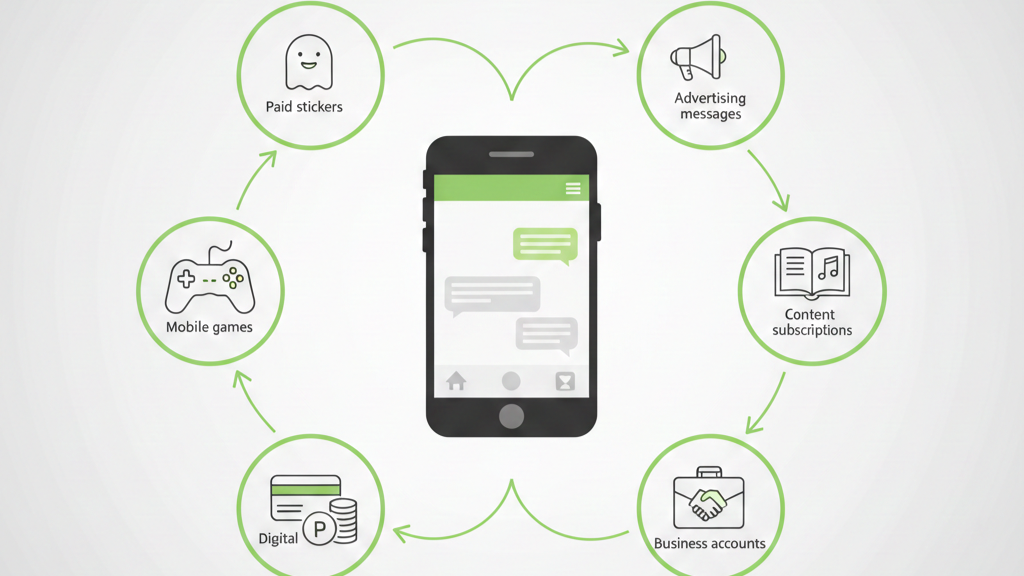
LINE makes money through messaging-based services like paid stickers, mobile games, advertising, digital payments, content subscriptions, and business tools turning a simple chat app into a full digital ecosystem.
At first glance, LINE looks like just another messaging app. But if you look closely, it’s actually a super app that sits at the center of daily digital life in countries like Japan and Thailand. To understand how LINE earns revenue and stays relevant, let’s break its business model down clearly.
What Is LINE?
LINE is a messaging and digital services platform that goes far beyond chatting.
It was launched in 2011 in Japan after the Great East Japan Earthquake, when phone networks were unreliable and people needed an internet-based way to communicate. LINE solved that problem—and adoption exploded.
Today, LINE operates mainly in:
- Japan
- Taiwan
- Thailand
- Indonesia
In these markets, LINE is not optional. It’s deeply integrated into daily life. People use LINE to:
- Message friends and family
- Pay in stores and online
- Follow brands and celebrities
- Play games
- Read manga and consume content
- Communicate with businesses and customer support
This “everything-in-one” positioning is what makes LINE a true super app, not just a chat platform.
LINE’s Core Value Proposition
For Users
For users, LINE focuses on simplicity, emotion, and convenience.
- Free and reliable messaging
- High-quality voice and video calls
- Expressive stickers that replace emojis and even words
- One app for communication, payments, entertainment, and services
LINE isn’t trying to be minimal. It’s trying to be useful all day, every day.
For Businesses and Creators
For businesses and creators, LINE acts as a direct communication channel, not just a marketing platform.
- Access to highly engaged users
- Direct messaging instead of algorithm-based feeds
- Built-in commerce and payments
- Multiple monetisation options
This makes LINE extremely attractive to small businesses, creators, and large brands alike.
LINE Business Model Overview
At its core, LINE follows a platform ecosystem model.
- It connects users, businesses, creators, developers, and financial services
- Messaging acts as the foundation
- Every other service is layered on top of chat
Instead of depending on one revenue stream, LINE spreads risk by earning from multiple sources, all tied to daily usage.
That diversification is one of the biggest strengths of LINE’s business model.
LINE’s Revenue Streams Explained
Stickers and Emoji Sales
Stickers are one of LINE’s most iconic features—and a surprisingly powerful revenue stream.
- Users buy premium sticker packs
- Many stickers are created by independent artists
- Creators earn revenue, and LINE takes a cut
In Asian markets, stickers are more than decoration. They carry emotion, tone, and personality. This makes people willing to pay for them, unlike emojis on most Western platforms.
Stickers turn emotion into monetisation.
Mobile Games
LINE runs a large gaming ecosystem with both in-house and third-party games.
- Free-to-play games with in-app purchases
- Character-based games linked to LINE branding
- Strong cross-promotion inside the app
Games keep users engaged for long periods and generate recurring revenue. Even if users don’t play daily, games increase overall time spent inside the LINE ecosystem.
Advertising Business
Advertising is another major revenue driver, but LINE approaches it differently.
Instead of relying only on feeds, LINE offers:
- Sponsored messages sent directly to users
- Display ads inside the app
- Ads in timelines and official content
Because LINE already has permission-based communication, ads often feel more personal and relevant than traditional social media ads.
For brands, this means higher engagement. For LINE, it means higher ad value.
LINE Official Accounts (Business Accounts)
This is one of LINE’s smartest monetisation moves.
Businesses can create LINE Official Accounts to:
- Message customers directly
- Send offers, updates, and support messages
- Build long-term customer relationships
Most official accounts operate on a subscription-based model, especially for higher message volumes.
For small and medium businesses, LINE becomes a mix of:
- CRM
- Marketing tool
- Customer support channel
That makes it hard to replace and easy to pay for.
LINE Pay and Fintech Services
LINE Pay turns the app into a financial tool.
- Peer-to-peer payments
- In-store and online merchant payments
- Cashback and loyalty programs
By embedding payments into chat, LINE removes friction. Users don’t feel like they’re using a “finance app”—they’re just paying inside a conversation.
Fintech also opens doors to:
- Transaction fees
- Financial partnerships
- Long-term ecosystem expansion
Content and Media Services
LINE also monetises content heavily.
Popular services include:
- LINE Manga
- LINE Music
- LINE TV
Revenue comes from:
- Subscriptions
- Pay-per-content
- Exclusive content deals
Because LINE already owns user attention, distributing content inside the app is far more efficient than building standalone platforms.
Enterprise and Platform Services
Behind the scenes, LINE also earns from B2B services.
- APIs and developer tools
- Enterprise messaging solutions
- Platform integrations
These services don’t get as much public attention, but they provide stable, high-value revenue, especially from large organisations.
How LINE Retains Users
LINE’s retention strategy is built around habit.
- Messaging keeps users coming back daily
- Stickers add emotional attachment
- Games and content increase session length
- Payments lock users into the ecosystem
Once someone uses LINE for communication and payments, switching becomes inconvenient. This creates a strong engagement flywheel that keeps churn low.
LINE’s Cost Structure
Running a super app isn’t cheap.
Major costs include:
- Cloud infrastructure and servers
- Content licensing and creator payouts
- Marketing and partnerships
- Compliance and financial regulations
However, because LINE monetises across multiple services, these costs are spread efficiently rather than tied to a single product.
Key Partnerships and Ecosystem Players
LINE’s ecosystem works because of partnerships.
- Content creators and artists
- Game developers
- Merchants and retail brands
- Banks and financial institutions
Instead of building everything alone, LINE acts as a platform that enables others to earn, while taking a share of the value created.
Competitive Advantage of LINE
LINE’s biggest advantage is local dominance with cultural understanding.
- Deep localisation for each market
- Strong emotional branding
- Messaging-first monetisation instead of feed-first
- Early move into the super app model
In markets like Japan, LINE feels less like an app and more like digital infrastructure.
Challenges in LINE’s Business Model
Despite its strength, LINE faces real challenges.
- Strong competition from WhatsApp, WeChat, and KakaoTalk
- Monetisation fatigue if users feel overwhelmed
- Regulatory pressure in fintech services
- Heavy reliance on a few geographic markets
Scaling globally is much harder than dominating locally.
LINE vs Other Super Apps
Compared to competitors:
- WhatsApp focuses mainly on messaging
- WeChat dominates China but is hard to replicate elsewhere
- KakaoTalk is strong in Korea but less global
LINE sits somewhere in between deeply embedded in specific markets, but not fully global.
Future Growth Opportunities
LINE’s future growth depends on:
- AI-powered messaging and assistants
- More commerce inside chat
- Cross-border payments
- Better creator monetisation tools
If LINE continues strengthening its ecosystem instead of chasing pure global expansion, it can remain highly profitable.
Final Take: Why LINE’s Business Model Works
LINE works because it treats messaging as infrastructure, not just a feature.
By combining emotion (stickers), utility (payments), entertainment (games and content), and business tools (official accounts), LINE turns everyday communication into a sustainable business.
For founders and product builders, the lesson is simple:
own the habit, then layer monetisation on top carefully and contextually.
Discover more from Business Model Hub
Subscribe to get the latest posts sent to your email.