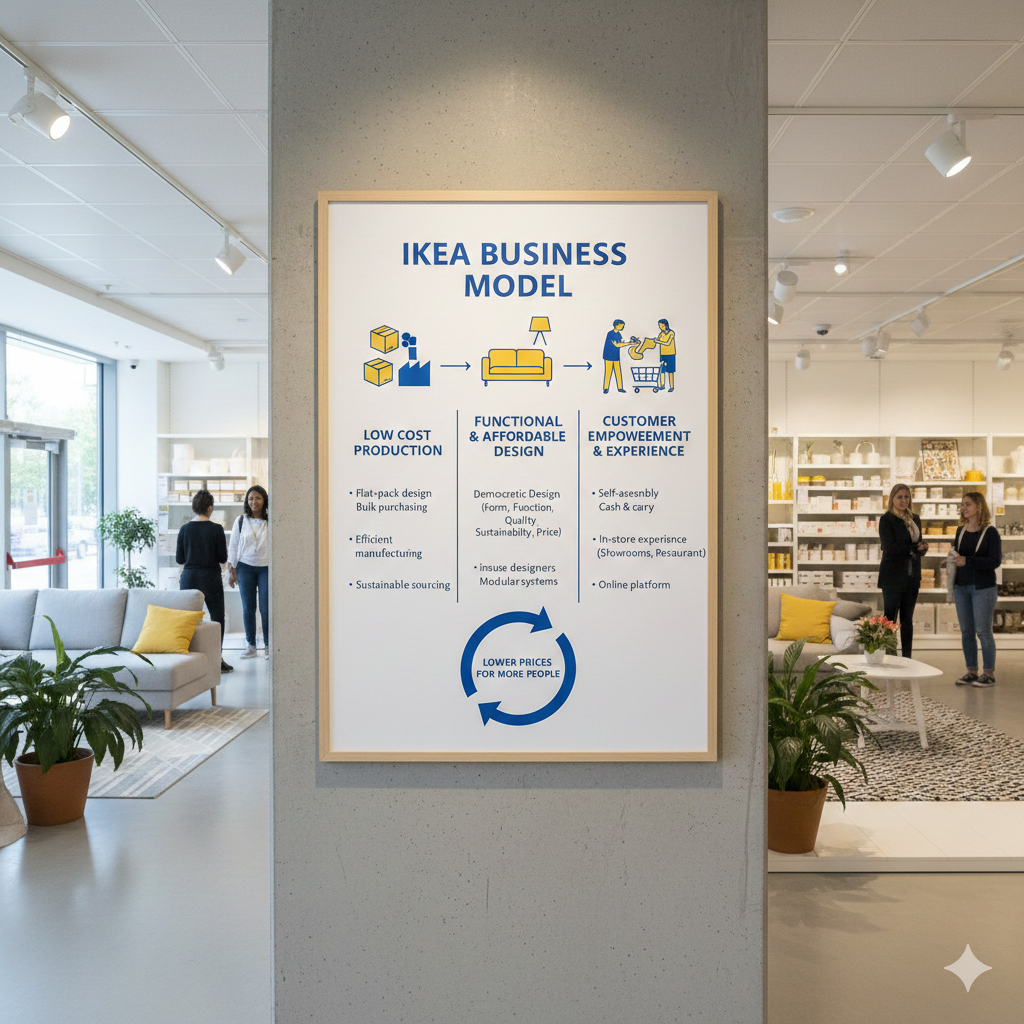
IKEA follows a vertically integrated, cost-leadership retail business model. It designs its own products, works closely with global manufacturers, sells through its own large-format stores and online channels, and keeps prices low by shifting part of the assembly and logistics work to customers.
Now let’s break this down step by step while exploring the unique perspectives that make IKEA one of the most fascinating retail case studies in the world.
What Is IKEA?
IKEA is a global furniture and home furnishings company founded in Sweden in 1943 by 17-year-old Ingvar Kamprad. It is best known for flat-pack furniture, DIY assembly, modern functional design, and affordable pricing.
Unlike most furniture retailers, IKEA controls almost the entire value chain—from design to manufacturing partnerships to retail. This control is the secret behind its extraordinary success and profitability.
The Numbers Behind the Blue and Yellow Giant
Before diving into how IKEA makes money, let’s look at the scale we’re talking about.
Revenue and Profitability
IKEA generated €45.1 billion in retail sales revenue for fiscal year 2024, though this represented a 5.3% decline from the previous year’s €47.6 billion. But here’s the twist: this revenue decline was intentional, driven by IKEA’s strategic decision to lower prices by an average of 10% globally to support customers during economic downturn.
In the US market specifically, IKEA concluded 2024 with $5.5 billion in total sales and $1.9 billion in ecommerce sales, showing the growing importance of digital channels.
Net income for 2023 was approximately 1.5 billion euros, and gross profit in 2023 amounted to roughly 14.7 billion euros, demonstrating healthy profitability despite the company’s cost-leadership strategy.
Global Footprint
As of April 2025, there are 483 IKEA stores operating in 63 countries, with Europe hosting 284 stores, representing the largest regional concentration. IKEA attracted approximately 899 million customer visits in 2024, while IKEA’s websites received over 4.6 billion visitors in FY2024.
The company employs 216,000 people worldwide and manufactures about 10% of its product range internally while sourcing the remaining 90% from over 800 external suppliers.
IKEA’s Core Business Model: The Vertical Integration Advantage
IKEA operates a vertically integrated retail model. That means IKEA designs its own products, works directly with manufacturers, controls packaging and logistics, sells through owned stores and online, and earns profit through high-volume, low-margin sales.
This tight control helps IKEA reduce costs at every stage—but more importantly, it allows them to optimize for total system efficiency rather than just squeezing margins at one point in the chain.
Who Are IKEA’s Customers?
IKEA mainly targets middle-income households, young professionals and first-time buyers, renters and urban families, and price-sensitive but design-conscious customers.
IKEA is especially popular among people who want stylish furniture at affordable prices, are okay with assembling furniture themselves, and prefer one-stop home shopping.
But here’s an underrated insight: IKEA doesn’t just serve budget-conscious millennials. It serves anyone who values smart design and efficiency over status signaling. That’s why you’ll find IKEA furniture in both student apartments and million-dollar homes.
How IKEA Makes Money: The Revenue Architecture
1. Furniture and Home Product Sales (Primary Revenue)
IKEA makes most of its money by selling furniture, kitchen solutions, storage products, home décor, and lighting and textiles.
Because IKEA designs products in-house, it avoids brand premiums and keeps better control over margins. More crucially, IKEA can optimize designs specifically for manufacturability and logistics—not just aesthetics.
This is why IKEA furniture often uses clever engineering tricks like honeycomb cardboard cores, interlocking joints, and modular components. Every design decision reduces manufacturing cost, shipping volume, or assembly complexity.
2. The Flat-Pack Revolution: Cost Engineering as Competitive Advantage
Here’s where IKEA’s genius truly shines. IKEA reduces costs by shipping furniture in flat packs and letting customers assemble products.
This cuts transportation costs (you can fit more units per truck), reduces warehouse space (flat boxes stack efficiently), and lowers damage risk (less movement of assembled parts).
But the deeper insight is this: IKEA turned a cost-cutting measure into a brand experience. Assembly isn’t just tolerated—for many customers, it’s part of the satisfaction. You’re not just buying furniture; you’re participating in its creation.
The economics are staggering. During FY24, IKEA reduced wholesale prices by a global average of 10%, with a full-year effect of 15%, which would be impossible for most retailers without destroying profitability. IKEA could do this because of decades of relentless cost optimization.
3. Store Design: Architecture That Sells
IKEA stores are designed to guide customers through a fixed path, showcase fully furnished rooms, and encourage impulse buying.
The average IKEA visit lasts over three hours—far longer than typical retail visits. This isn’t accidental. The store layout is engineered to maximize exposure to products while the room displays demonstrate possibilities rather than just individual items.
Small items like home accessories, kitchen tools, and décor items deliver high margins and boost overall profitability. These impulse purchases often have margins exceeding 50%, offsetting the razor-thin margins on large furniture items.
4. Food Services: The Underrated Revenue Stream
IKEA’s in-store restaurants and food courts increase customer time spent in stores, drive footfall, and operate as a brand-building tool.
IKEA sold 1.2 billion meatballs in 2024, and food isn’t just a novelty—it’s strategic. Customers with full stomachs shop longer and are more patient with children, reducing the friction of the lengthy IKEA experience.
Food isn’t the main revenue driver, but it improves overall store economics by increasing basket sizes and visit frequency.
5. Digital Transformation: Online Sales Growth
In 2023, online sales represented 23 percent of total retail sales, a significant increase from pre-pandemic levels. IKEA US saw a 5.6% increase in remote sales compared to the previous year.
IKEA has expanded into online furniture sales, home delivery, and click-and-collect services. The company also introduced the first-ever buy now, pay later program with Afterpay, acknowledging changing consumer payment preferences.
This helps IKEA stay relevant in an eCommerce-first world while still leveraging physical stores as showrooms and fulfillment centers.
6. The Franchise Model: Scaling Without Capital Intensity
Here’s something most people don’t realize: IKEA operates primarily through a franchise system. The IKEA brand is owned by Inter IKEA Systems B.V., while most stores are operated by Ingka Group and other franchisees who pay a 3% franchise fee.
This structure allows IKEA to expand globally while maintaining brand consistency and keeping the founding family’s long-term vision intact through a complex foundation ownership structure.
IKEA’s Cost Structure: Where the Money Goes
IKEA focuses heavily on cost control. Major costs include product design and R&D, manufacturing partnerships, logistics and warehousing, store operations, and sustainability initiatives.
However, IKEA offsets these costs through high volume production, long-term supplier contracts, and standardized designs.
Raw material and commodity prices, as well as costs related to transportation and logistics, came down significantly during FY24, improving gross margins despite lower revenues. This demonstrates IKEA’s sophisticated supply chain management.
Why IKEA Is So Cheap: The Cost Leadership Formula
IKEA’s low prices come from in-house product design (no brand licensing fees), flat-pack logistics (reduced shipping and storage costs), customer self-assembly (eliminated labor costs), high sales volume (economies of scale), and limited customization (standardization benefits).
Instead of charging more, IKEA chooses to sell more units. This is the essence of cost leadership strategy—winning through operational efficiency rather than premium pricing.
Unique Perspectives on IKEA’s Success
The “Democratic Design” Philosophy
IKEA’s concept of “democratic design”—making good design accessible to everyone—isn’t just marketing speak. It’s embedded in their business model. Every product must score well on five dimensions: form, function, quality, sustainability, and low price.
This forces designers to think differently. They can’t just create beautiful furniture; they must create beautiful furniture that’s affordable, durable, sustainable, and ships flat.
The Psychology of the IKEA Effect
Research shows people value self-assembled products more highly than identical pre-assembled items. This “IKEA Effect” means customers are more satisfied with purchases they assembled themselves, leading to higher perceived value and lower return rates.
IKEA accidentally discovered a psychological pricing advantage: customers willingly trade time for money, then feel better about their purchase afterward.
The Customer Journey as Product
IKEA doesn’t just sell furniture—it sells an experience. The store layout, the room displays, the Swedish food court, even the childcare area (Småland) are all part of a carefully designed customer journey.
IKEA also reintroduced “New Lower Prices,” leading to a 2.7% increase in the number of pieces purchased per basket, showing how strategic pricing can drive both volume and customer satisfaction.
IKEA vs Wayfair vs Amazon: Strategic Positioning
| Feature | IKEA | Wayfair | Amazon |
|---|---|---|---|
| Own product design | ✅ | ❌ | ❌ |
| Physical stores | ✅ | ❌ | Limited |
| Flat-pack model | ✅ | ❌ | ❌ |
| Marketplace | ❌ | ✅ | ✅ |
| Cost leadership | Very High | Medium | High |
| Assembly required | ✅ | ❌ | Varies |
IKEA’s edge is control and efficiency, Wayfair’s is choice and convenience, and Amazon’s is speed and breadth.
Strengths of IKEA’s Business Model
Strong global brand (valued at approximately $22 billion), tight cost control across the value chain, scalable product design that works globally, high customer trust and loyalty, and efficient supply chain management.
IKEA US has increased market share by 13.6% over the last five years, demonstrating the model’s resilience even in competitive markets.
Weaknesses and Challenges
Large store operating costs (real estate, utilities, staffing), limited customization options (standardization has trade-offs), assembly friction for some customers (not everyone enjoys DIY), and slower delivery compared to pure eCommerce competitors.
Additionally, the home furnishing market is contracting, presenting macro-economic headwinds.
Sustainability: The Long-Term Bet
IKEA is making massive investments in sustainability—not just for optics, but because it’s core to their long-term cost strategy. Renewable materials, circular economy initiatives, and energy efficiency all reduce long-term costs while appealing to increasingly conscious consumers.
The company aims to become climate positive by 2030, a goal that requires fundamental changes to sourcing, manufacturing, and logistics.
Innovation and Adaptation
IKEA continues to innovate beyond traditional furniture retail:
- Launching a secondhand marketplace called “IKEA Preowned” in Madrid and Oslo
- Opening eight new plan and order points and the first small format store in Rockwall, Texas
- Developing augmented reality apps for virtual furniture placement
- Launching a Spanish-language website in July 2024 for better accessibility
These moves show IKEA adapting to changing consumer preferences while maintaining its core model.
Is IKEA’s Business Model Sustainable?
Yes because IKEA focuses on long-term cost efficiency, sustainable materials, standardized designs, and global scale.
Its challenge is balancing physical retail with digital convenience. The company is addressing this through smaller format stores, improved online experiences, and hybrid shopping options that let customers research online and experience products in-store.
The intentional revenue decline in 2024 demonstrates something crucial: IKEA plays the long game. By substantially lowering prices across all 63 markets, IKEA chose customer relationships over short-term profits, a luxury enabled by private ownership and foundation structure.
Key Takeaways
IKEA’s business model works because it owns the product design (controlling quality and cost), reduces costs structurally at every touchpoint, aligns pricing with customer effort (DIY assembly = lower prices), and builds loyalty through experience and value.
The company has proven that you can be both the lowest-cost provider and a premium brand if you’re solving real customer problems with intelligent design.
With €45.1 billion in annual revenue, 483 stores across 63 countries, and nearly 900 million store visits annually, IKEA has built one of the most successful retail businesses in history not by selling premium products, but by making good design accessible to everyone.
For anyone studying retail strategy, supply chain management, or cost leadership, IKEA remains one of the best real-world examples of how relentless focus on a single strategic position affordable design can create a global powerhouse that’s both profitable and beloved by customers.
The genius isn’t in any single innovation. It’s in how every element from product design to store layout to assembly instructions reinforces the same core idea: good design should be accessible to the many, not just the few.
FAQs
What is the business model of IKEA in India?
Unlike many global brands, IKEA operates in India through 100% foreign direct investment (FDI) in single-brand retail, giving it full control over pricing, supply chain, and customer experience.
How does IKEA earn money?
Furniture and home furnishing sales
Kitchen, storage, and décor products
High-margin accessories and impulse items
In-store food and restaurant sales
Online orders and home delivery services
IKEA focuses on high volume, low margin sales, where affordability drives scale.
What kind of business is IKEA?
It can be described as:
A furniture and home furnishings retailer
A design-led manufacturing partner
A cost-leadership business
IKEA controls product design, packaging, sourcing, and retail — which is why it can keep prices low.
What is the IKEA model?
In-house product design
Flat-pack packaging
Customer self-assembly
High-volume production
Cost leadership pricing
This model reduces logistics and storage costs and passes savings to customers.
Is IKEA profitable in India?
IKEA India has faced initial losses due to:
High store setup costs
Real estate expenses
Supply chain localisation investments
Expansion into new cities
However, IKEA sees India as a long-term growth market and is focusing on:
Online sales growth
Smaller city formats
Improved supply chain efficiency
Profitability is expected over time as scale increases and costs stabilise.
Discover more from Business Model Hub
Subscribe to get the latest posts sent to your email.