
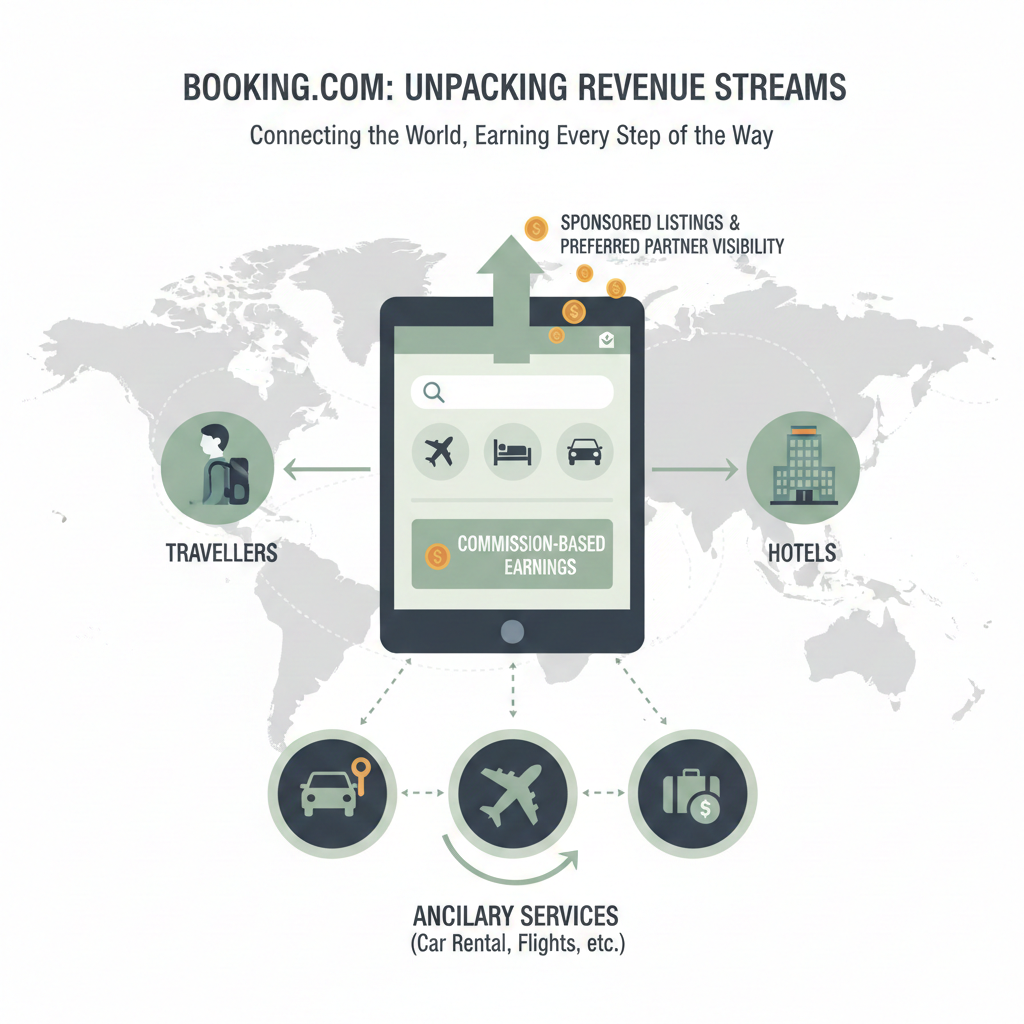
Short answer: Booking.com operates on a commission-based online travel marketplace business model, connecting travellers with hotels, vacation rentals, and other accommodations, and earning money by charging partners a commission for each completed booking.
How it works: The platform doesn’t own any hotels or properties. Instead, it acts as an intermediary, taking a percentage (typically 15-25%) from accommodation providers for each reservation made through its platform. This asset-light model has made Booking.com one of the most profitable companies in the travel industry.
To understand why Booking.com dominates global travel bookings, we need to break down how its marketplace, pricing power, and technology work together behind the scenes.
What Is Booking.com?
Booking.com was founded in 1996 in Amsterdam and is now part of Booking Holdings (formerly Priceline Group), which also owns brands like Kayak, Priceline, and Agoda. What started as a small Dutch startup has grown into the world’s largest accommodation booking platform, listing over 28 million properties across 220+ countries.
The problem it solves: For travellers, finding and booking trusted accommodations globally used to require calling hotels, working with travel agents, or hoping availability matched your dates. For property owners, reaching international customers meant expensive marketing and complicated distribution channels.
Core users: The platform serves two distinct groups—travellers seeking accommodation and property owners (hotels, vacation rental hosts, apartment managers, resorts) seeking customers.
Core promise: Booking.com offers travellers unprecedented choice, transparent pricing, verified reviews, and global availability, while giving property owners access to millions of potential guests without upfront marketing costs.
Booking.com’s Core Business Model Explained
Marketplace Platform Model
Booking.com operates as a two-sided marketplace connecting supply (properties) and demand (travellers). The company owns no hotels, vacation rentals, or real estate. This asset-light approach means Booking.com can scale globally without the capital requirements of traditional hotel chains.
The platform’s value increases with liquidity—the more properties listed, the more travellers visit; the more travellers visit, the more properties want to list. This network effect creates a powerful competitive moat.
Commission-Based Revenue Model
Booking.com charges accommodation partners a commission for each completed stay. This pay-per-booking structure means properties only pay when they actually receive guests, not for visibility alone.
Commissions typically range from 15% to 25% depending on location, property type, competition, and the visibility tier the partner chooses. A hotel in a competitive market like Paris might pay higher commissions than a guesthouse in rural Portugal.
How Booking.com Makes Money
Accommodation Commissions (Primary Revenue Source)
The vast majority of Booking.com’s revenue comes from commissions on completed bookings. Whether it’s a luxury resort in the Maldives, a budget hostel in Bangkok, or a vacation rental in Tuscany, every booking generates commission revenue.
The beauty of this model: revenue scales directly with transaction volume, and completed bookings (not just listings) drive income.
Preferred Partner Program
Properties can opt into higher commission tiers in exchange for better visibility in search results. This creates a dual benefit: partners willing to pay 20-25% commission appear higher in search rankings, driving more bookings for them and more revenue per listing for Booking.com.
Advertising and Sponsored Listings
Beyond organic rankings, properties can pay for sponsored placements at the top of search results. This performance advertising model allows Booking.com to monetize competitive searches while giving properties additional visibility control.
Ancillary Travel Services
While accommodations remain core, Booking.com has expanded into flights, car rentals, airport taxis, and experiences. These services generate additional commissions and increase customer lifetime value by becoming a one-stop travel platform.
Supply-Side Strategy (Hotels and Hosts)
Booking.com makes it remarkably easy for property owners to join:
Easy onboarding: Properties can list themselves online, set their own prices, and manage availability through an intuitive dashboard.
Flexible control: Unlike some platforms, property owners maintain pricing control and can adjust rates based on demand, seasonality, or competition.
Revenue management tools: The platform provides occupancy analytics and dynamic pricing suggestions, helping even small properties optimize revenue.
Global exposure: A family-run guesthouse in Greece gains instant access to millions of travellers worldwide—exposure that would be impossible to achieve independently.
Demand-Side Strategy (Travellers)
For customers, Booking.com offers:
Massive inventory: With 28 million+ properties, travellers can find options for virtually any destination, budget, or preference.
Price transparency: Clear pricing with fees shown upfront builds trust and reduces booking friction.
Flexible cancellation: Many listings offer free cancellation, reducing booking anxiety and increasing conversion rates.
Trust signals: Verified reviews from real guests help travellers make informed decisions. Booking.com displays review scores prominently, creating accountability for properties.
Localization: The platform supports 40+ languages and displays prices in local currencies, removing barriers for international travellers.
Technology and Platform Logic
While Booking.com’s technology is complex, its core mechanisms are straightforward:
Search and ranking algorithms prioritize properties based on relevance, guest ratings, commission tier, and availability. Properties with better reviews, more bookings, and higher commissions appear first.
Dynamic pricing signals help properties understand market rates, though Booking.com doesn’t control pricing—properties set their own rates.
Personalized recommendations use browsing history and preferences to surface relevant options, increasing booking likelihood.
Fraud prevention systems protect both travellers and properties from scams, payment fraud, and fake reviews.
Mobile-first experience: With over 50% of bookings happening on mobile devices, the app provides a seamless booking journey optimized for smartphones.
Customer Acquisition Strategy
Booking.com invests heavily in customer acquisition:
Performance marketing: The company spends billions annually on Google Ads and SEO, bidding on hotel names, destination keywords, and travel-related searches. This aggressive marketing drives massive traffic but also represents a significant cost.
App-first loyalty: The mobile app encourages repeat bookings through push notifications, saved preferences, and streamlined rebooking.
Genius loyalty program: Frequent users unlock discounts and perks, creating incentive to book repeatedly through Booking.com rather than competitors.
Brand recall: Consistent advertising has made Booking.com the default platform many travellers think of when booking accommodations.
Cost Structure (Where Booking.com Spends Money)
Performance marketing and advertising: This represents the largest expense, with billions spent annually on Google Ads, display advertising, and SEO.
Technology infrastructure: Maintaining a platform handling millions of daily searches requires significant engineering investment.
Customer support: Supporting travellers and properties across 40+ languages and 220+ countries requires substantial support operations.
Partner onboarding and management: Dedicated teams help properties optimize listings, manage disputes, and improve performance.
Compliance and localization: Operating globally means navigating different regulations, tax systems, and local requirements in every market.
Unit Economics Explained Simply
Booking.com’s economics improve with scale:
Cost to acquire a booking: Typically $30-50 in marketing costs per completed booking.
Commission per booking: Average commission of 17-18% on a $150 average booking value = roughly $25-27 revenue per booking.
Repeat customer advantage: First-time customers may be unprofitable due to acquisition costs, but repeat bookers (who don’t require new marketing spend) become highly profitable.
Why scale improves margins: As brand strength grows, more direct traffic arrives (people typing “booking.com” directly), reducing reliance on expensive paid advertising. This is why Booking Holdings consistently achieves operating margins above 30%.
Booking.com vs Competitors (Quick Comparison)
Booking.com vs Airbnb: Booking.com focuses on hotels and traditional accommodations with vacation rentals as secondary; Airbnb started with vacation rentals and emphasizes unique stays and experiences.
Booking.com vs Expedia: Both operate marketplace models, but Booking.com has deeper inventory in Europe and smaller properties, while Expedia has stronger loyalty programs (through brands like Hotels.com) and packaged deals.
Marketplace liquidity advantage: Booking.com’s massive inventory creates superior liquidity—travellers find more options, which attracts more properties, which attracts more travellers. This flywheel is hard for smaller platforms to compete against.
Challenges in Booking.com’s Business Model
Google dependency: With significant traffic coming from Google searches, algorithm changes or increased ad costs directly impact profitability. Google’s expansion into travel metasearch also creates a powerful competitor/gatekeeper dynamic.
Regulatory pressure: Cities like Amsterdam, Barcelona, and Paris have implemented restrictions on short-term rentals. Hotel taxes, commission transparency requirements, and data privacy regulations add compliance complexity.
Price parity pressure: Hotels sometimes offer better rates on direct booking channels, and some travellers have learned to use Booking.com for research but book directly to avoid commissions.
Platform trust management: Fake reviews, fraudulent properties, and booking scams require constant vigilance and sophisticated detection systems.
What Founders Can Learn from Booking.com
Liquidity matters more than features: Booking.com’s interface isn’t revolutionary, but its massive inventory creates unbeatable value. In marketplaces, depth of supply and demand beats beautiful design.
Supply depth builds demand automatically: By obsessively adding properties, Booking.com made itself indispensable to travellers. When you have what users need, they come—and they bring network effects with them.
Commissions scale better than inventory: Owning hotels requires capital and risk; taking commissions on others’ inventory requires software and marketing. The latter scales infinitely better.
Trust systems are core infrastructure: Reviews, verified bookings, fraud prevention, and dispute resolution aren’t nice-to-haves—they’re the foundation that makes the marketplace work.
Future of Booking.com’s Business Model
Expansion beyond accommodation: Flights, rental cars, and experiences represent growth areas as Booking.com evolves into a comprehensive travel platform.
AI-driven personalization: Expect more sophisticated recommendations based on preferences, past behavior, and contextual signals to increase conversion rates.
Direct booking incentives: The Genius loyalty program and app-exclusive deals aim to reduce Google dependency by building direct relationships with travellers.
Super-app travel experience: Integrating all travel needs—transport, accommodation, experiences, insurance—into one seamless journey increases stickiness and customer lifetime value.
Wrap Up
Booking.com remains dominant globally because it mastered marketplace discipline over hype. While competitors chased flashy features or narrow niches, Booking.com relentlessly expanded inventory, invested in customer acquisition, and optimized conversion.
The business model’s elegance lies in its simplicity: connect those with rooms to those needing rooms, charge only for completed transactions, and reinvest profits into acquiring more of both sides. This flywheel, powered by network effects and executed with operational excellence, has created a travel marketplace that processes hundreds of millions of bookings annually.
For entrepreneurs building marketplaces, Booking.com demonstrates that long-term compounding through scale and trust beats short-term innovation every time. The world’s largest travel marketplace wasn’t built with revolutionary technology it was built by solving a fundamental problem better than anyone else, consistently, for nearly three decades.
Discover more from Business Model Hub
Subscribe to get the latest posts sent to your email.






[…] ads and local agents now happens instantly through smartphone apps. Platforms like Airbnb, Vrbo, and Booking.com have democratized access to lodging inventory, enabling anyone with spare space to become a […]
[…] Booking.com operates a similar marketplace model but focuses more heavily on hotels and traditional accommodations, though it has expanded into vacation rentals. It takes a commission from properties for each booking and has a massive global footprint, particularly in Europe. […]
[…] Booking.com and Expedia have their own review systems and are increasingly positioning as destination research tools, not just booking engines. Google has integrated travel search deeply into its own products, intercepting some of the queries that used to flow to Tripadvisor. Airbnb is building experience and travel planning features. And a new wave of AI travel planning tools threatens to answer “what should I do in Tokyo” without sending users to a third-party platform at all. […]