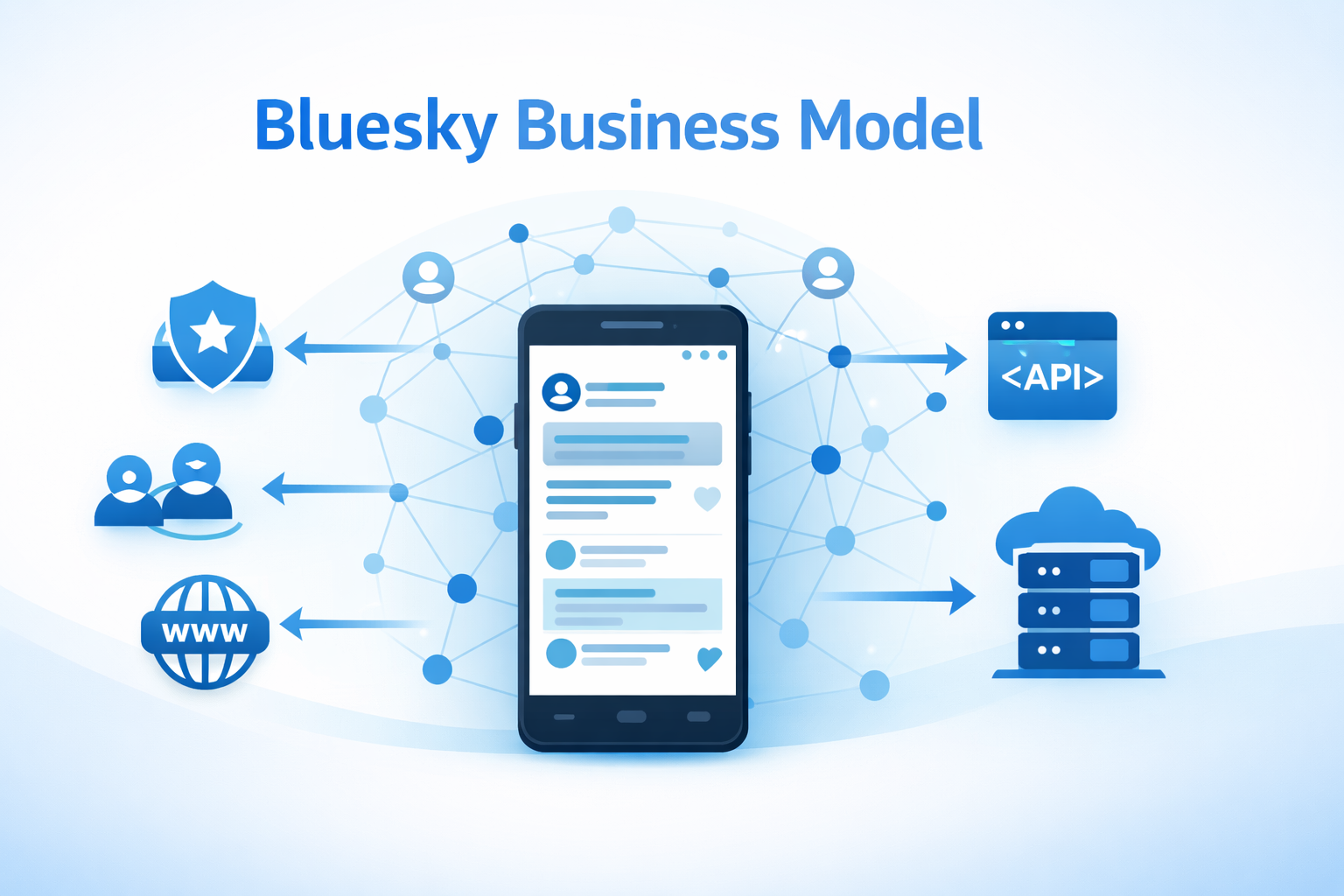
Bluesky’s business model is based on decentralized social networking using the AT Protocol, with future monetization expected through subscriptions, custom domain hosting, paid services, and platform-based ecosystem revenue rather than traditional ad-heavy models. Bluesky focuses on user control, open protocols, and interoperability instead of pure advertising-driven revenue like X (Twitter) or Meta.
Introduction: Why Everyone Is Talking About Bluesky
The social media landscape is experiencing a seismic shift, and Bluesky sits at the center of this transformation. What started as an experimental project within Twitter has evolved into one of the most talked-about alternatives to traditional social platforms.
Brief Background of Bluesky
Bluesky emerged from an unusual origin story. In 2019, then-Twitter CEO Jack Dorsey announced funding for a small independent team to develop an open and decentralized standard for social media. The vision was ambitious: create a protocol that would allow Twitter itself to eventually become a client of this larger, open ecosystem rather than a walled garden.
Jack Dorsey’s Involvement
Jack Dorsey’s philosophical shift toward decentralization played a crucial role in Bluesky’s inception. Frustrated with the challenges of content moderation, algorithmic control, and platform governance at scale, Dorsey envisioned a future where social media operated more like email—an open protocol that anyone could build upon, rather than a single company’s proprietary system.
Why Users Are Shifting from X to Bluesky
The migration to Bluesky has accelerated dramatically, particularly following changes at X (formerly Twitter) under Elon Musk’s ownership. Users cite several reasons for the exodus:
- Dissatisfaction with algorithmic changes prioritizing engagement over relevance
- Concerns about platform governance and content moderation policies
- Desire for more control over their social media experience
- Interest in supporting alternatives to billionaire-controlled platforms
- Appeal of owning their digital identity and data
Decentralization Trend in Social Media
Bluesky represents a broader movement toward decentralized social networking. This trend mirrors developments in other tech sectors, from cryptocurrency to cloud computing, where users increasingly value autonomy, data ownership, and freedom from single-point control. The philosophy is simple: rather than trusting one company with your digital social life, distribute that power across an open network where users maintain sovereignty over their identity and content.
What Is Bluesky? (Business Overview)
Bluesky is a social networking platform that fundamentally reimagines how social media should work. Unlike traditional platforms where a single company owns and controls everything, Bluesky operates on a revolutionary foundation.
Social Networking Platform
At its core, Bluesky looks and feels familiar to anyone who’s used Twitter. You can post short updates (up to 300 characters), follow other users, engage with content through likes and reposts, and build a community. The interface is clean, intuitive, and deliberately reminiscent of Twitter’s best days.
Built on AT Protocol (Authenticated Transfer Protocol)
The magic happens underneath. Bluesky runs on the AT Protocol, a technical foundation that enables decentralized social networking. Think of it as the difference between email and a messaging app. Email works across providers—you can use Gmail to email someone on Outlook. The AT Protocol aims to bring that same interoperability to social media.
Focus on Decentralization
Decentralization means no single entity controls the entire network. While Bluesky Social PBC (the company) built the initial app, the underlying protocol allows anyone to create compatible applications, run their own servers, or build entirely new experiences on the same social graph.
User-Owned Identity
Perhaps most revolutionary: your identity on Bluesky can be truly yours. Instead of being @username on a platform you don’t control, you can use your own domain name as your handle (like @yourname.com), ensuring you maintain ownership of your online identity even if you switch between different apps built on the AT Protocol.
Custom Algorithms
Unlike platforms where algorithms are mysterious black boxes optimized for engagement and ad revenue, Bluesky lets users choose their own algorithmic feeds. Want chronological? Done. Prefer algorithmic discovery? Available. Want something in between, or something entirely different created by a third-party developer? The choice is yours.
Explaining the Difference: Centralized vs Decentralized Platforms
Centralized platforms (like X, Facebook, Instagram):
- One company owns all servers, data, and code
- You’re subject to their rules, algorithms, and business decisions
- Your account exists only within their ecosystem
- If they shut down or ban you, you lose everything
- They monetize primarily through ads and your data
Decentralized platforms (like Bluesky):
- Multiple servers can host the network
- You own your identity and can move between services
- Open protocols allow competitive innovation
- Community-driven moderation and governance options
- Monetization focuses on services rather than surveillance
Why Bluesky Is Different
Bluesky occupies a unique middle ground. It’s more user-friendly than fully decentralized platforms like Mastodon, yet more open than traditional social networks. The AT Protocol provides the technical foundation for decentralization while Bluesky (the company) provides a polished, accessible client application that makes the technology approachable for everyday users.
This combination—familiar user experience plus revolutionary underlying architecture—positions Bluesky as potentially the first decentralized social platform to achieve mainstream adoption.
Bluesky Business Model Explained
Understanding Bluesky’s business model requires recognizing that it operates on multiple levels simultaneously. It’s not just a social media app—it’s platform infrastructure, an open protocol, and a community experiment all rolled into one.
A. Platform-Based Model
Social Networking Platform
At the most visible level, Bluesky operates as a traditional social networking platform. Users create accounts, build social graphs, share content, and engage with communities. This familiar model benefits from well-understood user behaviors and expectations.
User-Generated Content
Like all successful social platforms, Bluesky’s value comes from its users. Every post, reply, like, and follow creates content and connections that make the platform more valuable. This user-generated content requires no acquisition cost for Bluesky—users create it voluntarily because they derive social value from participation.
Network Effect-Driven Growth
The platform exhibits classic network effects: each new user makes the platform more valuable for existing users. As more people join, there are more interesting accounts to follow, more conversations to join, and more reasons for others to join. This creates a self-reinforcing growth cycle that, if sustained, becomes a powerful competitive moat.
B. Open Protocol Model (AT Protocol)
Anyone Can Build on Top of Bluesky
The AT Protocol transforms Bluesky from a simple platform into infrastructure. Third-party developers can create applications that interact with the same social graph, offering different interfaces, features, or experiences while users maintain their identity and connections.
App Ecosystem Potential
Imagine an ecosystem like iOS or Android, but for social networking. Developers could build:
- Specialized clients for creators, journalists, or specific communities
- Analytics and management tools
- Algorithmic feeds optimized for discovery, news, or entertainment
- Integration tools connecting Bluesky to other services
- Novel social experiences we haven’t imagined yet
Third-Party Services Layer
Beyond apps, the protocol enables an entire services layer. Companies could offer hosting, moderation, verification, analytics, or other value-added services. Bluesky becomes the foundation rather than the entire stack, creating opportunities for ecosystem participants to generate revenue while expanding the network’s capabilities.
C. Community-First Growth Strategy
Invite-Only Early Phase
Bluesky launched with an invite-only model that created both scarcity and selectivity. This approach served multiple purposes: managing server load during development, fostering a strong initial community, and generating buzz through exclusivity.
Controlled Scaling
Rather than rapid, chaotic growth, Bluesky scaled deliberately. This allowed the team to:
- Refine features based on real-world usage
- Build robust infrastructure before mass adoption
- Cultivate community norms and culture
- Identify and address issues at manageable scale
Organic Adoption
By relying on word-of-mouth and genuine enthusiasm rather than aggressive marketing, Bluesky built a community of invested users who understand and appreciate the platform’s philosophy. These early adopters become ambassadors, helping shape the platform’s culture and advocate for its growth.
This three-layered approach—platform, protocol, and community—creates multiple potential paths to sustainability. Bluesky isn’t locked into a single business model but can adapt based on what works best for the ecosystem’s long-term health.
How Does Bluesky Make Money? (Revenue Model)
Currently, Bluesky generates limited revenue and operates primarily on grants and investment funding. However, the company has outlined several potential revenue streams designed to sustain the platform without compromising its core values of openness and user control.
1. Paid Subscriptions
The most likely near-term revenue source is a subscription model offering premium features:
Premium Features
- Advanced posting options (longer posts, more media attachments)
- Enhanced profile customization
- Priority support and customer service
- Early access to new features
Custom Themes
- Personalized interface colors and designs
- Special badges or profile decorations
- Unique visual experiences while maintaining the core free platform
Advanced Moderation Tools
- Sophisticated filtering and blocking capabilities
- Automated moderation assistance
- Enhanced privacy controls
- Team or organization moderation features
Analytics Tools
- Detailed insights into post performance
- Audience demographics and growth tracking
- Engagement metrics and trends
- Creator-focused analytics for content optimization
The subscription approach allows Bluesky to generate revenue from users who can afford to pay while keeping core functionality free and accessible to everyone.
2. Custom Domain Hosting Fees
One of Bluesky’s most innovative features is allowing users to use their own domain names as handles (e.g., @jane.com instead of @jane.bsky.social).
Users Can Own Their Identity This transforms your social media handle from a platform-dependent username into a piece of digital property you truly own. Even if you switch to a different app built on the AT Protocol, your identity travels with you.
Hosting and Verification Services Bluesky can charge fees for:
- Domain verification and setup assistance
- Managed hosting for users who own domains but need technical help
- Premium vanity domains or special character handles
- Business verification and enhanced credibility features
This creates recurring revenue while providing genuine value—helping users establish portable, verifiable digital identities.
3. Developer Ecosystem Revenue
Paid APIs (Future Possibility) As the platform scales, Bluesky might offer paid API access for:
- Commercial applications requiring high rate limits
- Analytics and data access for businesses
- Enterprise integration tools
- Automated posting and management services
Third-Party App Integrations Revenue sharing agreements with applications built on the AT Protocol could create a sustainable ecosystem where Bluesky takes a percentage of subscription or service fees from third-party developers, similar to app store models.
Revenue-Sharing Model Establishing a marketplace where developers can offer paid services, with Bluesky taking a platform fee, creates aligned incentives: Bluesky succeeds when the ecosystem succeeds.
4. Marketplace or Creator Tools (Future Scope)
Paid Communities Similar to Discord’s model, Bluesky could enable creators to establish paid membership communities with exclusive content, special access, or premium features.
Creator Monetization Tools
- Subscription-based content (similar to Patreon integration)
- Pay-per-post or pay-per-access features
- Digital goods marketplace
- Event ticketing and community management
Tipping Systems Micropayment infrastructure allowing users to financially support creators they appreciate, with Bluesky taking a small transaction fee.
5. Infrastructure Services
Hosting Fees for Decentralized Servers While the AT Protocol is decentralized, many users will prefer managed hosting rather than running their own servers. Bluesky can offer:
- Personal Data Server (PDS) hosting with different tiers
- Backup and redundancy services
- Custom server configurations for organizations
- Enhanced performance and reliability guarantees
Enterprise-Level Services Organizations, businesses, or institutions might pay for:
- Branded instances or specialized environments
- Advanced compliance and data governance tools
- Integration with existing enterprise systems
- Dedicated support and service level agreements
Important Note on Current Status
As of early 2026, Bluesky remains primarily funded through grants and investment, not these revenue streams. The company has been transparent that monetization is still being developed, prioritizing user experience and protocol development over immediate profitability. This patient approach contrasts sharply with VC-backed social platforms that face intense pressure to monetize quickly, often at users’ expense.
Bluesky vs Twitter (X) Business Model Comparison
Understanding Bluesky requires seeing how fundamentally it differs from traditional social platforms. Here’s a comprehensive comparison with X (formerly Twitter):
| Factor | Bluesky | X (Twitter) |
|---|---|---|
| Structure | Decentralized protocol with multiple possible clients | Centralized platform owned and controlled by single entity |
| Primary Revenue | Subscription-based services (planned) | Advertising + X Premium subscriptions |
| Data Ownership | User-controlled; portable across apps | Platform-controlled; locked within X ecosystem |
| Algorithm | User-selectable from multiple options; transparent | Company-controlled; optimized for engagement and ads |
| Identity | Portable (can use own domain) | Platform-dependent (@username only valid on X) |
| Development | Open protocol; anyone can build clients | Closed ecosystem; third-party apps restricted |
| Moderation | User-chosen; multiple moderation services available | Centralized; company-determined policies |
| Content Policy | Distributed governance possible | Single authority (company leadership) |
| Network Effect | Can be shared across protocol-compatible apps | Locked within X platform only |
| Monetization Philosophy | Service-based; aligned with user interests | Ad-based; creates user-advertiser tension |
| Data Portability | Full export; can migrate to other AT Protocol apps | Limited export; no true portability |
| API Access | Open and free (with potential paid tiers) | Heavily restricted; expensive for developers |
| Business Alignment | Users are customers (through subscriptions) | Users are products (sold to advertisers) |
Deeper Look at Key Differences
Structural Philosophy
X operates on the assumption that centralized control creates the best user experience and business model. One company makes all decisions, controls all infrastructure, and captures all value. This creates efficiency but also concentration of power.
Bluesky inverts this assumption. By separating the protocol (AT Protocol) from the application (Bluesky app), it creates a competitive marketplace where different clients can serve users in different ways while sharing the same social graph.
Revenue Model Implications
X’s advertising-dependent model creates inherent conflicts of interest. The platform succeeds when users spend more time and see more ads, regardless of whether that time is valuable or healthy. Algorithmic feeds optimize for engagement (often through outrage and controversy) because that drives ad revenue.
Bluesky’s subscription-oriented approach aligns incentives differently. The platform succeeds when users find enough value to pay for premium features, not when they’re hooked into endless scrolling. This potentially creates healthier dynamics, though it requires convincing users to pay for something they’ve grown accustomed to getting “free.”
Control and Autonomy
On X, you’re subject to whatever decisions Elon Musk or future owners make. Algorithm changes, policy shifts, interface redesigns—all happen at the platform’s discretion, and users must accept them or leave (losing their network in the process).
Bluesky’s decentralized model distributes power. Don’t like the official Bluesky app’s choices? Use a different client. Don’t like available moderation options? Choose or create different ones. Your identity and network remain intact regardless of which apps or services you use.
Long-Term Sustainability
X’s model has proven profitable but faces challenges: advertiser friendliness conflicts with free speech values, subscription uptake remains limited, and user growth has plateaued. The platform’s value depends entirely on maintaining critical mass within X itself.
Bluesky’s sustainability is less proven but potentially more resilient. As a protocol, it could survive even if Bluesky Social PBC fails, with other entities supporting the ecosystem. However, this requires successfully monetizing without the proven revenue engine of advertising.
Bluesky Business Model Canvas
The Business Model Canvas provides a structured way to understand how Bluesky creates, delivers, and captures value. Here’s how each component applies:
1. Customer Segments
Bluesky serves multiple distinct customer groups:
Social Media Users
- Individuals seeking alternatives to mainstream platforms
- Users prioritizing privacy and data ownership
- People frustrated with algorithmic manipulation
- Communities seeking more control over their online spaces
Developers
- App creators wanting to build on open protocols
- Service providers offering moderation, hosting, or analytics
- Entrepreneurs seeing opportunities in the decentralized social ecosystem
- Open-source contributors interested in protocol development
Creators
- Content creators seeking better monetization options
- Journalists and writers wanting direct audience relationships
- Artists and performers looking for community-controlled platforms
- Influencers diversifying beyond traditional platforms
Privacy-Focused Users
- Individuals concerned about data collection and surveillance
- Those seeking ownership and control over digital identity
- Users wanting transparent, auditable systems
- People philosophically aligned with decentralization
2. Value Proposition
Bluesky’s core value propositions differentiate it from competitors:
Decentralization Users aren’t dependent on a single company’s decisions, creating resilience and user empowerment. The network can survive beyond any single entity.
Algorithm Choice Rather than accepting whatever feed the platform decides to show you, choose from multiple algorithmic options or even create your own. Transparency replaces mystery.
Data Ownership Your posts, connections, and identity belong to you, not the platform. This portability ensures you’re never locked in and can migrate if better options emerge.
No Heavy Advertising Without ad-driven revenue, the platform can prioritize user experience over advertiser demands. Your attention isn’t the product being sold.
Portable Identity Using your own domain as your handle creates a truly owned digital identity that transcends any single platform or application.
Community Control Moderation can be distributed and customized, allowing communities to set their own standards rather than accepting one-size-fits-all policies.
3. Channels
How Bluesky reaches and serves customers:
Mobile App iOS and Android applications provide the primary user experience for most people, offering familiar social networking functionality with the benefits of the AT Protocol.
Web Platform Browser-based access ensures availability across all devices and platforms, requiring no installation and offering flexibility.
Developer Ecosystem Documentation, APIs, and community support enable third parties to build complementary products and services, expanding Bluesky’s reach through ecosystem partners.
Community and Word-of-Mouth Organic growth through user advocacy and social proof, particularly important during the invite-only phase and early growth stages.
4. Customer Relationships
How Bluesky interacts with and retains users:
Community-Based Strong emphasis on community self-governance, user participation in platform development, and collaborative problem-solving. Users feel ownership and investment in the platform’s success.
Transparent Communication Open roadmaps, public development discussions, and honest communication about challenges and limitations build trust and set realistic expectations.
User Agency Empowering users with choices about algorithms, moderation, and experience rather than imposing one-size-fits-all solutions.
Developer Relations Active engagement with builders creating on the protocol, fostering an ecosystem mindset rather than competitive gatekeeping.
5. Revenue Streams
Planned and potential sources of income:
Subscriptions Premium features, enhanced customization, and advanced tools for power users willing to pay for additional value.
Domain Hosting Fees for custom domain handles, verification services, and managed hosting solutions.
Ecosystem Services Revenue sharing from third-party applications, API access fees, and marketplace transaction fees.
Infrastructure Hosting Paid hosting services for Personal Data Servers, backup solutions, and enterprise-grade infrastructure.
Creator Tools Transaction fees from creator monetization, paid communities, and marketplace activities.
6. Key Resources
Critical assets enabling Bluesky’s business model:
AT Protocol The foundational technology that enables everything else. This intellectual property and technical infrastructure is Bluesky’s most valuable asset.
Developer Community Contributors, third-party builders, and ecosystem participants who extend the platform’s capabilities and create additional value.
Brand Credibility Association with Jack Dorsey, positioning as the “better Twitter,” and reputation for principled stances on decentralization and user rights.
User Base and Network Effects The growing community of users whose presence attracts others and creates the social graph that makes the platform valuable.
Technical Team Engineers and developers who understand both the complex technical challenges of building decentralized systems and the user experience requirements of social platforms.
7. Key Activities
Essential operations for value creation:
Platform Development Continuous improvement of the Bluesky app, adding features, fixing bugs, and optimizing performance.
Moderation Tools Building sophisticated, flexible moderation infrastructure that can be customized and distributed while preventing abuse.
Protocol Improvement Ongoing development of the AT Protocol, adding capabilities, improving performance, and maintaining compatibility.
Community Management Fostering a healthy community, communicating with users, and managing the social dynamics of a growing platform.
Ecosystem Development Supporting third-party developers, creating documentation, and nurturing the broader ecosystem of apps and services.
8. Key Partners
External relationships critical to success:
Developers Third-party app creators, service providers, and ecosystem builders who extend Bluesky’s capabilities and reach.
Hosting Providers Infrastructure partners providing server capacity, content delivery, and technical infrastructure.
Infrastructure Services Domain registrars, payment processors, and other service providers enabling key functionality.
Research Community Academic and industry partners contributing to decentralized technology development and protocol evolution.
9. Cost Structure
Major expenses in operating the business:
Server Costs Hosting infrastructure for the primary Bluesky app and supporting network infrastructure as the platform scales.
Development Team Salaries for engineers, designers, product managers, and other technical staff building and maintaining the platform.
Security & Moderation Trust and safety teams, automated moderation tools, and security infrastructure to protect users and prevent abuse.
Research & Innovation Ongoing investment in protocol development, exploring new features, and staying ahead of technical challenges.
Community Support Customer service, community management, and user support operations.
Marketing and Growth Costs associated with user acquisition, brand building, and ecosystem development (though currently minimal compared to traditional platforms).
The Business Model Canvas reveals Bluesky’s unique position: it’s simultaneously a social platform, protocol developer, and ecosystem facilitator. This multi-faceted approach creates complexity but also multiple potential paths to sustainability and success.
Growth Strategy of Bluesky
Bluesky’s growth strategy represents a deliberate departure from the “growth at all costs” mentality that dominates Silicon Valley. Instead, the platform has pursued measured, intentional expansion focused on building a sustainable foundation.
Invite-Only Scarcity Strategy
Bluesky launched with an invite-only model that created both practical benefits and psychological intrigue:
Practical Benefits:
- Controlled server load during early development
- Manageable community size for testing features and policies
- Ability to identify and address issues before mass scale
- Time to refine the protocol and infrastructure
- Opportunity to build culture and norms with engaged early adopters
Psychological Dynamics:
- Scarcity creates perceived value
- Exclusivity generates media attention and social buzz
- Invite system encourages existing users to actively recruit aligned friends
- Creates a sense of being “in the know” among early members
- Generates viral moments as people share invite codes
This approach mirrors successful historical examples like Gmail’s early invite-only phase, which turned a email service launch into a cultural phenomenon.
Word-of-Mouth Growth
Rather than spending on traditional advertising, Bluesky has relied almost entirely on organic advocacy:
User Enthusiasm: Early adopters genuinely excited about the platform’s potential became natural ambassadors, explaining the vision to their networks and recruiting like-minded users.
Media Coverage: The platform’s association with Jack Dorsey, its ambitious decentralization goals, and its positioning as a Twitter alternative generated substantial earned media coverage without paid promotion.
Social Proof: As notable figures, journalists, and influencers joined, their presence validated the platform and attracted their followers, creating cascading adoption waves.
Community-Driven Promotion: Users created guides, comparison threads, and explainers helping others understand Bluesky’s unique value proposition, doing marketing work the company didn’t need to fund.
Decentralized Appeal
Bluesky taps into growing dissatisfaction with centralized tech platforms:
Anti-Monopoly Sentiment: Increasing public awareness of tech concentration and platform power makes decentralization emotionally and intellectually appealing to many users.
Data Privacy Concerns: Ongoing scandals about data misuse, surveillance, and privacy violations create demand for alternatives offering genuine user control.
Ideological Alignment: Users who value open source, digital rights, and internet freedom find Bluesky’s philosophy inherently attractive.
Platform Risk Awareness: High-profile examples of platforms making sudden, user-hostile changes have made people aware of the risks of centralization, making Bluesky’s portability promise valuable.
Anti-Big-Tech Positioning
Bluesky benefits from positioning itself as fundamentally different from established players:
David vs. Goliath Narrative: A small, mission-driven team against massive corporations creates an underdog story people want to support.
Values-Driven Alternative: When users feel mainstream platforms prioritize profit over people, Bluesky’s commitment to openness and user control provides a principled alternative.
Refuge During Controversies: Major controversies at X, Meta, or other platforms drive waves of users seeking alternatives, with Bluesky positioned to capture those looking for something genuinely different.
Network Effects: The Ultimate Growth Engine
Understanding network effects is crucial to assessing Bluesky’s growth potential:
Direct Network Effects: Each new user makes the platform more valuable for existing users by increasing the pool of potential connections, content creators, and conversation partners. This creates exponential value growth as the user base expands linearly.
Cross-Side Network Effects: More users attract more developers to build on the protocol, creating better apps and services, which attracts more users. This virtuous cycle can accelerate adoption once critical mass is reached.
Data Network Effects: As more people use custom algorithms and moderation services, these tools improve through accumulated data and usage, making them more valuable and attracting additional users.
Critical Mass Challenge: Network effects only become powerful after reaching a threshold size. Below that threshold, growth is hard because there aren’t enough people to make the platform valuable. Above it, growth accelerates because each new user adds value. Bluesky is currently working toward this critical mass.
Protocol Amplification: Unlike traditional platforms where network effects are confined to one app, the AT Protocol potentially allows network effects to compound across multiple applications. Your social graph, content, and connections have value across any AT Protocol app, not just Bluesky.
Competitive Moat Potential: If Bluesky successfully builds strong network effects, they become a powerful defense against competitors. Users stay not because they’re locked in technically, but because the value of the network makes switching costly.
Measured Expansion Phase
After the initial invite-only period, Bluesky has gradually opened access:
- Controlled rollout allowing infrastructure to scale with demand
- Regional expansion targeting markets where demand is strongest
- Feature-gated growth ensuring core functionality is solid before mass adoption
- Community capacity management to maintain culture and user experience quality
This growth strategy reflects a fundamental bet: that slow, sustainable growth focused on building genuine value will ultimately be more successful than aggressive, acquisition-focused expansion that prioritizes metrics over sustainability. Whether this patient approach can compete with well-funded rivals pursuing traditional growth strategies remains one of Bluesky’s key open questions.
Is Bluesky Sustainable Long-Term?
The question of long-term sustainability is perhaps the most critical challenge facing Bluesky. The platform’s idealistic vision and technical innovation are impressive, but can it survive and thrive in the competitive social media landscape?
Challenge of Monetization Without Ads
The Ad Revenue Reality: Social media advertising has proven extraordinarily profitable. Facebook, Instagram, X, and others generate billions because advertising scales efficiently: more users mean more ad inventory, higher targeting precision, and increased revenue per user.
Bluesky’s Dilemma: Rejecting advertising removes the most proven social media monetization model. This creates pressure to find alternative revenue sources that can:
- Generate sufficient income to cover infrastructure costs
- Fund ongoing development and innovation
- Provide returns for investors
- Support ecosystem growth
Subscription Challenges: Converting “free” social media users to paying subscribers faces several obstacles:
- Users are accustomed to ad-supported free services
- Willingness to pay varies dramatically across demographics and regions
- Competition from free alternatives (X, Threads, Mastodon)
- Need to demonstrate clear value beyond basic functionality
Potential Solutions:
- Freemium model with compelling premium features
- Business/enterprise tiers with substantially higher prices
- Ecosystem revenue from third-party services
- Infrastructure services for organizations and developers
The Optimistic Case: If even 5-10% of users pay for subscriptions, and ecosystem services generate additional revenue, the model could work. The key is reaching sufficient scale where this percentage represents meaningful absolute numbers.
Scaling Decentralized Systems
Technical Complexity: Decentralized architectures are inherently more complex than centralized ones. Challenges include:
- Maintaining performance as the network grows
- Ensuring data consistency across distributed systems
- Managing protocol evolution without breaking compatibility
- Coordinating between independent participants
Infrastructure Costs: Decentralization doesn’t eliminate costs; it redistributes them. Someone must pay for:
- Server hosting and bandwidth
- Data storage and redundancy
- Development and maintenance
- Moderation and trust & safety
Coordination Problems: As more entities participate in the ecosystem, coordinating standards, policies, and technical decisions becomes increasingly difficult. The protocol must balance flexibility with coherence.
User Experience Trade-offs: Decentralization can create friction:
- Choosing between services and providers
- Understanding complex technical concepts
- Managing portable identity and data
- Navigating distributed moderation systems
Bluesky’s Approach: The platform tries to abstract complexity, providing a user-friendly default experience while allowing power users to access deeper customization. Success requires maintaining this balance as the system scales.
Competition with Threads & X
Meta’s Threads: Launched with Instagram’s massive user base, Threads represents a formidable competitor:
- Instant access to hundreds of millions of potential users
- Tight integration with Instagram’s social graph
- Enormous resources for development and marketing
- Fediverse integration plans (ActivityPub protocol)
X’s Incumbent Advantage: Despite controversies, X retains significant strengths:
- Massive existing user base and established network effects
- Real-time news and information hub status
- Deep integration with media and journalism
- Brand recognition and cultural presence
Other Competitors:
- Mastodon and the Fediverse (decentralized alternatives)
- New platforms and experiments constantly emerging
- Niche communities and specialized networks
- Traditional platforms like Facebook and Instagram
Bluesky’s Competitive Position:
- More user-friendly than Mastodon
- More principled and open than Threads
- More innovative and forward-thinking than X
- Strong technical foundation with growth potential
Differentiation Challenge: Bluesky must convince users that its specific approach to decentralization is superior to alternatives while remaining accessible enough for mainstream adoption.
Need for Strong Developer Ecosystem
Ecosystem as Moat: Bluesky’s long-term success likely depends on building a thriving developer ecosystem that creates:
- Multiple client applications serving different needs
- Valuable services and tools built on the protocol
- Innovation that Bluesky itself couldn’t produce alone
- Network effects that transcend any single application
Developer Incentives: For this ecosystem to flourish, developers need:
- Clear monetization opportunities
- Stable, well-documented APIs
- Active user base to build for
- Supportive platform policies and partnerships
- Technical infrastructure that enables innovation
Platform Governance: Balancing openness with quality control presents ongoing challenges:
- Preventing abuse while maintaining freedom
- Setting standards without stifling creativity
- Managing protocol evolution with multiple stakeholders
- Building consensus in a decentralized community
Critical Mass Question: Developers generally build where users are. Bluesky needs sufficient users to attract developers, but needs developer innovation to attract users. Breaking this chicken-and-egg problem requires reaching critical mass where both sides see clear value.
Balanced Analysis: Paths to Success and Failure
Success Scenario: Bluesky reaches 50-100 million users over 3-5 years, with 5-10% conversion to paid subscriptions. A thriving ecosystem of third-party apps and services emerges, generating additional revenue and innovation. The protocol becomes the foundation for next-generation social networking, with Bluesky as the primary but not only client. Competition drives continuous improvement while users benefit from choice and portability.
Failure Scenario: Growth stalls before reaching critical mass. Most users stay on established platforms despite dissatisfaction. Monetization proves insufficient to cover costs. Investor patience runs out. Technical complexity hinders mainstream adoption. Competitors copy best ideas while leveraging superior resources. The project becomes a niche platform for enthusiasts rather than a mainstream alternative.
Most Likely Outcome: Bluesky probably carves out a sustainable but limited position: larger than Mastodon, smaller than X or Threads. It serves users who prioritize control and openness over convenience and network effects. The protocol influences larger platforms even if Bluesky itself doesn’t dominate. Financial sustainability comes from a combination of subscriptions, services, and possibly strategic partnerships or acquisitions.
Wildcard Factors:
- Major platform controversies driving migration waves
- Regulatory changes favoring interoperable systems
- Technical breakthroughs improving decentralized performance
- Cultural shifts toward digital sovereignty and data ownership
- Economic model innovations proving subscription-social-media viability
Sustainability isn’t guaranteed, but Bluesky has created a genuine alternative with meaningful differentiation. Whether that’s sufficient for long-term success depends on execution, market dynamics, and factors beyond the company’s control.
Risks in Bluesky Business Model
Every business model contains inherent risks and vulnerabilities. Understanding Bluesky’s specific challenges helps assess its prospects and potential pitfalls.
Monetization Uncertainty
Unproven Revenue Model: Unlike advertising-based social media with decades of proven success, subscription-based social networking remains largely theoretical at scale. Questions include:
- Will enough users actually pay for premium features?
- What price points maximize revenue without limiting adoption?
- Can subscription revenue cover operational costs at scale?
- How sustainable is reliance on voluntary payments?
Competition from Free Alternatives: Users have multiple free options for social networking. Convincing them to pay for Bluesky requires demonstrating clear, ongoing value that free alternatives don’t provide.
Payment Friction: Adding payment processes creates friction that reduces user adoption and retention. Even small barriers significantly impact conversion rates, particularly in markets with limited credit card penetration or payment infrastructure.
Revenue Timing Mismatch: Infrastructure and development costs occur immediately and continuously, but subscription revenue builds gradually as the user base grows. This creates a cash flow challenge requiring patient capital.
Infrastructure Cost Burden
Scaling Costs: Social media platforms face enormous infrastructure expenses as they grow:
- Server capacity and computation
- Data storage and redundancy
- Bandwidth and content delivery
- Security and reliability infrastructure
Decentralization Overhead: Distributed systems often cost more to operate than centralized ones due to:
- Redundancy requirements across multiple nodes
- Complex coordination and synchronization
- Higher technical complexity requiring specialized expertise
- Less efficient resource utilization
Economies of Scale Challenges: Centralized competitors benefit from massive economies of scale. Meta and Google can operate at marginal costs far below what smaller platforms achieve, creating competitive advantages in pricing and profitability.
The “Free” Expectation: Users expect social media to be free because advertising-supported models have created this norm. Justifying costs that competitors absorb through advertising requires strong value communication.
Regulatory Challenges
Content Moderation Responsibility: Regulators increasingly hold platforms accountable for user content. Decentralized moderation creates questions:
- Who is liable for illegal content on distributed systems?
- How do platforms comply with varying national regulations?
- Can decentralized systems meet regulatory requirements?
- What happens when different jurisdictions have conflicting rules?
Data Protection and Privacy: GDPR, CCPA, and similar regulations create compliance obligations:
- User data rights (access, deletion, portability)
- Consent management across distributed systems
- Data residency and sovereignty requirements
- Breach notification and security standards
Interoperability and Competition Law: While decentralization might align with regulatory goals for competition and interoperability, it also creates gray areas:
- Antitrust implications of protocol control
- Standards-setting and competition concerns
- Liability for third-party applications
- Cross-border data flows and jurisdiction
Platform Governance Requirements: Emerging regulations may mandate specific governance, transparency, or operational requirements that conflict with decentralized models or impose expensive compliance burdens.
The Moving Target: Social media regulation is evolving rapidly and unpredictably. What’s permissible today might be prohibited tomorrow, and compliance frameworks must constantly adapt.
Moderation Complexity in Decentralized Networks
Distributed Responsibility: When moderation is decentralized, fundamental questions arise:
- Who decides what content is acceptable?
- How is consensus reached on moderation policies?
- What happens when communities have conflicting standards?
- Who bears legal and social responsibility for failures?
Coordination Challenges: Effective moderation requires coordination, but decentralization complicates this:
- Bad actors can exploit inconsistencies between different moderators
- Harmful content may spread while different nodes decide how to respond
- Appeals and recourse become more complex
- Consistency suffers across the network
Scale vs. Effectiveness: As networks grow, moderation challenges multiply exponentially:
- Volume of content requiring review increases
- Sophistication of bad actors improves
- Edge cases and ambiguous situations proliferate
- Resources required for effective moderation grow faster than revenue
The Paradox of Tolerance: Decentralized systems face the classic tolerance paradox: being too tolerant allows intolerance to flourish, but being intolerant violates the principles of openness and free expression. Finding the right balance is philosophically and practically difficult.
User Safety vs. Free Expression: Different users prioritize these values differently. Some want aggressive moderation protecting against harassment and harm; others want minimal intervention preserving maximum free expression. Satisfying both simultaneously is nearly impossible.
Algorithmic Moderation: Automated systems are necessary at scale but create their own problems:
- False positives harming innocent users
- Difficulty understanding context and nuance
- Bias and discrimination in automated decisions
- Arms race with those circumventing detection
Economic Sustainability of Moderation: Content moderation is expensive, requiring:
- Human moderators reviewing flagged content
- Technology development and maintenance
- Legal expertise and policy development
- Mental health support for moderators
- Appeals processes and user support
For advertising-supported platforms, these costs are covered by ad revenue. For Bluesky, they must be funded through subscriptions or services, potentially consuming significant portions of revenue.
The Network Effect of Toxicity: Poor moderation can create a downward spiral: toxic behavior drives away quality users, reducing the network’s value, making it harder to attract new users, limiting resources for moderation, allowing more toxic behavior. Breaking this cycle requires vigilant, effective, well-resourced moderation exactly what’s most challenging in decentralized systems.
Bluesky’s Approach and Its Risks: Bluesky is developing “composable moderation”—users can choose from multiple moderation services, subscribe to different filters, and customize their experience. This is innovative but risky:
- Complexity might overwhelm average users
- Fragmentation could create echo chambers
- Inconsistency might enable abuse to spread
- Responsibility diffusion could allow harmful content to persist
Whether this approach proves more effective than centralized moderation remains uncertain and represents one of Bluesky’s biggest experimental bets.
Future of Bluesky Business Model
Looking forward, Bluesky’s business model evolution will likely shape the future of social networking more broadly. Several trends and possibilities emerge when considering the platform’s trajectory.
Web3-Style Identity Ownership
Digital Identity as Property: Bluesky pioneers treating online identity as property users genuinely own. This concept, borrowed from Web3 and cryptocurrency spaces, could transform social media:
- Usernames as portable assets across multiple platforms
- Verifiable credentials and reputation systems that travel with you
- Identity-based services and marketplace opportunities
- Ownership rights extending beyond platforms to broader digital presence
Implications: If this model succeeds, it could establish new norms where users expect to own and control their digital identities rather than renting them from platforms. This would represent a fundamental shift in the internet’s social layer.
Challenges: Making identity ownership accessible to non-technical users while maintaining security and preventing abuse requires solving complex usability and technical challenges.
Subscription-Led Social Networks
The Post-Advertising Era: Bluesky represents a bet that social media can thrive without heavy advertising. If successful, this could inspire a wave of subscription-first platforms:
- Services optimized for user value rather than engagement metrics
- Alignment between user satisfaction and business success
- Premium experiences without privacy violations or data exploitation
- Tiered offerings serving different user segments
Market Segmentation: Rather than one-size-fits-all free services, social media might fragment into:
- Free, ad-supported platforms for price-sensitive users
- Mid-tier subscription services balancing cost and features
- Premium platforms offering superior experiences
- Specialized networks serving specific communities or needs
The Sustainability Question: Whether subscription-based social networking can generate sufficient revenue to compete with advertising giants remains unproven. Bluesky serves as a crucial test case.
Creator-First Monetization
Direct Creator-Audience Relationships: Future iterations of Bluesky’s business model might emphasize helping creators monetize their audiences:
- Built-in payment and subscription infrastructure
- Marketplace for digital goods and services
- Tipping and micropayment systems
- Premium content and community features
Platform as Infrastructure: Rather than Bluesky capturing most value, it could position itself as enabling infrastructure:
- Creators keep majority of revenue
- Platform takes small transaction fees
- Services layer built by third parties
- Network effects benefit creators and platform simultaneously
Competition with Creator Platforms: This would position Bluesky alongside Patreon, Substack, OnlyFans, and similar creator-focused platforms, but with the advantage of an open social graph and protocol-level interoperability.
Community-Controlled Algorithms
Algorithmic Marketplace: The future might see algorithms becoming products themselves:
- Multiple competing algorithmic feeds for different purposes
- User choice and customization at unprecedented levels
- Transparent, auditable ranking systems
- Community-developed algorithms serving specific needs
AI-Powered Personalization: Advanced AI could enable hyper-personalized feeds:
- Learning individual preferences without centralized data collection
- Local AI processing preserving privacy
- Portable AI models that travel with your identity
- Continuous improvement through distributed learning
Governance and Standards: As algorithms proliferate, questions of governance emerge:
- Who decides what algorithms are acceptable?
- How is misinformation or manipulation prevented?
- Can markets self-regulate or is oversight needed?
- What standards ensure quality and safety?
Protocol as Business Model
Infrastructure Revenue: Bluesky might increasingly focus on protocol development rather than application operation:
- Selling hosting and infrastructure services
- Providing technical support for ecosystem participants
- Enterprise offerings for organizations building on AT Protocol
- Certification and verification services
The Plumbing Business: Like companies that provide internet infrastructure, Bluesky could become the foundational layer others build upon:
- Revenue from multiple apps using the protocol
- Services supporting the ecosystem
- Technical leadership and standards development
- Research and innovation driving protocol evolution
Ecosystem Orchestration: Success might mean Bluesky the company becomes less important while Bluesky the protocol becomes ubiquitous. The business model shifts from platform operator to ecosystem orchestrator.
Interoperability and Federation
Cross-Protocol Integration: Future developments might include:
- Bridging with ActivityPub (Mastodon/Fediverse)
- Integration with other decentralized platforms
- Shared identity across multiple protocols
- Content and social graph portability beyond AT Protocol
Standards Competition: Multiple decentralization standards (AT Protocol, ActivityPub, others) might compete or converge:
- Market determining best technical approaches
- Different protocols serving different needs
- Eventual consolidation around winning standards
- Or permanent plurality with bridging solutions
Institutional Adoption
Enterprise and Government Use: Organizations might adopt AT Protocol for:
- Internal social networking and collaboration
- Public communication and engagement
- Controlled, auditable social platforms
- Integration with existing systems
Revenue Opportunities: Institutional adoption could provide high-value revenue streams:
- Enterprise licensing and support
- Custom development and integration
- Compliance and governance tools
- Training and consulting services
The Vision: Social Media as Utility
Public Good Model: The ultimate vision might see social networking treated like infrastructure:
- Open protocols as public goods
- Competitive services layer built atop
- Regulation ensuring interoperability
- User rights and protections standardized
Bluesky’s Role: In this future, Bluesky might be remembered as the project that proved decentralized social networking could work at scale, even if the company itself evolves or merges into larger ecosystem.
Realistic Near-Term Future (2026-2028)
Probable Developments:
- Subscription tiers launching with premium features
- Custom domain hosting becoming revenue source
- Third-party apps emerging on AT Protocol
- Gradual user growth to 25-50 million users
- Continued refinement of moderation systems
- Limited profitability but sustainable operations
Key Uncertainties:
- Whether critical mass is achieved for network effects
- If subscription conversion rates meet targets
- How competition from Threads and X evolves
- What regulatory changes impact operations
- Whether technical vision translates to business success
The future of Bluesky’s business model remains genuinely uncertain—which is perhaps appropriate for a project trying to fundamentally reimagine social media’s foundations.
Wrapping Up
Bluesky represents one of the most ambitious attempts to reimagine social media’s business model in the platform era’s history. Unlike incremental improvements or feature additions, Bluesky questions fundamental assumptions about how social networks should operate and who should control them.
Bluesky Is Not Ad-Driven (Yet)
This single fact distinguishes Bluesky from virtually every successful social platform at scale. Whether this difference proves sustainable or forces eventual compromise remains the central question surrounding the platform’s future.
The rejection of advertising isn’t merely a business decision—it’s a philosophical statement about alignment and values. By not selling user attention to advertisers, Bluesky avoids the inherent conflicts that plague ad-supported platforms. The company succeeds when users find the platform valuable enough to pay for, not when they’re successfully manipulated into spending more time seeing more ads.
This creates healthier incentives in theory, but requires proving that enough users will actually pay for social networking they’ve grown accustomed to receiving “free.”
Focused on Protocol, Not Just Platform
Bluesky’s most significant innovation isn’t an app—it’s the AT Protocol. By separating the social networking protocol from any single application, Bluesky enables a competitive ecosystem where different clients can serve users while sharing the same social graph.
This represents a fundamental reimagining of social media architecture. Rather than vertically integrated platforms controlling everything from infrastructure to interface, Bluesky envisions a layered model:
- Protocol layer (AT Protocol) providing foundational standards
- Service layer (hosting, moderation, analytics) offered competitively
- Application layer (various clients and interfaces) competing on user experience
- Content layer (user posts and interactions) portable across all layers
If this vision succeeds, “social network” might become as category-agnostic as “website”—a type of thing that can be built by anyone on open standards rather than a proprietary product controlled by single companies.
Could Become Infrastructure for Next-Gen Social Media
Bluesky’s ultimate success might not be measured by whether Bluesky the app dominates, but whether AT Protocol becomes foundational infrastructure for social networking broadly.
Consider email: Gmail is popular, but email itself is the real innovation. The protocol enables countless clients, services, and use cases that transcend any single provider. Bluesky aspires to do for social networking what SMTP did for messaging.
In this scenario, Bluesky Social PBC might become one of many companies building on the protocol. Success means the protocol thrives even if the company’s role evolves. This requires accepting that the protocol’s success might not directly translate to the company’s market dominance—a challenging position for venture-backed startups expected to capture significant market share.
Monetization Will Likely Be Subtle, Service-Based, and Ecosystem-Focused
Unlike platforms that monetize through obvious mechanisms like ads or paywalls, Bluesky’s revenue model will likely be distributed and subtle:
Subtle:
- Infrastructure fees users barely notice
- Premium features that enhance rather than restrict
- Services that add value rather than extract it
- Revenue generation that doesn’t compromise user experience
Service-Based:
- Charging for genuine value-added services
- Infrastructure provision and hosting
- Developer tools and support
- Enhanced features and customization
Ecosystem-Focused:
- Revenue shared across multiple participants
- Third-party services generating platform fees
- Marketplace dynamics enabling distributed monetization
- Network effects benefiting entire ecosystem
This approach is harder to execute than advertising but potentially more sustainable long-term if it successfully aligns incentives between platform, users, and ecosystem participants.
The Real Question: Can Idealism Scale?
Bluesky’s business model is fundamentally idealistic. It assumes:
- Users will pay for social networking
- Decentralization can compete with centralization
- Open protocols can outcompete closed platforms
- Community governance can work at scale
- Technical complexity can be abstracted successfully
Whether these assumptions prove correct determines whether Bluesky represents the future of social media or an admirable but ultimately unsuccessful experiment.
What Success Looks Like
Success doesn’t necessarily mean Bluesky becoming the largest social network. Instead, success might mean:
- Proving sustainable business models exist beyond advertising
- Establishing AT Protocol as foundational infrastructure
- Creating genuine user agency and choice in social media
- Demonstrating that decentralization can work at meaningful scale
- Influencing larger platforms to adopt more user-friendly practices
Even if Bluesky remains smaller than incumbents, proving these concepts would represent transformative success for the internet’s social layer.
The Path Forward
Bluesky’s path forward requires:
- Reaching critical mass for network effects (likely 50-100M+ users)
- Successfully monetizing without compromising principles
- Building a thriving developer ecosystem
- Solving moderation challenges at scale
- Continuing innovation while maintaining stability
- Navigating regulatory complexity across jurisdictions
- Competing effectively with massively resourced incumbents
This is an extraordinarily challenging agenda. Success is far from guaranteed.
Why It Matters
Regardless of Bluesky’s ultimate fate, the platform represents something important: a genuine attempt to build social infrastructure that serves users rather than exploiting them.
In an era where digital platforms increasingly mediate our social, professional, and civic lives, questions about who controls these systems and whose interests they serve are fundamentally important. Bluesky’s business model however uncertain its prospects offers a vision where social media serves the people using it rather than monetizing them.
Whether that vision proves commercially viable will shape the next generation of social networking and determine whether the internet’s social layer becomes more open and user-controlled or further consolidates under centralized corporate control.
Discover more from Business Model Hub
Subscribe to get the latest posts sent to your email.