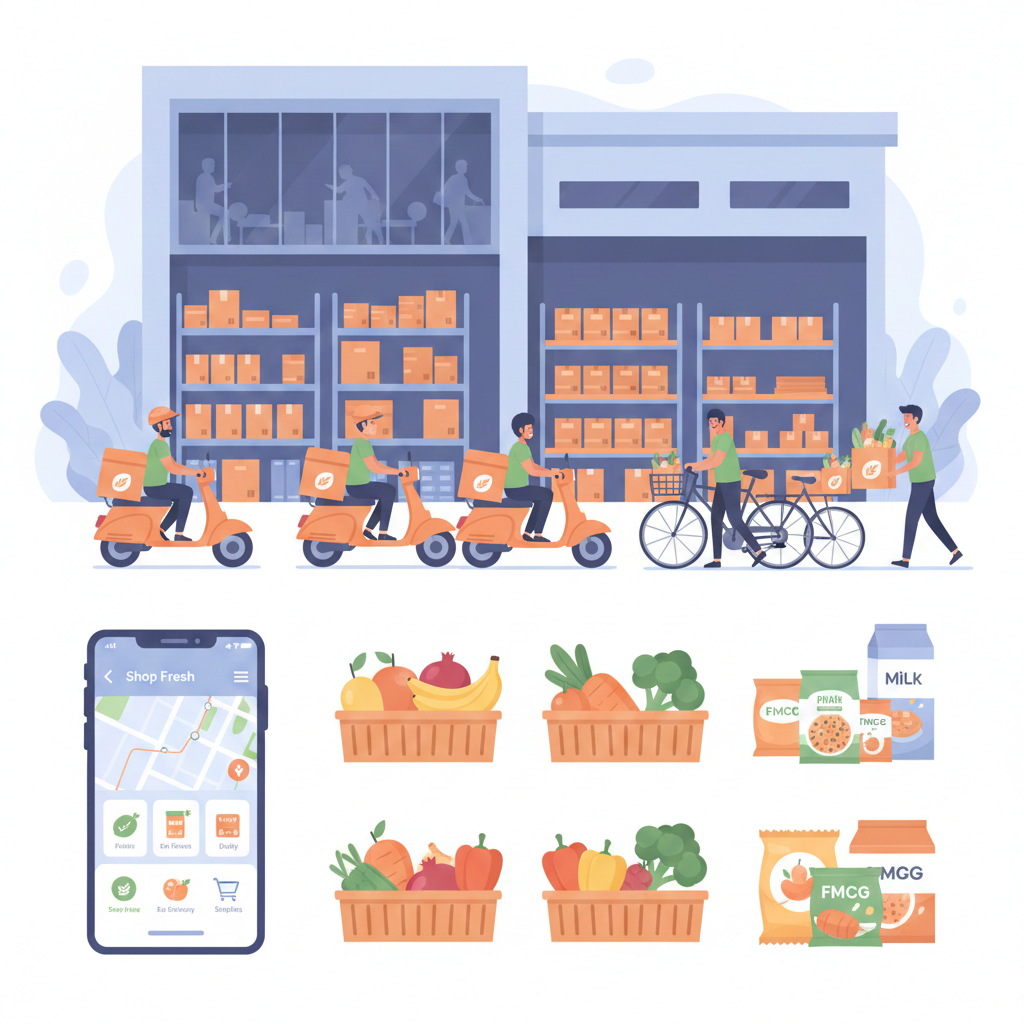
BigBasket operates on an inventory-led and hybrid marketplace business model, where it sources groceries directly from brands and farmers, stores them in its own warehouses (dark stores), and delivers orders using its logistics network. Alongside this, it also partners with selected sellers to expand product variety without taking full inventory risk.
To understand why BigBasket scaled faster and survived longer than most online grocery startups in India, we need to look closely at how its business model actually works behind the scenes.
What Is BigBasket?
BigBasket was founded in 2011 by Hari Menon, Vipul Parekh, Abhinay Choudhari, and Ramesh Ramanathan. In 2021, it became part of the Tata Group, which now holds a majority stake in the company.
BigBasket was built to solve a very common problem in Indian cities:
grocery shopping is repetitive, time-consuming, and inconvenient for working households.
Instead of visiting multiple stores every week, BigBasket offered one platform where customers could:
- Buy everything from vegetables to packaged foods
- Choose delivery slots
- Get consistent pricing
- Avoid last-minute shopping stress
Its primary customers are:
- Urban families
- Working professionals
- Middle- and upper-middle-income households
The core promise is simple: convenience, variety, and predictable pricing.
BigBasket’s Core Business Model Explained
Inventory-Led Model (Primary Model)
BigBasket’s main strength lies in its inventory-led model.
In this setup:
- BigBasket buys products directly from FMCG brands, wholesalers, and farmers
- Products are stored in BigBasket-owned warehouses and fulfilment centres
- The company controls pricing, quality checks, packaging, and availability
- Orders are delivered using BigBasket’s own logistics partners
This model gives BigBasket strong control over the customer experience. It also allows better margins compared to a pure marketplace model.
However, the trade-off is clear:
- High warehousing and storage costs
- Risk of wastage, especially for fresh produce
- Complex operations at scale
BigBasket chose control and reliability over speed.
Marketplace and Hybrid Layer
Alongside its inventory-led model, BigBasket also runs a hybrid marketplace layer.
In this model:
- Selected sellers and brands list products on the platform
- BigBasket manages product discovery and delivery
- Sellers get access to BigBasket’s customer base
This approach helps BigBasket:
- Expand product categories quickly
- Reduce inventory risk for long-tail items
- Offer wider assortment without heavy capital investment
This hybrid structure gives BigBasket flexibility while keeping its core inventory model intact.
How BigBasket Makes Money
Product Margins
BigBasket earns margins on most products it sells, especially:
- Staples
- Packaged foods
- Daily essentials
Margins in grocery are thin, but direct sourcing helps BigBasket keep them sustainable.
Private Label Brands
Private labels are one of BigBasket’s biggest profit drivers.
Some popular in-house brands include:
- BB Royal
- Fresho
- BB Home
- Tasties
These brands allow BigBasket to:
- Control pricing
- Improve margins
- Reduce dependency on large FMCG brands
- Build customer loyalty
Private labels are a long-term strategic advantage in grocery.
Delivery and Convenience Fees
BigBasket charges:
- Slot-based delivery fees
- Convenience fees for smaller orders
- Premium charges for faster deliveries under BB Now
These fees help offset logistics costs.
Advertising and Brand Promotions
FMCG brands pay BigBasket for:
- Sponsored listings
- Homepage banners
- In-app visibility
As traffic grows, advertising becomes a meaningful revenue stream.
BigBasket’s Supply Chain and Logistics Model
BigBasket’s real moat is not the app—it’s the supply chain.
Key components include:
- Direct farmer sourcing for fruits and vegetables
- Bulk procurement from manufacturers
- Regional warehouses and dark stores
- Cold storage for perishables
- Optimised last-mile delivery routes
Efficient logistics allow BigBasket to maintain quality while controlling costs.
Why this matters:
In online grocery, logistics efficiency decides profitability more than marketing.
Technology and Platform Logic (Non-Technical)
BigBasket uses technology mainly to improve operations, not to show off features.
Core systems include:
- Demand forecasting to reduce wastage
- Inventory planning to avoid stockouts
- Dynamic pricing logic for discounts and offers
- Delivery slot algorithms for route optimisation
- App and website as demand capture layers
Technology supports scale it is not the business itself.
BigBasket’s Customer Acquisition Strategy
BigBasket’s early growth relied heavily on:
- Discounts and cashback offers
- Referral programs
- First-order incentives
Over time, the focus shifted to retention through:
- Subscription programs like BB Star
- Habit-based weekly ordering
- Reliable delivery experience
Grocery is a habit business. Once trust is built, customers rarely switch.
Cost Structure (Where BigBasket Spends Money)
Major cost centres include:
- Warehousing and storage
- Delivery partners and logistics staff
- Technology infrastructure
- Marketing and discounts
- Inventory losses and wastage
Managing these costs is critical because grocery margins are thin.
Unit Economics Explained Simply
BigBasket’s unit economics depend on:
- Average order value
- Cost per delivery
- Inventory holding period
- Wastage control
The biggest challenge is balancing delivery cost versus order value.
This is why scale matters:
- More orders per route reduce delivery cost
- Higher volumes improve supplier negotiations
- Predictable demand reduces wastage
Profitability in grocery comes slowly and steadily.
Role of Tata Group in BigBasket’s Model
The Tata Group plays a crucial role in BigBasket’s stability.
Key benefits include:
- Strong capital backing
- Access to Tata brands and ecosystem
- Increased customer trust
- Focus on long-term profitability instead of short-term growth
Tata’s involvement shifted BigBasket from survival mode to sustainability mode.
BigBasket vs Competitors (Quick Comparison)
Compared to Blinkit and Zepto, BigBasket focuses more on:
- Scheduled deliveries
- Larger basket sizes
- Planned grocery shopping
Quick-commerce players focus on:
- Instant delivery
- Smaller baskets
- Convenience over cost efficiency
BigBasket’s model is slower but more stable.
Challenges in BigBasket’s Business Model
Despite its scale, BigBasket faces challenges such as:
- Thin margins in grocery
- Rising competition from quick-commerce apps
- High logistics and labour costs
- Price-sensitive Indian consumers
These challenges require constant operational discipline.
What Founders Can Learn from BigBasket
Key lessons include:
- Control your supply chain early
- Private labels improve margins over time
- Logistics is the real product
- Scale matters more than speed in low-margin businesses
BigBasket succeeded by staying operationally disciplined.
Future of BigBasket’s Business Model
Going forward, BigBasket is likely to focus on:
- Expansion of BB Now
- Hyperlocal fulfilment
- Growth of private labels
- Better data-driven demand planning
The goal is not fastest delivery but sustainable grocery dominance.
Wrap Up
BigBasket survived while many grocery startups failed because it:
- Chose control over hype
- Invested deeply in logistics
- Built for long-term habits, not impulse orders
Its inventory-led model is not a weakness—it is the reason BigBasket still exists today.
Discover more from Business Model Hub
Subscribe to get the latest posts sent to your email.