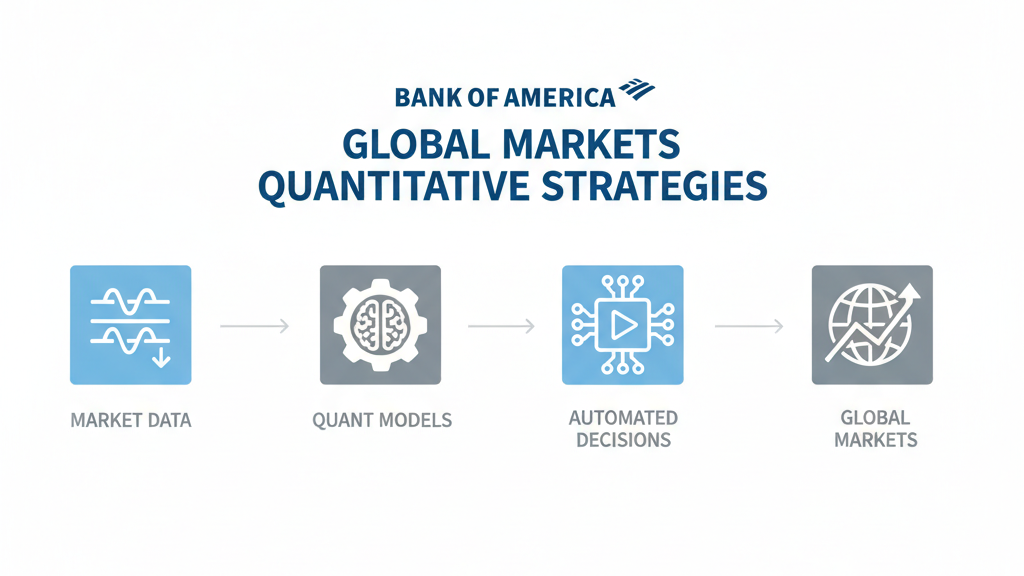
Bank of America Global Markets Quantitative Strategies use mathematical models, statistical algorithms, and systematic rules to make investment decisions across equities, fixed income, currencies, and commodities. Instead of relying on human judgment or gut feeling, these strategies process vast amounts of market data to identify patterns, manage risk, and execute trades automatically helping institutional investors achieve consistent, scalable, and emotion-free results in global markets.
Introduction: Why Quantitative Strategies Matter in Global Markets
The world of institutional investing has undergone a seismic shift over the past two decades. What once relied heavily on trader intuition, macroeconomic forecasts, and relationship-driven deal-making has evolved into a data-intensive, algorithmically driven ecosystem where milliseconds matter and emotions are liabilities.
Large banks like Bank of America don’t just dabble in quantitative strategies they’ve built entire divisions around them. Why? Because quant strategies solve fundamental problems that plague traditional investing: human bias, inconsistency, inability to process information at scale, and the simple fact that emotions like fear and greed often sabotage good decision-making.
Quantitative strategies reduce emotion and scale better globally because they operate on pre-defined rules that work the same way whether you’re trading Japanese government bonds at 3 AM or US equities during market hours. They don’t get tired. They don’t panic. They don’t fall in love with losing positions. For institutional investors managing billions across time zones and asset classes, this consistency is invaluable.
What Is Bank of America Global Markets?
Bank of America Global Markets is the institutional trading and investment banking arm of Bank of America. It’s the division that doesn’t deal with your checking account or credit card it serves the world’s largest investors, corporations, and financial institutions.
This division operates across virtually every major asset class: equities (stocks), fixed income (bonds), currencies (foreign exchange), commodities (oil, gold, agricultural products), and derivatives (options, futures, swaps). Think of it as the engine room where massive capital flows are managed, hedged, and optimized.
Their clients aren’t retail investors. They’re pension funds managing retirement money for millions of workers, hedge funds deploying sophisticated strategies, asset managers overseeing institutional portfolios, sovereign wealth funds, insurance companies, and corporate treasury departments hedging currency risk or interest rate exposure.
What Are Quantitative Strategies?
The word “quantitative” simply means “based on quantities” numbers, data, measurements. In finance, quantitative strategies are investment approaches that use mathematical models and statistical analysis to make decisions, rather than human judgment alone.
Here’s the core distinction: rule-based vs discretionary investing.
A discretionary trader looks at a chart, reads the news, considers their experience, and decides: “I think this stock will go up.” A quantitative strategy says: “When condition A, B, and C are all true based on historical data, buying this type of asset has resulted in positive returns 65% of the time with acceptable risk parameters. Execute the trade.”
Quantitative strategies replace gut feeling with probabilities. They don’t claim to predict the future perfectly—they claim that over thousands of trades, following disciplined rules based on historical patterns and statistical relationships will produce better risk-adjusted returns than emotional decision-making.
How Bank of America Uses Quantitative Strategies
Bank of America doesn’t use quantitative strategies in isolation—they’re deeply integrated with their Global Markets trading desks. Quant models inform decisions across equities, interest rates, foreign exchange, and commodities, working alongside (and sometimes replacing) traditional traders.
The power comes from systematic decision-making at scale. A human trader, no matter how brilliant, can realistically follow maybe 50-100 securities closely. A quantitative system can monitor tens of thousands of instruments simultaneously, identifying opportunities and risks that would be impossible for humans to catch.
This matters because Bank of America’s clients operate globally. A pension fund might need exposure to emerging market debt, developed market equities, commodity futures, and currency hedges—all balanced dynamically based on changing market conditions. Quantitative strategies make this kind of multi-asset, multi-geography complexity manageable.
Core Components of BofA’s Quantitative Strategy Framework
a) Data Inputs
Quantitative strategies are only as good as the data they consume. Bank of America’s quant systems ingest:
- Market prices: Real-time and historical prices across every asset class
- Volatility measures: How much prices swing, which signals risk and opportunity
- Macro indicators: GDP growth, inflation, employment data, central bank policies
- Alternative datasets: This is where things get interesting—satellite images of retail parking lots, shipping data, credit card transaction trends, social media sentiment. These non-traditional data sources can provide early signals before they show up in conventional market data.
The quality, breadth, and speed of data access is a competitive advantage. Bank of America’s scale gives them access to proprietary data flows that smaller firms simply can’t obtain.
b) Models & Algorithms
The data gets processed through various types of models:
- Statistical models: Identifying correlations, mean reversion patterns, and probabilistic relationships between assets
- Factor-based models: Analyzing characteristics like value (cheap vs expensive), momentum (trending up or down), quality (strong fundamentals), volatility, and size to predict future performance
- Machine-assisted pattern recognition: Using computational power to find recurring patterns in market behavior that humans might miss or can’t process at scale
These aren’t black boxes making random decisions—they’re systematic frameworks built on financial theory, tested on decades of data, and constantly refined.
c) Execution Systems
Having a good model means nothing if you can’t execute trades efficiently. Bank of America’s quantitative infrastructure includes:
- Automated trade execution: Orders sent to market instantly when signals trigger
- Risk-controlled position sizing: Never betting too much on any single trade, automatically adjusting exposure based on volatility
- Speed + efficiency advantage: Milliseconds matter in modern markets. Automated systems capture opportunities before they disappear and minimize transaction costs through smart order routing
Types of Quantitative Strategies Used
Bank of America employs multiple quantitative approaches, each designed for different market conditions and investor objectives:
Factor investing strategies select securities based on characteristics historically associated with outperformance—like buying undervalued stocks with strong momentum and high quality fundamentals while avoiding expensive, low-quality names.
Volatility-based strategies exploit patterns in how market fear and uncertainty evolve. When volatility is low, certain strategies collect premium. When volatility spikes, other strategies profit from dramatic price movements.
Trend-following strategies identify and ride momentum in markets—buying assets moving up, selling those moving down, based on the observation that trends tend to persist longer than random chance would suggest.
Market-neutral strategies try to make money regardless of whether markets go up or down, by going long undervalued assets while shorting overvalued ones, isolating skill from market direction.
Risk-parity style approaches allocate capital based on risk contribution rather than dollar amounts, ensuring diversification actually reduces portfolio volatility rather than just creating illusions of safety.
Quantitative Strategies Across Asset Classes
Equities
Stock selection based on factors, sector rotation models, statistical arbitrage between related securities, and smart beta approaches that systematically tilt toward proven sources of excess return.
Fixed Income
Yield curve modeling, credit spread strategies, duration management, and relative value trades between government bonds, corporate debt, and securitized products.
Foreign Exchange
Carry trades (earning interest rate differentials), momentum strategies in currency pairs, and purchasing power parity models that identify mispriced exchange rates.
Commodities
Trend-following in oil and metals, roll yield strategies in futures markets, and seasonal patterns in agricultural products.
Multi-Asset Portfolios
The real sophistication comes from combining strategies across asset classes—using correlations between stocks, bonds, currencies, and commodities to build portfolios that are resilient in different market environments.
Risk Management in Quant Strategies
Here’s what separates professional quantitative strategies from amateur attempts: risk management is built into the system from day one, not added as an afterthought.
Every strategy includes pre-defined risk rules: maximum loss per trade, maximum portfolio drawdown, position size limits, concentration constraints, and leverage controls. If a strategy starts losing beyond acceptable parameters, it automatically reduces exposure or shuts down.
Drawdown controls prevent catastrophic losses. The system asks: “If this strategy loses money, how much are we willing to lose before we stop?” This number is decided before any trades happen.
Stress testing and scenario analysis simulate extreme market events—what happens if correlations break down, if volatility spikes 300%, if liquidity evaporates? The strategy should survive even these black swan events.
Why risk logic matters more than predictions: Quantitative strategies don’t succeed because they predict the future perfectly. They succeed because they manage risk so well that even when they’re wrong (and they will be wrong plenty), the losses are controlled and the winners outweigh the losers over time.
Who Uses BofA’s Quantitative Strategies?
Institutional investors are the primary users—these are organizations managing money professionally, not individual retail investors.
Pension funds need consistent, diversified returns to meet long-term liabilities. Quantitative strategies provide systematic exposure to proven return sources without relying on star traders.
Hedge funds use Bank of America’s quantitative infrastructure and research to inform their own strategies, accessing proprietary models and execution technology they couldn’t build alone.
Asset managers running mutual funds or ETFs employ factor-based and systematic approaches to deliver better risk-adjusted returns than traditional active management.
Corporate treasury desks use quantitative strategies to hedge currency risk, manage interest rate exposure, and optimize cash management across global operations.
Benefits of Bank of America’s Quantitative Approach
Scalability: A human trader managing $100 million can’t simply manage $10 billion by working harder. Quantitative systems scale seamlessly—the same model works with $100 million or $100 billion, limited only by market liquidity.
Consistency: The strategy behaves the same way every time. No bad moods, no vacations, no personality changes, no conflicts of interest.
Reduced human bias: We’re hardwired with cognitive biases—anchoring, confirmation bias, loss aversion, recency bias. Quantitative strategies eliminate these systematic errors.
Global market coverage: Monitoring thousands of securities across dozens of countries and asset classes 24/7, something impossible for human teams.
Faster reaction to market changes: Identifying and acting on opportunities in milliseconds, not hours or days. In fast-moving markets, speed is alpha.
Limitations & Challenges of Quant Strategies
Quantitative strategies aren’t magic. They face real limitations:
Model risk: Every model is a simplification of reality. When markets behave in ways the model didn’t anticipate, strategies can fail spectacularly.
Data dependency: Garbage in, garbage out. If data is wrong, delayed, or incomplete, decisions will be flawed. If data vendors fail or feeds break, strategies can’t function.
Black-swan events: Quantitative models are built on historical data. When something truly unprecedented happens—a global pandemic, a financial system collapse, a geopolitical shock—historical patterns may not apply.
Over-optimization risk: It’s easy to build a model that perfectly explains the past but fails miserably in the future. This “curve fitting” or “data mining” is a constant danger—finding patterns in historical noise that don’t represent genuine market relationships.
Regulatory constraints: Banks face increasing regulation around algorithmic trading, market manipulation, and systemic risk. Quantitative strategies must comply with rules that sometimes limit their effectiveness.
How BofA Differentiates Its Quant Strategies from Others
Many firms offer quantitative strategies. What makes Bank of America’s approach distinct?
Global market depth: Operating in every major financial center with direct market access and local expertise. This isn’t a US-centric quant shop trying to trade emerging markets from afar.
Proprietary data access: As one of the world’s largest banks, BofA sees order flow, client positioning, and market microstructure data that pure quant firms don’t access.
Integration with research & trading: Quantitative teams don’t work in isolation—they collaborate with fundamental analysts, economists, and trading desks, combining systematic approaches with market intelligence.
Institutional-grade infrastructure: The technology, risk systems, compliance frameworks, and operational processes required to manage billions reliably aren’t built overnight. Bank of America’s scale provides infrastructure advantages smaller competitors can’t match.
Real-World Use Case (High-Level Example)
Imagine a large public pension fund with $50 billion in assets wants to diversify beyond traditional stocks and bonds while maintaining strict risk controls.
They work with Bank of America Global Markets to implement a multi-strategy quantitative portfolio:
What gets automated: Daily rebalancing across 3,000+ securities, factor exposure calculations, risk monitoring against defined limits, trade execution optimized for minimal market impact, currency hedging for international positions.
What remains under human oversight: Strategic allocation targets (how much in equities vs fixed income vs alternatives), risk tolerance parameters (maximum drawdown acceptable), governance decisions (adding or removing strategy components), and interpretation of results (understanding why performance occurred, not just that it happened).
The quantitative system handles the impossible-for-humans complexity of managing thousands of positions globally. Humans set the guardrails and make strategic decisions the model shouldn’t make.
Quantitative Strategies vs Traditional Trading
| Quantitative Trading | Traditional Trading |
|---|---|
| Rule-based | Judgment-based |
| Data-driven | Experience-driven |
| Scalable | Limited by humans |
| Emotion-free | Emotion-exposed |
| Transparent process | Opaque decision-making |
| Requires technology infrastructure | Requires talent retention |
| Consistent execution | Variable execution quality |
| Statistical edge over many trades | High-conviction concentrated bets |
Neither approach is universally superior—the best institutional programs often combine both, using quantitative strategies for systematic, scalable exposures while reserving discretionary trading for unique opportunities requiring human judgment.
Future of Quantitative Strategies at Global Banks
The quantitative arms race isn’t slowing down—it’s accelerating.
AI-assisted models are moving beyond traditional statistical approaches to neural networks and machine learning that find complex, non-linear patterns humans and conventional models miss. Bank of America is investing heavily in AI research, not to replace quantitative strategies but to enhance them.
Better real-time risk control using high-frequency data and advanced analytics will allow strategies to adapt faster to changing market conditions, reducing drawdowns and improving consistency.
More transparency for clients is becoming a competitive necessity. Institutional investors want to understand what they’re buying—not necessarily every line of code, but the logic, the risk controls, and the expected behavior in different scenarios. The “black box” era is ending.
Regulation-aware automation will embed compliance directly into execution systems. As regulators demand more accountability around algorithmic trading, quantitative strategies will evolve to provide audit trails, explanability, and built-in safeguards against market manipulation or systemic risk.
Key Takeaways
Quantitative strategies are core to modern global markets because institutional investing has become too complex, too fast, and too global for purely human-driven approaches to compete. The combination of vast data, computational power, and financial theory enables systematic strategies that manage risk better and scale more efficiently than traditional methods.
Bank of America is well-positioned in this landscape because they combine quantitative expertise with global market infrastructure, proprietary data access, and institutional relationships built over decades. They’re not a pure quant hedge fund trying to serve institutional clients—they’re an institutional platform with deep quantitative capabilities.
What investors should realistically expect: Quantitative strategies won’t produce guaranteed returns or eliminate losses. They will provide systematic exposure to proven sources of return, manage risk more consistently than emotional humans, and scale across complex, multi-asset global portfolios. The goal isn’t perfect prediction—it’s disciplined, repeatable, risk-managed execution at scale.
Conclusion
Quantitative strategies are systems, not shortcuts. They don’t offer a magic formula to beat markets effortlessly. What they offer is something more valuable: a disciplined, scalable, emotion-free approach to capturing the returns that markets offer to patient, systematic investors.
Big banks like Bank of America win in quantitative strategies not because they predict the future better than everyone else they win because of scale and discipline. Scale gives them data access, technology infrastructure, and market reach smaller competitors can’t match. Discipline ensures they follow their risk rules even when it’s uncomfortable, size positions based on evidence rather than ego, and build systems designed to survive and profit over decades, not quarters.
The future of institutional investing isn’t purely quantitative or purely discretionary—it’s the intelligent combination of both. Quantitative strategies handle what they do best: systematic, scalable, rule-based execution across thousands of securities and multiple asset classes. Human judgment focuses on what it does best: strategic decisions, interpreting unprecedented events, and asking the questions that models can’t answer.
For institutional investors navigating increasingly complex global markets, quantitative strategies aren’t optional anymore they’re essential infrastructure. And for banks like Bank of America, they’re not just a product offering. They’re a fundamental part of how modern markets work.
Discover more from Business Model Hub
Subscribe to get the latest posts sent to your email.