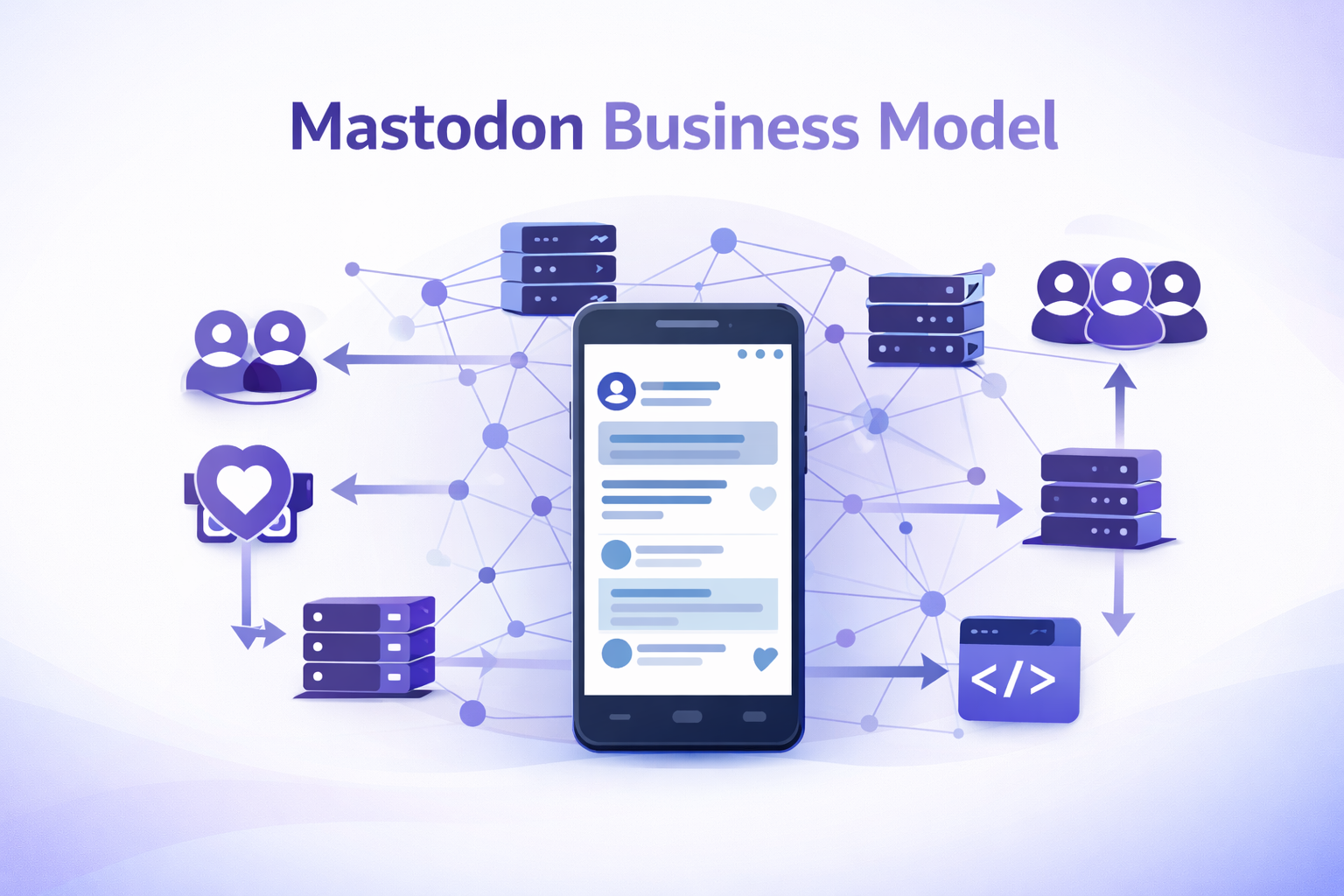

Mastodon’s business model is non-traditional and primarily donation-supported. Unlike ad-driven social media platforms, Mastodon operates as a decentralized, open-source network where independent servers (instances) may generate revenue through donations, memberships, hosting fees, or community funding. The platform itself is maintained by Mastodon gGmbH, a German non profit organization funded through Patreon, grants, and institutional support.
Introduction: Why Mastodon Is Different from Traditional Social Media
The social media landscape is undergoing a fundamental shift. After years of dominance by advertising-driven platforms like Facebook, Twitter, and Instagram, users are increasingly seeking alternatives that prioritize privacy, community control, and transparency over profits.
This movement toward decentralized platforms accelerated dramatically in recent years, particularly following controversial changes at Twitter/X under new ownership. Millions of users began exploring alternatives, with Mastodon emerging as one of the most popular destinations for those seeking a different kind of social media experience.
But what exactly makes Mastodon different? The answer lies in its federated architecture a term that might sound technical but represents a profound shift in how social networks can operate. Unlike traditional social media companies that control everything from a central headquarters, Mastodon distributes power across thousands of independently operated servers, creating what many call “federated social media.”
Perhaps most intriguingly, Mastodon isn’t really a company at all in the traditional sense. It’s open-source software that anyone can use to create their own social network, maintained by a non-profit organization rather than venture capitalists seeking returns. This raises an important question: if Mastodon doesn’t sell ads and doesn’t maximize profits, how does it sustain itself? Understanding Mastodon’s business model requires rethinking everything we know about how social media platforms operate.
What Is Mastodon? A Simple Explanation
Before diving into the business model, it’s essential to understand what Mastodon actually is—because it’s more complex than most social platforms you’re familiar with.
Mastodon is an open-source social network built on the ActivityPub protocol, an open standard for decentralized social networking. Think of it as the email of social media: just as you can have a Gmail account and still email someone with a Yahoo account, you can join one Mastodon server and still follow and interact with people on completely different servers.
This federation model means there isn’t one Mastodon.com where everyone signs up. Instead, there are thousands of independent servers (called “instances”), each with its own community, rules, and focus. You might join a server dedicated to technology, art, gaming, or your local city. Despite being on different servers, users can still communicate across the entire network.
Here’s what “federated” means in practice: Imagine if you could follow Instagram users from your Twitter account, or comment on Facebook posts from Reddit. That’s essentially what federation enables—interoperability between different servers running compatible software.
It’s crucial to understand the difference between Mastodon.org (the organization that develops the software) and individual servers (the independent communities using that software). Mastodon.org doesn’t control or monetize the network; it simply maintains the codebase that thousands of communities use to run their own social networks.
Mastodon Business Model Explained
A. Decentralized Network Model
The foundation of Mastodon’s business model is its radical decentralization. There is no single corporate entity controlling the entire network. Instead, thousands of independently run servers create a resilient ecosystem where:
- No central authority dictates policies for the entire network
- Community-managed moderation allows each server to set its own standards
- Power distribution prevents any single entity from having monopolistic control
- Resilience means the network continues functioning even if individual servers shut down
This decentralization isn’t just a technical feature—it’s a business philosophy. It means Mastodon deliberately avoids the concentration of power and profit that characterizes traditional social media companies.
B. Open-Source Software Model
Mastodon’s code is completely open-source and available on GitHub. This creates several important implications:
- Free to use: Anyone can download and deploy Mastodon without paying licensing fees
- Self-hosting capability: Organizations and individuals can run their own instances
- Transparent codebase: Users and developers can audit the code for privacy and security
- Community contributions: Developers worldwide contribute improvements and features
- No vendor lock-in: Communities aren’t dependent on a single company’s decisions
The open-source model means Mastodon’s development happens collaboratively rather than behind closed doors in a corporate office.
C. Non-Profit Foundation Structure
Mastodon is developed and maintained by Mastodon gGmbH, a non-profit entity registered in Germany. This legal structure is critical to understanding the platform’s business model:
- Focus on sustainability over profit maximization
- Mission-driven development prioritizing user needs over shareholder returns
- Transparent governance with public accountability
- Long-term thinking rather than quarterly earnings pressures
The “gGmbH” designation (gemeinnützige Gesellschaft mit beschränkter Haftung) specifically designates it as a non-profit limited liability company under German law, similar to a 501(c)(3) in the United States.
How Does Mastodon Make Money?
Here’s where things get interesting. We need to make an important distinction: Mastodon as software is different from individual Mastodon servers. The core project (Mastodon gGmbH) generates revenue differently than the thousands of independent servers running the software.
1. Donations & Crowdfunding
The primary revenue source for Mastodon development is direct community support through:
Patreon: Mastodon maintains an active Patreon page where supporters contribute monthly donations ranging from a few dollars to hundreds. These recurring donations provide predictable funding for ongoing development.
Open Collective: An alternative platform for transparent community funding, allowing supporters to see exactly how funds are spent.
One-time donations: Direct contributions from individuals and organizations who want to support the project.
This donation model creates a direct relationship between users and developers, eliminating the need for advertising or data harvesting. Supporters fund development because they value the platform’s mission and want to ensure its continued existence.
2. Grants & Institutional Funding
Mastodon has received support from organizations committed to promoting an open internet:
- Technology grants from foundations supporting open-source development
- Digital rights organizations that see decentralized social media as crucial infrastructure
- Government and EU funding for open-source projects
- University and research institution support
These grants often come with missions aligned with Mastodon’s values: privacy, decentralization, and user empowerment. They provide larger funding chunks for specific development goals or infrastructure improvements.
3. Sponsorships (Limited)
Unlike traditional social platforms that display sponsor content to users, Mastodon accepts limited, ethical sponsorships:
- Transparent funding disclosure about who sponsors development
- No influence over platform features or content moderation
- Alignment with values: Only sponsors whose missions align with open internet principles
- No user data sharing with sponsors
These sponsorships are fundamentally different from advertising—they support development without compromising user privacy or experience.
4. Hosting Fees (Instance-Level Revenue)
While Mastodon gGmbH doesn’t charge hosting fees, individual server administrators may generate revenue:
- Membership fees: Some private or specialized instances charge modest monthly fees
- Donations to server admins: Communities support their local server costs
- Corporate instance hosting: Companies may pay for private Mastodon instances
- Premium features: Occasional offerings like extra storage or priority support
These fees typically just cover server costs rather than generating profit, as most instance administrators volunteer their time.
5. Enterprise Hosting (Third-Party)
A growing ecosystem of third-party companies offers:
- Managed Mastodon hosting services for organizations that want their own instance without technical expertise
- White-label deployments for companies wanting branded social networks
- Consulting and setup services for enterprises
- Custom development and integration
These businesses build on top of Mastodon’s open-source foundation, creating economic activity around the platform without compromising its core values.
Mastodon Revenue Model vs Twitter/X
| Factor | Mastodon | X (Twitter) |
|---|---|---|
| Structure | Decentralized network | Centralized platform |
| Revenue Sources | Donations, grants, hosting | Advertising, X Premium subscriptions |
| Ownership | Community-run instances | Private corporation |
| Data Model | User-focused, minimal tracking | Ad-targeting, extensive data collection |
| Profit Goal | Sustainability | Profit maximization |
| Algorithm | Chronological, transparent | Proprietary, engagement-optimized |
| Moderation | Community-based per instance | Centralized policies |
| API Access | Free and open | Heavily restricted, expensive |
This comparison illustrates fundamentally different philosophies: Mastodon optimizes for user autonomy and sustainability, while traditional platforms optimize for engagement and revenue extraction.
Mastodon Business Model Canvas
1. Customer Segments
Mastodon serves several distinct user groups:
- Privacy-focused users concerned about data harvesting
- Open-source communities valuing transparency and collaboration
- Developers wanting to build on federated protocols
- Niche communities seeking self-governance
- Activists and journalists needing censorship-resistant platforms
- Organizations wanting control over their social infrastructure
2. Value Proposition
What Mastodon offers that traditional platforms don’t:
- No advertisements disrupting user experience
- Decentralization preventing monopolistic control
- Community moderation tailored to specific values
- Data control with users owning their content
- Chronological timelines without algorithmic manipulation
- Interoperability through open standards
3. Channels
How users access and discover Mastodon:
- Web platform accessible through any browser
- Mobile apps (official and third-party)
- Independent servers each with unique communities
- Federation discovery through connected instances
- Word-of-mouth and media coverage during migration events
4. Customer Relationships
Mastodon builds relationships through:
- Community-driven governance involving users in decisions
- Transparent development with public roadmaps and code
- Open communication between developers and users
- Responsive support through community channels
- User empowerment giving control over experience
5. Revenue Streams
As detailed earlier:
- Donations and crowdfunding
- Grants and institutional support
- Limited ethical sponsorships
- Instance-level hosting fees (community-generated)
- Third-party enterprise services ecosystem
6. Key Resources
What makes Mastodon possible:
- Open-source codebase as the foundation
- Developer community contributing improvements
- Brand trust built over years
- ActivityPub protocol enabling federation
- Network effects from growing user base
7. Key Activities
Core operations sustaining the platform:
- Software development and feature improvements
- Security updates and vulnerability patches
- Community coordination across instances
- Documentation for users and administrators
- Protocol development advancing federation standards
8. Key Partners
Critical relationships:
- Hosting providers offering infrastructure
- Open-source contributors developing features
- Non-profit supporters providing funding
- Standards organizations developing ActivityPub
- Instance administrators running communities
9. Cost Structure
Where resources are spent:
- Development team salaries and contractors
- Infrastructure costs for core services
- Legal and compliance expenses
- Security audits and improvements
- Community management and support
Growth Strategy of Mastodon
Mastodon’s growth follows a unique pattern distinct from venture-backed startups:
Word-of-mouth adoption: Users discover Mastodon through recommendations from trusted sources rather than targeted advertising. This creates slower but more sustainable growth.
Open-source evangelism: Developers and technologists advocate for Mastodon as exemplifying how social media should work, creating influential early adopters.
Migration waves: Mastodon experiences dramatic growth spikes during controversies at mainstream platforms. When Twitter introduced controversial changes, Mastodon gained millions of users in weeks.
Strong niche communities: Specific interest groups create vibrant instances—from artists to academics to activists—each attracting members seeking those particular communities.
This event-driven growth means Mastodon expands in waves rather than steady linear progression. Each wave brings new users who often stay even after immediate controversies fade, gradually building a more robust network.
Strengths of Mastodon Business Model
Community Loyalty
Without shareholders demanding growth, Mastodon can prioritize existing users over expansion. This creates deep loyalty among users who feel heard and respected.
No Dependency on Ad Market
Economic downturns affecting advertising budgets don’t threaten Mastodon’s core operations. The platform isn’t beholden to advertiser demands or subject to the volatility of digital ad markets.
Strong Privacy Positioning
In an era of increasing privacy concerns and regulations like GDPR, Mastodon’s minimal data collection is a competitive advantage rather than a limitation.
Open Ecosystem
The open-source nature encourages innovation without permission. Third-party developers create apps, tools, and services that enhance the ecosystem without needing corporate approval.
Weaknesses & Risks
Limited Centralized Funding
Donation-based funding creates uncertainty. If donor enthusiasm wanes, development could slow. There’s no venture capital cushion for difficult periods.
Infrastructure Fragmentation
Thousands of independent servers create inconsistent experiences. Some instances are well-maintained; others struggle. This fragmentation can confuse new users and create technical challenges.
Harder Mainstream Adoption
The federated model requires more user education than “just sign up.” Choosing an instance, understanding federation, and navigating decentralized moderation create barriers to entry.
Moderation Challenges Across Servers
While community moderation is a strength, it also creates challenges. Problematic instances can exist until they’re widely blocked. Coordinating responses to harassment or illegal content across thousands of servers is complex.
Is Mastodon Sustainable Long-Term?
The sustainability question is complex and multifaceted:
Donation sustainability: Can community donations scale with growth? Currently, Mastodon’s funding covers core development, but dramatic expansion could strain resources. However, the model has proven resilient through several years and growth cycles.
Scaling without ads: Traditional platforms use advertising revenue to fund infrastructure at scale. Mastodon’s federated model distributes costs across thousands of servers, creating different scaling economics. As long as communities are willing to fund their own servers, the network can grow sustainably.
Governance model: The non-profit structure prevents some threats (like acquisition by hostile actors) but creates others (like succession planning and long-term institutional stability). Ensuring good governance as the project matures will be crucial.
Competition: Bluesky (another federated platform) and Threads (Meta’s Twitter alternative with planned federation) present both challenges and opportunities. Competition could fragment the decentralized social media movement, but interoperability through ActivityPub means these platforms could ultimately strengthen the broader ecosystem.
The realistic assessment is that Mastodon has proven more sustainable than skeptics expected. It has survived and grown without the traditional social media business model. However, it will likely remain smaller than advertising-driven platforms while serving users who value its distinctive approach.
Future of Mastodon Business Model
Several trends could shape Mastodon’s evolution:
Growth of decentralized social web: As more platforms adopt ActivityPub and federated models, Mastodon becomes part of a larger movement rather than an isolated experiment. This increases its strategic importance and potential funding sources.
Web3 and identity ownership trends: Growing interest in user-controlled digital identity and data ownership aligns perfectly with Mastodon’s philosophy, potentially attracting new supporters and users.
Institutional adoption: Universities, governments, and organizations increasingly see value in running their own social media infrastructure. European institutions, in particular, have launched Mastodon instances, creating new use cases and funding opportunities.
Ethical monetization models: As awareness grows about the costs of “free” advertising-driven platforms, more users may embrace direct payment models. Mastodon could introduce optional paid features while maintaining its core free service.
The future likely involves Mastodon remaining a smaller but influential platform that proves alternatives to ad-driven social media are viable and sustainable.
Conclusion
Mastodon represents a fundamental challenge to how we think about social media business models. It demonstrates that platforms can survive and thrive while prioritizing sustainability over profit maximization, user privacy over data harvesting, and community governance over corporate control.
The platform’s success measured not in billions of users or valuation, but in creating sustainable, user-controlled social spaces shows that the advertising-surveillance model isn’t inevitable. Social media can exist without manipulative algorithms, invasive tracking, or shareholder pressure for endless growth.
Mastodon’s business model depends entirely on community support. Its future is determined not by venture capitalists or quarterly earnings, but by whether users and organizations find sufficient value in an open, decentralized social web to sustain it through donations, hosting, and participation.
This represents a profound shift toward treating social media as open internet infrastructure rather than proprietary platforms. Like email, the web itself, or other internet protocols, Mastodon suggests social networking could become a federated utility rather than a corporate product.
Whether this model can truly compete with tech giants in the long term remains to be seen. But Mastodon has already succeeded in proving it’s possible and in doing so, has expanded our understanding of how social media can work when designed for people rather than profits.
Discover more from Business Model Hub
Subscribe to get the latest posts sent to your email.