
What is a Creative Agency Business Model?
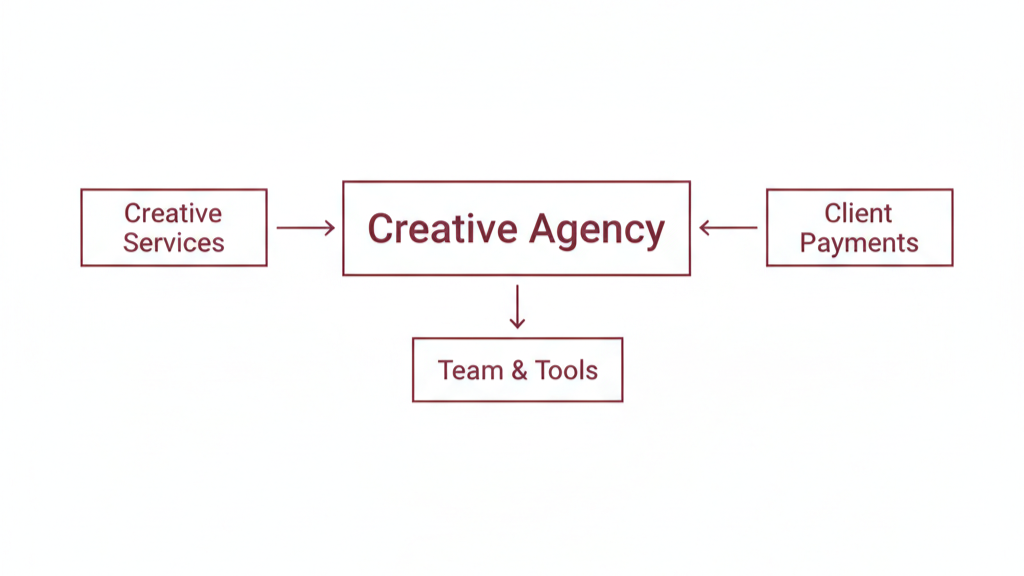
A creative agency business model is a client-service framework where agencies generate revenue by providing creative services branding, design, marketing content, and digital experiences to businesses that need professional creative work but lack in-house capabilities. Agencies typically earn through project fees, monthly retainers, or performance based arrangements, creating value by transforming client ideas into compelling brand identities, campaigns, and customer experiences that drive business growth. Creative agencies exist because most companies need world-class creative work but can’t justify hiring full-time specialists across every discipline from brand strategists to motion designers to UX architects. They serve everyone from early-stage startups building their first brand identity to Fortune 500 enterprises launching global campaigns, offering flexible access to concentrated creative talent without the overhead of permanent teams.
What Does a Creative Agency Actually Do?
Creative agencies translate business objectives into compelling visual and narrative experiences. Their work spans multiple disciplines, each requiring specialized expertise that most businesses can’t maintain internally.
Branding & Identity: Agencies develop brand strategies, visual identities, naming conventions, brand guidelines, and positioning frameworks that differentiate clients in crowded markets. This includes logo design, typography systems, color palettes, and the foundational elements that define how a brand shows up in the world.
Design Services: From UI/UX design for digital products to graphic design for marketing materials and packaging design for physical products, agencies create the visual interfaces between brands and customers. This includes website design, app interfaces, print collateral, environmental graphics, and presentation decks.
Marketing Creatives: Agencies produce the advertising and promotional content that drives customer acquisition—social media campaigns, display ads, video content, email templates, landing pages, and integrated marketing campaigns across multiple channels.
Content & Storytelling: Beyond visuals, agencies craft the narratives that connect brands with audiences through copywriting, content strategy, brand journalism, case studies, thought leadership pieces, and editorial calendars that maintain consistent brand voice.
Digital Experiences: Agencies design and sometimes build interactive experiences including websites, mobile applications, e-commerce platforms, branded games, AR/VR experiences, and other digital touchpoints that engage customers in meaningful ways.
Core Creative Agency Business Model Explained
The creative agency business model operates on a fundamental exchange: clients pay for specialized creative expertise and execution they can’t efficiently produce themselves, while agencies build sustainable businesses by serving multiple clients with shared creative resources.
Client-Service Foundation: Unlike product companies that build once and sell repeatedly, agencies customize solutions for each client. This means every engagement requires fresh creative thinking, custom execution, and relationship management. The model succeeds when agencies can deliver exceptional creative work while maintaining healthy margins through efficient processes and strategic positioning.
Project-Driven vs Relationship-Driven Work: Some agencies focus on discrete projects with clear deliverables and end dates—a brand refresh, a product launch campaign, a website redesign. Others cultivate ongoing relationships where they become an extension of the client’s team, providing continuous creative support across whatever needs arise. The best agencies balance both, using projects to attract clients and relationships to stabilize revenue.
Value Creation Logic: Agencies create value through a transformation process: they take client business challenges or opportunities, apply strategic thinking and creative expertise, execute beautifully crafted solutions, and deliver tangible outcomes like increased brand awareness, higher conversion rates, or market differentiation. This value chain—from insight to idea to execution to impact—justifies premium pricing when done well.
Key Stakeholders in a Creative Agency Model
Every creative agency operates within an ecosystem of stakeholders whose interests must be balanced for sustainable success.
Clients are the revenue engine, ranging from risk-taking startup founders to cautious corporate marketing directors. They bring budgets, business problems, and expectations that shape every project. Understanding their success metrics, approval processes, and organizational dynamics determines whether relationships thrive or struggle.
Creative Teams are the core value generators—designers who craft visual solutions, strategists who decode market positioning, writers who articulate brand voices, art directors who maintain creative vision, and producers who orchestrate complex deliveries. Their talent directly determines work quality, their satisfaction impacts retention, and their efficiency defines profitability.
Freelancers & Partners extend agency capabilities beyond core teams. Specialist illustrators, photographers, developers, video production companies, and niche consultants allow agencies to take on diverse projects without hiring for every conceivable skill. Managing this flexible workforce requires clear processes and strong relationships.
Platforms & Tools enable modern creative work—Adobe Creative Suite for design, Figma for collaborative interfaces, project management tools like Asana or Monday, communication platforms like Slack, Meta and Google ad platforms for campaign deployment, and emerging AI tools that augment creative processes. These partnerships determine workflow efficiency and capability boundaries.
Creative Agency Revenue Structure
Revenue structure determines whether an agency thrives or merely survives. The most successful agencies diversify across multiple revenue streams rather than depending on a single approach.
Project-Based Revenue
Project-based work remains the traditional foundation of agency revenue. Clients engage agencies for specific deliverables with defined scopes and timelines—a brand identity redesign, a product launch campaign, or a website rebuild.
One-Time Engagements: These range from small projects like designing a pitch deck for $5,000 to comprehensive brand overhauls commanding $150,000 or more. The appeal is clear project boundaries and the ability to take on multiple clients simultaneously. The challenge is feast-or-famine revenue cycles where three projects might end in the same month with nothing immediately following.
Fixed Pricing vs Scope-Based Pricing: Fixed pricing provides client budget certainty—$50,000 for a complete brand identity including logo, guidelines, and initial applications. Scope-based pricing ties cost to deliverable complexity, allowing flexibility if client needs expand mid-project. Most agencies use fixed pricing for well-defined work and scope-based pricing for exploratory or evolving projects, often with tiered packages (Basic, Professional, Premium) that help clients self-select while maintaining profitability.
Retainer-Based Revenue
Retainer relationships transform agencies from project vendors into strategic partners, providing the predictable revenue that enables long-term planning and team stability.
Monthly Creative Support: Retainers typically secure dedicated hours or deliverables each month—20 hours of design work, 5 social media campaigns, ongoing brand guidance—at rates from $5,000 monthly for small business support to $50,000+ for enterprise relationships. Clients gain reliable access to creative resources without project-by-project negotiations, while agencies build recurring revenue that covers fixed costs and enables investment in team development.
Long-Term Brand Partnerships: The strongest retainers evolve into true partnerships where agencies deeply understand client businesses, anticipate needs, and proactively suggest creative initiatives. These relationships often span years, generating millions in cumulative revenue while becoming increasingly efficient as teams align and trust builds.
Predictable Cash Flow: Retainers solve the creative agency’s existential problem—unpredictable revenue. When 60-70% of revenue comes from retainers, agencies can confidently hire, invest in tools, and weather market fluctuations. This stability attracts better talent and enables the kind of strategic thinking that produces exceptional work.
Hourly / Time-Based Billing
Hourly billing works best for consulting-style engagements where scope is genuinely uncertain or for supplemental work beyond fixed agreements.
Consulting & Strategy Work: Brand strategy sessions, creative audits, workshop facilitation, and advisory services often bill hourly at rates from $150 to $500+ depending on seniority and specialization. This approach makes sense when clients are buying strategic thinking rather than defined deliverables—they’re paying for the insights and recommendations that emerge from dedicated attention.
Pros & Cons: Hourly billing provides flexibility and protects agencies from scope creep—if clients request changes or additions, hours simply accumulate. However, it penalizes efficiency (faster work means less revenue), creates client anxiety about accumulating costs, and fails to capture the value of great ideas that emerge quickly. Most mature agencies minimize hourly work in favor of value-based approaches.
Performance-Linked Revenue
Performance-based pricing aligns agency success with client outcomes, though it requires careful structuring to work fairly.
Campaign-Based Success Fees: Agencies might charge a base fee plus bonuses for hitting targets—$30,000 base for campaign development plus $5,000 for every 10% increase in conversions above baseline. This approach works when metrics are clearly measurable and agencies have meaningful control over outcomes.
Revenue Share or Lead-Based Pricing: Some agencies, particularly in e-commerce or lead generation, take percentage-based compensation—2-5% of sales generated or $50-200 per qualified lead. This model works best when agencies have direct input on conversion optimization and when clients have systems to accurately track performance attribution.
The challenge with performance pricing is isolating agency contribution from other variables—market conditions, product quality, pricing, competition. Successful performance arrangements require sophisticated tracking, realistic baseline expectations, and shared commitment to optimization beyond initial creative delivery.
Digital Product Revenue
Forward-thinking agencies build productized offerings that generate revenue beyond client services, creating leverage that doesn’t require billable hours.
Templates, Brand Kits, Design Systems: Agencies can package their expertise into sellable products—website templates for specific industries ($500-2,000), brand identity starter kits ($1,000-5,000), or design systems for common platforms. These products provide revenue between client projects while marketing agency capabilities to potential clients.
Courses, Toolkits, Playbooks: Educational products transform agency knowledge into scalable offerings—courses on brand strategy fundamentals ($200-1,000), toolkits for DIY brand development ($50-500), or proprietary frameworks and playbooks. While rarely generating substantial revenue, these products establish thought leadership and create inbound lead generation that feeds the core service business.
Typical Pricing Models Used by Creative Agencies
How agencies price their work fundamentally shapes profitability, client relationships, and market positioning.
Fixed-Fee Pricing provides clarity for both parties—clients know their investment upfront, agencies can build scope disciplines that protect margins. A branding project might be $75,000 for defined deliverables: strategy workshop, brand positioning, logo and identity system, brand guidelines, and initial applications. This approach works best when agencies have deep experience estimating effort and when scope can be clearly bounded. The risk is underestimating complexity, leading to unprofitable overservicing.
Value-Based Pricing shifts focus from hours or deliverables to business impact. If a rebrand will help a client raise a $10M funding round, the value justifies premium pricing regardless of hours invested. An agency might charge $150,000 for brand work that takes 200 hours because the strategic value far exceeds time-based math. This approach requires confidence in positioning, deep understanding of client economics, and ability to articulate ROI. It’s how top agencies maintain 40-60% margins while boutique competitors struggle at 20-30%.
Hybrid Pricing Models combine approaches for different project phases—fixed fees for core deliverables, hourly rates for revisions beyond agreed rounds, performance bonuses for campaign results, and retainers for ongoing support. A product launch might include $100,000 for campaign creation, $10,000/month retainer for first quarter management, and 5% bonus if sales exceed projections.
Why Pricing Creativity is Hard: Creative work doesn’t fit neatly into cost-plus models. The brilliant brand name that emerges in a 30-minute brainstorm session delivers more value than weeks of mediocre alternatives. Clients struggle to evaluate creative quality before seeing results. Junior designers and senior creative directors spend similar hours but deliver vastly different outcomes. These complexities explain why pricing remains one of the most debated topics in creative business, and why agencies that master value communication command premium rates.
Cost Structure of a Creative Agency
Understanding cost structure is essential for building a profitable agency—revenue means nothing if costs consume margins.
Salaries & Freelancers typically represent 50-60% of agency revenue. Full-time salaries for designers, strategists, account managers, and creative directors range from $50,000 for junior designers to $200,000+ for senior leadership. Freelancer rates vary from $50-75/hour for execution work to $150-300/hour for specialized expertise. The key profitability challenge is balancing utilization (billable hours as percentage of capacity) with rates that cover both billable talent and non-billable overhead.
Tools & Software consume 3-5% of revenue—Adobe Creative Cloud subscriptions ($55-80/user/month), Figma for interface design ($45/editor/month), project management platforms ($10-25/user/month), cloud storage, analytics tools, and emerging AI platforms. These costs scale with team size and represent necessary investments in productivity.
Marketing & Sales often represent 10-15% of revenue for agencies actively acquiring new clients. This includes website maintenance, content creation, conference attendance, pitch materials, CRM systems, and business development salaries. Established agencies with strong referral networks can operate at 5-8%, while newer agencies might invest 20%+ to build momentum.
Office / Remote Infrastructure costs have evolved dramatically. Traditional agencies spent 8-12% of revenue on office space, now many operate remotely for 2-3% covering coworking memberships, home office stipends, and virtual collaboration tools. Hybrid models fall somewhere between, often maintaining smaller collaborative spaces rather than dedicated desks for everyone.
Client Acquisition Costs represent the often-hidden expense of winning new business—proposal development time, pitch meeting travel, spec creative work, discounted first projects, and sales cycles that stretch months. These costs can reach $5,000-20,000 per new client depending on deal size and competition intensity.
How Creative Agencies Scale Their Business Model
Scaling a creative agency requires fundamentally rethinking how value is created and delivered, moving beyond trading hours for dollars.
Moving from Founder-Led to Team-Led Delivery is the first critical transition. Many agencies stall when founders become the bottleneck—every project requires their creative direction, every client wants their involvement, and growth means personal exhaustion rather than business expansion. Scaling requires documenting creative processes, training team members to own client relationships, and building systems that maintain quality without founder intervention. This transition typically happens between $1-3M revenue when founders realize they’re running a job, not a business.
Productized Services transform custom work into repeatable offerings with defined scopes, processes, and pricing. Instead of “we’ll design your brand” (infinitely variable), productized services might be “5-Day Brand Sprint” (specific methodology, fixed timeline, clear deliverables, $25,000 price). Productization enables junior team members to deliver consistently, reduces sales cycles through clear offering definition, and improves margins through process efficiency. The best agencies maintain a few signature productized offerings while preserving custom capability for complex clients.
Retainers Over Projects provide the predictable revenue that enables scaling investment. An agency with 70% project revenue faces constant uncertainty—every month requires replacing completed projects with new sales. An agency with 70% retainer revenue has stable foundation supporting strategic planning, team development, and capability expansion. The path to retainer dominance involves proving value through project work, then proposing ongoing partnerships that serve client needs better than repeated project negotiations.
Niche Specialization unlocks premium pricing and efficient delivery. Instead of being “a creative agency” competing against thousands, specialists become “the brand agency for B2B SaaS companies” or “the go-to creative partner for consumer health brands.” Specialization enables deep industry expertise, reusable frameworks, powerful case studies, and referral networks that reduce acquisition costs. While counterintuitive, narrowing focus expands revenue potential by enabling premium positioning and operational leverage.
Creative Agency Business Model Canvas
The Business Model Canvas provides a structured view of how creative agencies create, deliver, and capture value.
Key Partners: Freelance specialists who extend capabilities, technology platforms that enable delivery, strategic partners like developers or PR firms for integrated offerings, and professional networks that generate referrals.
Key Activities: Creative concepting and strategy development, design and content production, client relationship management, continuous learning to stay current with trends and tools, and business development to maintain pipeline.
Value Propositions: Access to specialized creative talent without hiring costs, fresh outside perspectives that internal teams can’t provide, flexibility to scale creative resources up or down with business needs, and tangible deliverables that drive brand growth and market differentiation.
Customer Relationships: Project-based transactions for discrete needs, ongoing partnerships through retainer arrangements, collaborative co-creation where agencies integrate deeply with client teams, and consultative relationships for strategic guidance.
Customer Segments: Startups needing initial brand development, growth companies scaling marketing efforts, established enterprises requiring specialized campaigns or refreshes, and specific industry verticals where agencies develop deep expertise.
Revenue Streams: Project fees for defined deliverables, monthly retainers for ongoing support, hourly consulting for strategic advisory, performance bonuses tied to outcomes, and potentially productized offerings or digital products.
Key Resources: Creative talent with diverse specializations, proprietary processes and frameworks, technology infrastructure, portfolio of strong case studies, and reputation in the market or specific industry niches.
Channels: Referrals from satisfied clients, content marketing and thought leadership, industry events and conferences, partnerships with complementary service providers, and increasingly digital presence through social media and online communities.
Cost Structure: Personnel costs including salaries and freelancers, software and technology subscriptions, marketing and business development, workspace whether physical or remote, and client acquisition expenses.
Real-World Examples of Creative Agency Revenue Models
Different agency models succeed through distinct approaches to value creation and capture.
Boutique Branding Agency: A 10-person shop specializing in brand identity for tech startups generates $2M annual revenue through 12-15 comprehensive branding projects at $100,000-200,000 each. They’ve productized their “Foundation Brand Sprint”—a focused 4-week engagement covering strategy, identity, and initial applications. By specializing, they’ve built deep expertise in tech brand positioning, maintain a portfolio of funded startups, and command premium pricing through demonstrated ROI (several clients subsequently raised Series A funding). Their model works because they’ve made branding projects repeatable enough for team delivery while maintaining creative excellence that justifies premium pricing.
Digital-First Creative Agency: A 25-person agency focuses exclusively on digital experiences—websites, apps, and digital campaigns. They generate $4M revenue split between project work ($2M) and retainer relationships ($2M). Project work includes 20-25 website or app projects annually at $75,000-150,000 each, while retainers average $15,000/month for ongoing digital marketing creative. Their advantage comes from specialized digital expertise, efficient production workflows using modern design and development tools, and data-driven optimization that proves ROI. Clients stay on retainer because the agency continuously improves digital performance rather than just delivering static projects.
Performance-Driven Creative Studio: A lean 8-person studio works primarily with e-commerce and direct-to-consumer brands, charging base fees plus performance bonuses. A typical engagement might be $40,000 base for campaign creation plus 3% of incremental revenue above baseline during the campaign period. Last year they generated $1.5M revenue—$800K in base fees and $700K in performance bonuses. This model works because they’ve built expertise in conversion-focused creative, maintain small team overhead that allows competitive base pricing, and align incentives so they’re genuinely invested in client success. The risk is variability—performance bonuses can swing significantly quarter to quarter.
Global Network vs Small Studio: Large agency networks generate hundreds of millions through corporate clients requiring integrated campaigns across markets, charging $500,000-5M+ for comprehensive programs. They succeed through scale, full-service capabilities, and established client relationships, though often at lower margins (15-25%) due to overhead. Small studios operate at opposite end—a 3-person shop might generate $500K through highly specialized work for boutique clients, maintaining 40-50% margins through minimal overhead and founder-led delivery. Both models work, serving fundamentally different market segments with distinct value propositions.
Challenges in the Creative Agency Business Model
Despite opportunities, creative agencies face persistent structural challenges that explain why many struggle despite producing excellent work.
Unpredictable Revenue plagues project-dependent agencies. A pipeline that looks healthy in January can evaporate by March when three major projects end simultaneously and new sales haven’t closed. This volatility makes planning difficult, hiring risky, and growth inconsistent. Many agency founders describe the business as “perpetual anxiety punctuated by occasional relief,” never quite knowing when the next project will materialize.
Scope Creep silently destroys profitability. Clients request “just one more revision” or “a few additional deliverables”—seemingly small additions that accumulate into significant unbilled work. A $50,000 project budgeted for 250 hours expands to 400 hours through incremental requests, cutting margins from 35% to near zero. Controlling scope requires discipline to say no, clear contracts defining revision rounds, and processes for converting additional requests into change orders.
Client Dependency creates existential risk. When a single client represents 30-40% of revenue, losing that relationship threatens business survival. Yet developing deep client relationships naturally leads to concentration. The solution is actively diversifying—setting internal limits on any single client’s revenue contribution (typically 15-25% maximum) and continuously developing new relationships even when current clients are happy.
Talent Retention challenges agencies caught between client demands for low costs and employee needs for competitive compensation. Great designers have options—in-house roles, freelancing, competing agencies, tech companies. Retaining top talent requires competitive salaries, interesting work, growth opportunities, and culture that respects creativity. Yet many agencies squeeze margins so tight they can’t invest in their people, creating talent drain that undermines work quality.
Balancing Creativity with Profitability represents the fundamental agency tension. Clients hire agencies for creative excellence, but excellence requires time, experimentation, and occasional failure. Pure creative pursuit ignores business realities—agencies need healthy margins to survive. Pure profit maximization produces mediocre work that fails to attract good clients. The sustainable path requires disciplined creative processes, educating clients on creative value, and sometimes walking away from clients who want cheap work over great work.
Future of Creative Agency Business Models
The creative agency model is evolving rapidly as technology, client expectations, and market dynamics shift.
AI-Assisted Creativity is already transforming how agencies work. AI tools generate initial concepts, accelerate production work, analyze campaign performance, and automate repetitive tasks. This doesn’t eliminate creative roles—human judgment, strategic thinking, and emotional intelligence remain essential—but it changes what agencies sell. Forward-thinking agencies position as “AI-augmented creative partners” who deliver faster and more efficiently by leveraging technology while maintaining creative excellence. Agencies that resist AI risk becoming uncompetitive, while those that embrace it thoughtlessly risk commoditizing their work. The winners will use AI to enhance human creativity rather than replace it.
Subscription-Based Creative Services are emerging as alternatives to traditional project and retainer models. Startups like Design Pickle and ManyPixels offer unlimited design work for fixed monthly fees ($500-5,000), appealing to businesses wanting predictable costs and continuous access to creative resources. While these services handle relatively simple execution work, they suggest client appetite for subscription models. Premium agencies are exploring “creative subscriptions”—defined monthly deliverables (5 social campaigns, 2 web pages, 1 brand asset) for fixed fees, combining retainer predictability with productized clarity.
Outcome-Driven Pricing will accelerate as measurement improves. Instead of charging for brand strategy deliverables, agencies might charge based on brand awareness lift. Instead of fixed campaign fees, agencies might take percentage of attributed revenue. This shift requires sophisticated analytics, clear performance attribution, and client willingness to share upside. It also requires agencies to develop genuine business expertise beyond creative craft—understanding client economics, competitive dynamics, and growth levers that creative work influences.
Creator-Led Micro-Agencies represent a structural disruption. Individual creators building audiences on social platforms now offer creative services to followers—a YouTube creator with 100,000 subscribers might run a 1-3 person “agency” serving brands wanting authentic content. These micro-agencies operate at minimal overhead, charge lower rates, and move faster than traditional agencies. While they typically lack strategic depth and can’t handle complex projects, they’re capturing work that once went to small agencies, forcing the industry to evolve.
Conclusion: Is the Creative Agency Model Still Profitable?
The creative agency model remains fundamentally viable, but profitability increasingly depends on strategic positioning rather than simply producing good work.
Who Should Start One: Aspiring agency founders need three elements to succeed. First, specialized expertise that commands premium pricing—deep knowledge in specific creative disciplines, industries, or business problems. Second, business acumen beyond creative talent—understanding finance, sales, operations, and client management. Third, genuine passion for building a business rather than just doing creative work. Many talented creatives discover they prefer practicing their craft to managing clients, cash flow, and team dynamics. There’s no shame in that realization—staying freelance or working in-house often better serves those who love creativity more than business building.
When It Works Best: Creative agencies thrive in several scenarios. They work brilliantly for specialists who dominate narrow niches—becoming the definitive agency for a specific industry or creative discipline commands premium pricing and reduces competition. They work for agencies that successfully transition to retainer-based models, building recurring revenue that stabilizes business. They work when founders develop distinctive points of view that attract clients seeking those specific perspectives rather than generic creative services. And they work for agencies that embrace operational excellence—building systems, processes, and teams that deliver consistently while maintaining healthy margins.
What Founders Should Focus on in 2026: Successful agency founders in 2026 need to master several priorities. First, ruthlessly clarify positioning—being “a creative agency” isn’t enough when competing against thousands. Develop a sharp point of view on who you serve and what you’re brilliant at. Second, build retainer revenue systematically—every successful project should include a conversation about ongoing partnership. Third, embrace AI as creative augmentation while preserving the human judgment and strategic thinking clients truly value. Fourth, develop genuine business expertise in client domains—agencies that understand client economics and growth challenges become strategic partners rather than vendor services. Fifth, build systems that enable team-led delivery—founder dependence limits scale and creates burnout. Finally, focus relentlessly on profitability, not just revenue—a $2M agency at 40% margins outperforms a $5M agency at 15% margins in sustainability, team investment, and founder rewards.
Discover more from Business Model Hub
Subscribe to get the latest posts sent to your email.