
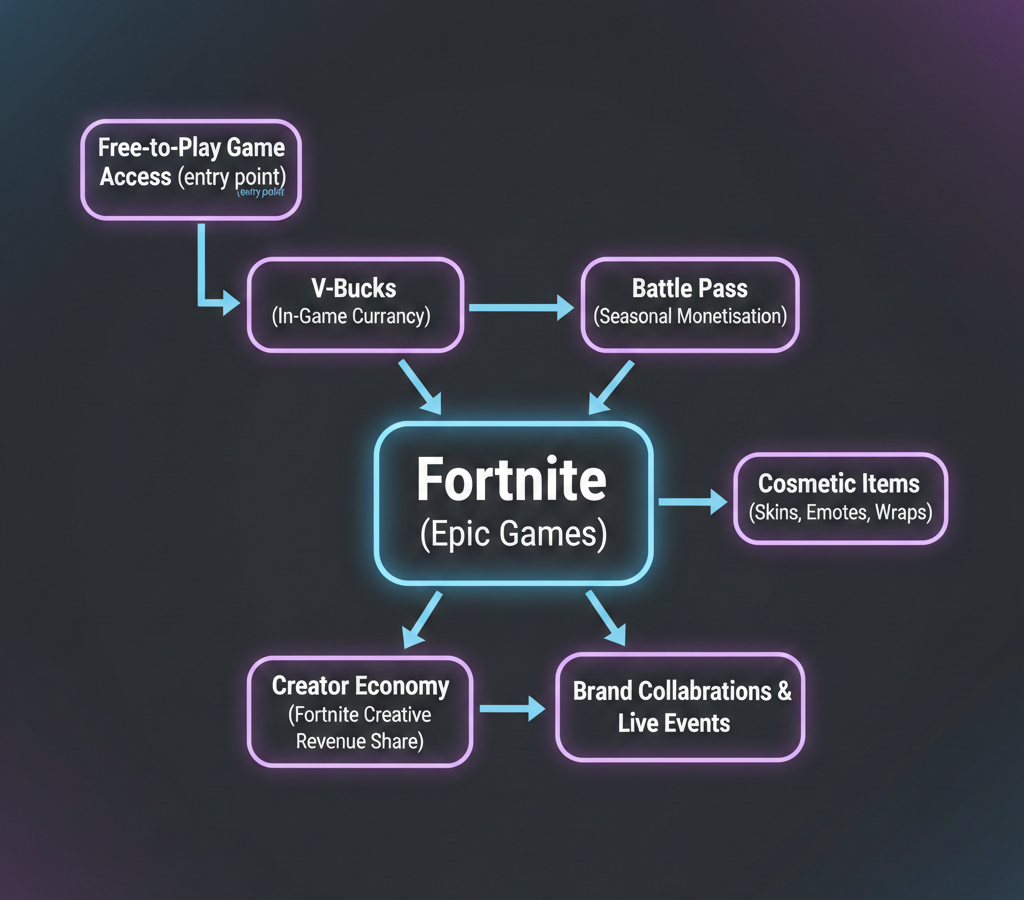
You’ve probably heard of Fortnite. Maybe your kids play it. Maybe you’ve played it yourself. But here’s what’s fascinating: the game is completely free, yet Epic Games pulls in billions of dollars every year from it.
No subscription fees. No pay to win mechanics. No mandatory purchases. Just a free game that somehow prints money.
So how does this work? And more importantly, what can we learn from a business model that turned a free product into one of the most profitable entertainment properties in history?
Let’s break it down.
What Fortnite Actually Is
Before we dive into the money side, let’s get clear on what Fortnite is because it’s evolved far beyond just being a video game.
Epic Games launched Fortnite in 2017 as a free-to-play multiplayer game. It exploded in popularity with its Battle Royale mode, where 100 players fight until one remains standing. But Fortnite has since expanded into multiple game modes: Creative mode where players build their own worlds, Zero Build mode for those who just want to fight, and live events that feel more like digital concerts than gaming.
The game runs on PC, PlayStation, Xbox, Nintendo Switch, and was on mobile until Epic’s legal battle with Apple. Millions of players jump in daily across these platforms.
But here’s the key insight: Fortnite isn’t really a game anymore. It’s a digital entertainment platform. It’s where people hang out, express themselves, attend concerts, and participate in cultural moments. Understanding this shift is crucial to understanding how it makes money.
The Foundation: Free Entry Changes Everything
The first pillar of Fortnite’s business model is deceptively simple: anyone can download and play the full game without paying a cent.
This free-to-play approach removes every barrier to entry. No credit card required. No $60 upfront investment. A curious teenager can download it on a whim. A parent can let their kid try it without financial risk. Friends can all jump in together without coordinating purchases.
The result? Massive player acquisition at a scale that paid games simply cannot match.
Traditional game companies sell millions of copies at $60 each and celebrate. Fortnite attracted hundreds of millions of players by charging nothing. This created a huge foundation of engaged users that Epic could then monetize in smarter ways.
Think about it from a business perspective: would you rather have 10 million customers paying $60 upfront, or 200 million users in your ecosystem with opportunities to earn revenue from them over years? Fortnite chose the latter, and it changed gaming economics forever.
The Secret Sauce: Selling Style, Not Advantage
Here’s where most people get confused about how Fortnite makes money. They assume it must be pay to win that players who spend money get better weapons or abilities.
Wrong.
Fortnite makes all its money from cosmetics. Skins that change how your character looks. Emotes that let you dance or celebrate. Wraps that customize your weapons. Gliders that change your parachute design. None of these affect gameplay whatsoever.
A player who’s never spent a dollar has the exact same chance of winning as someone who’s dropped $500 on cosmetics. The playing field stays completely level.
This is brilliant for two reasons. First, it keeps the game fair and competitive, which maintains long-term player engagement. Nobody quits because they’re getting crushed by people who bought better gear. Second, it means players spend money purely because they want to, not because they feel forced to compete.
When you buy a Fortnite skin, you’re buying self-expression. You’re buying the ability to stand out. You’re buying participation in culture. And people are far more willing to spend on those emotional values than on competitive advantages.
The V-Bucks Economy: Clever Currency Design
Fortnite doesn’t let you buy items with real money directly. Instead, you purchase V Bucks the in game currency.
This might seem like an unnecessary extra step, but it’s psychologically powerful.
First, V-Bucks create distance between spending and real money. Dropping 1,500 V-Bucks on a skin feels different than spending $15. The mental math gets fuzzy, which lowers spending resistance.
Second, V-Bucks come in bundles that never quite match item prices. You might need 1,500 V-Bucks for a skin, but V-Bucks sell in amounts like 1,000 or 2,800. This creates leftover currency sitting in your account, nudging you toward another purchase to “use up” what you already bought.
Third, having currency in your account ready to spend removes friction from impulse purchases. When a limited-time skin drops that you love, you don’t need to pull out your credit card you just spend the V-Bucks already sitting there.
It’s the same playbook theme parks use with game tokens or gift cards use to increase spending. It works.
Battle Pass: The Recurring Revenue Machine
If V-Bucks are Fortnite’s foundation, the Battle Pass is its recurring revenue engine.
Each season roughly every few months Fortnite releases a new Battle Pass for about 950 V-Bucks (around $10). The pass unlocks a progression system with 100 tiers of rewards: exclusive skins, emotes, loading screens, and more.
The genius is that you don’t get everything immediately. You unlock rewards by playing and completing challenges. This creates sustained engagement throughout the season. Players log in regularly to progress through their Battle Pass before the season ends and they miss out.
From a business perspective, this model delivers predictable recurring revenue. Epic knows millions of engaged players will buy each season’s Battle Pass. That’s steady, forecastable income they can plan around.
But there’s an even cleverer twist: if you complete the Battle Pass, you earn enough V-Bucks through it to buy next season’s pass without spending more real money. This seems generous and it is but it also locks players into a continuous cycle. Miss a season and you might need to pay again. The Battle Pass becomes a habit, a routine, something you just do every season.
Exclusivity and FOMO Drive Urgency
Fortnite has mastered the art of artificial scarcity.
Many skins appear in the item shop for just 24 hours, then disappear for months or forever. Some items are labeled as exclusive to certain events or seasons and will never return. Others rotate unpredictably, creating uncertainty about when you’ll get another chance.
This scarcity triggers fear of missing out. When a skin you love appears, you face a now-or-maybe-never decision. That urgency drives immediate purchases instead of “I’ll think about it” which often means “I’ll never buy it.”
Rarity tiers reinforce this. Common, Uncommon, Rare, Epic, Legendary these labels create perceived value hierarchies. Owning a Legendary skin signals something to other players, even though the gameplay impact is zero.
Players collect skins not just because they look cool, but because they’re rare, because they mark participation in specific moments, because they signal in-group membership. Fortnite isn’t selling graphics it’s selling social capital.
Brand Collaborations: The Cultural Amplifier
One of Fortnite’s most profitable innovations is bringing major brands and entertainment properties into the game.
Marvel superheroes. Star Wars characters. DC Comics icons. Musicians like Travis Scott and Ariana Grande. Sports leagues. Luxury brands like Balenciaga. Even car manufacturers like Ferrari.
These collaborations work on multiple levels. Brands pay Epic for access to Fortnite’s massive, engaged, young audience. Players pay for branded skins because they love these characters and want to embody them in-game. And these crossovers generate massive buzz and media coverage, pulling lapsed players back in.
When Travis Scott performed a virtual concert inside Fortnite, over 12 million people attended simultaneously. That’s not just a gaming event that’s a cultural moment. And every attendee who bought the Travis Scott skin turned themselves into a walking advertisement for both the artist and Fortnite.
These partnerships transform Fortnite from a game into a cultural platform where people experience and participate in broader entertainment culture. That positions it as far more valuable and defensible than just another shooter game.
The Creator Economy: Players Become Partners
Fortnite Creative mode lets players build their own maps, game modes, and experiences within Fortnite. Epic recognized this wasn’t just user generated content it was free content development.
So they formalized it. Epic now shares revenue with popular creators based on how much engagement their creations drive. If your custom map attracts lots of players who spend time in it, you earn money.
This turns engaged players into platform contributors with financial incentives to create compelling content. Epic effectively outsources content creation to thousands of motivated creators who work for a share of the upside.
For Epic, this means constantly fresh content without proportionally increasing their development costs. For creators, it means potential income from their passion. For players, it means endless variety beyond what Epic alone could produce.
The creator economy also deepens platform lock-in. Creators build followings and income streams tied to Fortnite specifically. They become invested stakeholders with reasons to promote the platform and keep players engaged.
Cross-Platform Play: Network Effects on Steroids
Fortnite made a bold decision early on: full cross-platform play. PlayStation users can play with Xbox users. PC players can join friends on Nintendo Switch. Everyone’s in the same ecosystem.
This dramatically strengthens network effects. Your entire friend group can play together regardless of what devices they own. That convenience keeps everyone in the Fortnite ecosystem rather than fragmenting across platform-exclusive games.
When your friends are all on Fortnite, when the skins you buy are visible to that entire social group, when the cultural moments happen inside this shared space switching to a different game means leaving that social world behind. The switching costs become social, not just financial or time-based.
Live Events: Marketing That Players Pay to See
Fortnite pioneered in-game live events at massive scale. Virtual concerts. Movie trailer premieres. Story events that permanently change the game map. Crossover moments with major entertainment properties.
These events draw huge audiences millions of concurrent players all experiencing the same moment together. They generate enormous press coverage. They pull back players who haven’t logged in for months. They create shareable moments that spread across social media.
And here’s the kicker: players eagerly log in to watch what is essentially marketing. Epic doesn’t pay for viewers’ attention viewers volunteer their time because the events are genuinely entertaining and culturally relevant.
Many players buy event-specific skins or items to commemorate participation. The events themselves drive monetization while simultaneously serving as their own marketing and re-engagement campaigns.
The Costs Behind the Free Game
Running Fortnite isn’t cheap, even though players don’t pay to access it.
Epic invests heavily in continuous game development. Every season brings new content, mechanics, balance changes, and features. The development team is large and constantly working.
Server infrastructure costs are massive. Millions of concurrent players worldwide require serious computing power and network bandwidth. These servers run 24/7.
Creator payouts are now a significant line item as the creator economy grows.
Licensing fees for all those brand collaborations don’t come free. Marvel, Star Wars, Nike they all negotiate their cuts.
Marketing, esports sponsorships, live event production these costs add up quickly.
But here’s the key: because Fortnite’s revenue is recurring and based on engaged players rather than upfront sales, Epic can invest in long-term player retention. A traditional game makes most money at launch, then declines. Fortnite’s revenue can actually grow over time if they keep players engaged and spending.
This changes the ROI calculus. Epic can justify ongoing heavy investment because the lifetime value of an engaged player is substantial and ongoing.
What Founders Can Learn From Fortnite’s Model
Fortnite’s business model offers lessons that extend far beyond gaming.
Free access can unlock exponential scale. Removing upfront costs removes the biggest barrier to trying your product. Once you have massive user numbers, you can find monetization paths that work better than charging everyone upfront.
Monetize emotion and identity, not just utility. People spend more freely on things that make them feel good, look good, or belong than on purely functional benefits. Fortnite sells self-expression and social participation, not competitive advantage.
Fairness builds long-term trust and retention. By refusing to sell gameplay advantages, Fortnite maintained competitive integrity. Players trust that the experience won’t become pay-to-win, which keeps them engaged for years instead of quitting in frustration.
Turn users into creators and partners. The creator economy means Epic gets content development and marketing help from passionate users who are intrinsically motivated to contribute.
Platforms beat products. Fortnite evolved from a game into a platform for social interaction, entertainment, and cultural participation. Platforms have stronger network effects and defensibility than standalone products.
The shift from selling a product once to building a relationship over time fundamentally changes business economics. Fortnite optimizes for lifetime player value, not launch sales. That enables different strategic choices and longer-term thinking.
The Long Game: Is This Sustainable?
Fortnite’s model faces real challenges. Sustaining engagement requires constant content creation. Operating costs remain high. Cultural relevance is fickle what’s hot today might be forgotten tomorrow.
The dependence on platform holders like Sony, Microsoft, and Apple creates vulnerability, as Epic learned with the Apple dispute that removed Fortnite from iOS.
But Epic has built significant defensibility. The game maintains strong brand loyalty. The creator economy provides content variety beyond what Epic alone could produce. The evolution into a broader entertainment platform with concerts, movie premieres, and brand experiences positions Fortnite as more than just a game.
Epic clearly sees Fortnite as a step toward their vision of a metaverse-like digital platform. Whether that vision fully materializes or not, Fortnite has already proven that virtual spaces where people socialize, express identity, and participate in culture can be extraordinarily valuable.
The Bottom Line
Fortnite didn’t succeed by accident. Every element of its business model is intentionally designed to maximize engagement and monetization while maintaining player trust.
Make the core experience free and fair. Sell emotional and social value through cosmetics. Create recurring revenue through Battle Passes. Use scarcity and exclusivity to drive urgency. Bring in cultural moments through brand partnerships. Turn players into creators. Make everything social and cross-platform.
The result is a free game that generates billions in revenue from players who happily choose to spend money without any gameplay pressure to do so.
For anyone building digital products, Fortnite proves a crucial insight: people don’t pay for access or features alone. They pay for experiences, identity, belonging, and participation in something bigger than themselves.
Discover more from Business Model Hub
Subscribe to get the latest posts sent to your email.