Gopuff Business Model: How America’s Instant Delivery Giant Actually Makes Money

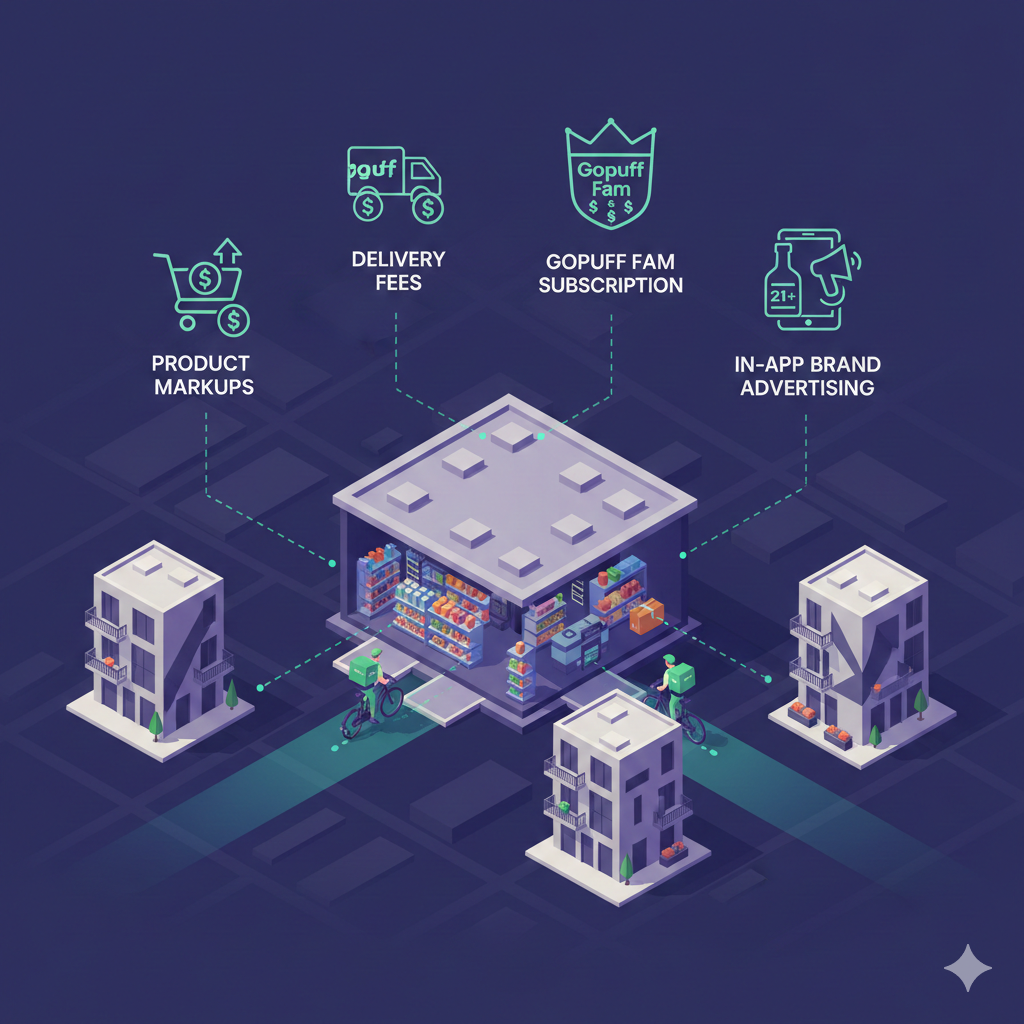
Gopuff makes money by owning inventory, operating local micro-fulfillment centers, and charging margins on products, delivery fees, subscriptions, and brand partnerships while trading profitability for speed and convenience.
What Is Gopuff?
Gopuff isn’t your typical delivery app. It’s an instant commerce company born in Philadelphia in 2013, founded by two Drexel University students who were tired of waiting hours for basic stuff like snacks and phone chargers.
Today, Gopuff operates across hundreds of cities nationwide, delivering everything from Ben & Jerry’s ice cream to Advil, White Claw to Red Bull—in under 30 minutes.
What Makes Gopuff Different?
Unlike DoorDash (which connects you to restaurants) or Instacart (which sends shoppers to grocery stores), Gopuff owns everything. The inventory. The warehouses. The delivery fleet.
They stock snacks, alcohol, essentials, OTC medications, and even cleaning supplies in compact warehouses called “micro-fulfillment centers.” When you order, their own drivers deliver straight from these mini-warehouses to your door.
Gopuff is not a marketplace—it’s a vertically integrated retailer with its own logistics network. Think of it as a 7-Eleven that comes to you, not the other way around.
The Core Problem Gopuff Solves
Americans want immediate convenience, and they want it now.
It’s 11 PM. You’re watching Netflix. You realize you’re out of ice cream, your phone charger just died, and you could really use some Tylenol. What do you do?
Before Gopuff, your options were limited: drive to a convenience store (if you’re lucky enough to have one nearby), wait 60 minutes for grocery delivery, or just go without.
Why 30-60 Minute Grocery Delivery Wasn’t Enough
Traditional grocery delivery works for meal planning. But it doesn’t work for impulse needs and late-night emergencies.
Gopuff understood the “I need it now” use case that urban Americans face constantly—especially young professionals, college students, and night owls who value their time more than a few extra dollars in fees.
Gopuff’s Business Model Explained
Inventory-Led Model: The Big Difference
Here’s where Gopuff gets interesting (and risky).
Most delivery platforms are marketplaces. They don’t own products—they just connect buyers to sellers and take a commission.
Gopuff does the opposite. They:
- Own the products outright by buying wholesale
- Operate dark stores (micro-fulfillment centers that aren’t open to walk-in customers)
- Employ their own drivers instead of using gig workers
This means when you order from Gopuff, you’re buying directly from Gopuff’s inventory, stored in a nearby warehouse, delivered by a Gopuff employee.
Why This Model Is Risky but Powerful
The upside: Higher margins, faster delivery, complete control over the customer experience, and no dependency on third-party retailers.
The downside: Massive capital requirements. Gopuff has to lease warehouses, buy inventory upfront, hire drivers, manage logistics, and deal with unsold products.
If a DoorDash order falls through, DoorDash loses a commission. If Gopuff inventory sits unsold, they eat the entire cost.
But when it works, Gopuff captures more value per transaction than any marketplace competitor could dream of.
How Gopuff Makes Money
Product Markups
This is the core revenue driver. Gopuff buys products wholesale and sells them at retail prices.
They negotiate bulk deals with brands like PepsiCo, Unilever, and Anheuser-Busch, then mark up products to retail pricing—often comparable to what you’d pay at a convenience store.
Private label products are where margins get really interesting. Gopuff sells its own brands (like Basically snacks and Goodnow toilet paper) at higher margins than national brands, while still pricing below premium competitors.
Delivery Fees
Gopuff charges a flat delivery fee per order, typically ranging from $1.95 to $3.95 depending on the market and time of day.
During peak hours or high-demand periods (Friday nights, holidays), they implement surge pricing similar to Uber’s model to balance supply and demand.
Gopuff Fam Subscription
For $5.95 per month, customers get unlimited free delivery on orders over a minimum threshold (usually $10-15).
This subscription does three powerful things:
- Locks in customers who become less price-sensitive per order
- Increases order frequency because the marginal cost per delivery is zero
- Creates predictable recurring revenue that Wall Street loves
Subscribers order 2-3x more frequently than non-subscribers, making this a critical retention tool.
Alcohol Sales
This is Gopuff’s secret weapon.
Alcohol has significantly higher margins than snacks or household items, and Americans are willing to pay premium prices for the convenience of not having to drive to a liquor store.
However, alcohol sales are heavily regulated state-by-state. Gopuff needs licenses in each market, faces delivery hour restrictions, and must verify age at the door. But the payoff is worth it—alcohol often represents 20-30% of revenue in markets where it’s available.
This gives Gopuff a competitive advantage over many competitors who avoid alcohol due to regulatory complexity.
Advertising & Brand Placement
Consumer packaged goods (CPG) brands are desperate for placement in fast-growing digital channels.
Gopuff monetizes this by offering:
- Paid product placements in prime app real estate
- Sponsored search results when users search for “chips” or “energy drinks”
- In-app promotions for new product launches
This is still a small revenue stream compared to product sales, but it’s high-margin and growing. Think of it as the “Amazon advertising” play for instant commerce.
Gopuff Cost Structure
Major Cost Buckets
Running an inventory-led delivery business is expensive. Here’s where the money goes:
Warehouse leases: Gopuff needs locations in high-rent urban areas to promise 15-30 minute delivery. Each micro-fulfillment center costs $10,000-30,000 per month in rent.
Inventory holding: Buying products upfront ties up capital. Gopuff has to predict demand accurately or risk spoilage (perishables) or dead stock (seasonal items).
Driver payouts: Unlike gig economy competitors, Gopuff employs W-2 drivers with hourly wages, benefits, and vehicle costs. This creates consistency but adds fixed costs.
Labor and operations: Each warehouse needs managers, inventory staff, and customer service teams.
Tech and logistics infrastructure: The app, routing algorithms, inventory management systems, and data infrastructure require constant investment.
Why Unit Economics Are Tough
The brutal truth: last-mile delivery is expensive.
Gopuff’s average order value (AOV) typically ranges from $20-30. After product costs, delivery expenses, and operational overhead, there’s not much margin left especially on non-alcohol orders.
When a customer orders a $3 bag of chips and a $2 soda, even with a $1.95 delivery fee, Gopuff barely breaks even after accounting for driver time, fuel, and warehouse overhead.
This is why Gopuff desperately needs to:
- Increase average order value
- Drive subscription adoption
- Sell more high-margin items (alcohol, private label)
- Optimize delivery routing to batch multiple orders
Gopuff vs DoorDash vs Instacart
Let’s break down how these models actually compare:
| Factor | Gopuff | DoorDash | Instacart |
|---|---|---|---|
| Inventory | Owned | Marketplace | Marketplace |
| Speed | 15-30 min | 30-60 min | Same-day |
| Margins | Higher (in theory) | Lower | Moderate |
| Risk | High | Lower | Medium |
| Selection | Limited (4,000 SKUs) | Unlimited restaurants | Full grocery stores |
| Control | Complete | Minimal | Moderate |
DoorDash and Instacart are asset-light. They don’t hold inventory, own warehouses, or employ drivers directly. This keeps their risk low and lets them scale quickly.
Gopuff is asset-heavy. They own everything, which gives them control but requires massive capital and operational excellence to work.
Why Gopuff Struggled With Profitability
During the pandemic, Gopuff raised billions in venture capital and expanded aggressively. They opened hundreds of warehouses, entered new cities, and prioritized growth at all costs.
Then reality hit.
Over-expansion: Many warehouses were underutilized. Opening in 50 new cities sounds great, but if each location only does 20 deliveries per day, the unit economics collapse.
High burn rate: Gopuff was burning through $100+ million per month at its peak, subsidizing delivery fees and offering aggressive promotions to acquire customers.
Warehouses under-utilized: Fixed costs (rent, labor, inventory) don’t scale down when demand softens. An empty warehouse costs almost as much as a busy one.
Shift from growth-at-all-costs to efficiency: Like the entire venture-backed startup world, Gopuff had to pivot from “grow fast” to “grow profitably” after 2022’s market correction.
Recent Strategic Changes
Gopuff has made hard choices to survive:
Closing underperforming warehouses: They’ve shut down hundreds of locations that couldn’t reach profitability, consolidating to focus on their strongest markets.
Focus on core cities: Instead of trying to be everywhere, Gopuff is doubling down on dense urban areas where delivery economics work—Philadelphia, New York, Los Angeles, Chicago.
Improving average order value: They’re experimenting with bundle deals, minimum order thresholds, and merchandising strategies to get customers to buy more per trip.
More private-label push: Gopuff-branded products carry better margins and create differentiation that keeps customers coming back.
Smarter delivery batching: Instead of one driver per delivery, they’re optimizing routes to batch multiple orders heading to the same neighborhood, dramatically reducing per-delivery costs.
Gopuff’s Competitive Advantages
Despite the struggles, Gopuff has real strengths:
End-to-end control: Owning the entire supply chain means they can optimize every step—from wholesale purchasing to delivery routing—without coordinating with third parties.
Fastest delivery promise: 15-30 minutes beats almost everyone. When speed matters most (late-night cravings, emergencies), Gopuff wins.
Strong private-label margins: Their own brands generate 30-40% higher margins than national brands while still offering competitive pricing.
Alcohol + convenience bundle: The combination of alcohol licensing, convenience items, and speed creates a unique value proposition that’s hard to replicate.
Risks & Weaknesses
Gopuff isn’t invincible. Major vulnerabilities include:
Capital-heavy model: Every new market requires massive upfront investment before generating returns. This limits expansion speed and requires continuous fundraising.
Regulation issues: Alcohol licensing varies wildly by state and city. One regulatory change can shut down their most profitable category in a market overnight.
Low customer loyalty outside subscription: Without Gopuff Fam, customers easily switch between delivery apps based on promotions and fees. Convenience alone isn’t a moat.
Competition from Amazon & Walmart: Amazon has been experimenting with ultrafast delivery through Amazon Fresh and Prime Now. Walmart is rolling out delivery in 30 minutes or less. These giants have deeper pockets and existing infrastructure.
Can Gopuff Become Profitable?
The billion-dollar question.
What Needs to Go Right
Higher average order values: If Gopuff can push AOV from $25 to $40, unit economics improve dramatically without adding delivery costs.
Subscription penetration: Getting 30-40% of customers on Gopuff Fam would create stable, predictable revenue and increase order frequency.
Operational excellence: Smarter inventory management, better routing algorithms, and optimized warehouse locations can shave 20-30% off delivery costs.
Private label growth: If half of purchases shift to Gopuff-branded products, margins could increase by 10-15 percentage points.
City-Level Profitability vs Global Profitability
Here’s the reality: Gopuff doesn’t need to be profitable everywhere—just in enough high-density cities to justify the business.
They might achieve profitability in Philadelphia, New York, and Los Angeles while losing money in smaller markets. That’s okay if the profitable cities generate enough cash to sustain the losses elsewhere.
Why Gopuff May Survive as a Regional Winner, Not a Global One
Gopuff will likely never be a global giant like Amazon or Uber. The model doesn’t scale internationally as easily as marketplaces do.
But they could become the dominant instant delivery player in top US metros—a $5-10 billion revenue business serving millions of urban Americans who value speed above all else.
That’s still a massive outcome, even if it’s not the $50 billion unicorn investors once envisioned.
What Founders Can Learn From Gopuff
Speed vs Sustainability Trade-Off
Moving fast and breaking things works until you break the bank. Gopuff showed that explosive growth without clear unit economics eventually forces painful contraction.
Lesson: Validate profitability in one market before replicating nationwide.
Inventory Ownership Pros & Cons
Owning inventory gives you control and margins, but it also gives you risk and capital requirements. This isn’t a decision to make lightly.
Lesson: Asset-heavy models can win—but only if you have operational excellence and patient capital.
Why Convenience Alone Isn’t a Moat
Being faster is great, but it’s not defensible if someone with deeper pockets can copy you. Gopuff’s real moat is the operational complexity of running micro-fulfillment centers profitably—not just speed.
Lesson: Build sustainable competitive advantages beyond customer-facing features.
When Vertical Integration Makes Sense
Gopuff’s vertically integrated model makes sense when:
- Existing solutions are fragmented and inefficient
- You can capture significantly more margin by owning the supply chain
- You have the capital and expertise to execute operations at scale
Lesson: Vertical integration is powerful in industries with broken infrastructure—but only if you can outexecute incumbents.
My Take
Gopuff bet big on owning everything from inventory to delivery to win convenience, but now has to prove that speed can actually scale profitably.
They’ve raised billions, built hundreds of warehouses, and delivered millions of orders in under 30 minutes. But the path to profitability remains uncertain.
If Gopuff can increase order values, grow subscriptions, and optimize operations, they’ll prove that inventory-led instant delivery can work at scale. If they can’t, they’ll become a cautionary tale about the limits of growth-at-all-costs thinking.
Discover more from Business Model Hub
Subscribe to get the latest posts sent to your email.

[…] the couch. The rise of instant commerce (sometimes called q-commerce) validated what platforms like Gopuff had been quietly building for years: the delivery economy wasn’t just about food, it was about […]