
Why WeChat Is More Than a Messaging App?
When WeChat launched in 2011, it entered a crowded market of messaging applications. Today, it stands as something entirely different: a comprehensive digital ecosystem that has fundamentally transformed how over a billion people communicate, shop, pay bills, access services, and conduct business.
Unlike Western apps that excel at single functions, WeChat has evolved into what’s known as a “super app” a platform where users can accomplish nearly everything they need without ever leaving the application. From ordering food and booking doctor appointments to investing in financial products and running entire businesses, WeChat has become indispensable to daily life in China.
This transformation isn’t just remarkable from a user experience perspective; it’s also created one of the most sophisticated and profitable digital business models in the world. Understanding how WeChat monetizes its ecosystem offers valuable lessons for entrepreneurs, platform builders, and anyone interested in the future of digital services.
WeChat at a Glance
Parent Company: Tencent Holdings Limited, one of the world’s largest technology conglomerates
User Scale: Over 1.3 billion monthly active users, with extremely high engagement rates users spend an average of over 80 minutes per day on the platform
Core Functions and Platforms:
- Messaging and social networking
- Mobile payments (WeChat Pay)
- Mini Programs (lightweight apps within WeChat)
- Official Accounts (content and business pages)
- Video calls and voice messages
- E-commerce and shopping
- Financial services
- Gaming and entertainment
WeChat isn’t just widely used; it’s deeply integrated into the fabric of Chinese society. It’s the app people open first thing in the morning and check last thing at night.
WeChat’s Core Value Proposition
All-in-One Digital Lifestyle
WeChat’s fundamental value proposition is convenience through consolidation. Instead of downloading dozens of separate apps for different needs, users can access hundreds of services within a single, familiar interface. This reduces friction, saves phone storage, and creates a seamless user experience.
Convenience and Trust
By handling everything from casual conversations with friends to significant financial transactions, WeChat has built deep trust with its user base. This trust is reinforced through consistent performance, security measures, and Tencent’s reputation.
Strong Network Effects
WeChat benefits from powerful network effects: the more people who use it, the more valuable it becomes. When your entire social circle, your favorite businesses, and essential services are all on WeChat, leaving the platform becomes nearly impossible. This creates a self-reinforcing cycle that continually strengthens WeChat’s position.
Key Components of the WeChat Ecosystem
Messaging and Social Networking
At its core, WeChat remains a communication platform. One-on-one and group chats support text, voice, video, and multimedia sharing. Moments, WeChat’s social feed similar to Facebook, allows users to share updates with their network. Video calls serve both personal and professional purposes, while voice messages have become particularly popular in Chinese communication culture.
This social layer is critical because it generates the traffic and engagement that makes everything else possible. Users come to WeChat primarily to connect with people, which creates opportunities for all other revenue-generating activities.
WeChat Pay
WeChat Pay transformed WeChat from a communication app into a transaction platform. The QR code economy enables instant payments by scanning codes displayed by merchants. Peer-to-peer transfers allow users to send money as easily as sending a message. The Red Packet feature, which enables digital gift envelopes for special occasions, went viral and drove mass adoption of the payment system.
WeChat Pay’s integration spans both offline and online contexts. From street vendors to luxury stores, it’s accepted virtually everywhere in China. Online, it seamlessly handles e-commerce, bill payments, and service fees. WeChat Pay’s success lies in making digital payments feel natural and effortless, eliminating the need for cash or even physical credit cards.
Mini Programs
Launched in 2017, Mini Programs represent one of WeChat’s most innovative features. These lightweight applications run within WeChat without requiring separate downloads. Users can access them instantly via QR codes, search, or sharing.
Mini Programs serve diverse use cases including e-commerce stores, food delivery, ticket booking, government services, and utility tools. For businesses, they offer a way to reach WeChat’s massive user base without the cost and complexity of developing standalone apps. For users, they provide app-like functionality without cluttering their phones.
The Mini Program ecosystem has exploded, with millions of programs now available, processing billions of transactions and serving hundreds of millions of daily active users.
Official Accounts
Official Accounts function as business and content pages within WeChat. They come in two main types: Subscription Accounts for content publishers and media, and Service Accounts for businesses providing customer service and transactions.
These accounts enable content distribution, marketing campaigns, customer service interactions, and brand building. Companies can push articles, videos, and updates directly to followers who have subscribed. This creates a direct channel between brands and consumers, reducing dependence on third-party platforms or traditional advertising.
Official Accounts have become essential marketing tools, with businesses ranging from multinational corporations to local shops using them to engage customers and drive sales.
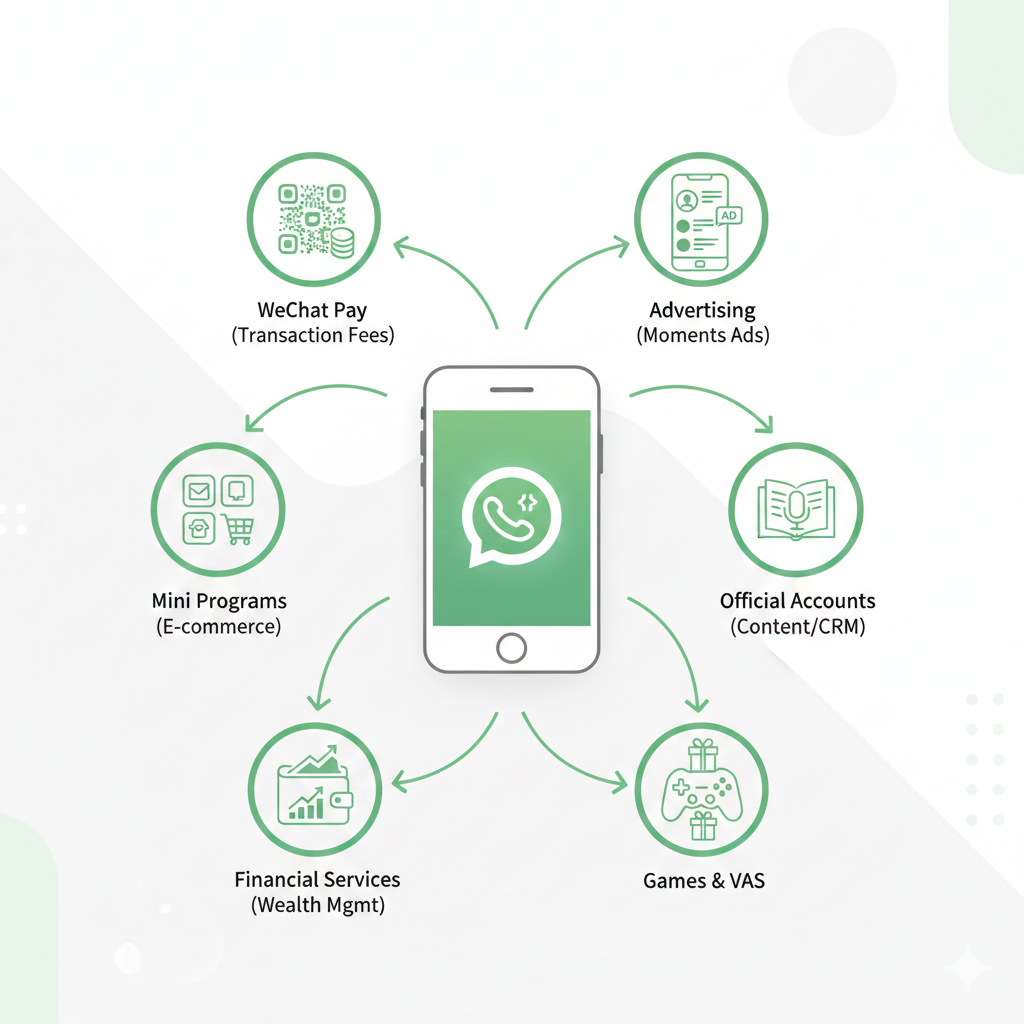
How WeChat Makes Money
Payment and Financial Services Revenue
WeChat Pay generates revenue through several streams. Merchants pay transaction fees when customers use WeChat Pay, similar to credit card processing fees. Financial products available through WeChat, including wealth management funds, insurance products, and credit services, generate commissions and fees. Cross-border payment services earn revenue from currency conversion and international transaction fees.
The payment infrastructure also creates valuable transaction data that helps WeChat understand user behavior and spending patterns, which can be leveraged for other revenue streams like advertising.
Advertising Revenue
Advertising has become one of WeChat’s largest revenue sources. Moments ads appear in users’ social feeds, similar to sponsored posts on Facebook or Instagram. These native ads blend seamlessly with organic content while maintaining clear labeling.
Banner ads and promotional content appear in Official Accounts and Mini Programs, creating additional advertising inventory. WeChat’s precision targeting capabilities, powered by extensive user behavior data, allow advertisers to reach specific demographics, interests, and behaviors. This targeting effectiveness commands premium advertising rates.
The advertising system balances revenue generation with user experience, carefully limiting ad frequency to prevent overwhelming users while maximizing value for advertisers.
Business and Developer Services
WeChat offers various services to businesses and developers building on its platform. Mini Program development tools and hosting services generate fees from businesses creating their own Mini Programs. Cloud services and enterprise solutions help companies digitalize their operations using WeChat’s infrastructure.
APIs and technical infrastructure allow developers to integrate WeChat functionality into their services, often requiring licensing fees or revenue sharing. Enterprise WeChat, a separate version designed for workplace communication, charges for premium features and advanced capabilities.
Value-Added Services
Digital stickers, themes, and customization options allow users to personalize their experience for small fees. Games and in-app purchases, particularly within WeChat’s gaming platform, generate significant revenue through virtual goods and premium content.
Membership and premium features for certain services, along with exclusive content subscriptions through Official Accounts, create recurring revenue streams. While individual transactions may be small, the massive user base makes these value-added services highly profitable.
WeChat Business Model Canvas
Understanding WeChat’s business model through the Business Model Canvas framework reveals its comprehensive ecosystem approach.
Key Partners include merchants who accept WeChat Pay, developers creating Mini Programs and services, banks and financial institutions enabling payment services, content creators publishing through Official Accounts, and advertisers funding the platform’s growth.
Key Activities encompass platform operations and maintenance, ecosystem management and governance, continuous innovation and feature development, user data analytics and insights, payment processing and security, and content moderation and compliance.
Value Propositions differ by customer segment. For users, WeChat offers an all-in-one platform for communication, payments, and services with convenience, security, and social connectivity. For businesses, it provides access to a massive user base, tools for customer engagement and sales, and reduced customer acquisition costs. For developers, it offers a large potential market, reduced development and distribution costs, and monetization opportunities.
Customer Relationships are built through network effects that create lock-in, personalized experiences driven by AI and data analytics, community building through social features, and continuous engagement through diverse services.
Revenue Streams include payment transaction fees, advertising income, business and developer services fees, financial services commissions, value-added services, and game monetization.
Key Resources comprise the massive user base and their engagement, sophisticated technology infrastructure, extensive transaction and user data, the Tencent brand and ecosystem, and the network of partners and developers.
Cost Structure includes technology development and maintenance, server and infrastructure costs, payment processing expenses, customer support operations, marketing and user acquisition, compliance and security measures, and content moderation.
How Businesses Make Money on WeChat
WeChat has created numerous opportunities for businesses to generate revenue within its ecosystem.
Private Traffic and Community Operations allow businesses to build owned audiences through Official Accounts and WeChat groups. Unlike relying on platform algorithms, businesses can communicate directly with followers, creating more predictable and cost-effective customer relationships. Community operations focus on nurturing these relationships through valuable content, exclusive offers, and personalized service.
E-commerce via Mini Programs has exploded as businesses create their own stores within WeChat. These Mini Program stores integrate seamlessly with WeChat Pay, making checkout frictionless. Businesses can sell everything from fashion and cosmetics to groceries and electronics without customers ever leaving WeChat.
Social Commerce and Influencer Sales leverage WeChat’s social features for commerce. Key Opinion Leaders (KOLs) and influencers promote products to their followers, often using a combination of Official Accounts, Moments, and group chats. The social trust built through these relationships translates into higher conversion rates compared to traditional advertising.
Customer Lifecycle Management becomes more sophisticated on WeChat. Businesses can guide customers through awareness, consideration, purchase, and retention phases all within one platform. From initial discovery through Official Account content, to purchase via Mini Programs, to after-sales service through customer service chat, WeChat enables complete lifecycle management.
Many businesses have built entire operations around WeChat, with some conducting 100% of their sales through the platform. The integration of communication, commerce, and payment creates unprecedented efficiency in customer acquisition and retention.
Competitive Advantages of WeChat
High User Retention
WeChat’s retention rates are extraordinarily high because it serves so many essential functions. Users can’t easily switch to competitors because WeChat hosts their social connections, payment methods, favorite services, and business relationships. This multi-sided lock-in creates exceptional stickiness.
Strong Payment Infrastructure
WeChat Pay’s ubiquity and reliability give WeChat a massive advantage. The payment infrastructure creates a foundation for commerce, financial services, and business transactions that competitors struggle to replicate. Users trust WeChat with their money, which represents the highest level of platform confidence.
Closed-Loop Ecosystem
WeChat has created a largely closed-loop ecosystem where users can accomplish most tasks without leaving the app. This reduces friction, increases engagement time, and creates more monetization opportunities. Each component of the ecosystem reinforces the others, creating a virtuous cycle of value creation.
The platform’s ability to capture the entire customer journey—from discovery through purchase to service—gives it unique insights and control that open ecosystems can’t match.
Challenges and Risks
Regulatory Oversight
As WeChat has grown more powerful and central to Chinese digital life, it faces increased regulatory scrutiny. Antitrust concerns, data privacy regulations, and content moderation requirements create compliance challenges and potential limitations on growth strategies. The Chinese government’s evolving approach to platform regulation represents an ongoing risk that could impact business models and operations.
Monetization vs User Experience Balance
WeChat must carefully balance aggressive monetization with maintaining user experience. Too many ads could drive users away or reduce engagement. Excessive fees might push merchants to alternative platforms. The company constantly navigates this tension, trying to maximize revenue without degrading the experience that made the platform valuable in the first place.
Competition from Other Platforms
While WeChat dominates in China, it faces competition from platforms like Douyin (Chinese TikTok), Alibaba’s ecosystem, and specialized apps that excel in specific verticals. E-commerce, short-form video, and other categories see intense competition that could fragment user attention and spending.
Internationally, WeChat has struggled to replicate its domestic success, facing entrenched competitors and different user behaviors in foreign markets.
Future Growth Opportunities
AI-Powered Services
Artificial intelligence represents a significant growth opportunity for WeChat. AI can enhance customer service through more sophisticated chatbots, improve content recommendations, provide smarter search functionality, and enable new types of personalized experiences. Voice and image recognition technologies could unlock new interaction methods and service categories.
Enterprise Digitalization
Enterprise WeChat, the business-focused version of the platform, has significant growth potential. As Chinese companies continue digitizing their operations, WeChat can provide integrated solutions for internal communication, customer relationship management, and business processes. The combination of internal and external communication on one platform creates unique value for enterprises.
International Expansion and Cross-Border Trade
While international expansion has proven challenging, cross-border trade presents opportunities. Chinese businesses selling to overseas customers, international brands reaching Chinese consumers, and facilitating tourism and travel all represent potential growth areas. WeChat Pay’s expansion to support international merchants and travelers creates new revenue streams and strengthens the platform’s global relevance.
The growing Chinese diaspora and increasing international business connections with China provide natural expansion opportunities that align with WeChat’s strengths.
Conclusion
Why WeChat’s Monetization Model Is Sustainable
WeChat’s monetization model is sustainable because it’s built on genuine value creation rather than exploitation. The platform makes money by facilitating transactions, enabling business success, and enhancing user experiences not by selling user data or manipulating behavior in harmful ways.
The diversified revenue streams protect against over-dependence on any single source. If advertising revenue declines, payment and financial services can compensate. If regulatory changes impact one area, others continue generating income. This diversity creates resilience.
Most importantly, WeChat has achieved true platform status where its success is tied to the success of its ecosystem participants. When businesses thrive on WeChat, the platform thrives. When users find value, they engage more, creating more monetization opportunities. This alignment of incentives creates a sustainable foundation for long-term growth.
Key Lessons for Digital Platforms and Startups
Several lessons emerge from WeChat’s success that apply broadly to digital platforms and startups:
First, solve a fundamental need exceptionally well before expanding. WeChat started as a messaging app and only added additional features after dominating communication. Build on strength rather than starting with everything.
Second, create network effects and switching costs. WeChat’s value increases with each additional user and service, making it nearly impossible for users to leave. Think carefully about how to build similar dynamics into your platform.
Third, enable ecosystem participants to succeed. WeChat’s growth is powered by millions of businesses, developers, and content creators who build on its platform. When they win, WeChat wins. Focus on creating value for all stakeholders, not just extracting value from them.
Fourth, balance monetization with user experience. WeChat has resisted short-term revenue opportunities that would degrade long-term platform value. Patient capital and long-term thinking enable sustainable growth.
Fifth, integrate vertically where it creates unique value. WeChat’s combination of social networking, payments, and services creates synergies that isolated apps can’t match. Look for opportunities to integrate complementary services in ways that enhance user value.
Finally, build for your specific market context. WeChat’s success in China reflects Chinese user behaviors, payment culture, and regulatory environment. International platforms that try to copy WeChat wholesale often fail because context matters enormously.
Thinking of building an app or Mini Program?
I will help you choose the right developers, not just any developers so your product is built to scale.
👉 Get expert developer recommendations
Discover more from Business Model Hub
Subscribe to get the latest posts sent to your email.






[…] WeChat dominates China but is hard to replicate elsewhere […]