
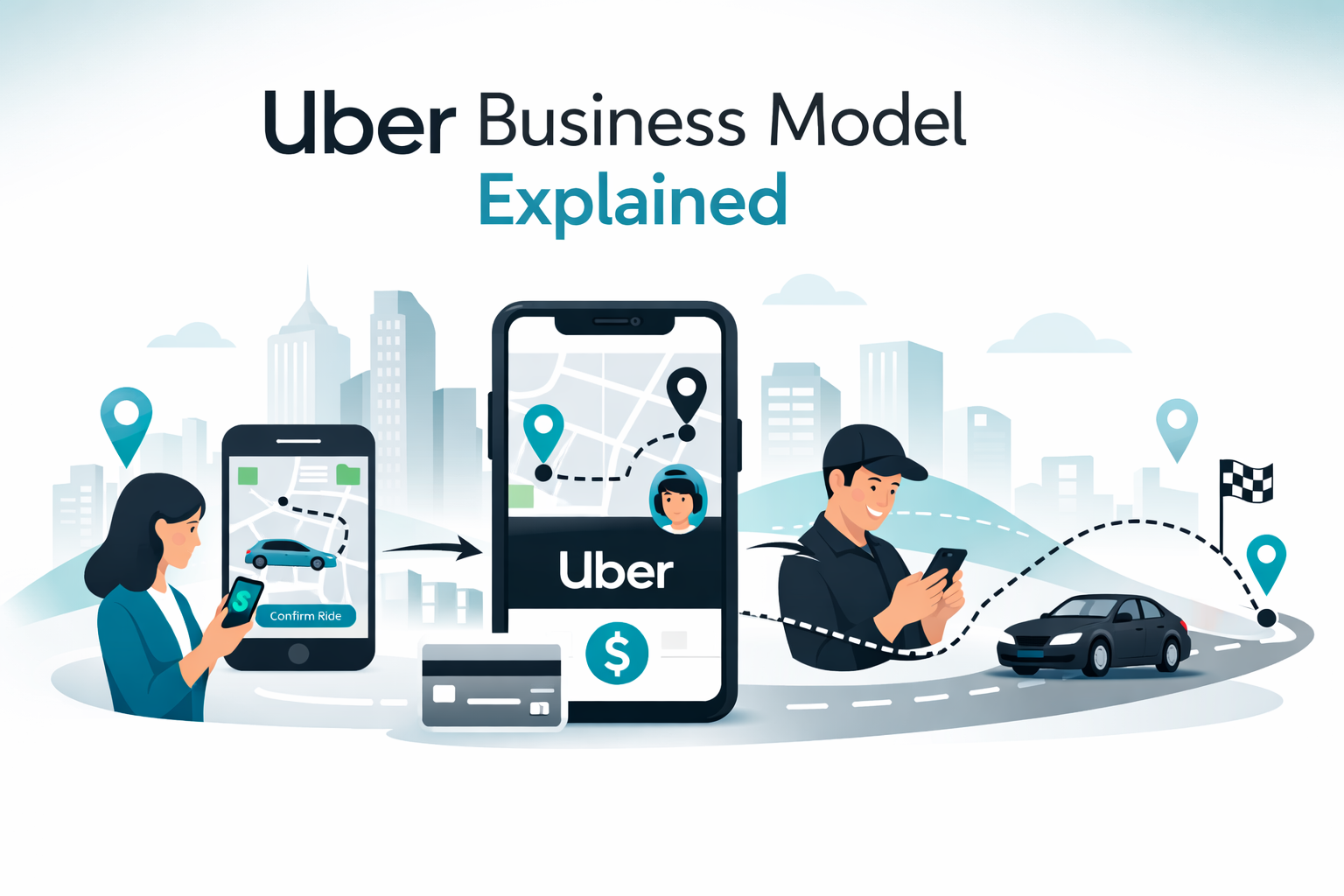
Uber operates as a multi-sided technology platform connecting riders, drivers, restaurants, and couriers across a global network. The company generates revenue primarily through commissions on ride-hailing services, food delivery transactions, and freight logistics optimized through sophisticated dynamic pricing algorithms, data-driven matching systems, and strategic network effects.
But understanding how Uber truly makes money requires looking beyond simple commission percentages. This is a story about transforming urban mobility, disrupting multiple industries simultaneously, and building one of the most complex marketplace ecosystems ever created.
What Uber Has Become: Beyond Ride-Hailing
Uber Technologies Inc. launched in 2009 with a revolutionary premise: tap a button, get a ride. That simple idea sparked a global transformation.
Today, Uber operates as a comprehensive mobility and logistics platform offering:
Mobility Services:
- UberX (economy rides)
- Uber Comfort (enhanced vehicles)
- Uber Black (premium service)
- Uber Pool (shared rides)
- Uber Moto (motorcycle taxis in select markets)
Delivery Services:
- Uber Eats (restaurant delivery)
- Uber Direct (white-label delivery for retailers)
- Grocery and convenience delivery
Logistics Solutions:
- Uber Freight (trucking marketplace)
- Uber Connect (package delivery)
Enterprise Solutions:
- Uber for Business (corporate travel management)
- Uber Health (medical transportation)
Membership Programs:
- Uber One (subscription benefits across services)
This diversification transformed Uber from a taxi alternative into a comprehensive platform for moving people, food, and goods.
The Numbers Behind the Global Giant
Understanding Uber’s scale requires examining the actual data:
- 150+ million monthly active platform consumers globally
- 5.4+ million active drivers and couriers providing services
- 70+ countries with active operations
- 15,000+ cities where Uber operates
- $37.3 billion in revenue (recent fiscal year)
- 9+ billion trips completed annually across all services
- First full-year operating profit achieved after 14 years of operations
These metrics don’t just represent business success—they demonstrate infrastructure-level impact on global transportation and commerce.
The Problems Uber Solved (And Created New Markets Around)
Before Uber fundamentally altered urban transportation, getting around cities involved significant friction.
The Pre-Uber Transportation Reality:
For passengers:
- Standing on street corners hoping to flag taxis
- No visibility into wait times or driver location
- Unpredictable pricing with potential for scams
- Cash-required transactions creating safety concerns
- Quality inconsistency across drivers and vehicles
- Limited recourse for poor service experiences
For drivers:
- Wasted time circling neighborhoods searching for passengers
- Revenue limited by random street encounters
- Expensive medallion systems creating artificial barriers
- No data on where demand actually existed
- Cash transactions creating robbery risks
For cities:
- Inefficient resource utilization with empty vehicles cruising
- No data visibility into actual transportation patterns
- Environmental waste from unnecessary mileage
- Accessibility gaps in underserved neighborhoods
Uber didn’t just improve taxi service—it rebuilt the foundational mechanics of urban mobility.
The Uber Solution:
Technology-enabled matching: GPS-based real-time connection between supply and demand Price transparency: Upfront fare estimates before booking Cashless transactions: Integrated payment reducing friction and safety concerns Quality accountability: Two-way rating systems enforcing standards Data-driven optimization: Algorithmic efficiency improving overall system performance
This transformation created entirely new market opportunities while destroying old business models built on artificial scarcity.
How Uber’s Platform Actually Operates
The user experience appears simple, but extraordinary technical and operational complexity powers every transaction.
The Complete Ride Flow:
1. Request Initiation
A passenger opens the Uber app and enters their destination. Immediately, sophisticated algorithms activate:
- Calculate optimal route and estimated fare
- Assess current demand and supply dynamics
- Determine if surge pricing applies
- Identify available drivers within proximity
- Predict pickup time based on traffic patterns
2. Intelligent Driver Matching
Uber’s system doesn’t simply ping the nearest driver. Instead, it considers:
- Driver’s current location and direction
- Driver’s acceptance rate and reliability score
- Estimated time to pickup location
- Driver’s preferred operating areas
- Overall network optimization across all pending requests
This matching happens in milliseconds, coordinating thousands of simultaneous requests across a city.
3. Dynamic Pricing Calculation
Fare calculation incorporates multiple variables:
- Base fare for vehicle category
- Distance-based pricing
- Time-based pricing
- Demand surge multiplier (if applicable)
- Local taxes and fees
- Route complexity adjustments
- Real-time traffic condition predictions
4. Journey Execution and Monitoring
During the ride:
- Real-time GPS tracking for safety
- Route optimization based on current traffic
- Estimated arrival time updates
- Safety features accessible to both parties
- Two-way communication channel
5. Automated Payment and Settlement
Trip completion triggers immediate processing:
- Automatic payment from rider’s linked account
- Uber’s commission deduction
- Driver payment calculation
- Two-way rating prompt
- Receipt generation and delivery
This entire orchestration represents platform marketplace economics operating at global scale.
Uber’s Revenue Architecture: How Money Actually Flows
1. Ride-Hailing Commissions: The Core Foundation
This remains Uber’s largest single revenue source, generating billions in annual income.
The commission structure:
Uber charges drivers a service fee typically ranging from 20% to 30% of gross booking value, varying by:
- Geographic market and local competition
- Ride category (UberX vs. Uber Black)
- Time of day and demand conditions
- Driver tenure and performance metrics
- Local regulatory requirements
Why this model scales:
With millions of daily rides, even modest commission percentages create substantial revenue. More importantly, marginal costs per additional ride remain minimal—the platform infrastructure handles increased volume without proportional cost increases.
Strategic considerations:
Uber continuously balances commission rates against driver supply. Too high, and drivers leave for competitors. Too low, and profitability suffers. Dynamic adjustments maintain this delicate equilibrium.
2. Uber Eats: Food Delivery Revenue Streams
Uber Eats has evolved into a major business segment, sometimes generating more revenue than ride-hailing in certain markets.
Multiple revenue sources:
Restaurant commissions: Typically 15-35% of order value, varying by:
- Restaurant size and negotiating power
- Promotional agreements
- Delivery distance
- Order frequency
Delivery fees: Charged to customers, ranging from $0.99 to $5.99+ based on:
- Distance to restaurant
- Time of day
- Demand conditions
- Membership status
Service fees: Small percentage added to orders Small order fees: Charged on orders below minimum thresholds
Strategic value:
Food delivery provides revenue diversification, reduces reliance on mobility alone, and increases platform engagement frequency. Users might order food daily but only ride weekly.
3. Surge Pricing: The Economics of Dynamic Markets
Surge pricing represents Uber’s most controversial yet economically elegant feature.
How surge pricing functions:
When ride demand exceeds driver supply in specific areas:
- Prices increase automatically (1.2x to 5x+ multipliers)
- Higher fares incentivize offline drivers to start working
- Some price-sensitive riders delay trips
- Market equilibrium restores relatively quickly
Revenue impact:
During surge periods, Uber’s absolute commission value increases significantly. A $10 ride at 2.5x surge becomes $25—Uber’s commission grows proportionally.
The economic logic:
Critics view surge pricing as exploitation. Economists recognize it as efficient resource allocation—ensuring rides remain available by incentivizing supply increases and demand moderation.
4. Uber Freight: Enterprise Logistics Revolution
Uber Freight applies marketplace principles to trucking and logistics.
The business model:
- Connects shippers needing freight transported with truck drivers
- Provides real-time pricing and automated booking
- Handles payment processing and invoicing
- Offers enterprise logistics management tools
Revenue generation:
- Margin on freight transactions (similar to ride commissions)
- Subscription fees for premium shipper features
- Enterprise logistics software licensing
Long-term potential:
The global freight market represents trillions in annual value. Even small market share captures enormous revenue opportunity while leveraging existing platform capabilities.
5. Uber One: Subscription Revenue and Loyalty
Uber One membership ($9.99/month in the US) offers:
- $0 delivery fees on eligible orders
- Discounts on rides
- Priority customer support
- Exclusive promotions
Strategic benefits beyond direct revenue:
- Increases platform engagement frequency
- Improves customer retention metrics
- Reduces price sensitivity through perceived value
- Generates predictable recurring revenue
- Creates switching costs to competitors
Membership economics:
Heavy users find subscriptions valuable. Light users subsidize the program. The model optimizes lifetime value while improving overall platform liquidity.
6. Advertising: The High-Margin Growth Engine
Uber’s advertising business is rapidly expanding, leveraging unique audience data.
Advertising opportunities:
In-app restaurant promotions: Restaurants pay for featured placement in Uber Eats Sponsored listings: Priority visibility in search results Banner advertisements: Display ads across the platform Journey ads: Advertisements during rides (in-vehicle tablets in some markets)
Why advertising works for Uber:
- Massive captive audience with high purchase intent
- Rich behavioral data enabling precise targeting
- Existing merchant relationships reducing sales friction
- Software-like margins (90%+ gross margins typical)
Growth trajectory:
Advertising could eventually represent 10-15% of total revenue—transforming profitability since margins far exceed ride or delivery commissions.
Uber’s Cost Structure: Where Billions Get Spent
Despite being asset-light, Uber faces substantial operational costs.
1. Driver and Courier Incentives
Ongoing expenses:
- Sign-up bonuses for new drivers
- Performance bonuses and rewards
- Peak-hour incentive payments
- Quest bonuses for completing trip thresholds
- Retention programs for experienced drivers
Strategic necessity:
Maintaining driver supply requires continuous investment. Competitors constantly recruit Uber’s drivers, necessitating defensive spending.
2. Insurance and Safety Costs
Required coverage:
- Commercial liability insurance for all rides
- Collision coverage during trips
- Background check systems
- Safety technology development
- Incident response teams
Regional variations:
Insurance requirements and costs vary dramatically by market, significantly impacting local profitability.
3. Technology and R&D Investment
Core platform development:
- Mobile app continuous improvement
- Backend infrastructure scaling
- Machine learning algorithms
- Fraud detection systems
- Payment processing optimization
Future technology bets:
- Autonomous vehicle development (though scaled back)
- Electric vehicle infrastructure
- Advanced routing algorithms
- Safety technology innovation
4. Sales, Marketing, and Promotions
Customer acquisition:
- Digital advertising campaigns
- Promotional discounts and credits
- Referral program payments
- Partnership marketing
Merchant onboarding:
- Restaurant acquisition teams
- Onboarding incentives
- Account management resources
5. Legal, Regulatory, and Compliance
Ongoing costs:
- Legal teams across 70+ countries
- Regulatory lobbying and compliance
- Litigation expenses (driver classification lawsuits)
- Government relations staff
- Policy development teams
Regional complexity:
Each market requires specific legal infrastructure, multiplying costs across global operations.
6. Operations and Support
Required infrastructure:
- Customer support centers globally
- Operations teams in each market
- Greenlight Hubs for driver support
- Community management
- Safety response teams
The Path to Profitability: Uber’s Strategic Evolution
For over a decade, Uber prioritized growth over profits—a deliberate strategy to establish network effects before competitors.
The Growth Phase Strategy (2009-2020):
- Expand to as many markets as possible
- Subsidize rides heavily to build user base
- Invest aggressively in driver supply
- Outspend competitors for market dominance
- Accept massive losses as investment in future monopoly
Result: Billions in cumulative losses but dominant global market position.
The Profitability Pivot (2020-Present):
Strategic changes:
- Exit unprofitable international markets (China, Southeast Asia, Russia)
- Reduce driver incentive spending
- Increase take rates (commission percentages)
- Expand high-margin businesses (advertising, subscriptions)
- Optimize operational efficiency
- Focus on unit economics over volume growth
Result: First full-year operating profit achieved, demonstrating model viability.
Uber’s Strategic Framework: The Master Plan
Uber’s strategy operates across multiple timeframes and objectives:
Near-Term Priorities:
1. Profitability Optimization
- Improve margins through advertising and subscriptions
- Reduce driver incentive dependency
- Optimize operational efficiency
2. Market Share Defense
- Maintain liquidity in core markets
- Counter competitive threats
- Expand delivery services
Medium-Term Objectives:
3. Ecosystem Expansion
- Build super-app functionality
- Integrate complementary services
- Increase platform engagement frequency
4. Enterprise Solutions
- Scale Uber for Business
- Grow freight operations
- Develop healthcare transportation
Long-Term Vision:
5. Autonomous Mobility
- Partner with AV developers
- Prepare platform for driverless future
- Reduce largest cost component (driver payments)
6. Sustainability Leadership
- Transition to electric vehicles
- Reduce carbon footprint
- Meet regulatory requirements
Competitive Landscape: Uber’s Market Position
Uber faces competition across multiple fronts:
Global Competitors:
| Company | Primary Market | Core Advantage |
|---|---|---|
| Uber | Global | Scale and diversification |
| Didi | China | Government relationships |
| Grab | Southeast Asia | Super-app integration |
| Bolt | Europe/Africa | Low-cost positioning |
| Ola | India | Local market knowledge |
| Lyft | US | Driver-friendly reputation |
Strategic Competitive Advantages:
Uber’s global scale creates:
- Technology amortization across markets
- Negotiating leverage with partners
- Data advantages from billions of trips
- Brand recognition enabling market entry
- Financial resources for sustained competition
However:
Local competitors often win specific markets through regulatory relationships, cultural adaptation, or aggressive pricing that global players cannot sustain everywhere.
Why Uber’s Business Model Works (When It Does)
1. Powerful Network Effects
More riders attract more drivers. More drivers mean faster pickups. Faster pickups attract more riders. This virtuous cycle creates winner-take-most dynamics in each market.
The tipping point phenomenon:
Once Uber achieves critical mass in a city, competitors struggle to offer comparable service quality, making market entry extremely difficult.
2. Data Compounds Over Time
Every completed trip generates valuable data:
- Improved demand forecasting
- Better pricing algorithms
- Enhanced safety through pattern recognition
- Route optimization
- Fraud detection
Competitors starting today cannot replicate years of accumulated data, creating sustainable advantages.
3. Asset-Light Scalability
Uber owns essentially no vehicles. This means:
- Capital requirements remain manageable
- Scaling to new cities requires minimal infrastructure
- Risk stays concentrated in technology and operations
- Exit from unprofitable markets incurs limited losses
4. Multi-Sided Platform Synergies
Uber’s platform creates value for multiple stakeholders simultaneously:
- Riders get convenient transportation
- Drivers earn flexible income
- Restaurants access delivery customers
- Cities gain mobility data insights
This multi-sided value creation proves difficult for single-purpose competitors to replicate.
The Challenges Uber Cannot Ignore
1. Regulatory Uncertainty and Driver Classification
The fundamental question persists: Are drivers independent contractors or employees?
Implications:
- Employee classification would increase costs 20-30%
- Benefits, minimum wage, and overtime obligations
- Fundamentally altered economics
- Regional regulatory fragmentation
Different jurisdictions reach different conclusions, creating operational complexity.
2. Market Saturation and Competition
Challenges:
- Mature markets show slowing growth
- Customer acquisition costs rising
- Competitive intensity remains high
- Alternative transportation options improving
3. Profitability Pressures
While achieving operating profitability, Uber still faces:
- Thin margins in core ride-hailing
- Need for continuous driver incentives
- Customer expectations for low prices
- Investor pressure for sustainable profits
4. Autonomous Vehicle Transition Risks
Autonomous vehicles could:
- Benefit Uber: Eliminate largest cost (driver payments)
- Threaten Uber: Enable automakers to compete directly
The platform that controls autonomous fleets may control future urban mobility.
5. Environmental and Social Concerns
Growing scrutiny around:
- Carbon emissions from increased vehicle miles
- Impact on public transportation usage
- Driver earnings adequacy
- Congestion in urban centers
Future Growth Opportunities: Where Uber Is Heading
1. Advertising Expansion
Already growing rapidly, advertising could become 10-15% of revenue with exceptional margins.
2. Financial Services Integration
Uber Wallet, driver financing, and payment services leverage platform scale.
3. Autonomous Vehicle Partnerships
Collaborating with AV developers positions Uber for driverless future without massive R&D costs.
4. Healthcare Transportation
Uber Health connects patients with medical appointments, accessing healthcare transportation budgets.
5. Super-App Evolution
Integrating additional services (payments, e-commerce, travel) increases engagement and revenue per user.
The One-Sentence Uber Model
Uber operates a technology-enabled marketplace that monetizes movement—of people, food, and goods—by facilitating transactions and capturing commission on the value created through efficient matching and dynamic pricing.
Ending Perspective: Understanding Uber’s True Innovation
Uber’s story teaches profound lessons about modern business:
Platform businesses require patience: Profitability came after 14 years and billions in losses—but established dominant market position first.
Network effects create powerful moats: Once established, platforms become increasingly difficult to disrupt.
Data advantages compound: Years of operational data create AI and algorithmic capabilities competitors cannot easily replicate.
Regulatory strategy matters: How companies position themselves legally determines long-term viability.
Diversification reduces risk: Multiple revenue streams protect against single-market disruption.
Whether you’re studying marketplace economics, technology platforms, or global business strategy, Uber represents a masterclass in both success and struggle. It’s not just a ride-hailing app—it’s a comprehensive exploration of how technology reshapes entire industries while navigating complex regulatory, competitive, and economic challenges.
The Uber business model isn’t perfect. But it’s undeniably transformative.
FAQs
Uber follows a platform marketplace business model. It connects riders with drivers, restaurants with customers, and shippers with truck drivers. Uber earns money by taking a commission on each transaction rather than owning vehicles or employing drivers.
Uber’s main sources of income are:
Ride-hailing commissions from drivers
Food delivery fees and restaurant commissions via Uber Eats
Logistics margins through Uber Freight
Subscriptions (Uber One)
Advertising and sponsored listings on Uber Eats
Ride-hailing remains Uber’s largest revenue contributor.
Yes, Uber is now profitable at the operating level.
After years of losses due to aggressive expansion and driver incentives, Uber achieved consistent operating profitability in recent years by:
Reducing incentives
Exiting unprofitable markets
Improving pricing efficiency
Expanding high-margin businesses like ads and subscriptions
However, profitability can still fluctuate quarter to quarter.
In India, Uber follows the same commission-based ride-hailing model, but with local adaptations.
Key points:
Uber connects riders with independent drivers
Drivers use their own vehicles
Uber earns a commission per ride
Prices are kept competitive due to strong competition from Ola
Focus is on affordability, digital payments, and high ride volume
Uber India operates with lower margins compared to Western markets due to price sensitivity.
Uber typically takes 15% to 30% commission per ride, depending on:
City
Ride type (Uber Go, Uber Premier, etc.)
Demand and supply conditions
Exact commission rates may vary and are not publicly fixed.
In many cities, Uber is cheaper or similarly priced compared to traditional taxis, especially during non-peak hours. However, during high demand, surge pricing can make Uber more expensive.
Uber prioritised:
Market expansion
User acquisition
Driver incentives
Technology investment
This growth-first strategy delayed profits but helped Uber build massive global scale.
Uber’s biggest advantage is:
Global presence
Strong brand recognition
Diversified services (rides, food, freight, ads)
While local players dominate certain regions, Uber remains the most globally diversified mobility platform.
Yes, Uber’s long-term sustainability depends on:
Maintaining profitability
Managing regulatory risks
Expanding high-margin revenue streams
Adopting electric and autonomous vehicles
Uber’s platform scale gives it a strong foundation for long-term growth.
Discover more from Business Model Hub
Subscribe to get the latest posts sent to your email.



[…] the ride-hailing wars, two names dominate the conversation: Uber and lyft. Both started with the same basic idea connecting riders with drivers through a smartphone […]
[…] Uber […]
[…] + Paytm + Spotify + Amazon + Uber inside one […]
[…] vs Uber and Grab: Different Business […]
[…] marketplaces like Airbnb and Uber represent the opposite extreme from Craigslist. They control pricing, handle payments, verify […]
[…] traditional ride-hailing services and robotaxis lies in the driver economics. Companies like Uber Technologies typically pay 60-80% of each fare to drivers, leaving slim margins for the platform. Robotaxis […]
[…] of transaction-based income. The model was directly comparable to DoorDash’s DashPass and Uber’s Uber One all three recognized that subscription revenue was a more stable and defensible business […]
[…] you look at Uber’s evolution, it’s no longer just a ride-hailing […]
[…] Uber aggregates independent drivers and connects them with passengers. It controls surge pricing, cancellation policies, driver ratings, and the entire app experience. Drivers aren’t Uber employees they’re suppliers operating under Uber’s brand rules. […]
[…] Uber’s pricing is entirely algorithmic. inDrive’s pricing is negotiated between humans. Uber’s commission rates sit between 20% and 30%. inDrive’s sit between 5% and 10%. On Uber, the platform controls the transaction. On inDrive, the rider and driver share that control. Uber offers moderate transparency about how fares are calculated. inDrive offers complete transparency because the fare is simply what two parties agreed to. […]
[…] main competitors include Uber, Lyft, Grab, and DiDi, each of which takes a different approach to the global mobility […]
[…] model is notably different from ride-hailing platforms like Uber. Turo enables self-driven rentals where the renter takes the car independently, rather than being […]
[…] 2021, Uber acquired Drizly for approximately $1.1 billion, recognizing its dominant position in the alcohol […]