The Rise of AI-Generated Music
The creative industries are experiencing a seismic shift as generative AI technologies mature and become accessible to mainstream users. From text generation to image creation, AI tools are democratizing creative production in ways previously unimaginable. Now, this revolution has reached the music industry, where AI-generated music is transitioning from experimental novelty to practical tool.
At the forefront of this transformation stands Suno AI, a platform that allows anyone to create original, high-quality music simply by describing what they want in plain text. Within seconds, Suno transforms written prompts into complete songs with vocals, instrumentation, and production quality that rivals human-created tracks.
What makes Suno particularly notable isn’t just its technological capability, but how it has built a sustainable business model around AI music generation. While many AI tools struggle with monetization, Suno has crafted an approach that balances accessibility with profitability, free exploration with premium features, and individual creativity with commercial opportunities. Understanding how Suno monetizes AI-generated music offers valuable insights into the future of creative AI tools and the emerging creator economy built around them.
What Is Suno AI?
Suno AI is a generative artificial intelligence company founded in 2022 by a team of musicians and AI researchers from tech companies including Meta, TikTok, and Kensho. Based in Cambridge, Massachusetts, the company launched publicly in 2023 and quickly gained attention for the quality and ease of its music generation capabilities.
The core product is remarkably straightforward: users input text descriptions of the music they want to create, and Suno’s AI generates complete songs including melody, harmony, rhythm, instrumentation, and even vocals with lyrics. The platform can produce music across virtually any genre, from pop and rock to classical and electronic, in multiple languages and styles.
Suno targets a diverse user base spanning hobbyists exploring AI music for fun, content creators needing background music for videos and podcasts, independent musicians looking for inspiration or collaboration tools, and businesses requiring custom music for commercials, games, or applications. This wide appeal has helped Suno rapidly build a substantial user community and establish itself as a leader in the competitive AI music generation space.
Suno AI’s Core Value Proposition
Music Creation Without Technical Skills
Traditional music production requires significant technical knowledge including music theory, instrument proficiency, recording techniques, and mastery of complex digital audio workstation software. Suno eliminates these barriers entirely. Anyone who can describe what they want in words can create music, regardless of their musical background or technical expertise.
Speed, Accessibility, and Creativity
What might take professional musicians hours, days, or weeks to compose, record, and produce, Suno accomplishes in seconds. This speed enables rapid iteration and experimentation. Users can try dozens of variations, explore different genres, and refine their vision without the time and cost constraints of traditional production.
The accessibility extends beyond speed. Suno operates through a simple web interface requiring no software installation, specialized hardware, or expensive equipment. A standard internet connection and basic computer are sufficient to produce professional-quality music.
Democratizing Music Production
Suno’s ultimate value proposition is democratization. Just as smartphones democratized photography and social media democratized publishing, Suno aims to democratize music production. It opens creative possibilities to people who previously couldn’t afford studio time, couldn’t play instruments, or lacked the years of training typically required to produce quality music.
This democratization has profound implications for creativity and culture, enabling more diverse voices and perspectives to express themselves through music.
How Suno AI Works
While the underlying technology is complex, the user experience Suno provides is remarkably simple. Users begin by writing a text prompt describing the music they want to create. This might include genre specifications, mood descriptors, tempo instructions, lyrical themes, or specific musical elements like “upbeat indie pop song about summer with female vocals and acoustic guitar.”
Suno’s AI models, trained on vast datasets of existing music, interpret these prompts and generate original compositions. The models understand musical structure, genre conventions, emotional tone, and how different elements combine to create cohesive songs. They generate not just melodies but complete arrangements with multiple instruments, vocal performances, and production polish.
The process typically takes 30 seconds to a few minutes, after which users receive their generated track. They can then regenerate variations, make adjustments to prompts, or accept the output as is. Songs are delivered in standard audio formats ready for download, sharing, or integration into other projects.
Importantly, Suno emphasizes that its AI creates original compositions rather than copying or assembling existing tracks. Each generation produces unique musical content, though the models have learned patterns and structures from their training data.
Suno AI Business Model Overview
Suno operates primarily as a platform-as-a-service, providing access to its AI music generation capabilities through a web-based platform. This approach keeps infrastructure costs centralized while making the service accessible to users worldwide without complex software distribution.
The business model foundation is freemium, offering basic functionality at no cost while reserving advanced features, higher usage limits, and commercial rights for paying subscribers. This strategy allows Suno to build a large user base, demonstrate value, and convert satisfied users into paying customers.
Unlike some AI tools that focus on enterprise sales, Suno maintains a direct-to-consumer focus, optimizing for individual creators and small teams. This approach aligns with the democratization mission and allows rapid user growth through viral adoption and community building rather than lengthy enterprise sales cycles.
How Suno AI Makes Money
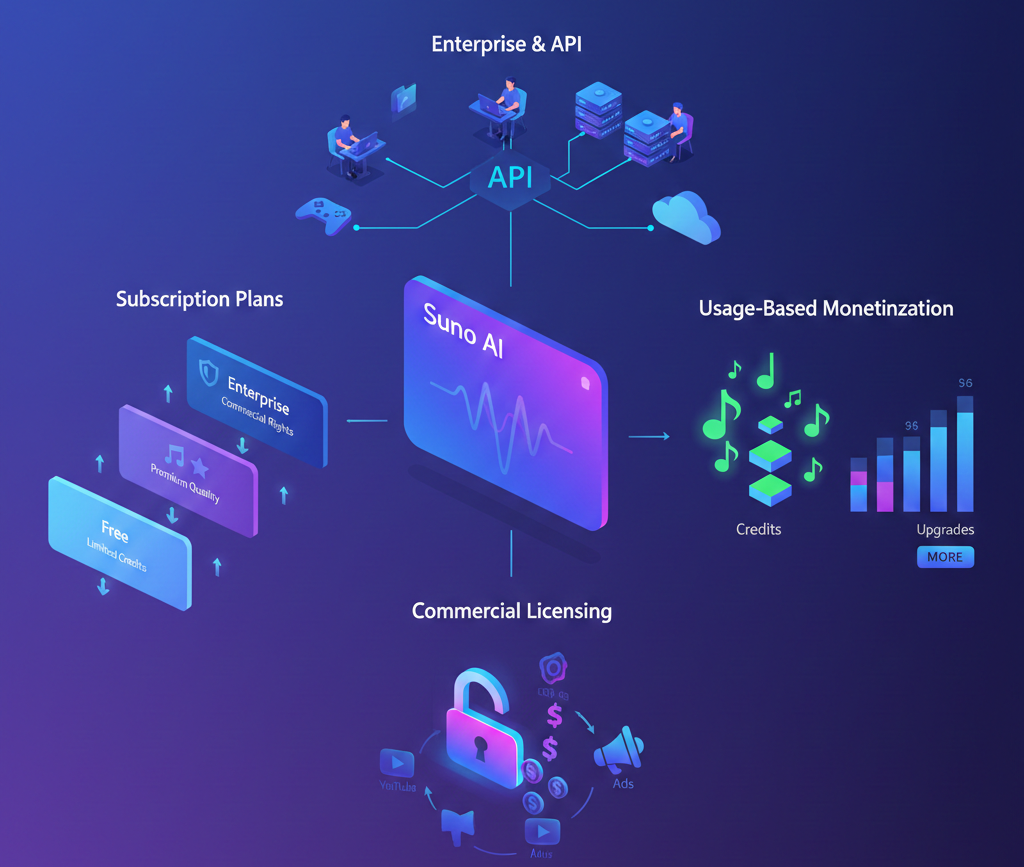
Subscription Plans
Subscription revenue forms the core of Suno’s monetization strategy. The platform offers multiple tiers designed to serve different user needs and commitment levels.
Free Tier: Suno provides a free tier that allows users to explore the platform and generate a limited number of songs. This tier typically includes restrictions on daily generation credits, watermarked outputs, or limitations on song length and quality. Crucially, free tier users cannot use their generated music for commercial purposes.
Pro Tier: The paid Pro subscription, priced monthly or annually, dramatically expands capabilities. Subscribers receive substantially more generation credits, access to higher quality output, priority generation speed, and the ability to create longer songs with more control over the generation process. Pro subscribers also gain commercial usage rights, allowing them to monetize music they create with Suno.
Premier/Enterprise Tier: For high-volume users and professional creators, Suno offers premium tiers with even higher limits, additional features, and expanded commercial rights. Annual pricing typically offers discounts compared to monthly billing, encouraging longer-term commitments and improving revenue predictability.
The pricing strategy reflects industry standards for creative AI tools, positioning Suno as affordable for serious hobbyists and professionals while remaining accessible enough to attract a broad user base.
Usage-Based Monetization
Beyond flat subscription fees, Suno implements usage-based constraints that encourage upgrades. Each tier includes a specific number of generation credits per month. Once users exhaust their credits, they must wait for the monthly reset, purchase additional credits, or upgrade to a higher tier.
This usage-based approach serves multiple purposes. It manages infrastructure costs by preventing unlimited free usage, creates natural upgrade triggers when users hit limits, and allows flexible monetization as usage scales with user needs.
For premium subscribers, higher credit allocations enable professional-level production volumes while still maintaining some constraints that could drive additional purchases or tier upgrades for power users.
Commercial Licensing
Perhaps the most significant component of Suno’s business model is how it handles commercial licensing and rights. This differentiates tiers and creates strong incentives for conversion to paid plans.
Free tier users receive non-commercial licenses only. They can create and share music personally but cannot use it in monetized YouTube videos, sell recordings, license to businesses, or incorporate it into commercial projects. This restriction is enforceable and clearly communicated in the terms of service.
Paid subscribers receive commercial usage rights, granting them the ability to monetize their Suno-generated music. They can use tracks in commercial content, license them to clients, include them in products they sell, or stream them on platforms where they earn revenue. This commercial license represents substantial value for content creators, musicians, and businesses, justifying the subscription cost.
The licensing structure creates a clear value proposition: casual exploration and personal use remain free, but anyone wanting to profit from or professionally use Suno’s output must subscribe. This aligns incentives between Suno and users who derive economic value from the platform.
Enterprise and API Opportunities
While currently focused on direct-to-consumer subscriptions, Suno has emerging opportunities in enterprise and API-based business models. Several potential revenue streams are developing in this space.
Game developers could integrate Suno’s technology to generate dynamic, adaptive soundtracks that respond to gameplay. Advertising agencies might use Suno to quickly produce custom music for campaigns without licensing costs. App developers could embed music generation capabilities directly into their products.
These B2B opportunities would likely involve API access with usage-based pricing, revenue sharing arrangements, or enterprise licensing agreements. While not yet Suno’s primary revenue source, enterprise and API monetization represents significant growth potential as the technology matures and business use cases expand.
Customer Segments
Individual Creators and Musicians
Hobbyist musicians, aspiring artists, and musical experimenters form a substantial user base. They use Suno for creative exploration, generating ideas for original compositions, creating backing tracks, or producing complete songs for personal projects. Some use it as a learning tool to understand song structure and genre conventions.
Content Creators
YouTubers, TikTok creators, podcasters, and social media influencers represent a particularly valuable segment. They constantly need background music, intro/outro tracks, and custom audio for their content. Suno provides unlimited, royalty-free options without the copyright concerns or licensing costs associated with using existing music.
This segment often converts to paid plans quickly because they directly monetize their content and need commercial licenses for their generated music.
Businesses and Brands
Marketing teams, small businesses, and creative agencies use Suno to generate custom music for commercials, promotional videos, presentations, and branded content. The ability to create music that perfectly matches their brand voice and specific needs, without hiring composers or dealing with music licensing, provides substantial value and cost savings.
Developers and Platforms
App developers, game creators, and technology platforms explore integrating AI-generated music into their products. They might use Suno to provide music generation features to their own users or to create audio content for their applications.
Distribution and Growth Strategy
Social Media Virality
Suno’s growth has been significantly accelerated by social media virality. Users create surprising, funny, impressive, or emotionally resonant songs and share them across platforms like Twitter, Reddit, TikTok, and Discord. These shares often include prompts or creation stories, naturally demonstrating Suno’s capabilities and driving new user acquisition.
The shareability of AI-generated music creates organic marketing that’s more authentic and effective than traditional advertising. Each viral song serves as both product demonstration and user testimonial.
Community Sharing and Remix Culture
Suno has fostered a vibrant community where users share their creations, exchange prompts and techniques, collaborate on projects, and celebrate particularly impressive or creative outputs. This community engagement increases platform stickiness, provides valuable user-generated content for marketing, and creates a network effect where active users attract new users.
The platform enables remix culture, where users can build on others’ creations, generating variations and inspiring new directions. This collaborative aspect enhances creativity and deepens user investment in the platform.
Partnerships and Platform Integrations
Strategic partnerships expand Suno’s reach and utility. Integrations with content creation platforms, music distribution services, or creative software could embed Suno’s capabilities into workflows where users already operate, reducing friction and increasing usage.
Partnerships with influencers, music educators, and creator communities help Suno reach targeted audiences with credible endorsements and practical demonstrations of value.
Competitive Advantages of Suno AI
High-Quality Music Generation
Suno has earned recognition for producing music that sounds remarkably natural and professionally produced. The quality of vocal synthesis, instrumental coherence, and overall production polish distinguishes Suno from many competitors. Users frequently express surprise at how “real” the generated music sounds.
This quality advantage is crucial because music is an emotional, subjective medium where listeners have high standards. Lower-quality AI music that sounds robotic or poorly arranged fails to meet user needs, regardless of how accessible or affordable it might be.
Ease of Use and Speed
Suno’s interface is intentionally simple, prioritizing accessibility over complexity. While some AI music tools require understanding of music theory or technical parameters, Suno accepts natural language descriptions and handles the complexity behind the scenes. This lowers barriers to entry and accelerates the path from idea to output.
The generation speed also provides advantage. Users can iterate quickly, trying multiple variations in the time it would take to set up a single recording session or even to compose a basic melody traditionally.
Strong Creator Adoption
Suno has successfully built adoption among creators who actively use and promote the platform. These users become advocates, creating tutorial content, showcasing impressive creations, and normalizing AI music generation within creative communities. This grassroots adoption is more sustainable and credible than top-down marketing campaigns.
The creator community also provides valuable feedback, helping Suno identify and prioritize improvements that matter most to active users.
Challenges and Risks
Copyright and IP Concerns
The most significant challenge facing Suno and all AI music generators involves copyright and intellectual property questions. Critics and some copyright holders argue that training AI models on existing music without explicit permission constitutes copyright infringement. Several lawsuits have been filed against AI companies making similar arguments.
Even if legally defensible, these concerns create uncertainty for both Suno and its users. Businesses might hesitate to use AI-generated music if there’s risk of future legal challenges. Musicians worry about their work being used to train systems that could replace them.
Suno maintains that its models generate original compositions and don’t copy existing music, but these debates continue to evolve legally and ethically.
Competition from Other AI Music Tools
The AI music generation space is becoming increasingly crowded. Companies like Udio, Stable Audio, Google’s MusicLM, and numerous startups are developing competing offerings. Some are backed by larger technology companies with substantial resources.
Maintaining technological leadership, quality advantages, and user loyalty as competition intensifies will require continued innovation and investment. The risk of commoditization exists if multiple tools achieve comparable quality, which could pressure pricing and margins.
Regulatory and Ethical Considerations
Beyond copyright, broader regulatory questions loom. How should AI-generated content be labeled and disclosed? What responsibilities do platforms have regarding deepfakes or impersonation? How will music streaming platforms and copyright collection societies handle AI-generated music?
Ethical considerations include the impact on working musicians and composers, questions about cultural authenticity when AI generates music in traditional or culturally specific styles, and concerns about the value and meaning of human creativity in an age of AI generation.
These challenges don’t have clear solutions and will likely evolve through a combination of legal decisions, regulatory action, industry standards, and social consensus.
Future Growth Opportunities
Expanded Genres and Languages
While Suno already supports diverse genres, continuous expansion into more specific subgenres, regional music styles, and cultural traditions could broaden appeal and addressable markets. Enhanced language support, including better lyrical generation in languages beyond English, would open growth in international markets.
Specialized capabilities for particular contexts like meditation music, children’s songs, educational content, or therapeutic applications could unlock niche markets with specific needs.
Creator Monetization Tools
Suno could develop features helping creators monetize their AI-generated music more effectively. This might include direct integration with music streaming platforms, marketplace features where creators can license their Suno tracks to others, collaboration tools enabling multiple creators to work together, or analytics helping creators understand what resonates with audiences.
By enabling creator success and monetization, Suno strengthens loyalty and justifies premium pricing while participating in the revenue creators generate.
B2B Licensing and Platform Partnerships
Enterprise opportunities represent substantial growth potential. Deeper partnerships with game engines like Unity or Unreal could embed Suno’s technology into game development workflows. Integrations with video editing software like Adobe Premiere or Final Cut Pro would position Suno where content creators already work.
White-label solutions allowing other platforms to offer AI music generation to their users under their own branding could expand reach while generating licensing revenue. These B2B opportunities typically involve higher contract values and more predictable revenue than consumer subscriptions.
Business Model Canvas
Key Partners
Suno’s ecosystem relies on several partner categories. Cloud infrastructure providers like AWS or Google Cloud supply the substantial computational resources required for AI model training and inference. Music industry stakeholders including distributors, streaming platforms, and rights organizations are important for navigating licensing and distribution questions.
Technology partners providing complementary services, creative platform integrations, and developer community relationships all contribute to Suno’s ecosystem strength.
Key Activities
Core activities include continuous AI model development and improvement, maintaining platform infrastructure and ensuring reliability, providing customer support and community management, navigating legal and licensing compliance, and conducting marketing and user acquisition efforts.
Product development based on user feedback and market needs remains essential for maintaining competitive advantage and serving evolving user requirements.
Key Resources
Suno’s most valuable resource is its proprietary AI technology and the trained models representing substantial computational investment and expertise. The engineering and research talent capable of advancing this technology is equally crucial.
The growing user base and community represent significant value, both for network effects and as a feedback mechanism driving improvement. Financial resources enabling continued investment in expensive computational infrastructure and talent are necessary for sustained competition.
Brand reputation and trust within the creator community serve as intangible but valuable resources differentiating Suno from competitors.
Cost Structure
Major cost categories include cloud computing and infrastructure expenses for model training and music generation, research and development investments in AI advancement, employee salaries for engineering, product, and support teams, marketing and customer acquisition costs, and legal expenses related to intellectual property and regulatory compliance.
As usage scales, infrastructure costs represent the largest variable expense, making efficient model architecture and generation processes critical for profitability.
Revenue Streams
Primary revenue comes from subscription fees across different tiers. Usage-based revenue from credit purchases or overage charges supplements subscription income. Potential enterprise licensing and API fees represent emerging revenue sources.
Future revenue could include transaction fees from creator marketplaces, partnership revenue sharing, or premium feature add-ons beyond base subscriptions.
Customer Relationships
Suno builds relationships through community engagement in forums and social platforms, responsive customer support, educational content helping users maximize platform value, and transparent communication about product development and policy decisions.
The self-service platform model means most customer relationships are digital and scalable, but community management and support ensure users feel heard and valued.
Conclusion
Why Suno AI’s Business Model Is Scalable
Suno’s business model demonstrates several characteristics that support scalability and sustainable growth. The platform-as-a-service approach means that infrastructure investments serve all users, creating favorable economics as the user base expands. Software-based delivery eliminates physical production and distribution costs.
The freemium model allows viral, low-cost user acquisition while converting the most engaged users to profitable subscriptions. The mix of subscription and usage-based pricing aligns revenue with value delivered and infrastructure costs incurred.
Multiple revenue stream opportunities reduce dependence on any single monetization method. As Suno matures, it can expand into enterprise, API, creator marketplaces, and partnership models without fundamentally changing its core business.
Perhaps most importantly, Suno addresses genuine user needs with demonstrable value. Content creators save time and licensing costs, musicians find inspiration and tools, businesses access affordable custom music, and hobbyists explore creative possibilities. When a product creates real value, sustainable business models follow.
Key Takeaways for AI Startups and Creators
Several lessons from Suno’s approach apply broadly to AI startups and the emerging creator economy built around AI tools.
First, prioritize accessibility and user experience over technical complexity. Suno succeeds not because its technology is necessarily superior in all dimensions, but because it makes powerful capabilities accessible to non-technical users. Reducing friction from idea to output accelerates adoption and demonstrates value quickly.
Second, freemium models work effectively for creative AI tools. They allow users to explore, understand value, and commit only after experiencing benefits. However, clear differentiation between free and paid tiers is essential. Suno’s commercial licensing distinction creates obvious value for users who want to monetize their creations.
Third, community building accelerates growth and creates defensibility. Users who feel part of a community become advocates, contributors, and sticky customers. Facilitating sharing, collaboration, and celebration of creative outputs strengthens this community effect.
Fourth, address legal and ethical concerns proactively rather than reactively. While Suno faces copyright questions like all AI music companies, engaging thoughtfully with these issues, communicating policies clearly, and participating in industry discussions builds trust and reduces long-term risk.
Fifth, focus on enabling user success rather than just providing technology. Suno succeeds when its users create music they’re proud of, that serves their needs, and potentially generates income. Aligning business incentives with user success creates sustainable, ethical monetization.
Finally, recognize that creative AI tools are still early in their evolution. Business models, regulatory frameworks, social acceptance, and technological capabilities will all continue developing. Flexibility, responsiveness to feedback, and willingness to adapt as the landscape changes are essential for long-term success.
Discover more from Business Model Hub
Subscribe to get the latest posts sent to your email.