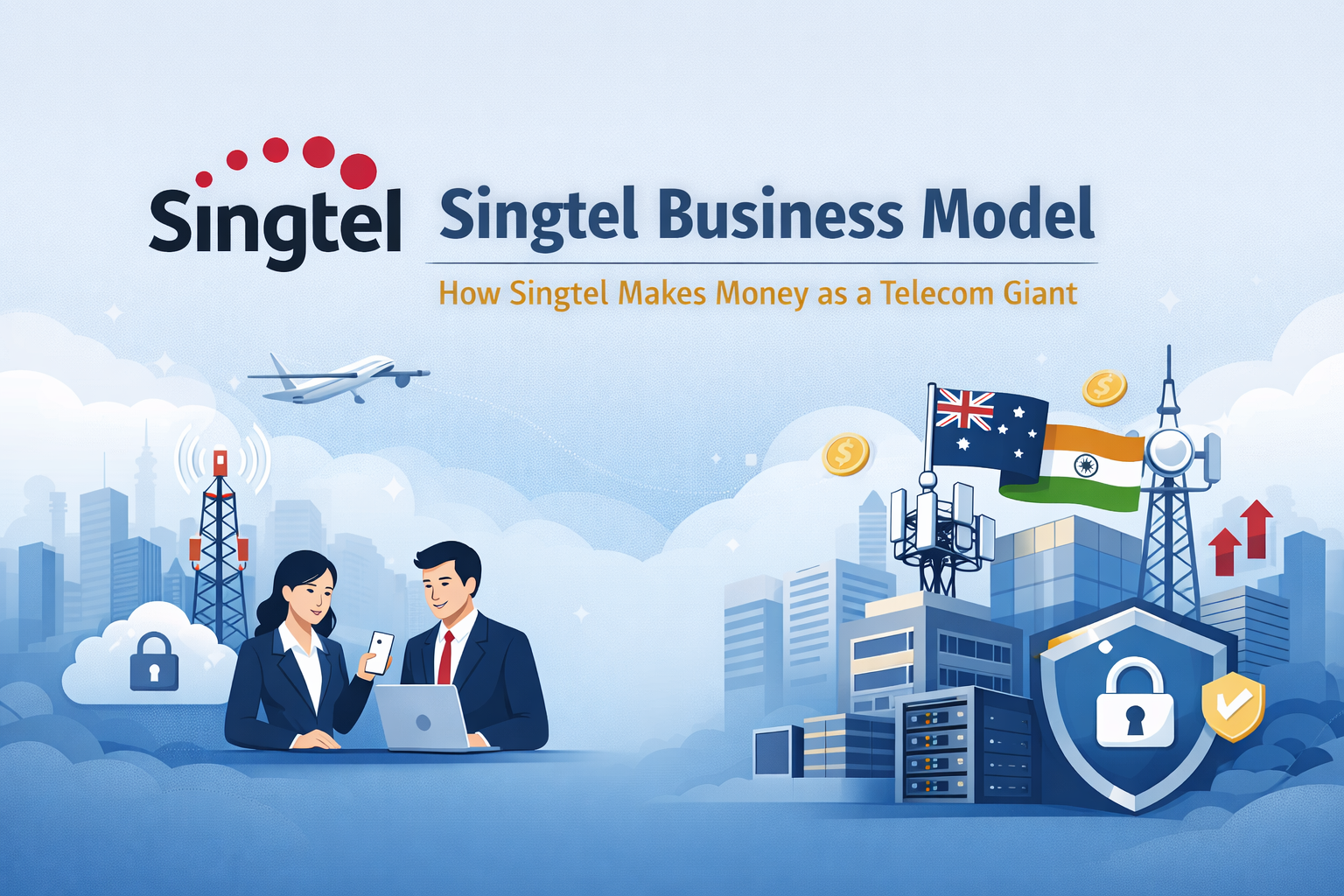
Singtel (Singapore Telecommunications Limited) makes money through a diversified business model that goes far beyond traditional phone services. The company generates revenue from three main pillars: core telecommunications services (mobile, broadband, and fixed-line), digital and enterprise solutions (cloud computing, cybersecurity, data centers), and strategic regional investments in telecom operators across Asia and Australia. Unlike typical telecom companies that rely solely on selling phone plans, Singtel has transformed itself into a digital services powerhouse while maintaining strong ownership stakes in major regional players like Optus in Australia and Bharti Airtel in India. This multi-layered approach allows Singtel to capture revenue from consumer subscriptions, enterprise contracts, and dividend income from its investment portfolio.
About Singtel
Singtel is Singapore’s largest telecommunications company and one of Asia’s leading communications groups. Founded in 1879 as a government department managing telegraph services, it was corporatized in 1992 and has since evolved into a regional telecom and technology giant.
Today, Singtel operates in more than 20 countries across Asia, Australia, Africa, and the United States. Its primary markets include Singapore (where it holds roughly 45% mobile market share), Australia (through its subsidiary Optus), and various Asian markets through strategic investments.
What makes Singtel unique is that it’s no longer just a telecom company. It has transformed into a digital infrastructure provider offering cloud services, cybersecurity solutions, data analytics, digital banking, and enterprise IT services. This evolution positions Singtel as a critical digital enabler for both consumers and businesses in the region.
Who Are Singtel’s Customers?
Singtel serves four distinct customer segments, each with different needs and spending patterns:
Individual Consumers
These are everyday people who use Singtel for mobile plans, home broadband, and entertainment services. They’re looking for reliable connectivity, good coverage, and increasingly, bundled packages that include streaming services and digital content. In Singapore, consumers value quality and are willing to pay premium prices for consistent service.
Businesses & Enterprises
Small to large businesses use Singtel for corporate mobile plans, internet connectivity, and increasingly complex digital services. These customers need reliable communication tools, scalable solutions, and often require customized packages for their teams.
Government & Large Institutions
Government agencies, healthcare systems, educational institutions, and large corporations require enterprise-grade solutions. They need maximum security, dedicated support, and often sign long-term contracts worth millions. These customers generate high-value, stable revenue streams.
Digital Users
A growing segment that uses Singtel’s newer offerings like digital banking services, cloud storage, IoT (Internet of Things) solutions, and over-the-top (OTT) digital services. These customers may not even think of Singtel as their telecom provider—they’re using Singtel’s digital ecosystem.
Why diversification matters: By serving multiple customer types, Singtel reduces risk. When consumer mobile revenue slows down, enterprise contracts can pick up the slack. When one market faces challenges, another keeps growing.
Singtel’s Core Value Proposition
People and businesses choose Singtel for several compelling reasons:
Network Reliability
Singtel consistently ranks as one of the most reliable networks in Singapore and Australia. For businesses where downtime means lost revenue, this reliability is non-negotiable. Consumers appreciate fewer dropped calls and consistent internet speeds.
Coverage & Infrastructure Advantage
Singtel has spent decades building extensive infrastructure from submarine cables connecting continents to the densest 4G and 5G coverage in Singapore. This infrastructure is expensive to replicate, giving Singtel a significant moat against competitors.
Bundled Digital Services
Instead of just selling phone plans, Singtel bundles telecommunications with entertainment (Disney+, HBO), security services, cloud storage, and smart home solutions. This creates an ecosystem that’s convenient and harder to leave.
Enterprise-Grade Solutions
For businesses, Singtel offers end-to-end solutions: from basic connectivity to sophisticated cybersecurity, cloud migration, data analytics, and managed IT services. Smaller telcos simply can’t match this comprehensive offering.
What Singtel does better than smaller competitors: Scale, trust, and integration. Smaller providers might offer cheaper prices, but they can’t match Singtel’s infrastructure quality, its ability to bundle multiple services, or its track record with large enterprise clients. For risk-averse customers especially businesses this makes Singtel the safe choice.
How Singtel Makes Money (Revenue Model Breakdown)
Here’s where Singtel actually generates its billions in revenue:
1. Mobile & Broadband Services
This is the traditional telecom business that still forms a substantial revenue base.
Postpaid vs Prepaid: Postpaid customers (those with monthly contracts) are more valuable because they generate predictable, recurring revenue and typically spend more. Prepaid customers pay upfront and offer less predictability but require less credit risk management.
ARPU (Average Revenue Per User): This is a key metric in telecom. Singtel makes money by maximizing ARPU—getting each customer to spend more per month through premium plans, add-ons, international roaming, and bundled services. In Singapore, Singtel’s mobile ARPU is among the highest in the region because consumers are willing to pay for quality.
Home broadband works similarly: customers pay monthly fees for internet speeds, and Singtel upsells faster plans, WiFi mesh systems, and entertainment bundles.
2. Enterprise & Corporate Services
This is Singtel’s fastest-growing and highest-margin segment:
Cloud Services: Businesses are migrating to the cloud, and Singtel helps them do it. Through partnerships with AWS, Microsoft Azure, and Google Cloud, plus its own data centers, Singtel earns revenue from cloud migrations, management, and ongoing hosting fees.
Cybersecurity: As cyber threats grow, companies pay Singtel substantial fees for security operations centers (SOC), threat monitoring, penetration testing, and security consulting. This is a high-margin business with long-term contracts.
Data Centers: Singtel owns and operates multiple data centers across Asia. Companies rent server space, computing power, and storage, paying monthly fees that can run into hundreds of thousands of dollars for large deployments.
Managed IT Services: Many businesses outsource their entire IT operations to Singtel—from help desk support to network management. These contracts are typically multi-year and provide stable, recurring revenue.
3. Digital & Emerging Businesses
Singtel is aggressively pushing into new digital revenue streams:
Digital Banking / Fintech: Through ventures like the digital bank consortium in Singapore, Singtel is entering financial services, earning fees from banking transactions, lending, and financial products.
Advertising & Data Platforms: Singtel monetizes user data (with appropriate privacy compliance) by offering targeted advertising platforms to businesses. Think of it like a telecom company with insights into customer behavior that advertisers value.
OTT and Content Partnerships: Singtel doesn’t just carry Netflix and Disney+ traffic—it partners with these platforms to bundle services, earning revenue-sharing fees and making its own plans more attractive.
4. Regional Investments & Associates
This is Singtel’s unique differentiator—it operates like both a telecom company and an investment fund:
Optus (Australia): Singtel owns 100% of Optus, Australia’s second-largest telecom operator. Optus contributes directly to Singtel’s consolidated revenue and is a massive profit center.
Airtel (India): Singtel owns approximately 29% of Bharti Airtel, India’s second-largest mobile operator. While Singtel doesn’t control Airtel, it receives substantial dividend income and benefits from Airtel’s growth in one of the world’s largest telecom markets.
Other Asian Telco Stakes: Singtel holds investments in telcos across Thailand (AIS), Indonesia (Telkomsel), and the Philippines (Globe Telecom). These investments pay dividends and appreciate in value.
Why this acts like a portfolio business model: Instead of putting all its eggs in Singapore’s mature market, Singtel spreads risk and captures growth in faster-growing Asian markets. When Singapore’s revenue growth slows, India or Indonesia might be booming. This portfolio approach stabilizes earnings and provides exposure to different economic cycles.
Singtel’s Cost Structure (Where the Money Goes)
Running a telecom empire isn’t cheap. Here’s where Singtel spends its money:
Network Infrastructure
Building and maintaining cell towers, fiber optic cables, data centers, and network equipment requires billions. Every time you see a cell tower, that’s a significant capital investment. Singtel must continuously upgrade this infrastructure to stay competitive.
Spectrum Licenses
Governments auction radio spectrum (the airwaves that carry mobile signals). These licenses cost hundreds of millions to billions of dollars and must be renewed periodically. Singtel competed in Singapore’s recent 5G spectrum auction, spending significant capital to secure frequencies.
Technology Upgrades
The shift from 4G to 5G requires replacing or upgrading thousands of cell sites. Laying new fiber optic cables, upgrading data centers, and implementing new software systems all require massive investment. Telecom is a technology treadmill—stand still and you fall behind.
Staff & Operations
Singtel employs over 20,000 people globally. Salaries, training, benefits, and operational overhead (office space, equipment, utilities) represent a significant ongoing cost.
Marketing and Customer Acquisition
Acquiring new customers is expensive. Singtel spends heavily on advertising, retail stores, sales commissions, promotional discounts, and subsidized handphones (those “free” phones with contracts aren’t actually free—Singtel pays the manufacturer and recoups the cost over your contract term).
The challenge: Telecom is a high-fixed-cost business. Once you’ve built the network, adding more customers is relatively cheap, but the initial investment is enormous. This is why scale matters so much—larger operators can spread these fixed costs across more customers, improving profitability.
Key Assets That Power Singtel’s Business Model
Singtel’s competitive position rests on several irreplaceable assets:
Telecom Infrastructure
Decades of investment in cell towers, fiber networks, and equipment create a physical moat. Competitors can’t replicate this overnight—it takes years and billions of dollars.
Submarine Cables & Data Centers
Singtel owns stakes in multiple submarine cable systems connecting Asia to the rest of the world. These cables literally carry internet traffic between continents. Singtel also operates tier-3 data centers across the region, critical infrastructure that’s expensive and time-consuming to build.
Brand Trust in Singapore
In a small market like Singapore, brand trust is everything. Singtel is seen as the reliable, established choice—particularly important for risk-averse enterprise customers and older consumers. This brand equity took decades to build.
Strategic Partnerships
Relationships with equipment vendors (Ericsson, Nokia, Huawei), cloud providers (AWS, Microsoft, Google), content providers (Disney, Netflix), and technology companies give Singtel negotiating power and early access to new technologies.
Regional Ownership Stakes
Singtel’s investments in Optus, Airtel, and other regional telcos are strategic assets that generate passive income, provide operational synergies, and offer growth exposure. These stakes are difficult to acquire today—Singtel bought many of them when these companies were smaller and cheaper.
Singtel’s Competitive Advantage
Despite intense competition, Singtel maintains strong market position through several advantages:
Scale Advantage
Singtel is much larger than competitors like StarHub and M1 in Singapore. This scale allows better deals with equipment vendors, content providers, and handset manufacturers. Larger customer base means more negotiating leverage.
Government Backing & Regulation Benefits
As Singapore’s incumbent operator and formerly state-owned, Singtel enjoys certain advantages. While the market is now competitive, Singtel’s historical position gave it first-mover advantage in infrastructure development. Regulators ensure competition, but they also value Singtel’s role in national infrastructure.
Long-Term Contracts
Enterprise customers typically sign 3-5 year contracts. Once a large organization chooses Singtel for their IT infrastructure, cybersecurity, and connectivity, switching costs are enormous. This creates sticky revenue streams.
Switching Costs for Users
Changing phone numbers, re-configuring services, potentially dealing with coverage differences, and losing bundled benefits creates friction. While number portability exists, many consumers and businesses stay with Singtel out of convenience and risk aversion.
Regional Exposure Reduces Risk
Unlike pure-play Singapore operators, Singtel’s diversification across Australia, India, and Southeast Asia means it’s not dependent on any single market. Regulatory changes, economic downturns, or competitive pressure in one country doesn’t sink the entire business.
Singtel Business Model Canvas
The Business Model Canvas is a strategic tool that maps out how a company creates and delivers value. Here’s Singtel’s model broken down:
Key Partners
- Network equipment vendors (Ericsson, Nokia)
- Cloud platforms (AWS, Microsoft Azure, Google Cloud)
- Content providers (Disney, Netflix, HBO)
- Regional telco partners and associates
- Government and regulatory bodies
- Handset manufacturers (Apple, Samsung)
Key Activities
- Building and maintaining network infrastructure
- Selling mobile and broadband plans
- Delivering enterprise IT solutions
- Managing data centers and cloud services
- Investing in and managing regional telco stakes
- Developing new digital services
Value Proposition
For consumers: Reliable connectivity, bundled entertainment, seamless digital services For businesses: End-to-end solutions, security, scalability, dedicated support For enterprises: Mission-critical infrastructure, compliance, integration, expertise
Customer Segments
- Individual consumers (mass market and premium)
- Small and medium businesses
- Large enterprises
- Government institutions
- Digital-first users
Customer Relationships
- Self-service apps and online portals
- Retail stores for personal interaction
- Dedicated account managers for enterprise clients
- 24/7 customer support
- Community forums and support resources
Channels
- Direct: Retail stores, website, mobile app
- Indirect: Third-party retailers, partnerships
- B2B: Sales teams, partner networks
- Digital: Online sign-ups, app-based services
Revenue Streams
- Monthly subscription fees (mobile, broadband)
- Usage charges (roaming, international calls)
- Enterprise contracts (IT services, cybersecurity)
- Equipment sales (handsets, routers)
- Digital services revenue (cloud, data centers)
- Dividend income from regional investments
Cost Structure
- Network infrastructure and maintenance
- Spectrum licensing fees
- Staff salaries and operations
- Marketing and customer acquisition
- Technology upgrades and R&D
- Content licensing and partnerships
Key Resources
- Physical: Network infrastructure, data centers, cables
- Intellectual: Brand, technology patents, operational expertise
- Human: Skilled engineers, sales teams, support staff
- Financial: Capital for investments, credit rating for financing
This interconnected system shows how Singtel creates value at scale using infrastructure assets to serve multiple customer segments through various channels, while maintaining cost efficiency through scale and diversification.
How Singtel Is Adapting to Digital & 5G Era
The telecom industry is undergoing massive transformation, and Singtel is actively reinventing itself:
Shift from Pure Telco → Digital Services Company
Singtel recognizes that simply providing phone and internet services is a commoditizing, low-growth business. It’s deliberately transitioning to become a digital services provider, where the connectivity is just the foundation for higher-value services. This is why it has invested heavily in cybersecurity, cloud, IoT, and digital platforms.
Focus on Enterprise, Cloud, and Cybersecurity
Consumer mobile revenue is slowing, but enterprise spending on digital transformation is accelerating. Singtel is capturing this shift by positioning itself as an end-to-end digital transformation partner, not just a connectivity provider. The margins on enterprise services are typically better than consumer plans.
Monetizing 5G Beyond Faster Internet
5G isn’t just about faster phones—it’s about enabling new use cases: autonomous vehicles, smart cities, industrial IoT, remote surgery, augmented reality. Singtel is working with businesses to develop 5G-enabled solutions that create new revenue streams beyond traditional subscriptions.
Examples include:
- Smart port operations in Singapore using 5G sensors
- Manufacturing automation with ultra-low latency connections
- Entertainment experiences like VR gaming and immersive content
- Healthcare applications requiring real-time data transmission
Reducing Dependency on Consumer Telecom Margins
Consumer mobile is competitive and margin-pressured. Singtel is deliberately growing other businesses (enterprise, digital, investments) to reduce reliance on consumer telco revenue. The goal is to have enterprise and digital services represent 50%+ of profit within the next few years.
Risks & Challenges in Singtel’s Business Model
No business model is perfect. Here are Singtel’s key vulnerabilities:
Price Wars in Telecom
Telecom is brutally competitive, especially in mature markets like Singapore and Australia. Competitors regularly slash prices to gain market share, forcing Singtel to match or lose customers. This price competition compresses margins and makes growth difficult.
Regulatory Pressure
Governments regulate telecom heavily, and changes in policy can impact profitability. For example, regulators might force lower wholesale prices, mandate infrastructure sharing, or impose expensive service requirements. In India, regulatory changes have significantly impacted Airtel’s profitability at times.
High Infrastructure Costs
Upgrading to 5G, expanding fiber networks, and building data centers requires billions in capital expenditure. These investments have multi-year payback periods, and if technology changes or customer adoption is slower than expected, Singtel might not earn adequate returns.
Competition from OTT Players
WhatsApp, Zoom, Microsoft Teams, and other over-the-top services provide communication services that bypass traditional telecom revenue streams. People make fewer voice calls and send fewer SMS because of these apps, eroding traditional revenue sources.
Slower Growth in Mature Markets
Singapore and Australia are mature, saturated markets where almost everyone already has a mobile phone and broadband. Growth comes from upselling existing customers or taking share from competitors—both difficult strategies. This is why Singtel’s regional investments in faster-growing markets like India are so important.
Technology Disruption
New technologies could disrupt the model—low-earth orbit satellite internet (like Starlink) might eventually compete with fixed broadband, new communication protocols could reduce reliance on traditional networks, or entirely new business models could emerge.
What Startups & Founders Can Learn from Singtel
Singtel’s evolution offers valuable lessons for entrepreneurs:
Why Infrastructure Businesses Need Patience
Singtel’s success came from decades of patient infrastructure investment. There are no shortcuts in building physical networks or earning customer trust. For founders building infrastructure-heavy businesses (logistics, real estate tech, manufacturing), the lesson is clear: you need long-term capital and patient execution.
Importance of Diversification
Singtel didn’t stay comfortable as Singapore’s telecom monopoly. It diversified into new markets, new services, and new geographies. This diversification protected it when any single segment faced challenges. Founders should think about how to build multiple revenue engines rather than depending on a single product or market.
Regional Expansion Strategy
Rather than trying to build operations from scratch in every market, Singtel bought stakes in existing regional leaders. This gave it exposure to growth markets without the full operational burden. For startups, this suggests exploring partnerships, investments, or acquisitions rather than always building internally.
How Mature Companies Reinvent Themselves
Singtel is over 140 years old, yet it’s actively transforming into a digital services company. This shows that company age doesn’t doom you to irrelevance—strategic vision, willingness to cannibalize existing businesses, and investment in new capabilities matter more. Even as a founder of a young company, building this adaptability into your culture from day one is valuable.
The Power of Platform Thinking
Singtel isn’t just selling individual products—it’s building an ecosystem where multiple services work together (mobile + broadband + entertainment + security + banking). This platform approach increases customer lifetime value and creates switching costs. Think about how your product could become a platform rather than just a standalone offering.
Is Singtel’s Business Model Sustainable?
Strengths
Singtel has built a robust, diversified business model that generates stable cash flows from multiple sources. Its infrastructure assets create high barriers to entry, its regional investments provide growth exposure beyond Singapore’s mature market, and its evolution into digital services positions it for the future. The enterprise segment offers strong growth potential, and the company’s balance sheet can support continued investment.
Weaknesses
The core consumer telecom business faces margin pressure from competition and disruption from OTT players. Growth in Singapore and Australia is limited by market saturation. High capital requirements for 5G and technology upgrades pressure returns. Regulatory risks in markets like India create uncertainty around investment values. The transition to digital services is competitive, with cloud giants and specialized cybersecurity firms as rivals.
Long-Term Outlook
Singtel’s business model is sustainable, but the company must successfully execute its digital transformation. The days of easy money from voice and SMS are gone. Success depends on:
- Growing enterprise and digital services faster than consumer telco decline
- Maintaining strong returns from regional investments, especially Airtel
- Successfully monetizing 5G through new business models
- Defending market share against aggressive competition
- Managing capital allocation efficiently knowing when to invest vs. return cash to shareholders
The smart money says Singtel survives and potentially thrives, but not without significant strategic evolution. It’s no longer enough to be a great telecom company Singtel must become an excellent digital infrastructure and services company.
Why Singtel Remains a Strong Case Study
Whether you’re a business student, investor, or entrepreneur, Singtel demonstrates several timeless principles:
- Infrastructure creates durable competitive advantages
- Diversification reduces risk in changing industries
- Incumbent advantage isn’t permanent—continuous reinvention is necessary
- Scale matters in capital-intensive businesses
- Portfolio thinking (like their regional investments) can outperform pure organic growth
For those studying business models, Singtel shows how a 140-year-old company can remain relevant by evolving from government telegraph service to digital-age infrastructure provider a transformation few companies successfully complete.
The bottom line: Singtel makes money through a sophisticated combination of traditional telecom services, enterprise digital solutions, and strategic regional investments. Its business model is complex, capital-intensive, but remarkably resilient. As the digital economy grows, Singtel is positioning itself not as a phone company, but as the critical infrastructure layer enabling Asia’s digital future.
Discover more from Business Model Hub
Subscribe to get the latest posts sent to your email.