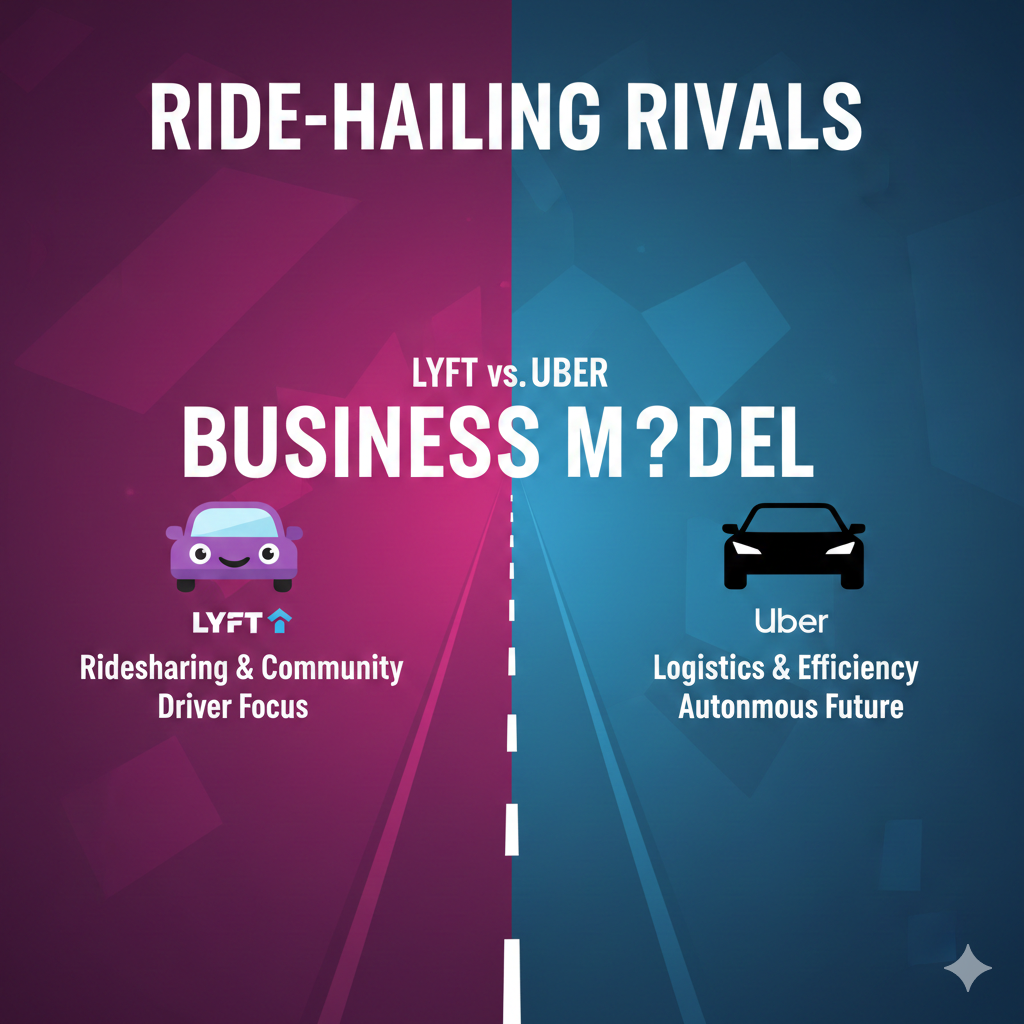
In the ride-hailing wars, two names dominate the conversation: Uber and lyft. Both started with the same basic idea connecting riders with drivers through a smartphone app but their paths have diverged dramatically.
Uber has transformed into a sprawling global marketplace spanning rides, food delivery, freight logistics, and advertising. Lyft, meanwhile, has chosen a different route: deep focus on ride-hailing primarily within the United States, optimizing for profitability over explosive growth.
The question isn’t which company is better. It’s which business model makes more sense, and what entrepreneurs can learn from their contrasting strategies.
Let me break down exactly how these two giants operate, make money, and compete without the corporate jargon or marketing spin.
Understanding What Uber and Lyft Actually Are
Before comparing business models, let’s clear up a common misconception: neither Uber nor Lyft is a taxi company.
Both are technology platforms that facilitate transactions between two groups: people who need rides and people willing to provide them. This distinction fundamentally shapes everything about how they operate and make money.
What they don’t do:
- Own fleets of vehicles
- Employ drivers as traditional full-time workers
- Handle vehicle maintenance or fuel costs
- Operate traditional dispatch centers
What they do provide:
- Mobile applications connecting supply and demand
- Payment processing infrastructure
- Dynamic pricing algorithms
- Insurance coverage during rides
- Safety features and rider protections
- Rating and feedback systems
This asset-light, platform-based approach allows both companies to scale rapidly without the capital requirements of traditional transportation businesses. But how they’ve chosen to leverage this model is where the real differences emerge.
Core Business Model: The Fundamental Difference
If I had to summarize the strategic difference between Uber and Lyft in one sentence, it would be this:
Uber operates as a global super-platform spanning multiple services and markets, while Lyft runs a focused, ride-centric marketplace concentrated primarily in North America.
Think of it this way: Uber is building an everything app for urban logistics and mobility. Lyft is perfecting one thing—ride-hailing—in markets it knows intimately.
This philosophical difference cascades into every aspect of their businesses, from cost structure to revenue diversification to competitive positioning.
How Uber’s Business Model Works
Uber has evolved far beyond its origins as a black car service. Today, it operates what I call a “mobility and logistics super-platform.”
Uber’s Major Services:
Ride-hailing: The original business, now including multiple tiers from budget UberX to premium Uber Black, plus Uber Comfort, XL for larger groups, and specialized options like Uber Pet.
Uber Eats: Food delivery connecting restaurants with hungry customers, now one of Uber’s largest revenue generators.
Uber Freight: A logistics platform matching shippers with trucking companies, bringing the Uber model to the freight industry.
Uber One: A subscription service bundling benefits across rides and food delivery, creating sticky recurring revenue.
Advertising: Leveraging its massive user base, Uber sells ad placements to restaurants, consumer brands, and other businesses.
Emerging Services: Uber has tested everything from grocery delivery to alcohol delivery to package delivery, constantly experimenting with new revenue streams.
The core revenue logic is straightforward: Uber takes a commission on every transaction across all these verticals. A rider pays for a trip, a restaurant pays to list on Uber Eats, an advertiser pays for prominent placement—Uber extracts value at every touchpoint.
This diversification makes Uber more complex to operate, but also more resilient. When ride-hailing struggled during the pandemic, Uber Eats exploded in growth, actually increasing the company’s total revenue.
How Lyft’s Business Model Works
Lyft has taken a deliberately different path: focused execution in a concentrated market.
Lyft’s Core Services:
Ride-hailing: The overwhelming majority of Lyft’s business, offering standard rides, XL for bigger groups, and Lux for premium experiences.
Bikes and scooters: Micro-mobility options for short urban trips, positioning Lyft as a comprehensive urban transportation solution rather than just cars.
Lyft Pink: A subscription program offering ride discounts, priority airport pickup, and other benefits to frequent users.
Corporate programs: B2B partnerships with employers, healthcare providers, and organizations needing transportation solutions.
Limited advertising: Some in-app promotional opportunities, though far less developed than Uber’s ad business.
Notice what’s missing: food delivery, freight logistics, international operations, and aggressive expansion into adjacent markets.
This isn’t an oversight—it’s strategy. Lyft deliberately chose to avoid the capital-intensive, low-margin, operationally complex businesses that Uber pursued. The bet: operational efficiency and focus would eventually win over sprawling diversification.
Lyft’s leadership has been explicit about this choice. Rather than chase every possible revenue stream, they’ve optimized the core ride-hailing business, improved margins, reduced unnecessary spending, and focused on markets where they can actually compete effectively.
Revenue Streams: A Side-by-Side Comparison
Understanding where each company makes money reveals the fundamental difference in their approaches.
Ride commissions (Both companies): This remains the foundation for both businesses. When you pay for a ride, the driver gets the majority of the fare, and the platform takes typically 20-30% as commission. Both companies earn billions annually from this stream alone.
Surge pricing (Both companies): When demand exceeds supply, prices increase. Uber calls it “surge pricing,” Lyft calls it “Prime Time,” but the mechanism is identical. During peak periods, bad weather, or special events, both platforms earn significantly higher commissions.
Subscriptions:
- Uber One: Bundles discounts on rides and Uber Eats orders for a monthly fee, creating predictable recurring revenue
- Lyft Pink: Focuses specifically on ride benefits, including discounts, priority pickups, and free bike unlocks
Food delivery:
- Uber: Generates billions through Uber Eats, taking commissions from restaurants and delivery fees from customers
- Lyft: Doesn’t operate in this space at all
Advertising:
- Uber: A rapidly growing segment, with ads in the app, sponsored restaurant placements, and partnerships with consumer brands
- Lyft: Limited advertising offerings, primarily promotional partnerships
Freight and logistics:
- Uber: Uber Freight connects shippers with carriers, expanding into commercial transportation
- Lyft: No presence in this market
Micro-mobility:
- Uber: Limited bike and scooter presence after selling Jump to Lime
- Lyft: Strong presence with integrated bikes and scooters in many US cities
The pattern is clear: Uber diversifies across multiple verticals, while Lyft concentrates on rides and related mobility services.
Geographic Strategy: Scale vs. Focus
Perhaps no difference is more striking than their geographic approaches.
Uber’s global footprint: Uber operates across more than 70 countries and 10,000+ cities worldwide. From São Paulo to Sydney, from Tokyo to Toronto, Uber has pursued aggressive international expansion.
This global presence brings advantages: massive scale, diversified risk across markets, and ability to leverage learnings from one region to another. But it also brings challenges: navigating wildly different regulatory environments, adapting to local competition, managing currency fluctuations, and dealing with political resistance.
Uber has exited multiple markets where it couldn’t achieve dominance, including China (selling to Didi), Southeast Asia (merging with Grab), and Russia (consolidating with Yandex). These exits suggest that global expansion, while impressive, doesn’t guarantee profitability everywhere.
Lyft’s concentrated approach: Lyft operates almost exclusively in the United States and select Canadian cities. That’s it.
This focus allows Lyft to develop deep expertise in American regulations, consumer preferences, and market dynamics. Instead of fighting regulatory battles on six continents, Lyft fights them in specific US states and cities where it can deploy resources effectively.
The tradeoff is obvious: Lyft’s total addressable market is smaller. But the counterargument is equally valid: profitability in three markets beats losses in thirty markets.
Cost Structure: Complexity vs. Efficiency
How each company spends money tells you a lot about their strategic priorities.
Uber’s cost structure:
- Driver incentives and bonuses across multiple service types
- Food delivery logistics including restaurant partnerships and delivery operations
- Global marketing campaigns in dozens of languages and markets
- Regulatory and legal expenses fighting battles worldwide
- Platform infrastructure supporting multiple verticals
- Customer support across time zones and languages
Uber’s costs are inherently higher because its operations are more complex. Managing food delivery in addition to rides means handling restaurant relationships, food safety, delivery logistics, and an entirely separate supply chain. Operating globally means maintaining infrastructure, compliance, and support systems everywhere.
Lyft’s cost structure:
- Driver incentives focused on ride-hailing
- Insurance and safety programs
- Technology development and app infrastructure
- US-focused marketing and branding
- Regulatory compliance in American markets
- Customer support for a more contained user base
Lyft’s costs are lower in absolute terms but represent a higher percentage of revenue because there are fewer revenue streams to spread them across. The company has deliberately reduced costs by exiting unprofitable markets, reducing promotional spending, and optimizing operations.
The key question: does Uber’s higher spending generate proportionally higher returns, or does Lyft’s leaner approach produce better unit economics?
The Profitability Picture: Who’s Actually Making Money?
For years, both companies burned through billions of dollars in pursuit of market dominance. But the profitability picture has evolved significantly.
Uber’s path to profitability: Uber has made substantial progress toward consistent profitability through several strategic shifts:
- Advertising revenue: High-margin ad sales have become a significant profit driver
- Uber Eats improvements: After years of losses, delivery margins have improved through better restaurant terms and operational efficiency
- Subscription bundling: Uber One creates recurring revenue with minimal incremental costs
- Market exits: Pulling out of unprofitable international markets has reduced cash burn
- Price increases: In many markets, Uber has successfully raised prices without losing significant volume
Uber has reported profitable quarters, though profitability remains inconsistent and heavily dependent on which segments are included in the calculations.
Lyft’s profitability challenges: Lyft has faced a harder road to profitability for several reasons:
- Limited diversification: With 95%+ of revenue from rides, Lyft can’t offset losses in one vertical with profits in another
- Price sensitivity: Riders often comparison shop between Uber and Lyft, limiting pricing power
- Driver incentives: To maintain adequate supply, Lyft must continually spend on driver acquisition and retention
- Single market concentration: All eggs in the US basket means no geographic diversification of risk
However, Lyft has made meaningful improvements by cutting costs, reducing driver incentives, optimizing pricing, and focusing on operational efficiency rather than growth at all costs. The company has also reported adjusted profitable quarters, though GAAP profitability remains elusive.
The bottom line: both companies are closer to sustainable profitability than ever before, but neither has definitively proven the superiority of their model in terms of financial returns.
Customer Value Proposition: Different Strokes for Different Folks
What riders actually get from each platform differs in subtle but meaningful ways.
Uber’s value proposition:
- Convenience: One app for multiple needs—rides, food, grocery delivery
- Global availability: Travel internationally with the same familiar app
- Multiple tiers: From budget to luxury, Uber offers more ride options
- Cross-platform benefits: Uber One bundles benefits across services
Uber appeals to customers who value versatility and want a single platform for various urban logistics needs. The “everything app” approach means fewer apps to download and manage.
Lyft’s value proposition:
- Simplicity: A cleaner, more focused app experience without the clutter of multiple services
- Brand identity: Lyft has cultivated a friendlier, more community-oriented image
- Rider-first positioning: Marketing emphasizes treating riders and drivers well
- Local optimization: Deeper focus on US markets means potentially better local service
Lyft appeals to customers who prefer a specialist over a generalist and who respond to the company’s brand positioning as the “nicer” alternative to Uber.
These differences matter less than you might think for most casual users, but they create meaningful loyalty among frequent riders who identify with one brand over the other.
Network Effects: Scale vs. Density
Both companies benefit from network effects—the phenomenon where the platform becomes more valuable as more people use it—but in different ways.
Uber’s network effects: With a truly global network, Uber creates value through:
- Cross-border consistency: Same app, same payment method, same experience everywhere
- Massive scale: More total users means more data, better algorithms, and stronger negotiating power with partners
- Service cross-pollination: Riders who use Uber Eats might try Uber rides, and vice versa
Lyft’s network effects: With concentrated density, Lyft creates value through:
- Local liquidity: More drivers and riders in specific cities means shorter wait times
- Market-specific optimization: Deep data on US riding patterns enables better matching and pricing
- Community density: Stronger local brand presence in key markets
The question: is it better to be everywhere with moderate density, or somewhere with high density? The answer likely depends on the specific market and customer segment.
Business Model Canvas: A Structured Comparison
Looking at both companies through the Business Model Canvas framework reveals structural differences:
Key Partners:
- Uber: Drivers, restaurants, merchants, freight carriers, payment processors, mapping services
- Lyft: Drivers, cities, bike/scooter manufacturers, corporate partners, payment processors
Key Activities:
- Uber: Multi-platform operations, restaurant onboarding, driver management, logistics optimization, advertising sales
- Lyft: Ride optimization, driver management, city partnerships, subscription management
Key Resources:
- Uber: Massive user base, global brand, sophisticated algorithms, diverse data, investor capital
- Lyft: US market expertise, focused brand, ride-specific algorithms, corporate relationships
Value Proposition:
- Uber: Comprehensive urban logistics platform—everything from rides to food in one app
- Lyft: Simple, reliable, rider-friendly transportation focused on getting you where you need to go
Customer Relationships:
- Uber: Transactional with subscription overlay, cross-selling between services
- Lyft: Personal brand connection, subscription programs, community-focused marketing
Revenue Streams:
- Uber: Highly diversified across rides, food, freight, advertising, subscriptions
- Lyft: Ride-centric with supplementary subscriptions and micro-mobility
Cost Structure:
- Uber: Complex and global with costs spread across multiple verticals
- Lyft: Leaner and more focused with concentrated spending
This framework makes the strategic differences crystal clear: Uber optimizes for breadth, Lyft optimizes for depth.
Which Business Model Is Actually Better?
Here’s the honest answer: it depends entirely on what you’re optimizing for.
Uber’s model wins if you value:
- Diversification: Multiple revenue streams reduce dependence on any single market
- Global scale: Presence in emerging markets with high growth potential
- Cross-selling opportunities: Ability to move customers between services
- Market dominance: Being the biggest player commands negotiating power
Lyft’s model wins if you value:
- Focus: Operational simplicity and clarity of purpose
- Unit economics: Potentially better margins in core business
- Reduced complexity: Fewer moving parts means easier management
- Market depth: Strong positioning in the world’s largest economy
Neither model is objectively superior. Execution matters more than strategy. A perfectly executed focused strategy beats a poorly executed diversification strategy every time, and vice versa.
What we can say definitively: both models can work, which is proven by the fact that both companies have survived brutal competition, regulatory challenges, and a global pandemic.
Lessons for Entrepreneurs and Founders
The Uber vs. Lyft comparison offers valuable insights for anyone building a platform business:
Lesson 1: Expansion isn’t always the answer Uber’s global expansion created scale but also created complexity, regulatory battles, and market exits. Lyft’s restraint avoided losses but limited growth. Conclusion: expand strategically based on competitive advantage, not ego.
Lesson 2: Focus can be a weapon Lyft’s decision to avoid food delivery and international markets seemed limiting at first but reduced cash burn and allowed optimization. Sometimes saying no is more powerful than saying yes.
Lesson 3: Diversification improves survival When ride-hailing collapsed during COVID-19, Uber Eats kept the company afloat while Lyft had no backup. Multiple revenue streams provide resilience, even if they complicate operations.
Lesson 4: Two-sided marketplaces require constant balance Both companies struggle with the same fundamental challenge: keeping drivers happy enough to stay on the platform while keeping prices low enough for riders. This balance is never permanently solved.
Lesson 5: Profitability eventually matters more than growth Both companies spent years prioritizing growth over profits, burning billions in investor capital. Today, both are laser-focused on sustainable profitability. Growth gets you funded; profitability keeps you alive.
Lesson 6: Brand differentiation matters in commoditized markets When the core service is nearly identical, brand becomes a key differentiator. Lyft’s “friendly” positioning versus Uber’s “efficient” image creates real loyalty among subsets of users.
The Competitive Landscape: Beyond Just Two Players
While Uber and Lyft dominate discussion, the ride-hailing market includes other players worth noting:
- Regional competitors: Companies like Via (shared rides) and Curb (taxi integration) serve specific niches
- International giants: Didi in China, Grab in Southeast Asia, Bolt in Europe, Ola in India
- Traditional taxis: Many cities have seen taxi apps improve dramatically in response to ride-hailing competition
- Autonomous vehicles: Companies like Waymo and Cruise represent a potential future threat to both business models
Neither Uber nor Lyft can afford complacency. The competitive landscape continues evolving, and both must innovate to maintain relevance.
Looking Forward: What’s Next for Both Companies?
The future of both business models depends on several evolving factors:
Regulatory environment: How governments classify drivers, mandate benefits, and regulate platforms will significantly impact profitability for both companies.
Autonomous vehicles: If self-driving cars become viable, the economics of ride-hailing transform completely. Both companies are investing, but neither has a clear technological advantage.
Market maturation: As ride-hailing markets mature, growth slows and pricing power becomes critical. Can both companies raise prices without losing riders?
Economic cycles: Ride-hailing is somewhat recession-resistant but not recession-proof. Economic downturns test both models.
Sustainability pressures: Increasing focus on environmental impact may push both companies toward electric vehicles and carbon-neutral operations, changing cost structures.
The next chapter of this competition will likely focus less on explosive growth and more on sustainable profitability, operational efficiency, and incremental improvements to existing services.
Unbiased Perspective: Two Paths to the Same Destination
The Uber vs. Lyft comparison isn’t really about determining a winner. Both companies have built billion-dollar businesses solving real problems for millions of people.
Uber chose the path of diversification and global scale playing offense by expanding into every possible market and service line. The strategy: win through sheer breadth and cross-selling.
Lyft chose the path of focus and operational excellence playing defense by optimizing the core business and avoiding distractions. The strategy: win through superior economics in concentrated markets.
Both strategies have merit. Both have challenges. Both can ultimately succeed.
For customers, competition between these different models means better service, more options, and continued innovation. For drivers, it means multiple platforms to choose from. For entrepreneurs, it means proof that multiple strategic approaches can work in the same industry.
The real lesson isn’t which model is better—it’s that clear strategic choices, consistent execution, and relentless focus on customer value matter more than picking the “right” strategy on paper.
In the end, both Uber and Lyft prove that how you build matters as much as what you build.
Discover more from Business Model Hub
Subscribe to get the latest posts sent to your email.