Lalamove is an on-demand logistics platform that connects customers who need instant delivery with independent drivers. The company makes money by charging delivery fees to customers and taking commissions from each completed order.
What Is Lalamove?
Picture this: it’s 2013 in Hong Kong, and a group of entrepreneurs noticed something frustrating. Small businesses desperately needed fast delivery options, but traditional courier services were either too slow, too expensive, or required booking days in advance.
That’s how Lalamove was born.
Founded in Hong Kong in 2013, Lalamove built a same-day and instant delivery platform that today operates across Asia, Latin America, and beyond. If you’ve heard people call it “Uber for delivery, but focused on businesses,” that’s pretty accurate.
Here’s the founder’s key insight: logistics is a massive headache for SMEs. A restaurant owner needs to deliver food now, not tomorrow. An eCommerce seller gets an urgent order and needs it shipped today. A furniture store customer wants their couch delivered this afternoon.
These businesses can’t afford to own delivery fleets. Lalamove connected them with drivers who already own bikes, vans, and trucks. Problem solved.
The Core Problem Lalamove Solves
Let me paint you a real-world picture.
You run a small bakery. A corporate client just ordered 50 cupcakes for a meeting in two hours. You need delivery, fast. Traditional courier companies? They’ll schedule you for next Tuesday. Too late.
Or maybe you’re moving apartments and need a van to transport your furniture across town today. Renting a truck is expensive and complicated. Calling a traditional mover means waiting a week and paying premium prices.
This is the gap Lalamove fills.
Businesses need fast delivery without the overhead of owning vehicles. Individuals need quick, point-to-point delivery for one-off tasks. Traditional courier services are slow, rigid, and frankly outdated for today’s on-demand economy.
Lalamove fixes this with on-demand driver matching and dynamic pricing. You get what you need, when you need it, at a fair price.
How Lalamove Works (Step-by-Step Flow)
The beauty of Lalamove is in its simplicity. Here’s exactly how it works:
Step 1: Customer opens the Lalamove app and enters pickup location, drop-off address, and selects vehicle type (motorcycle, van, truck, etc.)
Step 2: The app’s algorithm matches the request with the nearest available driver
Step 3: Driver accepts the job and heads to the pickup location
Step 4: Pickup happens, and delivery begins. Customer can track everything in real time via GPS
Step 5: Delivery is completed, and payment processes automatically through the app
Step 6: Lalamove takes its commission from the transaction
The entire process can happen in under an hour for nearby deliveries. No phone calls, no paperwork, no hassle.
Lalamove Business Model Explained
Let’s break down how Lalamove actually operates as a business.
Platform-Based Marketplace Model
Lalamove is what we call a two-sided marketplace. On one side, you have customers—businesses and individuals who need deliveries. On the other side, you have drivers with vehicles ready to work.
Lalamove sits in the middle as the technology layer and trust broker. They don’t deliver anything themselves. Instead, they provide the platform, handle payments, manage quality through ratings, and ensure both sides get what they need.
Asset-Light Logistics Model
Here’s where it gets smart: Lalamove doesn’t own a single delivery vehicle.
Every driver uses their own bike, van, or truck. This is what we call an asset-light model, and it’s brilliant for several reasons:
- Lower fixed costs: No fleet to maintain, insure, or garage
- Faster scaling: Want to expand to a new city? Just onboard drivers
- Reduced risk: No massive capital investment in depreciating assets
Traditional logistics companies spend millions on vehicles. Lalamove spent that money on technology instead.
Lalamove Revenue Model: How Does Lalamove Make Money?
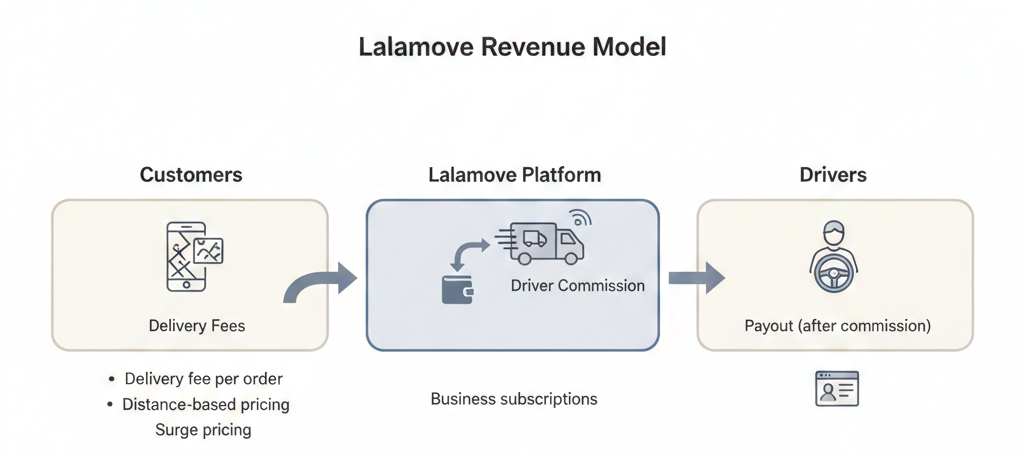
Now for the money question. Lalamove has four main revenue streams:
1. Delivery Fee per Order
This is the primary revenue source. Customers pay a fee based on:
- Distance: How far the delivery travels
- Time: How long it takes
- Surge pricing: During peak hours or high demand, prices increase
Think of it like Uber’s pricing model, but for packages instead of people.
2. Commission from Drivers
For every completed delivery, Lalamove takes a percentage cut from the driver’s earnings. This varies by region and vehicle type.
A motorcycle delivery in Thailand might have a different commission rate than a truck delivery in Mexico. Lalamove adjusts based on local economics and competition.
3. Business Accounts & Subscriptions
Small businesses and enterprises can open business accounts with benefits like:
- Monthly invoicing instead of per-transaction billing
- Priority driver matching
- Better pricing for volume users
- Dedicated account management
This creates recurring revenue and customer loyalty.
4. Additional Charges
Lalamove adds fees for special requirements:
- Extra stops: Multiple pickup or drop-off locations
- Heavy items: Oversized or heavy cargo handling
- Waiting time: If the driver waits beyond a certain threshold
- Insurance add-ons: Extra coverage for valuable items
These micro-monetizations add up across millions of deliveries.
Who Are Lalamove’s Customers?
Lalamove serves a diverse customer base:
Small & Medium Businesses: Restaurants delivering food, eCommerce sellers shipping products, retailers moving inventory between stores
Retail Chains: Larger companies using Lalamove for last-mile delivery and inter-store transfers
Individuals: People moving furniture, sending documents, transporting personal items across town
Enterprises: Companies needing bulk logistics solutions, daily delivery routes, or backup capacity during peak seasons
The sweet spot? SMEs. They’re too big for personal errands but too small to justify their own delivery fleet.
Driver Ecosystem: Supply Side of the Model
Let’s talk about why drivers actually join Lalamove.
Why Drivers Sign Up:
Flexible working hours: Drive when you want, stop when you want. No fixed shifts.
Fast payouts: Get paid quickly, often within days or weekly, not monthly like traditional jobs.
No long-term commitment: No contracts, no obligations. Try it for a week, see if you like it.
Use your own vehicle: If you already own a van or motorcycle, you’re already equipped to earn.
The Challenges:
Driver retention: Keeping good drivers is tough. They might switch to competitors offering better rates.
Pricing pressure: Drivers want more pay, customers want lower prices. Lalamove sits in the middle.
Incentive costs: To keep drivers active, Lalamove often runs bonus programs and incentives, which eat into margins.
Balancing driver satisfaction with profitability is one of Lalamove’s biggest ongoing challenges.
Key Technology Behind Lalamove
Here’s what makes Lalamove work behind the scenes (explained in plain English):
Real-time matching algorithm: Instantly finds the closest, most suitable driver for each delivery request
GPS tracking: Both customers and drivers can see exactly where the delivery is at any moment
Dynamic pricing logic: Automatically adjusts prices based on demand, distance, time, and driver availability
In-app payments: Secure, cashless transactions that make the whole process seamless
Rating & trust system: Customers rate drivers, drivers rate customers, building accountability on both sides
Founder insight: After working with dozens of logistics startups, I’ve learned this: logistics apps are 80% operations and reliability, 20% fancy UI. You can have the prettiest app in the world, but if drivers don’t show up or deliveries are late, you’re done.
Lalamove vs Traditional Courier Companies
Let’s compare Lalamove to old-school courier services:
| Factor | Lalamove | Traditional Couriers |
|---|---|---|
| Speed | Same-day, often within hours | Next-day or 2-3 days |
| Flexibility | On-demand, instant booking | Scheduled, advance booking required |
| Pricing | Dynamic, pay per delivery | Fixed rates, often with minimums |
| Scale | Operates across multiple countries | Often limited to specific regions |
| Technology | App-based, real-time tracking | Phone/email booking, limited tracking |
Traditional couriers excel at international shipping and complex logistics. Lalamove dominates local, urgent, same-day delivery.
Lalamove’s Competitive Advantage
Let’s be realistic about what gives Lalamove an edge:
First-mover advantage in many regions: They entered Southeast Asian markets early and built strong brand recognition before competitors arrived.
Strong driver network: In many cities, Lalamove has the largest pool of active drivers, which means faster matching and better coverage.
Local market adaptation: They don’t just copy-paste their model. Lalamove adapts pricing, vehicle types, and features to match local needs. Motorcycles dominate in Manila, vans in Hong Kong, trucks in warehouse districts.
Focus on SMEs, not just consumers: While many competitors chase individual consumers, Lalamove built solid relationships with businesses that use their service daily.
Challenges in Lalamove’s Business Model
Let’s be honest about the problems, because understanding challenges is how founders learn.
Thin Margins
Logistics is a low-margin business. After paying drivers, covering technology costs, customer acquisition, and operations, there’s not much left. Profitability requires massive scale.
Driver Churn
Drivers constantly compare platforms. If a competitor offers 5% better commission, drivers switch. High churn means constant recruitment and training costs.
Regulatory Issues
Different countries have different labor laws, vehicle regulations, and licensing requirements. Scaling internationally means navigating this complexity constantly.
Price Wars with Competitors
When competitors enter a market, they often slash prices to gain market share. This forces Lalamove to match prices, destroying margins for everyone.
Operational Complexity at Scale
Managing thousands of drivers across dozens of cities in multiple countries is incredibly complex. Quality control, customer service, driver support—all of it multiplies with growth.
These aren’t reasons to avoid the model, but they’re realities you need to solve.
Can This Business Model Be Replicated?
Short answer: Yes, but execution is brutally hard.
Here’s what makes replication challenging:
Requires strong local operations: You need boots on the ground in every city to onboard drivers, handle issues, and manage quality.
Driver onboarding is the hardest part: Finding reliable drivers, verifying them, training them, and keeping them active is where most competitors fail.
Demand-supply balance is everything: Too few drivers? Customers wait and leave. Too many drivers? They don’t earn enough and quit. Nailing this balance is an art.
Unit economics matter from day one: If you’re losing money on every delivery, growth just means losing money faster. You need to figure out profitable pricing before scaling.
I’ve seen plenty of Lalamove clones launch with great apps and marketing, only to shut down within a year because they couldn’t solve driver retention or unit economics.
How to Build an App Like Lalamove (High-Level Breakdown)
If you’re thinking about building something similar, here’s what you actually need:
Customer App
- Order placement with pickup/drop-off locations
- Vehicle type selection
- Real-time price estimation
- GPS tracking of delivery
- In-app payment
- Rating and review system
- Order history
Driver App
- Accept/reject delivery requests
- GPS navigation to pickup and drop-off
- Earnings tracking
- Payout history
- Customer contact information
- Delivery proof (photos, signatures)
Admin Dashboard
- Monitor all active deliveries in real-time
- Driver management and verification
- Customer support tools
- Analytics and reporting
- Pricing management
- Payout processing
Core Features Needed
- Real-time matching algorithm
- Dynamic pricing engine
- GPS integration
- Payment gateway integration
- Push notifications
- SMS/email alerts
Monetization Logic
Build your commission structure, surge pricing rules, and additional fee calculations directly into the system from day one.
MVP vs Full-Scale Platform
Start with MVP: Single city, one vehicle type (motorcycles are easiest), basic matching, simple pricing. Prove the model works.
Then scale: Add vehicle types, expand to nearby cities, introduce business accounts, build advanced features.
Don’t build everything at once. Most founders overbuild and run out of money before finding product-market fit.
Want to Build an App Like Lalamove?
If you’re planning to build an on-demand delivery or logistics app like Lalamove, understanding the business model is only one part of the puzzle.
The real challenge is building a scalable app that handles the operational complexity managing drivers, real-time tracking, dynamic pricing logic, and seamless payments all without overbuilding features you don’t need yet.
We help founders design and develop Lalamove-style delivery apps, from MVP to full-scale platforms:
- Customer & driver mobile apps
- Admin dashboard for operations
- Real-time GPS tracking
- Scalable backend architecture
- Monetization setup and pricing logic
- Payment gateway integration
Our approach: Start with a simple MVP. Test it in one city. Prove the unit economics work. Then scale.
👉 Ready to discuss your logistics or delivery app idea? Let’s talk about building your MVP the right way.
Business Side for Founders
Lalamove is a fantastic case study for anyone interested in on-demand logistics or marketplace platforms.
What you should copy:
- The asset-light model (don’t buy vehicles)
- Focus on a specific niche (SME deliveries, not everything)
- Technology-first operations
- Dynamic pricing to balance supply and demand
What you shouldn’t copy:
- Trying to launch in 10 cities at once
- Competing purely on price
- Underestimating driver retention challenges
- Ignoring unit economics early on
Remember this: Logistics isn’t won by the best idea. It’s won by the best execution. You’re competing on reliability, speed, driver quality, and operational excellence not just features.
The market is huge. There’s room for regional players who execute well, understand their local market, and solve real problems for businesses and individuals.
The question is: are you ready to do the hard work of building and operating it?
Discover more from Business Model Hub
Subscribe to get the latest posts sent to your email.