Let me start with a scenario you’ve probably lived through: It’s 5 AM, you’re standing outside your home with luggage, waiting for that pre-booked taxi to take you to your hometown. The driver calls and cancels. Panic sets in. Sound familiar?
This is where Ola’s intercity services promised to change the game entirely.
India’s intercity travel landscape has been evolving rapidly. Whether it’s professionals shuttling between cities for meetings, families traveling for weddings and festivals, or students heading home for the holidays, the demand for reliable, comfortable intercity transportation has never been higher. We’re no longer satisfied with the unpredictability of traditional taxis or the rigid schedules of buses and trains—we want flexibility, and we want it now.
So here’s what I’m setting out to do in this analysis: I want to take a hard, honest look at Ola’s intercity services. What are they doing right? Where are they falling short? And most importantly, are they actually solving the problems they set out to address?
My thesis is straightforward: While Ola has made intercity travel more accessible and convenient for millions of Indians, there are significant operational and service gaps that prevent it from being the complete solution we need. Let’s dig into why.
Overview of Ola as a Transportation Company
Before we zoom in on intercity services, let’s establish some context.
Ola was founded in 2010 by Bhavish Aggarwal and Ankit Bhati—two guys who, like many of us, were frustrated with India’s fragmented transportation system. What started as a simple cab aggregator in Mumbai has grown into one of India’s largest mobility platforms.
Today, Ola isn’t just about cabs. They’ve diversified significantly: autos for short city rides, bikes for quick commutes, rentals for hourly bookings, and of course, intercity services for longer journeys. They’ve even ventured into electric vehicles with Ola Electric.
Within this ecosystem, intercity services occupy an interesting position. It’s not their bread-and-butter like city rides, but it represents a crucial segment—one that addresses a specific pain point and has the potential for higher revenue per trip. Think about it: a ₹3,000 intercity booking versus a ₹150 city ride. The math is compelling.
Understanding Ola Intercity Services
So what exactly is Ola Intercity?
Simply put, it’s Ola’s solution for traveling between cities without the hassle of owning a car, dealing with unpredictable taxi operators, or conforming to public transport schedules. You open the app, enter your pickup and drop locations in different cities, and book a cab—just like you would for a regular ride, except this one might take you 200 kilometers away.
Ola offers two primary intercity options:
One-way intercity rides are exactly what they sound like—point A to point B, done. You’re traveling from Pune to Mumbai for a meeting? Book a one-way ride. The driver drops you off and heads back.
Round-trip bookings are for when you need a vehicle for the entire day or multiple days. Going to a wedding in another city and need a car to move around while you’re there? Round-trip has you covered. The driver stays with you for the duration.
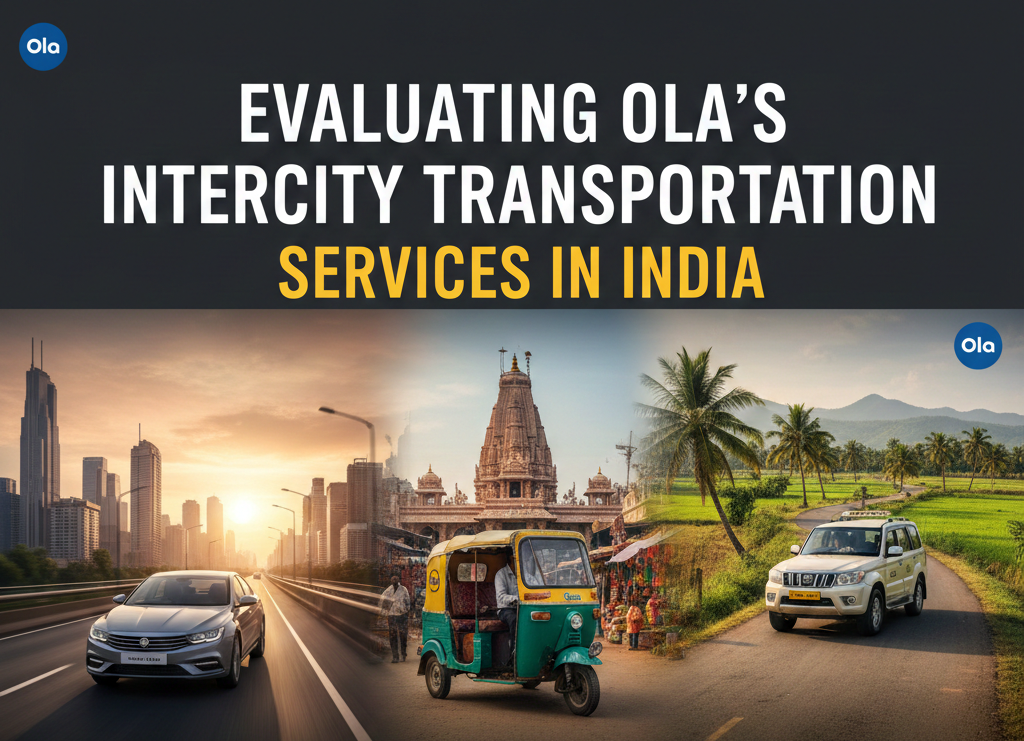
Geographically, Ola Intercity has expanded to cover major routes across India—think Mumbai-Pune, Delhi-Jaipur, Bangalore-Mysore, Chennai-Pondicherry. They’ve also made inroads into tier-2 and tier-3 cities, though availability can be inconsistent in these areas.
The typical use cases? They’re pretty diverse. Airport transfers from nearby cities are huge—imagine living in Gurgaon but flying out of Delhi. Business travelers use it extensively for client meetings in nearby cities. Families rely on it for emergency medical trips or attending functions. And increasingly, young professionals are using it for weekend getaways.
Market Need for Intercity Transportation in India
Let’s be honest about India’s traditional intercity transport options—they’ve been problematic for a long time.
Buses are economical but often uncomfortable for long journeys, run on fixed schedules that may not align with your needs, and let’s not even talk about the highway toilet stops. Trains are fantastic for longer distances, but booking can be a nightmare, they don’t offer door-to-door service, and good luck getting a confirmed ticket during peak seasons. Self-drive cars are an option, but not everyone is comfortable driving long distances, especially on highways they’re unfamiliar with. Plus, there’s the fatigue factor.
This is where app-based intercity travel found its opening.
The value proposition is compelling: convenience, flexibility, and door-to-door service. You don’t need to reach a bus stand or railway station. You don’t need to match your schedule to a departure time. You get picked up from your doorstep and dropped at your exact destination. For many Indians, especially those traveling with elderly family members or small children, this convenience is worth the premium.
Consumer behavior has shifted dramatically too. We’ve become accustomed to on-demand everything—food, groceries, entertainment. Why should travel be any different? The smartphone generation expects mobility solutions that adapt to their schedules, not the other way around.
Pricing Strategy of Ola Intercity
Now let’s talk money because ultimately, that’s what makes or breaks the deal for most people.
Ola’s intercity pricing follows a relatively straightforward model: there’s a base fare, then charges based on distance and time. They typically quote you a package rate upfront—say, ₹2,500 for a Bangalore to Mysore trip—which includes a certain number of kilometers and hours. Exceed those, and you pay extra.
How does this compare to alternatives?
Against traditional taxi operators, Ola often comes out competitive or even cheaper, with the added benefit of app-based convenience and better vehicle quality. You’re not haggling with a driver outside a railway station who’s quoting you ₹4,000 for a trip that should cost ₹2,500.
Compared to buses and trains, yes, Ola is significantly more expensive. A bus from Delhi to Jaipur might cost you ₹500-800, while Ola could charge ₹3,500-4,500. But you’re paying for privacy, comfort, and flexibility. Different value propositions entirely.
Against Uber Intercity? The pricing is remarkably similar on most routes, often within 10-15% of each other. The competition keeps both platforms honest.
The transparency factor is where Ola does reasonably well. The app shows you the fare upfront before booking, which eliminates the anxiety of meter manipulation or surprise charges. However, there’s a catch—surge pricing during peak demand can throw a wrench into your budget, sometimes doubling the usual fare. More on this later.
Service Quality and Customer Experience
Here’s where things get real, because service quality is where Ola either wins your loyalty or loses you forever.
The booking experience through the app is generally smooth. The interface is familiar if you’ve used Ola for city rides, and booking an intercity trip isn’t much different. You enter your cities, select your date and time, choose the car type, and confirm. Within minutes, you typically get a driver assigned.
But let’s talk about driver availability, which is hit-or-miss depending on your route and timing. Popular routes like Mumbai-Pune or Bangalore-Mysore? Usually good availability. But try booking a one-way trip from Nagpur to a smaller town, and you might wait hours for driver acceptance. Why? Because drivers often prefer round-trips or routes where they can easily get a return fare.
Vehicle quality has improved over the years. Ola’s Prime and Lux categories offer decent sedans that are comfortable for long journeys. However, consistency is an issue. Sometimes you get a well-maintained car with a courteous driver; other times you get a vehicle that clearly needs servicing and a driver who’s been on the road for 12 hours already.
Driver behavior and professionalism—this is a mixed bag. I’ve had excellent experiences with knowledgeable drivers who knew the route well, drove safely, and were respectful. I’ve also encountered drivers who were clearly exhausted, unfamiliar with the route, or worse, tried to upsell additional stops or manipulate the route to increase charges.
Safety measures include GPS tracking, emergency buttons in the app, and driver verification. These are table stakes now, and Ola does implement them. The question is enforcement and response time when issues arise.
Customer support is where Ola often stumbles. Getting through to a helpful support executive during a trip can be frustrating. Complaint resolution takes time, and refunds for poor experiences are often partial at best.
Technology and Platform Efficiency
Technology is supposed to be Ola’s strength, so how well does it work for intercity travel?
The Ola app handles intercity bookings reasonably well. The interface separates intercity from city rides clearly, lets you schedule bookings in advance (crucial for planned trips), and provides estimated fares upfront.
Navigation and route optimization rely on Google Maps integration, which works well on major highways but can be problematic in rural areas with poor connectivity. I’ve been in situations where the driver and I were both staring at a phone trying to figure out the route because the app’s navigation failed.
Live tracking is a feature I genuinely appreciate. Family members can track your journey in real-time, which adds a security layer, especially for solo travelers or late-night trips.
Payment options are comprehensive—cash, UPI, cards, Ola Money wallet. The digital integration is seamless when it works, but I’ve experienced instances where payment failures led to booking cancellations, which is incredibly frustrating when you’re already running late.
Platform reliability during long trips is generally acceptable, but the app can be a battery drainer, and you’re dependent on network connectivity for tracking and support, which isn’t always available on highways.
Competitive Analysis
Let’s see how Ola stacks up against the competition.
Ola Intercity vs Uber Intercity
This is the most direct comparison. Honestly? They’re remarkably similar. Pricing is competitive, vehicle quality is comparable, and both suffer from similar availability issues on less popular routes. Uber has a slight edge in customer support responsiveness in my experience, but Ola has better penetration in tier-2 cities. It often comes down to which app shows better availability for your specific route on your specific day.
Ola Intercity vs Traditional Taxi Operators
Ola wins on convenience, transparency, and vehicle tracking. You’re not dealing with haggling, you know the fare upfront, and you have recourse if something goes wrong. Traditional operators might offer better rates if you negotiate well and have local connections, but you lose the digital safety net and the assurance of vehicle quality.
Ola Intercity vs Self-Drive Car Rentals
This is interesting. Services like Zoomcar give you complete control—you drive at your pace, stop where you want, play your music. But you bear the fatigue, the stress of unfamiliar routes, and the risk of vehicle damage. Ola eliminates these concerns but costs more and gives you less control. It’s a trade-off based on your comfort level with driving long distances.
Key differentiators? For Ola, it’s the brand trust, the established app ecosystem, and the driver network. Limitations? Driver availability for one-way trips, inconsistent service quality, and limited differentiation from Uber.
Challenges Faced by Ola Intercity
No analysis is complete without acknowledging the problems, and Ola Intercity has several significant ones.
Driver availability for one-way trips is perhaps the biggest operational challenge. Think about it from a driver’s perspective: you take a passenger from City A to City B, drop them off, and now you’re 200 kilometers from home with no guaranteed return fare. You’ve spent fuel, time, and vehicle wear, but you only get paid one way. This economic reality makes drivers reluctant to accept one-way bookings, especially to smaller towns. Ola tries to mitigate this with pricing adjustments, but it’s an ongoing problem.
Return trip logistics create a domino effect. Drivers often demand return charges or cancel bookings at the last minute when they realize it’s a one-way trip to an area where getting a return passenger is unlikely. This leaves customers stranded.
Price fluctuations and surge pricing can be brutal. I’ve seen intercity fares double during festival seasons or long weekends. While surge pricing is a market mechanism to balance supply and demand, the magnitude can feel exploitative, especially when you’ve planned a trip based on normal pricing and suddenly face a 2x charge.
Customer trust and complaint resolution remain weak points. When something goes wrong—a breakdown, a driver behaving inappropriately, overcharging—the complaint resolution process is often slow and inadequate. You’re left feeling like just another transaction rather than a valued customer.
Operational challenges in tier-2 and tier-3 cities are pronounced. The driver network is thinner, vehicle quality is less consistent, and customer support is even harder to reach. While Ola has made efforts to expand to these areas, the execution doesn’t match the ambition yet.
Impact on Indian Transportation Ecosystem
Stepping back, what has Ola Intercity’s presence meant for India’s broader transportation landscape?
Effect on traditional taxi and travel businesses has been significant. Many traditional intercity taxi operators have seen their business decline, especially on popular routes. Some have adapted by partnering with platforms like Ola as driver-partners, while others have struggled to compete with the convenience and pricing of app-based services.
Employment opportunities for drivers have expanded. Thousands of drivers have found a livelihood through Ola’s platform, including many who previously struggled with irregular income from traditional taxi operations. However, it’s worth noting that this comes with its own challenges—driver earnings can be inconsistent, especially after Ola’s commission, fuel costs, and vehicle maintenance.
Contribution to organized intercity transport is perhaps Ola’s most underappreciated impact. They’ve brought structure, transparency, and accountability to a sector that was largely unorganized. GPS tracking, digital payments, and customer ratings have formalized what was once a cash-based, trust-dependent service.
Influence on consumer travel preferences has been transformative. An entire generation of travelers now considers app-based intercity cabs a default option rather than an exception. This shift in behavior has broader implications for how Indians think about mobility, ownership, and convenience.
Future Opportunities and Improvements
So where does Ola Intercity go from here? I see several paths forward.
Expansion into more cities and routes is the obvious first step. There are hundreds of intercity corridors in India that remain underserved. Routes connecting tier-2 and tier-3 cities—Indore to Ujjain, Coimbatore to Ooty, Ranchi to Jamshedpur—represent untapped potential.
Subscription or fixed-price intercity plans could be a game-changer for regular travelers. Imagine a monthly pass for business professionals who travel the same route weekly, or fixed-price packages during festival seasons to eliminate surge pricing anxiety. This would create revenue predictability for Ola and cost certainty for customers.
Better driver incentives for long-distance trips are essential to solve the availability problem. This could include guaranteed return fares, higher commission structures for one-way trips to difficult locations, or strategic positioning of drivers to enable efficient ride chains.
Improved safety and service consistency should be non-negotiable. This means stricter vehicle inspection protocols, better driver training programs, mandatory rest periods for drivers on long routes, and a complete overhaul of customer support to make it responsive and empowered to solve problems in real-time.
Additionally, partnerships with hotels and tourist destinations could create bundled offerings. Imagine booking an intercity trip to a hill station along with your hotel stay, all through the Ola app. The ecosystem possibilities are vast.
Conclusion
So, after this deep dive, where do we land?
Ola’s intercity services have undeniably filled a crucial gap in India’s transportation ecosystem. They’ve made intercity travel more accessible, predictable, and organized for millions of people. The convenience of booking a ride from your phone, the transparency of upfront pricing, and the safety of GPS tracking are genuine improvements over what existed before.
However and this is important Ola Intercity is far from perfect. Driver availability issues plague one-way trips. Service quality is inconsistent. Surge pricing can feel predatory. Customer support often disappoints when you need it most. These aren’t minor glitches; they’re fundamental operational challenges that affect the core customer experience.
My overall assessment? Ola Intercity is a solid 7 out of 10. It works well enough for popular routes and planned trips, but it’s not yet reliable enough to be your default solution for all intercity travel needs.
On sustainability and growth potential, I’m cautiously optimistic. The market demand is real and growing. India’s intercity travel needs will only increase as economic activity spreads beyond metros. Ola has the brand, technology, and network to capitalize on this. But they need to solve the economics for drivers, invest in service consistency, and build genuine customer loyalty rather than transaction-based usage.
Ola Intercity’s role in India’s future mobility landscape will likely be as one of several options rather than the dominant player. As electric vehicles become more affordable, self-drive rentals improve, and perhaps even autonomous vehicles enter the picture, the intercity mobility space will become more competitive and fragmented.
For now, though, when I need to travel from Nagpur to Mumbai for a family function, I’ll probably still open the Ola app after checking Uber for comparison, keeping my fingers crossed for driver availability, and hoping that the service lives up to the promise.
And honestly? That’s both the opportunity and the challenge for Ola. They’ve built a service that’s good enough to consider, but not yet reliable enough to trust blindly. Closing that gap will determine whether Ola Intercity becomes indispensable or merely remains a convenient option among many.
Discover more from Business Model Hub
Subscribe to get the latest posts sent to your email.