
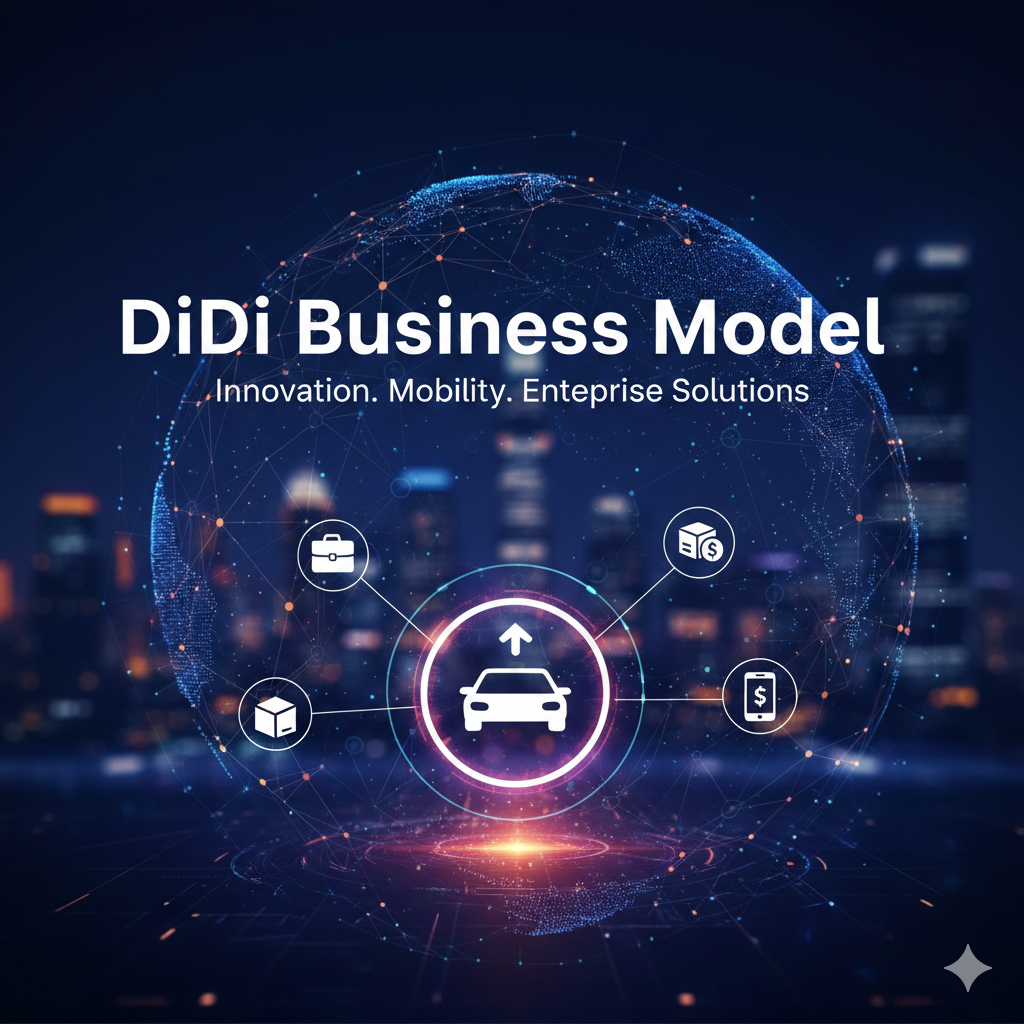
DiDi Chuxing generates revenue through a diversified mobility ecosystem earning primarily from ride-hailing commissions while expanding into freight logistics, enterprise services, financial products, and international operations across 15+ countries.
But that’s just scratching the surface. The real story is how DiDi built a mobility empire that processes tens of millions of rides daily and fundamentally transformed urban transportation in the world’s most populous nation.
What Makes DiDi Different From Every Other Ride-Hailing App
DiDi isn’t just “China’s Uber.” That comparison misses the point entirely.
While Uber focuses predominantly on ride-hailing, DiDi has evolved into a comprehensive mobility infrastructure platform. It’s the difference between running a taxi service and orchestrating an entire transportation ecosystem.
Founded in 2012 as “Didi Dache,” the company merged with competitor Kuaidi Dache in 2015, creating an unstoppable force that eventually pushed Uber out of China entirely. Today, DiDi Chuxing stands as one of the world’s largest mobility platforms—and arguably the most operationally sophisticated.
The Numbers That Tell the Real Story
Let’s talk scale:
- 15+ countries with active operations
- Hundreds of millions of registered users globally
- Tens of millions of rides processed daily at peak capacity
- Over 9 billion annual rides before regulatory adjustments
- USD 25+ billion in annual revenue at its height
These aren’t just impressive statistics. They represent the digitization of urban mobility at an unprecedented scale. Every ride generates data. Every route optimization saves time. Every payment builds the ecosystem stronger.
The Problem DiDi Actually Solved
Before DiDi transformed Chinese transportation, urban mobility was frustrating and inefficient.
The passenger experience: Standing on street corners for 30 minutes hoping to flag down a taxi. Drivers refusing destinations. No way to track arrival times. Cash-only payments creating security risks.
The driver experience: Empty vehicles circling neighborhoods burning fuel. No visibility into where demand actually existed. Revenue limited by geography and luck.
The city experience: Congestion from inefficient matching. Environmental waste from unnecessary driving. No data to inform infrastructure planning.
DiDi didn’t just create an app. It rebuilt the fundamental mechanics of how people and vehicles connect in space and time.
How DiDi’s Platform Actually Works
The user experience appears simple, but extraordinary complexity operates beneath the surface.
Step 1: Intelligent Request Processing
A user opens DiDi and requests a ride. Immediately, algorithms assess dozens of variables—current location, destination, time of day, weather conditions, local events, historical patterns, and available driver supply within proximity.
Step 2: Dynamic Matching Optimization
DiDi’s AI doesn’t just find the nearest driver. It predicts optimal matches based on the driver’s likely next destination, traffic patterns, and overall network efficiency. This matching happens in milliseconds.
Step 3: Real-Time Pricing Calculation
Fare calculations incorporate distance, estimated time, current demand, supply availability, and route complexity. During peak hours, surge pricing activates automatically—balancing supply and demand through economic incentives.
Step 4: Seamless Payment and Settlement
After ride completion, payment processes automatically through integrated mobile wallets (Alipay, WeChat Pay). DiDi deducts its commission, transfers the driver’s earnings, and updates both users’ profiles with ratings and feedback.
This entire sequence—from request to settlement—represents the platform business model operating at maximum efficiency.
DiDi’s Revenue Architecture: Multiple Streams, Massive Scale
1. Core Ride-Hailing Commissions: The Foundation
This remains DiDi’s primary revenue driver, accounting for the majority of total income.
How it works: DiDi charges drivers a commission on each completed ride, typically ranging from 15% to 30% depending on city, service tier, and market conditions.
Why it’s powerful: With tens of millions of daily rides, even modest commissions generate enormous revenue. Scale transforms small percentages into substantial profits.
The strategic advantage: Unlike asset-heavy competitors, DiDi doesn’t own vehicles. Every ride generates commission revenue without corresponding vehicle depreciation, maintenance, or insurance costs.
2. Licensed Taxi Integration: The Regulatory Masterstroke
Here’s where DiDi demonstrated strategic brilliance that eluded Uber in many markets.
Rather than disrupting traditional taxis, DiDi integrated them into the platform. Licensed taxi drivers receive digital booking capabilities, cashless payments, and route optimization—while DiDi earns service fees per ride.
Why this matters: This approach transformed potential regulatory adversaries into platform participants. Government authorities saw modernization, not disruption. Taxi unions became partners, not enemies.
This single strategic decision helped DiDi navigate regulatory complexity that destroyed competitors in other markets.
3. Carpooling and Shared Rides: Margin Optimization
DiDi’s carpooling services (DiDi Hitch and shared rides) create multiple revenue opportunities from single trips.
The economics are compelling:
- One driver, multiple paying passengers
- Higher per-trip revenue for the platform
- Better vehicle utilization rates
- Lower per-passenger pricing increases demand
The result: Improved margins without proportional cost increases—the ultimate platform economics advantage.
4. Enterprise and Corporate Solutions: Predictable High-Value Revenue
DiDi’s enterprise mobility solutions target businesses with consistent transportation needs.
Services include:
- Centralized employee travel management
- Corporate expense integration
- Customized billing and reporting
- Dedicated support channels
Why enterprises pay premium rates:
- Reduced administrative overhead
- Better cost visibility and control
- Improved employee experience
- Compliance and safety assurance
This segment delivers higher lifetime value, lower churn, and more predictable revenue than consumer rides.
5. Freight and Logistics: Expanding Beyond Passengers
DiDi Freight represents strategic diversification into commercial transportation.
The platform connects:
- Truck owners with shipping demand
- Businesses needing short-distance logistics
- Fleet operators requiring optimization tools
Revenue sources:
- Commission on freight bookings
- Subscription fees for fleet management software
- Premium routing and optimization tools
Strategic value: This reduces dependence on passenger ride-hailing while leveraging existing technology infrastructure and operational expertise.
6. International Expansion: Geographic Diversification
DiDi operates across Latin America, Australia, Japan, and parts of Africa—generating commission revenue while hedging against China-specific regulatory risks.
Each market requires localized strategies, but the underlying platform model remains consistent: connect drivers and passengers, optimize matching, charge commissions.
The Cost Structure: Where Money Gets Spent
Building and operating DiDi requires massive ongoing investment:
Driver Incentives and Bonuses: Retention programs, peak-hour rewards, and performance bonuses keep quality drivers on the platform. These subsidies can be substantial, especially when competing for driver supply.
Technology Infrastructure: AI-powered routing algorithms, demand forecasting systems, fraud detection, safety monitoring, and real-time optimization require continuous development and refinement.
Regulatory Compliance: Data security investments, government partnerships, licensing fees, and legal expertise represent significant ongoing expenses—particularly after increased scrutiny.
Marketing and User Acquisition: Customer acquisition costs remain high in competitive markets, requiring sustained promotional spending and discount campaigns.
Why DiDi’s Model Proves So Powerful
Network Effects at Massive Scale
More drivers mean faster pickup times. Faster pickups attract more passengers. More passengers attract more drivers. This self-reinforcing cycle creates nearly insurmountable competitive advantages once established.
Data Advantages Through Billions of Rides
Every completed ride generates valuable data. DiDi’s AI systems learn continuously from this information—improving pricing algorithms, optimizing routes, predicting demand patterns, and enhancing safety protocols.
Competitors can’t replicate this data advantage. Years of accumulated ride data create predictive capabilities that new entrants simply cannot match.
Deep Integration with Local Infrastructure
DiDi succeeded where Uber struggled by adapting to Chinese digital infrastructure. Seamless integration with Alipay and WeChat Pay. Collaboration with government authorities. Customization for local preferences and regulations.
This localization strategy proves replicable in international markets—each requiring similar adaptation to local conditions.
DiDi vs. Uber: Understanding the Critical Differences
| Dimension | DiDi | Uber |
|---|---|---|
| Primary Market | China-dominant | Globally distributed |
| Service Range | Rides + freight + enterprise + finance | Primarily ride-hailing |
| Regulatory Approach | Collaboration and integration | Disruption and lobbying |
| Data Concentration | Extremely dense in core market | Spread across markets |
| Diversification | High across verticals | Moderate, ride-focused |
These differences explain why DiDi dominates China while Uber leads globally. Different strategies optimized for different contexts.
The Challenges DiDi Cannot Ignore
Regulatory Pressure Intensifies
Chinese authorities have imposed stricter data privacy requirements, temporarily removed DiDi from app stores, and increased compliance expectations. These regulatory headwinds create ongoing operational challenges and compliance costs.
The Profitability Paradox
Despite massive scale, consistent profitability remains elusive. High driver incentives, price-sensitive consumers, and intense competition compress margins. Growth and profit optimization continue pulling in opposite directions.
Fierce Global Competition
Uber globally, Grab in Southeast Asia, Bolt in Europe, and countless local competitors mean DiDi faces battles on multiple fronts. International expansion requires sustained investment with uncertain returns.
What’s Next: DiDi’s Future Trajectory
The company is betting heavily on several transformative opportunities:
Autonomous Vehicle Integration: Self-driving technology could eliminate driver costs entirely—transforming economics fundamentally. DiDi is actively testing robotaxis in multiple Chinese cities.
Electric Vehicle Transition: Partnering with EV manufacturers and building charging infrastructure positions DiDi for the electrification of urban mobility.
Smart City Partnerships: Collaborating with municipal governments on integrated transportation planning, traffic optimization, and infrastructure development.
Logistics Network Expansion: Scaling freight services to compete with dedicated logistics platforms while leveraging existing technology and operational capabilities.
The Strategic Lessons DiDi Teaches
For entrepreneurs, investors, and business strategists, DiDi’s model demonstrates several powerful principles:
Localization beats globalization: Deep adaptation to local markets often outperforms standardized global approaches.
Regulation is a feature, not a bug: Working with authorities creates sustainable advantages that disruption cannot match.
Data compounds over time: Early advantages in data collection create widening gaps competitors cannot easily close.
Diversification reduces risk: Multiple revenue streams protect against single-point failures.
Scale creates optionality: Massive user bases enable expansion into adjacent markets that small platforms cannot access.
Wrapping Up: Why DiDi’s Model Matters
DiDi’s business model succeeds because it solved real problems at massive scale through platform economics, adapted to regulatory environments rather than fighting them, leveraged data advantages competitors cannot replicate, and diversified revenue beyond single-service dependency.
FAQs
How does DiDi make money?
In simple terms, DiDi earns whenever a trip, delivery, or mobility service is completed on its app.
Is DiDi a profitable company?
Reasons:
High driver incentives
Heavy spending on compliance and data security
International expansion costs
However, DiDi has shown improving margins, reduced losses, and stronger operational efficiency, especially after restructuring and focusing on core markets.
What is DiDi’s strategy?
Key pillars of DiDi’s strategy:
Dominate urban mobility in core markets (especially China)
Expand beyond passenger rides into freight, enterprise travel, and logistics
Use AI and big data to optimise pricing, routing, and safety
Work closely with governments instead of fighting regulation
Gradually expand international operations to reduce market risk
This strategy helped DiDi outcompete Uber in China.
Who is bigger, Uber or DiDi?
By global presence: Uber is bigger (operates in more countries)
By ride volume: DiDi has historically handled more rides annually than Uber
By dominance in a single market: DiDi is far bigger in China than Uber ever was
In short:
Uber is more globally diversified
DiDi is stronger in high-density, high-volume markets
Is DiDi cheaper than Uber?
Why DiDi is often cheaper:
Lower commission in some cities
More frequent subsidies and discounts
Higher ride density (more drivers nearby)
Strong competition-driven pricing
However, prices can vary depending on demand, time, and city.
Does DiDi own cars or employ drivers?
It does not own cars at scale
Drivers are independent contractors or fleet partners
This helps DiDi scale quickly while keeping capital costs low.
Is DiDi safe to use?
In-app emergency features
Trip monitoring
Driver verification
AI-based safety alerts
Safety remains a key focus area, especially after past incidents, and DiDi continues to upgrade safety systems.
Does DiDi operate outside China?
Latin America
Australia
Japan
Parts of Africa
International expansion helps DiDi reduce dependence on the Chinese market.
Discover more from Business Model Hub
Subscribe to get the latest posts sent to your email.






[…] Didi […]