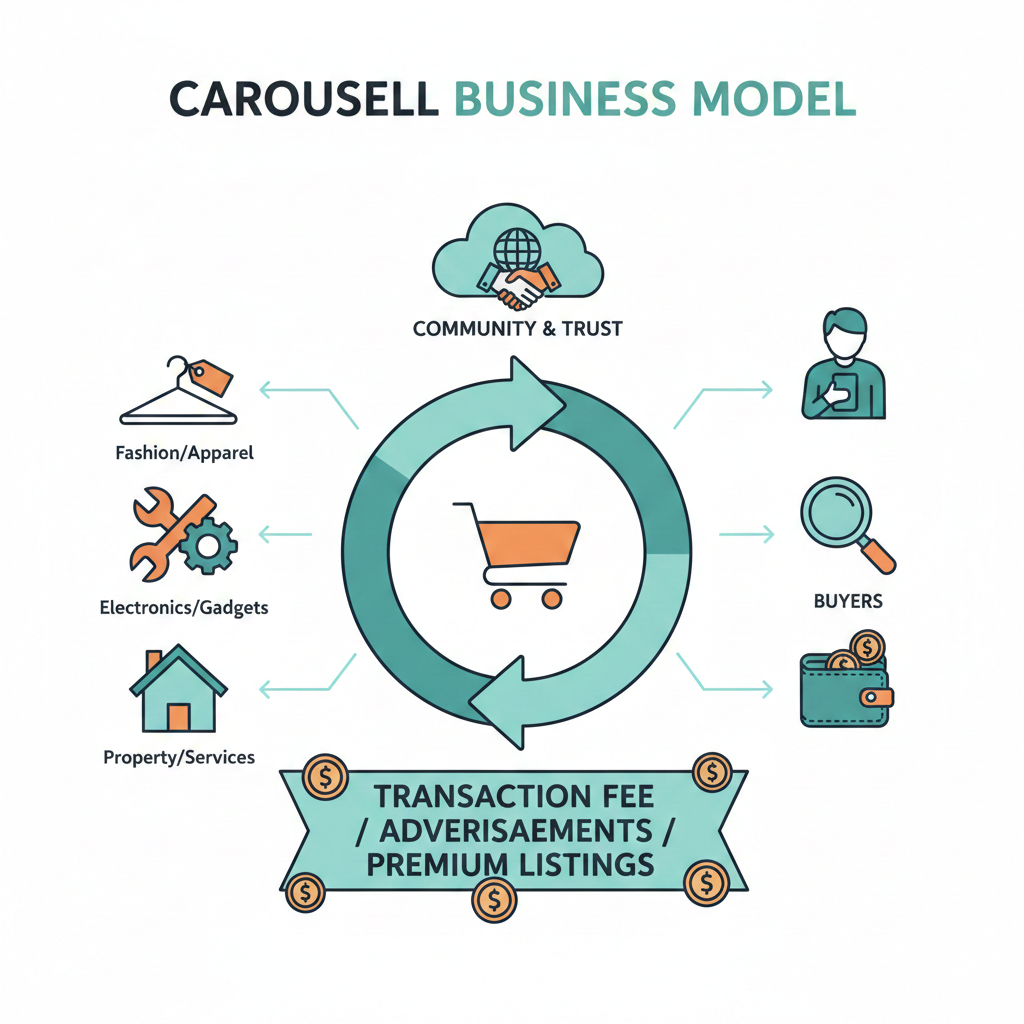
Carousell is a C2C and B2C online marketplace that lets individuals and small businesses buy and sell new or second-hand products locally. It is mainly used by everyday sellers, resellers, and bargain-seeking buyers. Carousell makes money through promoted listings, seller subscriptions, transaction fees, and advertising services.
What Is Carousell?
Carousell is a mobile-first online marketplace designed for buying and selling new and second-hand items easily within local communities. It was founded in 2012 in Singapore by three entrepreneurs who wanted to simplify peer-to-peer selling using smartphones.
Today, Carousell operates across Singapore, Malaysia, Indonesia, the Philippines, Hong Kong, Taiwan, and Australia. Its core purpose is to promote recommerce encouraging people to reuse items while enabling local, trust-based buying and selling without complex logistics.
Carousell’s Target Users
Individual Sellers (C2C)
Carousell is widely used by everyday individuals who want to sell unused or pre-owned items such as clothes, gadgets, furniture, or collectibles. These users value Carousell because it is free to start, easy to list products using a smartphone, and allows direct chat-based negotiation with local buyers.
Small Businesses & Resellers (B2C)
Carousell also attracts small businesses, home-based sellers, and professional resellers who use the platform to reach local customers without building their own website. These sellers often opt for paid promotions or subscription plans to increase visibility, manage multiple listings, and generate consistent sales, making Carousell a practical B2C sales channel.
Buyers Looking for Second-Hand or Local Deals
On the buyer side, Carousell is popular among users searching for affordable, second-hand, or nearby deals. Buyers prefer the platform for its wide variety of listings, lower prices compared to retail, and the option for local meetups or quick delivery, especially for high-value or bulky items.
Carousell Business Model Explained
Marketplace Model
Carousell operates as a hybrid marketplace, combining both C2C (consumer-to-consumer) and B2C (business-to-consumer) models. Individual users sell directly to other users, while small businesses and resellers use the same platform to reach local customers.
It follows an asset-light platform model, meaning Carousell does not own or manage products, warehouses, or logistics. There is no inventory ownership involved. Instead, Carousell earns by enabling transactions, improving visibility for sellers, and offering paid tools allowing it to scale without heavy operational costs.
How the Platform Works
The Carousell user journey is simple and mobile-first:
- Listing: Sellers upload photos, add descriptions, and set prices within minutes.
- Discovery: Buyers find listings through search, categories, and promoted placements.
- Chat: Buyers and sellers communicate directly via in-app chat to negotiate or clarify details.
- Payment & Delivery: Transactions are completed through in-app payments, delivery options, or local meetups, depending on the market.
Carousell follows a local-first approach, prioritising nearby listings and community interactions. This reduces logistics complexity, builds trust between users, and makes buying and selling faster compared to traditional eCommerce platforms.
How Carousell Creates Value
Value for Sellers
Carousell makes selling simple and accessible, especially for first-time sellers. Anyone can list items for free, which lowers the entry barrier and encourages more participation on the platform. The mobile-first design allows sellers to upload photos, write descriptions, and respond to buyers directly from their phone, without any technical setup.
For sellers who want faster results, Carousell offers paid visibility options such as bumps and promoted listings. These features help sellers reach more buyers, sell items quicker, and are especially useful for resellers and small businesses.
Value for Buyers
Buyers benefit from affordable prices, as many listings are second-hand or locally sourced, making them cheaper than retail alternatives. Carousell’s local pickup option allows buyers to inspect items before purchase and avoid high delivery costs, particularly for bulky or high-value goods.
In selected markets, Carousell also provides buyer protection, where payments are held securely until the item is received. This builds trust and reduces the risk of fraud, making the platform safer for everyday users.
How Carousell Makes Money (Revenue Model)
Promoted Listings
Promoted listings are Carousell’s primary revenue source. Sellers can pay to increase the visibility of their items so they appear higher in search results and category feeds.
- Bump: Pushes a listing to the top, increasing short-term exposure.
- Spotlight: Highlights listings in premium positions across the app.
- Visibility boosts: Combines multiple promotion tools to reach more buyers faster.
These features are popular because higher visibility directly leads to quicker sales.
Subscription Plans (Carousell PRO)
Carousell offers subscription-based plans designed for power sellers and business accounts that list items regularly. These plans typically include more listing credits, frequent boosts, advanced tools, and better exposure.
This model generates recurring revenue, helping Carousell move beyond one-time payments and build predictable monthly income.
Transaction Fees
In markets where Carousell supports in-app payments, the platform charges a transaction fee on completed sales. This fee often covers payment processing and operational costs.
Additionally, when buyers opt for buyer protection, Carousell earns a small fee for providing secure payment handling and dispute support, increasing trust across the marketplace.
Advertising & Brand Partnerships
Carousell also earns from advertising and brand collaborations, especially with retailers and local businesses. This includes:
- Sponsored listings placed in high-visibility sections
- Display ads shown to targeted user segments
These ads allow brands to reach users who are already in a buying mindset.
Vertical-Based Monetisation
Carousell monetises high-value verticals such as cars and property differently from regular listings. In these categories, revenue comes from dealer fees, featured placements, and lead-generation charges.
Because these listings involve higher transaction values, even fewer sales can generate significantly higher revenue per listing, making vertical monetisation a strong growth lever for Carousell.
Latest Carousell Stats & Numbers
📊 Revenue (Latest Year)
In the 2024 financial year, Carousell reported $119.3 million in revenue, marking a modest 2.9 % increase year-on-year as it strengthened its classifieds and advertising segments.
👥 User Base & Market Presence
Carousell now serves tens of millions of monthly active users across Southeast Asia and Greater Asia, with platforms in countries such as Singapore, Malaysia, Indonesia, the Philippines, Hong Kong, Taiwan, and more.
📉 Loss/Profit Trend
Although still unprofitable, net losses narrowed to $33.2 million in 2024 about 13 % lower than the previous year reflecting a trend of tighter cost control and focus on higher-margin segments.
🔄 Recommerce Growth Trend
While overall revenue grew, recommerce revenue declined by about 6 % in 2024, even as the company sharpened its strategy toward higher-margin advertising and classifieds offerings.
Carousell Cost Structure
Carousell’s cost structure reflects its role as a technology-driven marketplace operating across multiple countries. While it follows an asset-light model, maintaining trust and growth still requires significant ongoing investment.
Product & Engineering
A large portion of Carousell’s costs goes into product development and engineering. This includes building and maintaining the mobile app, improving search and recommendation systems, developing payment features, and ensuring platform scalability and performance across different markets.
Trust & Safety
Since Carousell operates a C2C marketplace, trust and safety are critical. Costs in this area include fraud detection systems, content moderation, dispute resolution teams, and customer support. These investments help reduce scams and build long-term user confidence.
Marketing & User Acquisition
Carousell spends on marketing and user acquisition to attract new users and retain existing ones. This includes digital advertising, app store marketing, referral campaigns, and local promotional activities. Marketing is especially important when entering new markets or competing with global platforms.
Regional Operations
Operating in multiple countries requires regional teams and localisation efforts. Costs include local staff, compliance with country-specific regulations, customer support in local languages, and partnerships with payment or delivery providers. These regional operations help Carousell adapt its platform to local user behaviour and market needs.
Why Carousell Focuses on Local Commerce
Carousell’s business model is deliberately built around local commerce, rather than large-scale logistics or nationwide delivery networks. This approach aligns closely with how second-hand and peer-to-peer selling naturally works.
No Warehouses
Carousell does not operate warehouses or fulfilment centres. Sellers keep their own items and handle delivery or meetups directly with buyers. This keeps Carousell asset-light and avoids the high fixed costs that traditional eCommerce platforms face.
Lower Logistics Costs
By encouraging local meetups and nearby transactions, Carousell reduces dependence on complex logistics. This lowers shipping costs, minimises returns, and makes it easier to sell bulky or fragile items such as furniture, electronics, or vehicles.
Community-Driven Trust
Local transactions help build community-based trust. Buyers and sellers often deal with people from the same city or neighbourhood, supported by profiles, ratings, and chat history. This personal connection increases confidence in C2C transactions.
Chat-Based Negotiation Advantage
Carousell’s in-app chat is central to the buying experience. It allows real-time negotiation, quick clarifications, and relationship building between buyers and sellers. This conversational approach mirrors offline bargaining and gives Carousell an edge over fixed-price, checkout-only platforms.
Carousell Growth Strategy
Carousell’s growth strategy is focused less on rapid user expansion and more on increasing value per user, especially from sellers who are most active on the platform.
Monetising Power Sellers
Carousell increasingly targets power sellers—users and businesses that list and sell frequently. By offering promoted listings, analytics, and business tools, Carousell encourages these sellers to spend more in exchange for better visibility and faster sales.
Expanding Subscriptions
Subscription plans such as Carousell PRO are a key growth lever. These plans convert frequent sellers into recurring revenue customers, helping Carousell build predictable income while reducing reliance on one-time promotion fees.
Strengthening Trust Features
To support higher-value transactions, Carousell continues to invest in trust and safety features. This includes secure in-app payments, buyer protection, verification systems, and improved dispute handling, all of which increase user confidence and transaction completion rates.
Focus on High-Value Verticals
Carousell prioritises high-value verticals like cars and property, where each successful listing can generate significantly more revenue. By improving tools for dealers, agents, and professional sellers in these categories, Carousell boosts monetisation without needing massive increases in user numbers.
Competitive Advantage of Carousell
Carousell’s competitive advantage comes from being purpose-built for local recommerce, rather than trying to replicate traditional eCommerce models.
Recommerce-First Platform
Carousell was designed specifically for buying and selling second-hand items, not adapted later from a retail platform. This gives it a natural advantage in categories like used electronics, fashion, and furniture, where peer-to-peer trust and flexibility matter more than fixed pricing.
Strong Network Effects
Carousell benefits from strong network effects. As more sellers list items, buyers get more choice. More buyers then attract even more sellers. This self-reinforcing loop makes the platform harder for new competitors to displace, especially in local markets.
Asset-Light Model
By not owning inventory, warehouses, or logistics infrastructure, Carousell operates an asset-light business model. This keeps operational costs lower, allows faster scaling across regions, and makes the platform more resilient during market downturns.
Local Dominance vs Global Players
While global players like Facebook Marketplace operate at scale, Carousell wins through local market focus. Its deep understanding of regional behaviour, local languages, and community-driven buying habits helps it maintain dominance in key Asian markets where global platforms often take a more generic approach.
Challenges in Carousell’s Business Model
Despite its strong position in recommerce, Carousell faces several ongoing challenges that impact growth and profitability.
Fraud & Scams
As a C2C marketplace, Carousell is vulnerable to fraud, fake listings, and scams. Even with trust and safety systems in place, managing user behaviour at scale is difficult and costly. Any increase in scams can quickly reduce user trust and transaction activity.
Competition from Facebook Marketplace
Facebook Marketplace is a major competitor because it is free, deeply integrated into a social network, and already has a massive user base. Many casual sellers choose Facebook for convenience, which puts pressure on Carousell to continuously improve features and justify paid services.
Monetisation Resistance from Casual Users
Most Carousell users are occasional sellers who list items infrequently. These users are often reluctant to pay for promotions or subscriptions, limiting monetisation opportunities. Carousell must balance generating revenue without discouraging these casual sellers from using the platform.
User Retention
User activity on Carousell can be transaction-based people join to sell one item and leave after it’s sold. Retaining users beyond a single transaction requires ongoing engagement through recommendations, notifications, and new category discovery, which remains a key challenge.
Is Carousell Profitable?
Carousell has traditionally prioritised growth over short-term profitability, focusing on expanding its user base and strengthening its marketplace ecosystem. Like many platform businesses, early investments were directed toward product development, trust systems, and regional expansion rather than immediate profits.
Growth vs Profitability Approach
Instead of chasing rapid profits, Carousell chose to build scale and engagement first. In recent years, however, the company has shifted toward controlled growth, reducing losses and improving operational efficiency, signalling a clearer path toward profitability.
Path to Sustainable Margins
Carousell’s route to sustainable margins lies in high-margin revenue streams such as promoted listings, subscriptions, and advertising. Since the platform is asset-light, incremental revenue from these services can significantly improve margins without a proportional increase in costs.
Focus on Revenue per User
Rather than relying solely on adding new users, Carousell is increasingly focused on increasing revenue per user, especially from power sellers and businesses. By monetising frequent sellers more effectively, Carousell can grow revenue while keeping user acquisition costs under control.
Carousell Business Model Summary
| Element | Details |
|---|---|
| Business Type | Marketplace (C2C + B2C hybrid) |
| Users | Individual sellers, small businesses, and buyers |
| Main Revenue | Promoted listings |
| Secondary Revenue | Subscription plans, transaction fees, advertising |
| Key Advantage | Local recommerce focus, asset-light model, community trust |
Conclusion
Carousell’s business model works because it combines simplicity, trust, and local focus. By enabling easy peer-to-peer transactions, offering monetisation options for active sellers, and maintaining an asset-light, mobile-first platform, it has carved out a niche in the competitive eCommerce space.
For marketplace startups, Carousell offers key lessons:
- Focus on a specific market segment rather than trying to serve everyone.
- Build trust and community, especially in C2C platforms.
- Monetise gradually, starting with power users before casual participants.
- Maintain an asset-light model to scale without huge fixed costs.
Looking ahead, the recommerce trend is expected to grow as sustainability and circular economy principles gain importance. Carousell’s focus on second-hand and local transactions positions it well to benefit from this shift, making it a long-term player in the recommerce ecosystem.
Discover more from Business Model Hub
Subscribe to get the latest posts sent to your email.