You know what’s wild? While most dating apps were playing the same old game of “swipe, match, hope someone messages you,” Bumble walked in and said, “What if we just… flipped the script?”
And that simple flip turned into a multi-billion dollar business.
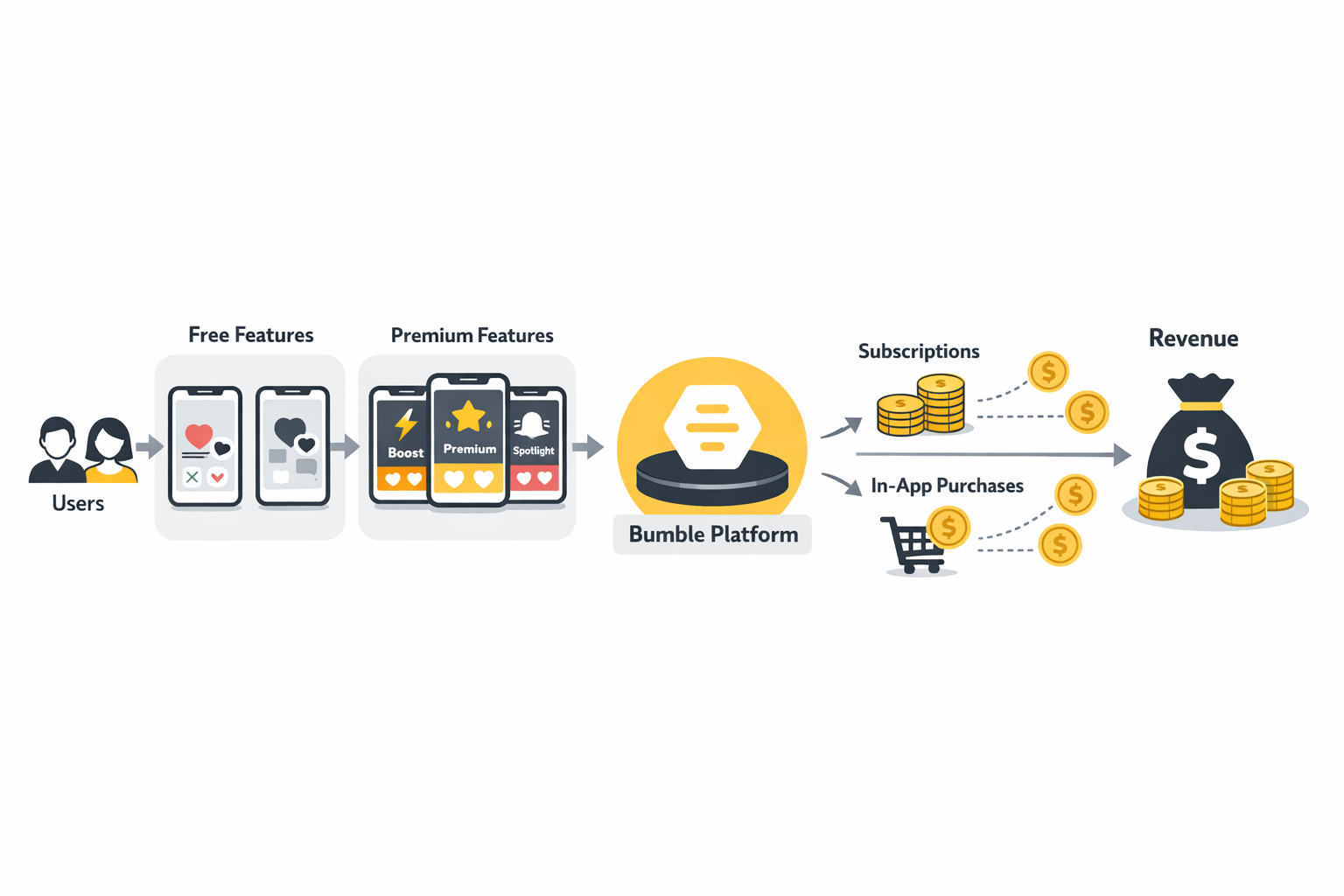
Here’s the quick answer: Bumble makes money primarily through premium subscriptions (Bumble Boost and Premium) and in-app purchases like SuperSwipes and Spotlight, while keeping the core experience free. They’ve built a freemium model that doesn’t feel gross or desperate which, let’s be honest, is pretty rare in the dating app world.
But here’s why Bumble is actually fascinating to study as a business model: they took a crowded market dominated by Tinder, added one simple rule (women message first), wrapped it in a safety-focused brand, and somehow convinced millions of people to pay for premium features. Not because they were locked out of finding matches, but because the experience was good enough that they wanted more of it.
That’s the difference between desperate monetization and smart monetization.
Let’s break down exactly how they did it.
What Is Bumble, Really?
Okay, quick history lesson. Bumble was founded in 2014 by Whitney Wolfe Herd, who previously co-founded Tinder. After a pretty messy departure from Tinder (including a lawsuit), she decided to build something different. Not just another dating app, but a social platform that actually respected women’s experiences online.
The core idea was deceptively simple: women make the first move.
In heterosexual matches, only women can initiate conversation. Men can’t send the first message. This one rule completely changed the dynamic—it reduced unsolicited messages, put women in control, and (somewhat ironically) made men feel less pressure to come up with clever opening lines.
But Bumble didn’t stop at dating. They expanded into:
- Bumble Date (the original dating app)
- Bumble BFF (finding friends)
- Bumble Bizz (professional networking)
This turned Bumble from “just another dating app” into a full social connection platform. And that’s smart business—more use cases = more reasons to stay engaged = more opportunities to monetize.
Bumble’s Core Products (The Three-Headed Beast)
Bumble Date
This is the flagship. The bread and butter. The reason most people download the app.
Purpose: Help people find romantic connections—dates, relationships, whatever they’re looking for.
Target users: Primarily people in their 20s and 30s, though it skews slightly older than Tinder. More relationship-focused than hookup-focused.
Key differentiation: Women message first (in straight matches). This attracts women who are tired of the “Hey” and unsolicited messages on other apps, and it attracts men who appreciate meeting women who are genuinely interested enough to reach out.
Bumble BFF
This one’s genius, honestly.
The use case: Moving to a new city? Lost touch with friends after college? Just want to expand your social circle? Bumble BFF lets you swipe to find friends the same way you’d swipe for dates.
Why it matters for business: It gives people a reason to stay on Bumble even when they’re in a relationship. And it increases daily engagement—you might not be actively dating, but you’re still opening the app to chat with potential friends.
Bumble Bizz
The professional networking play.
The angle: Like LinkedIn meets dating app mechanics. Swipe on people in your industry, make professional connections, find mentors or collaborators.
Lifetime value impact: This is about keeping users on the platform long-term. Even if you find a partner on Bumble Date and friends on Bumble BFF, you might still use Bizz for career networking. More touchpoints = stickier product = higher lifetime value per user.
How Bumble Actually Works (The User Flow)
Let me walk you through what happens when you join Bumble:
1. Onboarding: You create a profile with photos, basic info, and prompts about yourself. The app asks what you’re looking for—dating, friends, or networking (or all three).
2. Matching logic: You see profiles based on location, age preferences, and other filters. Swipe right if you’re interested, left if you’re not. Pretty standard stuff.
3. Here’s where it gets different: When two people both swipe right, it’s a match. But in heterosexual matches, only the woman can send the first message. She has 24 hours to do so, or the match expires.
4. Once she messages, the guy has 24 hours to respond, or that match expires too.
This time pressure is built into the product intentionally. It creates urgency, reduces “match hoarding,” and keeps people actively engaged. You can’t just collect matches and never talk to anyone—the app forces action.
And guess what? You can pay to extend those time limits. See where this is going?
Bumble Business Model Explained
Bumble runs on a classic freemium platform business model.
Here’s the logic:
- Give away the core product for free (swiping, matching, messaging)
- Build trust and engagement by making the free experience genuinely good
- Offer premium features that enhance the experience (not gatekeep it)
- Create urgency and scarcity that makes paid features more appealing
The platform itself is a two-sided marketplace—they need both men and women to show up and engage. Too many of either gender and the experience breaks. So they have to carefully balance acquisition, engagement, and monetization.
The genius is that they monetize around the core experience, not through it. You don’t need to pay to find matches. You pay to find them faster or more conveniently.
How Bumble Makes Money
Alright, here’s the money section. How does Bumble actually pay the bills and make its investors happy?
1. Subscription Revenue (The Big One)
This is where most of Bumble’s money comes from. They offer two main subscription tiers:
Bumble Boost
This is the mid-tier subscription. You get:
- Unlimited right swipes (free users have daily limits)
- Ability to rematch with expired connections
- See who’s already swiped right on you (massive time-saver)
- Extend matches by 24 hours (one per day)
- Advanced filters (education, politics, etc.)
Pricing varies by region and subscription length. Monthly is most expensive per month, but they discount if you commit to 3 or 6 months. Classic subscription economics.
Bumble Premium
This is the top tier. You get everything in Boost, plus:
- Travel Mode (change your location to anywhere)
- Unlimited Advanced Filters
- Beeline (see everyone who’s liked you, not just when you come across their profile)
- Incognito Mode (browse without being seen unless you swipe right)
- SuperSwipe unlimited (more on this below)
Why subscriptions work so well for Bumble:
It’s recurring revenue. Predictable. High margin. And the psychology is perfect—once someone subscribes, they’re invested. They’re more likely to keep using the app actively (sunk cost fallacy works in Bumble’s favor), which means they’re more likely to renew.
Bumble doesn’t disclose exact revenue splits publicly, but analyst estimates suggest subscriptions account for 80-90% of total revenue. That’s a damn good business model.
2. In-App Purchases (The Impulse Buys)
These are one-time purchases for specific features:
Spotlight
Pay to boost your profile to the top of the stack for 30 minutes. You’ll be seen by way more people in your area. Think of it like Instagram or Facebook ads, but for your dating profile.
This is impulse-driven. You’re feeling confident after updating your photos, or it’s Friday night and you want more matches. You drop $5-10 for a Spotlight boost.
SuperSwipes
This is Bumble’s version of a “super like.” You send a SuperSwipe to someone to show extra interest—they get a notification that you really liked them, not just a regular swipe.
You get a few free ones, but you can buy more. It’s about standing out in someone’s queue.
Why in-app purchases complement subscriptions:
They serve different psychological needs. Subscriptions are for power users who are on the app regularly. In-app purchases are for casual users who want an occasional boost or who want to make a move on someone specific.
Different user segments, different monetization strategies. Smart.
3. Advertising (But They Keep It Minimal)
Here’s what’s interesting: Bumble could make a lot more money from ads. But they choose not to.
Why? Brand safety and user experience.
Dating apps are intimate spaces. You’re vulnerable. You’re putting yourself out there. Slapping ads all over that experience would cheapen it and drive users away.
Bumble does run some sponsored content and brand partnerships, but it’s very selective. They’ll work with brands that align with their values (think: female-focused brands, lifestyle companies, etc.).
The limited advertising actually strengthens the brand. It signals “we care more about your experience than squeezing every dollar out of you.” And that trust translates into higher willingness to pay for subscriptions.
Bumble’s Pricing Strategy (The Psychology Behind It)
Let’s talk about how Bumble thinks about pricing, because it’s more sophisticated than it looks.
The freemium psychology:
The free version is genuinely useful. You can absolutely find matches, have conversations, go on dates—all without paying. This is critical. If the free version sucked, no one would stick around long enough to consider paying.
But the free version also has strategic limitations:
- Daily swipe limits (creates scarcity)
- Can’t see who liked you (creates curiosity)
- Matches expire if you don’t message quickly (creates urgency)
These aren’t bugs. They’re features. Bumble designed the free experience to make you want the paid features, without making you need them.
Feature-based upselling:
Notice how they don’t have just one “premium” option. They have Boost and Premium, plus à la carte purchases. This is price discrimination done right—different features for different customer segments at different price points.
Casual user who just wants to see their likes? Boost is perfect. Power user who wants every bell and whistle? Premium. Someone who just wants one specific feature right now? In-app purchase.
Regional pricing:
Bumble adjusts pricing based on geography. A subscription in India costs way less than in the US or UK. This is smart globalization—they’re optimizing for local purchasing power, not just charging one global price.
Why Bumble doesn’t push ads aggressively:
Because their brand is their moat. The “women-first, safety-focused, premium experience” positioning attracts users who are willing to pay for quality. Ads would undermine that positioning and commoditize the experience.
They’d rather have fewer users paying higher subscription prices than more users seeing ads.
Who Actually Uses Bumble? (The Target Audience)
Understanding who uses Bumble helps explain why their business model works.
Gender split: Pretty balanced, though slightly more women than men in many markets (which is rare for dating apps). The women-first approach actually attracts more women, which then attracts more men.
Age demographics: Primarily 25-40. Skews slightly older and more professional than Tinder. These are people with disposable income who are looking for actual relationships, not just hookups.
Urban vs. semi-urban: Strong in cities and college towns. Less penetration in rural areas (though that’s true for most dating apps).
Why this matters for revenue: This audience is willing to pay for quality experiences. They have money. They value their time. They’re looking for efficiency. That’s the perfect customer profile for a premium subscription business.
Bumble’s Value Proposition (Why People Choose It Over Tinder)
Let’s be clear about what Bumble is selling:
Safety: The women-first messaging rule reduces harassment and unsolicited messages. The app has strong moderation and photo verification.
Control: Women control who they talk to and when. Men don’t have to stress about crafting perfect opening lines.
Quality over quantity: The time limits and women-first approach tend to attract more intentional users. Fewer bots, fewer time-wasters.
Multi-purpose platform: You’re not just downloading a dating app. You’re getting access to friend-finding and professional networking too.
This value proposition attracts a specific type of user—one who’s willing to pay for a better experience.
The Metrics That Make Bumble Tick
If you’re building a similar business, here are the numbers you should obsess over:
Monthly Active Users (MAU): How many people open the app each month. This is your top-of-funnel metric.
Free-to-paid conversion rate: What percentage of users upgrade to paying subscribers. For dating apps, this is typically 2-5%. Higher is better.
Retention: Are subscribers sticking around month after month? Are free users coming back daily? Retention is everything in a subscription business.
Engagement time: How long people spend in the app daily. More time = more opportunities to monetize.
Match-to-conversation rate: Of all the matches that happen, how many turn into actual conversations? This measures product-market fit. If matches aren’t converting to chats, something’s broken.
These metrics feed into each other. Better engagement → more matches → higher satisfaction → better retention → higher lifetime value → more revenue per user.
How Bumble Grows (Without Spending a Fortune on Ads)
Bumble’s growth strategy is surprisingly organic for a tech company.
Word-of-mouth: Happy users tell friends. Women especially recommend Bumble to other women because of the safety features.
Influencer and social branding: Bumble built a lifestyle brand, not just a product. They sponsor events, partner with influencers, run campaigns around female empowerment. This attracts users who align with those values.
Localized launches: When entering new markets, Bumble hosts events and partners with local influencers. They build community before they build user base.
Strong brand positioning: The “feminist-friendly” angle differentiates them and generates press coverage. Controversy (some people hate the women-first approach) actually helps—any press is good press when you’re building awareness.
This is way more sustainable than competing on paid acquisition with Tinder. Bumble can’t outspend Match Group (which owns Tinder, Hinge, etc.). So they compete on brand and community instead.
What It Costs to Run Bumble (The Expense Side)
Every business has costs. Here’s where Bumble spends money:
App development and maintenance: Engineers aren’t cheap. Keeping the app running smoothly across iOS and Android takes ongoing work.
Moderation and safety: Human moderators reviewing reported profiles, AI systems detecting fake accounts and inappropriate content, photo verification technology. This is critical for brand trust but expensive to scale.
Marketing and user acquisition: Events, influencer partnerships, paid ads (though less than competitors), brand campaigns.
Cloud infrastructure: Serving millions of users globally requires serious server capacity. AWS or Google Cloud bills add up fast.
The key is that most of these costs have economies of scale. Once you build the moderation system or the matching algorithm, it doesn’t cost much more to serve 1 million users vs. 10 million. That’s why subscription businesses can be so profitable at scale.
The Competition (Who Else Is Fighting for Your Swipes?)
Bumble doesn’t exist in a vacuum. Let’s quickly compare:
Tinder: The 800-pound gorilla. More users, more casual, more hookup-focused. But also more harassment and lower-quality matches for many users (especially women).
Hinge: Positioned as “designed to be deleted.” Relationship-focused. Similar demographic to Bumble but without the women-first rule.
OkCupid: Old-school dating site that pivoted to mobile. More profile depth, quiz-based matching. Different vibe entirely.
Why Bumble still stands out: The women-first rule is a genuine differentiator. It’s not just marketing—it actually changes behavior. And the multi-app approach (Date, BFF, Bizz) creates stickiness that pure dating apps don’t have.
Strengths of Bumble’s Business Model
Let’s talk about what works really well:
Strong brand identity: Everyone knows Bumble as “the one where women message first.” Clear positioning = easier to market.
High willingness to pay: The target demographic values quality and safety. They’ll pay for premium features.
Loyal user base: Lower churn than many competitors. People stick around because the experience is better.
Multiple revenue streams: Subscriptions + in-app purchases + limited advertising = diversified income.
Multiple use cases in one app: Dating, friendship, networking. More reasons to stay engaged = higher lifetime value.
Weaknesses and Risks (Nothing’s Perfect)
But let’s be real about the challenges:
Dating app fatigue: People get burned out. Swiping feels like work after a while. This affects all dating apps, but it’s still a risk.
High churn when people find partners: Ironically, when your product works, people leave. They find a relationship and delete the app. This is a feature, not a bug, but it means constant user acquisition.
Competition copying features: Tinder and others have added “women message first” options. Your core differentiator can be copied.
Dependency on subscriptions: If conversion rates drop or retention weakens, revenue takes a hit fast. Subscription businesses live and die by these metrics.
Market saturation: How many dating apps can one market support? Eventually, growth slows as you run out of new users.
What Founders Can Learn From Bumble
Okay, if you’re building a startup (dating app or otherwise), here’s what to steal from Bumble’s playbook:
1. Build trust before you monetize.
Bumble spent years establishing itself as the safe, women-friendly option. They earned trust. Then they monetized that trust through subscriptions. Too many startups rush to monetization and destroy the experience.
2. Design product rules that shape behavior.
The “women message first” rule isn’t just a feature. It’s a behavior-shaping constraint that makes the entire product work differently. Think about what rules or constraints could make your product better.
3. Freemium done right means a great free experience.
Don’t cripple your free tier. Make it genuinely valuable. Then make your paid tiers even better. Bumble nailed this.
4. Monetize engagement, not desperation.
Bumble doesn’t lock basic features behind paywalls. They don’t make you pay to send messages. They monetize convenience and enhancement. There’s a dignity to that approach that users appreciate.
5. Brand is a moat.
Bumble can’t out-spend Match Group on user acquisition. So they built a brand that attracts their target users organically. Brand loyalty = competitive advantage.
6. Think beyond your core use case.
Bumble didn’t stop at dating. They added BFF and Bizz. This increased engagement and lifetime value. What adjacent problems could your product solve?
Can You Build an App Like Bumble?
Alright, real talk: Is this something you could actually build?
Technically? Yes. The technology isn’t rocket science. Swiping mechanics, matching algorithms, real-time messaging—these are all solved problems. You can absolutely hire a team or use no-code tools to build a functional dating app.
Successfully? That’s way harder.
Here’s what you’d need to figure out:
Key features required:
- Profile creation and photo uploads
- Swipe/matching mechanism
- Real-time messaging
- Geolocation and filters
- Payment processing for subscriptions
- Moderation and safety systems
- Push notifications
- Admin dashboard
Monetization planning: Don’t just copy Bumble’s pricing. Think about your specific users. What would they pay for? How much? Test different price points.
Regulatory and safety challenges: This is the part most founders underestimate. You need:
- Age verification systems
- Robust moderation (human + AI)
- Systems to prevent harassment and scams
- Data privacy compliance (GDPR, CCPA, etc.)
- Terms of service that actually protect you legally
The hard part isn’t building the app. It’s building the trust and the community. That takes time, money, and really thoughtful execution.
Want to Build a Dating or Social App Like Bumble?
Look, I’m not going to pretend this is easy. Building a successful social app takes serious planning especially around user experience, safety, and monetization.
If you’re thinking about building something in this space, here’s what you should be thinking through:
- What’s your actual differentiator? (And “like Bumble but for X” usually isn’t enough)
- How will you build trust and safety from day one?
- What’s your monetization strategy beyond “we’ll figure it out later”?
- How will you handle cold start problems (no users = no value = no users)?
The opportunity is definitely there. Dating and connection apps aren’t going anywhere. But you need to be smart about product strategy, user experience, and business model from the start.
If you want to talk through your idea or need help thinking through the product strategy, monetization, or UX hit me up. I love helping founders work through this stuff before they spend six months building something nobody wants.
Just don’t come to me with “it’s like Tinder but with dogs.” We’re better than that.
FAQs
Yes, Bumble is profitable, but with fluctuations.
Bumble has reported profitable quarters, mainly driven by subscription revenue from paying users. However, like most consumer internet platforms, profitability can vary due to marketing spend, product development costs, and global expansion. The core business itself is capable of generating profits once user acquisition costs are controlled.
The key difference is who starts the conversation.
On Bumble, women must make the first move after a match, which changes user behaviour and reduces unwanted messages. Bumble also positions itself as a relationship-first and safety-focused platform, while Tinder is more open-ended and casual. Additionally, Bumble offers BFF (friends) and Bizz (networking) modes, making it more than just a dating app.
Yes, Bumble is free to download and use.
Users can create profiles, swipe, match, and message for free. However, Bumble uses a freemium model, where advanced features like seeing who liked you, extending matches, and boosting visibility require paid plans or one-time purchases.
Bumble’s main revenue comes from paid subscriptions.
Most of its income is generated through Bumble Boost and Bumble Premium, which unlock advanced dating features. Additional revenue comes from in-app purchases like Spotlights and SuperSwipes. Advertising plays a very limited role compared to subscriptions.
Discover more from Business Model Hub
Subscribe to get the latest posts sent to your email.