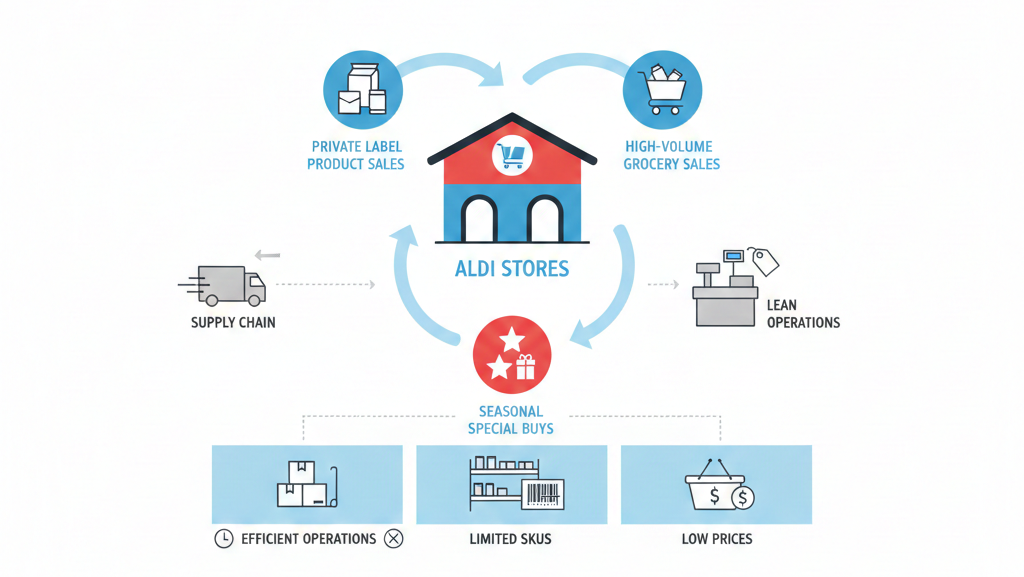
Aldi makes money by cutting costs everywhere except product quality, selling mostly private-label items, and running extremely efficient stores.
Aldi doesn’t try to look fancy.
It tries to be cheap, fast, and predictable and that’s exactly why it works.
Let’s break it down properly.
What Is Aldi?
Aldi is a global discount supermarket chain founded in Germany in 1913.
Today, Aldi operates in:
- Europe
- The UK
- The US
- Australia
It is technically split into:
- Aldi Nord
- Aldi Süd
But both follow almost the same business model.
Aldi’s Core Philosophy
Aldi runs on one simple belief:
Customers care more about price and quality than variety and experience.
So Aldi removes everything that increases cost but doesn’t add real value.
This mindset shapes every part of the business.
Aldi Business Model Explained
Aldi follows a hard-discount retail model.
That means:
- Fewer products
- Smaller stores
- Minimal staff
- Zero unnecessary features
This allows Aldi to sell products cheaper than traditional supermarkets—consistently.
How Aldi Makes Money
Aldi earns money through high-volume, low-margin retail sales.
But unlike other supermarkets, Aldi:
- Cuts operating costs aggressively
- Controls supply chains tightly
- Focuses on repeat weekly purchases
Lower costs → lower prices → higher customer loyalty.
Key Elements of Aldi’s Business Model
1. Private Label Dominance (Biggest Advantage)
Around 90%+ of Aldi products are private labels.
Why this matters:
- No brand premiums
- Better supplier control
- Higher margins
- Price consistency
Customers trust Aldi’s own brands—so Aldi doesn’t need Coca-Cola or Nestlé on shelves.
2. Limited SKUs (Less Choice, More Efficiency)
Typical supermarket: 30,000–40,000 products
Aldi store: 1,500–2,000 products
This reduces:
- Inventory costs
- Storage needs
- Waste
- Decision fatigue
Fewer products = faster stocking + faster checkout.
3. Ultra-Efficient Store Design
Aldi stores are:
- Small
- No-frills
- Easy to navigate
Cost-saving tactics:
- Products kept in shipping cartons
- No background music
- Basic shelving
- Simple lighting
Nothing is added unless it improves speed or cost.
4. Lean Staffing Model
Aldi stores run with very few employees.
How?
- Employees handle multiple roles
- Cashiers sit (faster + less fatigue)
- Self-service bagging
This reduces labour costs without hurting efficiency.
5. Customer Pays for “Extras”
Aldi charges for:
- Shopping bags
- Trolleys (coin deposit)
- Premium placement (rare)
This:
- Reduces store costs
- Encourages responsible behaviour
- Keeps prices low for everyone
6. Strong Supplier Relationships
Aldi works with:
- Fewer suppliers
- Long-term contracts
- High-volume orders
Suppliers accept lower margins in exchange for:
- Guaranteed volumes
- Stable demand
- Predictable planning
This keeps procurement costs low.
7. Minimal Marketing Spend
Aldi doesn’t rely on heavy advertising.
Instead:
- Word of mouth
- Weekly deals
- Consistent low pricing
Marketing is functional, not emotional.
Aldi’s Customer Segments
Aldi targets:
- Price-conscious families
- Middle-income shoppers
- Value-focused consumers
- Smart bargain hunters
Important insight:
Aldi shoppers are not poor—they are price-aware.
Aldi’s Cost Structure
Aldi saves money on:
- Store size
- Staffing
- Inventory
- Branding
- Marketing
- Supply chain complexity
Biggest costs:
- Procurement
- Logistics
- Real estate
But even those are optimised for scale.
Aldi vs Traditional Supermarkets
| Feature | Aldi | Traditional Supermarket |
|---|---|---|
| Product range | Limited | Huge |
| Brands | Mostly private | Brand-heavy |
| Prices | Very low | Higher |
| Store design | Basic | Fancy |
| Staff | Lean | Large |
Aldi competes on price certainty, not experience.
Aldi Business Model Canvas
1. Key Partners
Aldi keeps partners limited and strategic.
- Private-label manufacturers
- Farmers and food producers
- Logistics and distribution partners
- Packaging suppliers
- Real estate owners
👉 Fewer partners = better pricing power.
2. Key Activities
What Aldi focuses on daily:
- Private-label product sourcing
- Inventory and supply chain optimisation
- Cost-efficient store operations
- Quality control and pricing discipline
- Logistics and distribution management
Aldi avoids anything that doesn’t lower costs.
3. Key Resources
Aldi’s real assets are efficiency-driven.
- Strong private-label brands
- Global procurement scale
- Efficient logistics network
- Lean store operations model
- Cost-focused company culture
4. Value Propositions
For Customers
- Consistently low prices
- Good quality at affordable cost
- Fast, simple shopping experience
- Predictable weekly grocery spend
For Suppliers
- Large, stable order volumes
- Long-term contracts
- Simple product requirements
5. Customer Relationships
Aldi keeps relationships functional, not emotional.
- Self-service shopping
- Minimal in-store assistance
- Consistent pricing builds trust
- Weekly specials drive repeat visits
No loyalty cards, no data tracking.
6. Channels
How Aldi reaches customers:
- Physical discount stores
- Weekly print and digital leaflets
- Website for promotions
- Word-of-mouth reputation
Aldi relies more on habit than marketing.
7. Customer Segments
Aldi targets:
- Price-conscious households
- Families managing weekly grocery budgets
- Middle-income value seekers
- Smart shoppers who prefer savings over variety
Aldi customers are value-driven, not brand-driven.
8. Cost Structure
Where Aldi spends money:
- Procurement and sourcing
- Logistics and distribution
- Store operations
- Staff wages (lean teams)
- Real estate
Where Aldi saves:
- Marketing
- Store décor
- Product variety
- Branding costs
9. Revenue Streams
How Aldi makes money:
- Retail sales from private-label products
- High-volume, low-margin grocery sales
- Seasonal and limited-time product offers
No ads. No subscriptions. No upselling tricks.
Aldi Business Model Canvas Summary
| Block | Focus |
|---|---|
| Core Strategy | Cost leadership |
| Key Advantage | Private labels + efficiency |
| Customer Promise | Lowest reliable prices |
| Growth Driver | Repeat weekly shopping |
| Risk | Limited variety |
Why Aldi’s Business Model Works
Because it’s obsessively focused.
Aldi doesn’t try to:
- Be premium
- Be convenient
- Be experiential
It tries to:
- Be cheapest
- Be fastest
- Be reliable
And that clarity creates scale.
Risks & Limitations
Aldi’s model has trade-offs:
- Limited choice may frustrate some customers
- Less flexibility in product variety
- Hard to localise deeply
But Aldi accepts these limits to protect efficiency.
Lessons for Founders
Aldi teaches powerful business lessons:
- Focus beats variety
- Cost discipline is a strategy
- Private labels = control
- Simplicity scales
- Customers accept trade-offs if value is clear
Wrapping Up
Aldi proves that boring can be brilliant.
No fancy stores.
No endless choices.
Just:
Lower costs → Lower prices → Loyal customers
That’s why Aldi continues to grow even against retail giants.
Want to build a grocery or retail app like Aldi?
I help founders plan, design, and develop cost-efficient retail apps focused on speed, simplicity, and real business logic.
👉 Start your app development discussion
Discover more from Business Model Hub
Subscribe to get the latest posts sent to your email.