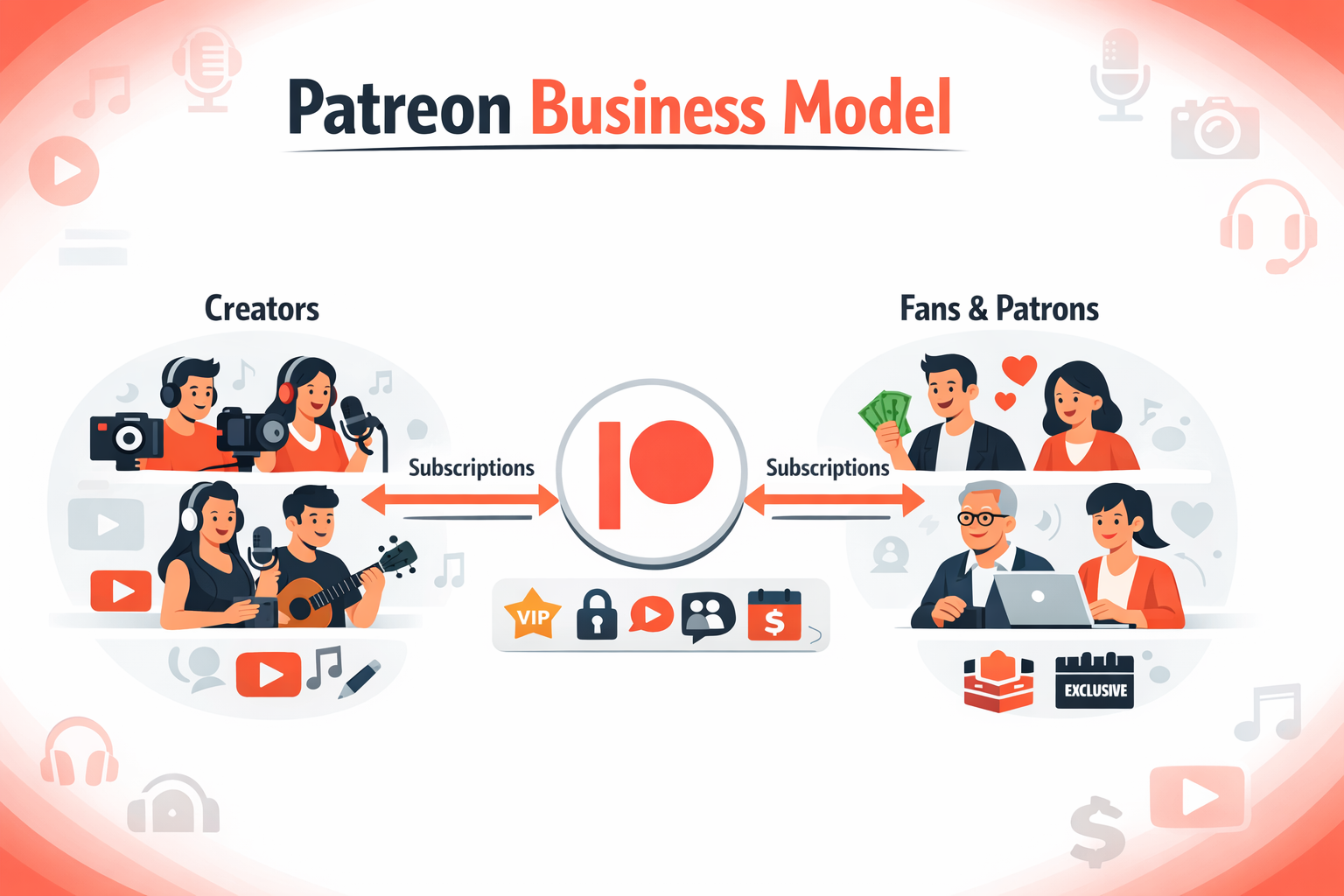
Patreon Business Model: How Patreon Makes Money by Helping Creators Earn

The Patreon business model allows creators to earn recurring income directly from their fans, while Patreon makes money by taking a percentage cut from creator earnings.
Instead of relying on ads, algorithms, or brand deals, Patreon focuses on membership-based creator monetization a model that’s reshaping how independent creators sustain their work.
Now let’s break this down properly and understand why this model has become so important in the creator economy.
What Is Patreon?
Patreon is a creator membership platform that helps creators get paid regularly by their most loyal fans, who are called patrons. Think of it as a subscription service, but instead of subscribing to Netflix or Spotify, fans subscribe directly to individual creators they want to support.
The core offering is simple but powerful. Creators provide exclusive value through:
Exclusive content that’s not available on free platforms like YouTube or Instagram. This could be bonus episodes, extended cuts, premium tutorials, or content that’s too niche for mainstream platforms.
Early access to content before it’s released publicly. Fans get to see videos, read articles, or hear podcast episodes days or weeks before anyone else, creating a sense of VIP status.
Behind-the-scenes updates that pull back the curtain on the creative process. This might include work-in-progress shares, creative struggles, decision-making processes, or personal insights that create deeper connection.
Community perks such as exclusive Discord servers, monthly Q&A sessions, voting rights on future content, or direct messaging access with the creator.
In return for these benefits, fans pay a monthly subscription fee that they choose based on different membership tiers.
Patreon acts as the middle platform that makes all of this possible by:
Handling payments securely across multiple currencies and payment methods, dealing with all the complexity of international transactions, tax compliance, and payment processing infrastructure.
Managing memberships automatically, including billing cycles, tier changes, cancellations, and reactivations—administrative work that would otherwise consume creators’ time.
Providing creator tools for content delivery, community management, analytics, and communication, essentially offering creators a complete business-in-a-box solution.
Why Patreon Was Needed: The Core Problem It Solves
To understand Patreon’s value, you need to understand the fundamental challenges that creators face on traditional platforms.
Most creators struggle with several interconnected problems:
Unstable ad revenue that fluctuates wildly based on factors beyond their control. A creator might earn $2,000 one month and $800 the next, making it impossible to plan financially or treat content creation as a sustainable career.
Algorithm dependency on platforms like YouTube, Instagram, and TikTok means that changes to how content is distributed can devastate a creator’s reach overnight. You can have 100,000 followers but reach only 2% of them organically, making those followers almost meaningless without paying for ads.
Brand deal uncertainty creates feast-or-famine income patterns. Landing a $5,000 sponsorship feels great until you realize you have no idea when the next one will come, and negotiating deals takes time away from creating.
One-time income instead of predictable cash flow makes it impossible to plan ahead, invest in better equipment, hire help, or simply pay rent reliably. This uncertainty forces many talented creators to treat their passion as a side hustle rather than a real business.
Patreon solves these problems by offering something fundamentally different:
Recurring monthly income that creators can count on. When you have 500 patrons paying an average of $7 per month, you know you’ll make roughly $3,500 every month, allowing you to plan, invest, and grow.
Direct creator–fan relationship that isn’t mediated by algorithms or platform policy changes. Your patrons chose you specifically and will see everything you post for them—no algorithm deciding who sees what.
Platform independence from ad-based models means you’re not building your business on someone else’s monetization strategy. You’re not subject to advertiser boycotts, demonetization, or changing platform policies about what content can earn money.
This is the foundation of Patreon’s business model—solving a real, painful problem for creators in a way that creates value for everyone involved.
How the Patreon Business Model Works: Step-by-Step
Let’s walk through the complete journey of how Patreon operates from both the creator and patron perspectives.
Step 1: Creator Sets Up a Patreon Page
The process begins when a creator decides to launch their Patreon presence. They go through several key decisions:
Creators choose subscription tiers, typically offering 2-4 different levels to appeal to fans with different budgets and commitment levels. The psychology here matters—multiple tiers give fans options and create upsell opportunities.
They set monthly pricing that reflects the value they’re providing while remaining accessible to their audience. Pricing varies dramatically by niche, audience size, and content type.
They define exclusive benefits for each tier, clearly articulating what patrons get at each level to justify the price difference.
A typical structure might look like:
- $5/month → Exclusive posts, behind-the-scenes updates, supporter badge
- $15/month → Everything above plus early access to all content, monthly bonus episode
- $30/month → Everything above plus direct Q&A access, voting rights on future content
The tiered structure is critical because it allows Patreon creators to capture value from both casual supporters and superfans who want maximum access.
Step 2: Fans Subscribe and Become Patrons
Potential patrons discover the creator’s Patreon through links in YouTube descriptions, podcast show notes, social media bios, or direct promotion in content.
Fans join by selecting a tier that matches their budget and desired level of access. The decision often isn’t purely rational—it’s emotional, driven by gratitude for free content the creator has already provided and a desire to see them succeed.
They pay monthly through saved payment methods, making it frictionless to continue supporting month after month without thinking about it.
They get instant access to perks, including the entire back catalog of patron-only content in many cases, creating immediate value and reducing buyer’s remorse.
This creates the holy grail for any business: predictable recurring revenue that compounds as the patron base grows.
Step 3: Content & Community Delivery
Once patrons are paying, creators must consistently deliver value to justify the ongoing subscription:
Private posts that patrons receive as updates, creating a sense of exclusive communication and insider access.
Videos, podcasts, newsletters, and other content formats tailored specifically for paying members, often with more depth, honesty, or niche focus than public content allows.
Discord or community access that creates horizontal value—patrons connect with each other, not just with the creator, building a tribe around shared interests.
Patreon provides the infrastructure to manage all of this through their platform, including content hosting, delivery systems, analytics, and communication tools. This technical infrastructure is worth thousands of dollars in development costs if a creator tried to build it themselves.
Step 4: Patreon Takes Its Platform Fee
This is where Patreon’s revenue model comes into play. From each patron payment, Patreon deducts:
Platform commission based on the creator’s plan (more on this below)
Payment processing fees to cover credit card processing, currency conversion, and transaction costs
The remaining amount—typically 85-95% of the original payment—goes to the creator as their earnings.
This fee structure is how Patreon sustains its business while enabling creators to earn.
Patreon Revenue Model: How Patreon Makes Money
Patreon’s income comes primarily from creator earnings, not from patrons directly. This alignment of incentives is crucial to understanding why the model works.
1. Platform Fees: Primary Revenue Source
Patreon offers multiple subscription plans for creators, each with different fee structures and features:
Lite Plan charges a lower platform fee (around 5%) but provides only basic tools. This option appeals to creators just starting out or those with simple needs who want to maximize their take-home earnings.
Pro Plan charges a moderate fee (around 8%) and includes advanced features like analytics, special offers, unlimited creative freedom with tiers, and other growth tools. Most established creators use this plan as it balances cost with capability.
Premium Plan charges the highest fee (around 12%) but includes dedicated support, custom tiers, merch services, and priority assistance. This plan serves creators earning substantial income who need white-glove service.
Patreon earns a percentage of creator revenue depending on the plan, which means Patreon’s success is directly tied to creator success. If creators earn more, Patreon earns more—creating natural alignment.
2. Payment Processing Fees
In addition to platform fees, every transaction incurs costs:
Card processing fees from Visa, Mastercard, and other payment networks
Currency conversion for international patrons paying in different currencies
International payment infrastructure to support global transactions
These fees typically add another 2.9% plus $0.30 per transaction. Patreon doesn’t profit from these—they’re passed through to cover actual costs—but they do impact the creator’s net earnings.
3. Add-On Tools & Features
Patreon also generates revenue through optional premium features:
Advanced analytics that help creators understand their patron demographics, retention, and growth patterns
Community integrations that connect Patreon with Discord, WordPress, or other platforms
Merch and digital delivery tools that allow creators to offer physical or digital products to patrons
These add-ons create additional revenue streams while providing genuine value to creators who need them.
Who Are Patreon’s Customers?
Patreon operates a two-sided marketplace, but it’s important to understand who the real customer is.
1. Creators: The Primary Customers
From a business model perspective, creators are Patreon’s true customers because they’re the ones who pay Patreon directly through platform fees.
The creator base includes:
YouTubers who want stable income beyond unpredictable ad revenue and sponsor deals
Podcasters offering bonus episodes, ad-free content, or extended interviews to paying listeners
Writers and journalists who’ve launched independent newsletters or serialized fiction outside traditional media
Artists and musicians sharing works-in-progress, tutorials, or exclusive releases with supporters
Educators and niche experts teaching specialized skills, from woodworking to language learning to investing strategies
Creators are the real revenue drivers for Patreon—without creators, the platform has no purpose.
2. Fans/Patrons: Indirect Customers
Fans don’t pay Patreon directly—they pay creators, who then share a portion with Patreon.
However, patrons are essential to the ecosystem because they:
Pay monthly subscriptions that generate the revenue creators and Patreon share
Fund creators they trust, driven by gratitude, community belonging, or desire for exclusive content
Get exclusive access that makes them feel like VIP supporters rather than passive consumers
They don’t pay Patreon directly, but their satisfaction determines whether creators can sustain their Patreon income—which determines whether Patreon can sustain its business.
Key Value Propositions of Patreon
Understanding what each side gets from the platform reveals why it works.
For Creators
Predictable monthly income allows creators to plan their lives and businesses. Knowing you’ll make at least $2,000 every month is transformative compared to the chaos of ad revenue.
Direct fan relationship means you own the connection with your supporters. If Patreon disappeared tomorrow, you’d have your patron list and could continue the relationship elsewhere.
Less dependence on algorithms frees creators from constantly gaming YouTube’s recommendations or Instagram’s explore page. You create for your patrons, not for an algorithm.
Full creative control over content, pricing, and community rules. No platform policies dictating what you can or can’t say to your paying supporters.
For Fans
Exclusive content they can’t get anywhere else, creating a sense of special access and insider status.
Closer connection to creators through direct communication, community spaces, and behind-the-scenes access that humanizes creators.
Support creators directly with the satisfaction of knowing their money goes to someone they admire rather than a large corporation.
Community belonging with other fans who share their interests and passion for the creator’s work.
Why Patreon’s Business Model Works
From a business perspective, Patreon benefits from several structural advantages that make it increasingly valuable over time.
1. Recurring Revenue Model
Monthly subscriptions create stable, predictable cash flow that compounds as the platform grows. Unlike one-time purchases, subscriptions create lifetime value that accumulates month after month.
2. High Switching Costs
Once creators build a community on Patreon, moving becomes extremely difficult. They’d need to migrate hundreds or thousands of paying members to a new platform, rebuild payment infrastructure, and risk losing patrons in the transition. This creates strong retention.
3. Creator Economy Growth
As more people become creators—a trend accelerated by social media democratizing content creation—Patreon’s addressable market expands naturally. Every new YouTuber, podcaster, or writer is a potential Patreon user.
4. Network Effects
As Patreon grows, it becomes the default platform for creator memberships, making it easier to attract new creators and easier for fans to support multiple creators in one place with saved payment information.
Patreon vs Ad-Based Creator Platforms
Understanding the contrast with traditional platforms clarifies Patreon’s unique position:
| Factor | Patreon | Ad-Based Platforms |
|---|---|---|
| Income Source | Direct subscriptions | Advertising revenue |
| Stability | High and predictable | Unstable and fluctuating |
| Algorithm Dependence | Low (direct relationship) | Very high (reach controlled) |
| Creator Control | High (full creative freedom) | Limited (platform policies) |
| Audience Ownership | Yes (direct access) | No (platform mediates) |
| Revenue Predictability | Can forecast monthly income | Completely unpredictable |
| Content Restrictions | Minimal (within reason) | Strict (advertiser-friendly) |
This comparison shows why many creators use Patreon alongside YouTube or Instagram rather than replacing them. The platforms serve different purposes—public platforms for discovery and reach, Patreon for monetization and community.
Challenges in the Patreon Business Model
Patreon isn’t perfect, and understanding its challenges provides a complete picture.
1. Creator Churn and Consistency
If creators stop posting consistently, patrons cancel their memberships. Unlike passive media consumption, Patreon requires active value delivery. Creators who get burned out, take breaks, or reduce output see patron numbers drop rapidly.
2. Growing Competition
Patreon faces increasing competition from platforms offering similar monetization:
YouTube Memberships allow creators to offer paid tiers directly on YouTube
Substack has captured the newsletter and writing market with a similar model
Buy Me a Coffee offers a simpler, lower-friction alternative for smaller creators
Ko-fi provides similar functionality with different fee structures
OnlyFans (despite its reputation) operates on essentially the same membership model for various types of creators
This competition pressures Patreon to continually add features and justify its platform fees.
3. Platform Fee Sensitivity
Smaller creators often feel that platform fees eat too much of their earnings, especially when they’re making only $100-500 per month. Taking $8-12 from a $100 monthly income feels significant even though Patreon provides substantial infrastructure value.
4. Payment Processing Complexities
International creators face challenges with:
- Currency conversion fees
- Payout delays
- Tax compliance across jurisdictions
- Payment method availability in different countries
Is Patreon Profitable as a Business?
Patreon has focused on long-term sustainability rather than quick profitability, which is common for platforms building network effects.
The company’s profitability depends on several factors:
Creator retention rates determine whether revenue compounds or requires constant replacement of churning creators
Subscription growth within existing creator bases as they add more patrons and higher-tier memberships
Average creator earnings which directly impact Patreon’s revenue since they take a percentage
Platform operating costs including payment processing, hosting, support, and engineering for new features
As the creator economy continues growing with more people treating content creation as a career rather than a hobby Patreon’s model scales well. Reports suggest Patreon facilitates over $3.5 billion in annual payments to creators, generating substantial platform fees.
The Future of the Patreon Business Model
Patreon is evolving beyond simple membership management toward becoming a comprehensive creator business platform.
The company is moving toward:
Community-first features that strengthen the bond between creators and patrons through improved discussion forums, events, and social features that increase stickiness.
Better creator analytics providing insights into patron behavior, retention drivers, and growth opportunities—helping creators optimize their offerings.
More ownership for creators including tools to export patron data, integrate with other platforms, and reduce dependency on Patreon itself (counterintuitively building trust).
Deeper integrations with Discord for community management, podcast platforms for audio delivery, WordPress for content management, and email newsletters for communication.
The platform is positioning itself as a creator-owned internet layer, not just a payment tool. The vision seems to be becoming the financial and community infrastructure that independent creators build their entire businesses upon.
Ending Perception
The Patreon business model succeeds because it aligns incentives perfectly across all parties involved:
Creators earn recurring income that allows them to treat their passion as a real business, invest in quality, and create consistently without financial desperation.
Fans support creators they trust and receive exclusive value in return, feeling like active participants in their favorite creator’s success rather than passive consumers.
Patreon earns by enabling both, taking a reasonable percentage that funds the infrastructure, features, and support that make the entire ecosystem possible.
In a world where algorithms control reach and ad revenue fluctuates unpredictably, Patreon offers creators something far more valuable than viral growth: ownership and stability. The platform has proven that fans will pay directly for content they value, that creators can build sustainable businesses on recurring relationships rather than attention-grabbing virality, and that middle platforms can succeed by serving both sides of the marketplace genuinely.
FAQs
The Patreon business model is a subscription-based platform where creators earn recurring monthly income from fans, and Patreon takes a percentage remember fee from creator earnings.
Patreon makes money by charging platform fees and payment processing fees on the monthly subscriptions that creators earn from their patrons.
No, Patreon is not free. Creators must choose a paid plan, and Patreon deducts a percentage of earnings depending on the selected plan.
Patreon’s primary customers are content creators, while fans (patrons) are indirect customers who fund creators through subscriptions.
Patreon focuses on long-term growth. Its profitability depends on creator retention, subscription growth, and operational efficiency rather than ad revenue.
Patreon is a creator economy platform that operates on a membership and recurring revenue business model.
Patreon earns through subscriptions, while platforms like YouTube and Instagram mainly earn through advertising and algorithm-driven content distribution.
Creators use Patreon to build predictable monthly income, reduce dependency on algorithms, and create direct relationships with their most loyal fans.
Discover more from Business Model Hub
Subscribe to get the latest posts sent to your email.



[…] Patreon is a subscription model for ongoing creator support (monthly pledges to YouTubers, podcasters, writers) […]
[…] Patreon: Longer established, more mainstream reputation, used heavily by podcasters, artists, and writers. Takes a smaller or similar commission depending on the plan. Does not allow adult content. […]
[…] Patreon […]