Instacart Business Model: How Instacart Makes Money Without Owning Inventory

Instacart connects you to groceries from your favorite local stores—without actually owning a single banana or bag of chips. It’s a platform, not a grocer, and that distinction is everything.
Here’s what makes it interesting: Instacart reported over $3 billion in revenue in 2023, showing how grocery delivery can be profitable without owning stores. That’s a signal for anyone building in marketplaces, logistics, or retail tech. You don’t always need to own the supply chain to win.
If you’re a founder, product builder, or just someone who wants to understand how modern platforms actually make money, Instacart’s model is worth studying. In this post, I’ll break down how Instacart serves its customers, how it generates revenue from multiple angles, where its costs go, and why the whole thing works without ever stocking a warehouse.
What is Instacart?
Instacart is a same-day grocery delivery and pickup service that launched in 2012. It solves a simple but universal problem: grocery shopping takes time, and most people would rather spend that time doing something else.
The platform operates across the U.S. and Canada, partnering with thousands of grocery stores—from Whole Foods and Kroger to Costco and local co-ops. You browse products on the Instacart app, add them to your cart, and within hours, someone delivers them to your door.
But here’s the key: Instacart doesn’t own the stores, the inventory, or the real estate. It acts as a middle layer between you (the customer), the retailer (the store), and the shopper (the person doing the picking and delivery). It’s pure orchestration.
How Instacart Works
Let’s walk through what happens when you place an order:
- You place an order on Instacart – You open the app, select a store, add items to your cart, choose a delivery window, and check out.
- The retail partner receives the order – Instacart sends the order details to the store’s system (or directly to a shopper assigned to that store).
- A shopper picks items from the store – An independent contractor (the shopper) goes to the physical store, grabs your items, and communicates with you if something’s out of stock.
- Delivery to your door – The shopper bags everything, drives to your address, and drops off your groceries.
- Payments and commissions are settled – Instacart charges you (the customer), pays the shopper, takes a commission from the retailer, and keeps the difference as revenue.
It’s a beautifully simple system on the surface, but the magic is in the coordination, pricing, and incentives that make all three parties show up.
Instacart’s Target Customers
Instacart doesn’t just serve one customer—it serves three distinct groups, each with different needs.
1. End Consumers
These are people like you and me who want groceries without the trip to the store.
- Busy households – Parents juggling work and kids, professionals with no time to meal prep, anyone who values time over the cost of delivery.
- Urban users – People in cities where parking is a nightmare and lugging bags up four flights of stairs isn’t appealing.
- Convenience-first buyers – Customers willing to pay a premium for same-day delivery and the ability to shop multiple stores in one order.
2. Retail Partners (Grocery Stores)
Instacart’s retailer customers are the stores themselves.
- Local grocery chains – Regional players who want an online presence but don’t have the tech budget to build their own app.
- Big retailers – National chains like Costco, Kroger, and Publix that use Instacart to reach more customers without building competing infrastructure.
- Why retailers need Instacart – It gives them instant access to digital demand, delivery logistics, and ad tools—without the capital expense or tech debt.
3. Shoppers (Gig Workers)
These are independent contractors who do the actual shopping and delivery.
- Shoppers choose Instacart for flexible income—they can work when they want, as much as they want.
- There’s no inventory risk for them, no upfront costs, and no long-term commitment.
Instacart Value Proposition
For Customers
- Time savings – No driving, no parking, no wandering aisles looking for tahini.
- Same-day delivery – Order in the morning, eat fresh groceries by dinner.
- Wide store selection – Shop from multiple stores in one order, compare prices, access specialty items.
For Retailers
- Online presence without building tech – Instacart provides the app, the logistics, the customer support. Retailers just fulfill orders.
- Access to demand – Instacart brings customers who might never walk into their physical store.
- Data and ad tools – Retailers get insights into buying patterns and can promote products through Instacart’s ad platform.
For Shoppers
- Flexible income – Work your own hours, no boss, no schedule.
- No inventory risk – You’re not buying anything upfront or managing stock. Just pick, deliver, get paid.
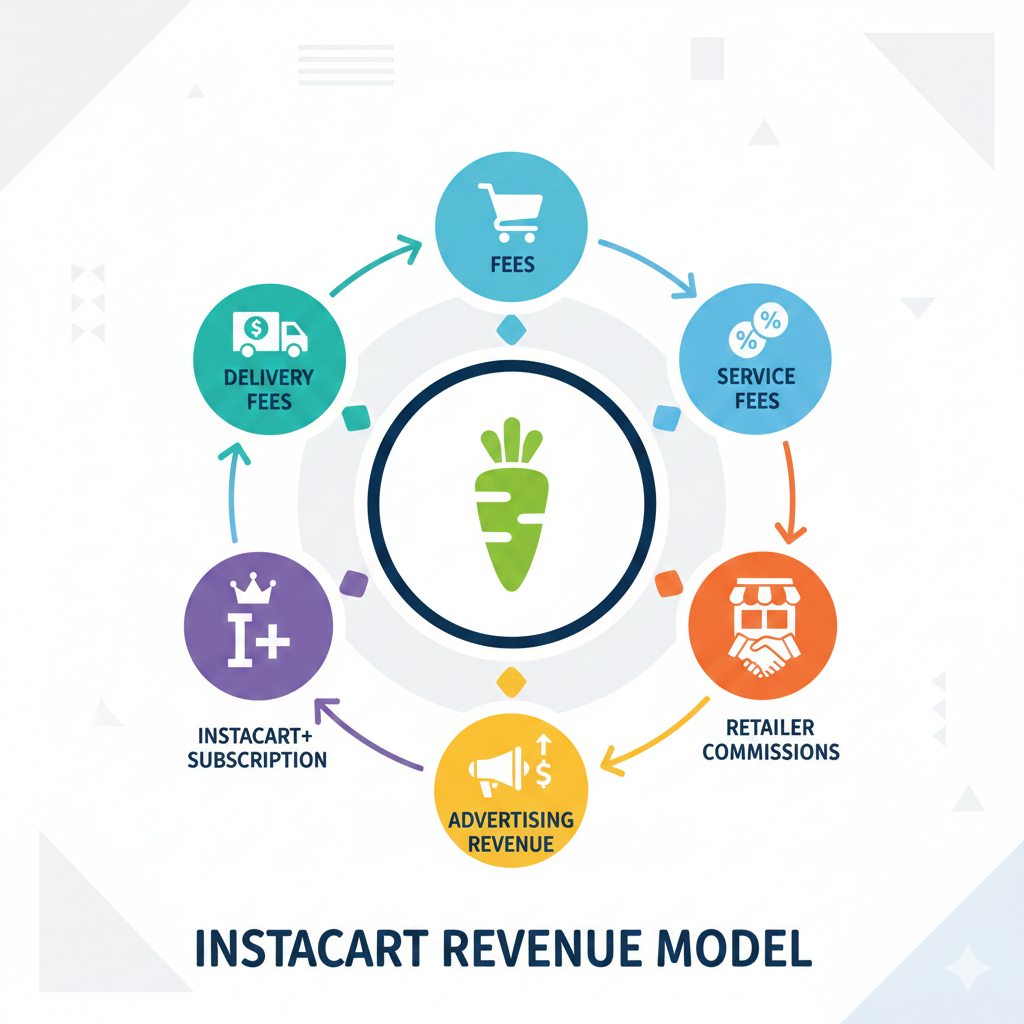
Instacart Revenue Model
This is where it gets interesting. Instacart doesn’t just make money one way—it stacks multiple revenue streams, which is exactly how platforms scale profitably.
1. Delivery Fees
Every order comes with a delivery fee, usually between $3.99 and $9.99, depending on order size, distance, and demand. During peak times (Sunday mornings, holidays), fees go up. It’s dynamic pricing, but applied to groceries.
2. Service Fees
This is the sneaky one. On top of the delivery fee, Instacart charges a service fee—typically around 5% of your order total. It’s not always transparent to customers, but it’s a consistent margin contributor. Some users don’t even notice it until they look at the receipt.
3. Instacart+ Subscription
For $9.99 a month (or $99 a year), you get free delivery on orders over $35, reduced service fees, and exclusive perks. This is Instacart’s version of Amazon Prime—predictable, recurring revenue that smooths out the volatility of order-based income.
Subscriptions also increase customer lifetime value. Once someone subscribes, they order more often because the marginal cost of each order feels lower.
4. Retailer Commissions
Instacart charges retailers a commission on every order—typically 5% to 15% of the order value, depending on the partnership deal. You might wonder: why would stores agree to give up that margin?
Because Instacart brings them customers they wouldn’t have otherwise reached, increases basket sizes (people tend to add more when shopping digitally), and saves them from building their own tech stack.
5. Advertising Revenue (High-Margin)
This is Instacart’s most profitable revenue stream. Brands pay to promote their products in search results, on category pages, or as recommended items. Think of it as Google Ads, but for groceries.
Instacart built what’s called a retail media network—a platform where CPG brands (Coca-Cola, Unilever, Nestlé) bid for visibility. Ads have high margins because there’s no physical cost attached—it’s pure software. And for Instacart, it’s become a major profit engine as grocery delivery margins stay thin.
Cost Structure of Instacart
Making money is one thing. Keeping it is another. Here’s where Instacart’s revenue goes:
- Shopper payouts – The biggest expense. Shoppers earn per order, plus tips, and Instacart has to stay competitive with other gig platforms like DoorDash and Uber.
- Delivery operations – Routing algorithms, customer support for delivery issues, insurance, and logistics coordination.
- Technology and platform maintenance – Servers, app development, AI-powered recommendations, inventory syncing with retailers.
- Marketing and promotions – Customer acquisition costs are high. Instacart spends heavily on ads, referral bonuses, and discounts to pull users from competitors.
- Customer support – Refunds for missing items, incorrect orders, and quality complaints eat into margins.
The challenge for Instacart—and any delivery platform—is that the unit economics are tough. Every order has thin margins. That’s why ads and subscriptions matter so much. They subsidize the low-margin delivery business.
Why Instacart Doesn’t Own Inventory (And Why That Matters)
This is the genius of Instacart’s model: it’s asset-light.
Traditional grocery stores own or lease real estate, manage inventory, deal with spoilage, and absorb the cost of unsold products. Instacart does none of that. It doesn’t own a single carrot. It just connects demand (you) with supply (the store).
That means:
- Lower risk – If demand drops, Instacart doesn’t have warehouses full of rotting produce.
- Faster scalability – Want to expand to a new city? Just sign up local stores. No need to build infrastructure.
- Higher flexibility – Instacart can partner with any retailer, any size, any niche, without committing capital.
Compare this to a model like Amazon Fresh or Walmart’s delivery service, where the company owns the inventory. Those models have higher upfront costs, more operational complexity, and slower scaling. Instacart sidesteps all of that.
Instacart Business Model Canvas
Here’s a snapshot of Instacart’s business model in one view:
| Component | Description |
|---|---|
| Key Partners | Grocery retailers, CPG brands, gig workers (shoppers) |
| Key Activities | Platform development, shopper coordination, retailer partnerships, advertising |
| Key Resources | Technology platform, shopper network, retailer relationships, data |
| Value Propositions | Convenience for customers, online reach for retailers, flexible income for shoppers |
| Customer Segments | Busy consumers, grocery retailers, gig economy workers |
| Channels | Mobile app, website, retailer integrations |
| Revenue Streams | Delivery fees, service fees, subscriptions, retailer commissions, advertising |
| Cost Structure | Shopper payouts, technology, marketing, operations, support |
Competitive Advantage of Instacart
So why does Instacart win when there are plenty of competitors?
- First-mover advantage – Instacart launched in 2012, before grocery delivery was cool. It built deep relationships with retailers early and locked in customer habits.
- Deep retailer relationships – Thousands of stores already integrated with Instacart. Switching costs are high for both retailers and customers.
- Data and ads ecosystem – Instacart knows what you buy, when you buy it, and what you’re likely to buy next. That data powers its advertising business, which is hard for competitors to replicate.
- Network effects – More customers attract more shoppers. More shoppers mean faster delivery. Faster delivery attracts more customers. It’s a flywheel.
Challenges and Risks in Instacart’s Model
No business model is perfect. Here’s where Instacart struggles:
- Thin delivery margins – Even with multiple revenue streams, the core delivery business is low-margin. Shopper costs, promotions, and refunds add up fast.
- Shopper satisfaction and churn – Gig workers can easily switch to DoorDash, Uber Eats, or another platform if pay or conditions are better. Retention is a constant challenge.
- Competition from Amazon and Walmart – Both have deep pockets, existing logistics networks, and the ability to subsidize grocery delivery with profits from other businesses.
- Profitability pressure – Instacart went public in 2023, and now faces quarterly scrutiny. Investors want to see sustainable profits, not just revenue growth.
What Founders Can Learn from Instacart
If you’re building a platform or marketplace, here’s what Instacart teaches you:
- Platform beats inventory – Owning assets is expensive. Orchestrating other people’s assets is scalable.
- Multiple revenue streams matter – Relying on one income source makes you fragile. Instacart stacks fees, subscriptions, commissions, and ads to diversify risk.
- Ads can subsidize logistics – High-margin ad revenue can cover the low margins of delivery. Think about where you can insert advertising into your model.
- Partnerships scale faster than ownership – Building everything yourself takes time and capital. Partnering with existing players lets you grow fast.
Can This Business Model Work for Startups?
Instacart’s model is replicable, but it’s not easy.
Where this model works:
- Fragmented industries where small businesses need digital reach (pharmacies, liquor stores, pet supplies, office supplies)
- Markets with high delivery demand but low infrastructure
- Niche categories where you can build deep vertical expertise
Where it doesn’t:
- Low-margin industries with no room for commissions
- Markets where incumbents already dominate logistics
- Categories with low order frequency (you need repeat customers to justify acquisition costs)
Capital and operational realities:
You need funding. Customer acquisition is expensive, shopper coordination is complex, and you’ll burn cash before you break even. Instacart raised over $2 billion before going public. Bootstrapping this model is nearly impossible.
Niche-market adaptations:
The smart play for startups isn’t to compete with Instacart head-on—it’s to apply the model to underserved categories. Think: farm-to-table delivery, halal groceries, organic baby food, or meal kits for specific diets.
Conclusion
Instacart isn’t really a delivery company. It’s a tech and ads company that happens to deliver groceries.
The delivery part is low-margin and operationally complex. The real money comes from subscriptions, retailer commissions, and especially advertising. That’s where the unit economics flip from break-even to profitable.
The model works because it’s asset-light, multi-sided, and designed to extract value at every touchpoint without taking on inventory risk. It’s a masterclass in platform economics.
Key takeaway: If you’re building in logistics, marketplaces, or retail tech, think like Instacart own the platform, not the product. Stack revenue streams. And always look for the high-margin wedge that subsidizes the low-margin hustle.
Discover more from Business Model Hub
Subscribe to get the latest posts sent to your email.


[…] and Instacart are asset-light. They don’t hold inventory, own warehouses, or employ drivers directly. This […]
[…] Instacart operates with a wider retail footprint, partnering with hundreds of grocery chains across North America. Shipt tends to focus on a more curated set of partners, with Target at the center. […]
[…] an app like Instacart means creating a three-sided marketplace that connects customers, retail stores, and delivery partners in real […]
[…] Marketplace is the Instacart model. You do not own inventory. You connect stores that already exist with customers who want delivery. […]